
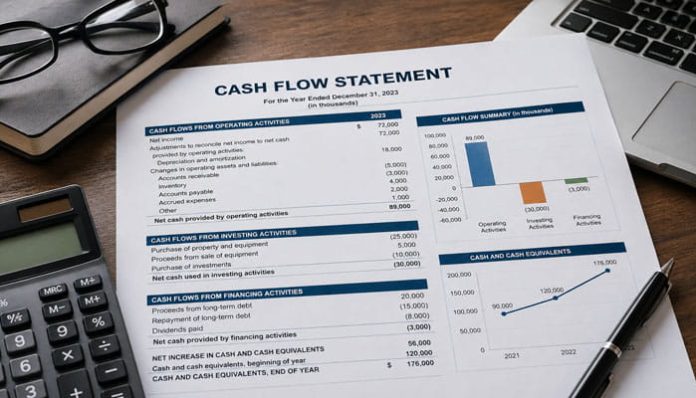

A business can report a healthy profit and still struggle to pay employees, suppliers, lenders, or other bills. That may sound contradictory, but it happens because profit and cash are not the same thing. That is exactly why understanding What Is a Cash Flow Statement matters.
A cash flow statement, also called a statement of cash flows, is a financial statement that shows how cash and cash equivalents moved into and out of a business during a specific reporting period.
Instead of simply answering whether a company earned a profit, the cash flow statement helps answer practical questions such as:
- How much cash did normal business operations generate?
- How much cash did the company spend on equipment or investments?
- Did the business borrow money?
- Did it repay debt?
- Did it issue shares?
- Did it pay dividends?
- Why did the company’s cash balance rise or fall?
- Are reported accounting profits actually turning into cash?
The U.S. Securities and Exchange Commission explains that cash flow statements report a company’s cash inflows and outflows. While an income statement helps show whether a company made a profit, a cash flow statement helps reveal whether the company actually generated cash.
This guide explains What Is a Cash Flow Statement, how its three major sections work, how to prepare and analyze one, direct vs. indirect methods, free cash flow, cash-flow quality, GAAP vs. IFRS differences, current accounting developments, and both fictional and real-world examples.
Quick Answer: What Is a Cash Flow Statement?
A cash flow statement is a financial report that tracks cash entering and leaving a business during a specific period.
The statement normally separates cash flows into three categories:
- Operating activities — cash generated or used through the company’s normal business activities.
- Investing activities — cash spent on or received from long-term assets and investments.
- Financing activities — cash raised from or returned to lenders and owners.
The basic calculation can be summarized as:
Operating Cash Flow + Investing Cash Flow + Financing Cash Flow = Net Change in Cash
Then:
Beginning Cash + Net Change in Cash = Ending Cash
IAS 7 similarly classifies cash flows into operating, investing, and financing activities.
Key Takeaways
- A cash flow statement tracks cash entering and leaving a business.
- It has three sections: operating, investing, and financing activities.
- Profit and cash flow are different, so a profitable company can still face cash shortages.
- Operating cash flow helps show whether the core business is generating cash.
- Negative investing cash flow is not always bad if the company is investing for growth.
- Cash flow can be reported using the direct or indirect method.
- Free cash flow is useful for analysis but is not one of the three main statement sections.
- U.S. GAAP and IFRS can classify some cash flows differently.
- A cash flow statement shows past cash activity, while a forecast estimates future cash movements.
- For better analysis, review it alongside the income statement, balance sheet, and financial notes.
Why Is a Cash Flow Statement Important?
To understand What Is a Cash Flow Statement, it helps to know why profit alone is not enough. A business can report revenue or profit before it actually receives the cash.
For example, if a company makes a $50,000 credit sale in December but the customer pays in January, the sale may appear as December revenue even though no cash was collected that month.
This matters because growing businesses still need cash to:
- Pay employees and suppliers
- Cover rent, taxes, and debt
- Buy inventory and equipment
- Fund expansion and other investments
Sales can rise while cash becomes tied up in accounts receivable or inventory. That is why the cash flow statement is useful it shows whether the business is actually generating enough cash to support its operations.
A company can therefore be profitable but cash poor.
What Are the 3 Parts of a Cash Flow Statement?
When learning What Is a Cash Flow Statement, the key is understanding its three main sections: operating, investing, and financing activities.
| Cash Flow Section | What It Shows | Common Examples |
|---|---|---|
| Operating Activities | Cash from normal business operations | Customer payments, suppliers, payroll |
| Investing Activities | Cash related to long-term assets and investments | Equipment purchases, property sales |
| Financing Activities | Cash related to lenders and owners | Loans, debt repayment, shares, dividends |
1. Cash Flow From Operating Activities
Operating cash flow (CFO) shows cash generated or used by a company’s normal business activities.
Common examples include:
- Cash received from customers
- Payments to suppliers and employees
- Taxes and operating expenses
- Certain interest payments
For example, if a company collects $500,000 and pays $404,000 in operating costs, its net operating cash flow is:
$500,000 – $404,000 = $96,000
Positive operating cash flow can help a company invest, repay debt, build reserves, and support growth.
2. Cash Flow From Investing Activities
Investing cash flow (CFI) shows cash used to buy or sell long-term assets and investments.
Common examples include:
- Buying equipment or property
- Selling machinery
- Purchasing investments
- Acquiring another business
If a company buys equipment for $40,000 and sells old equipment for $6,000:
$6,000 – $40,000 = -$34,000
Negative investing cash flow is not always bad. It may simply mean the business is investing in future growth.
3. Cash Flow From Financing Activities

Financing cash flow (CFF) shows how a business raises or returns money through debt and equity.
Common inflows include:
- Bank loans
- Bond issuance
- Selling shares
Common outflows include:
- Debt repayments
- Dividends
- Share repurchases
For example, if a company borrows $25,000, repays $10,000, and pays $12,000 in dividends:
$25,000 – $10,000 – $12,000 = $3,000
So, net cash from financing activities is +$3,000.
Together, these three sections explain where a company’s cash came from and where it went during the reporting period.
What Are Non-Cash Investing and Financing Activities?
Some important financial transactions do not involve an immediate cash payment.
Examples include:
- Acquiring assets by taking on debt
- Converting debt into equity
- Certain lease transactions
- Issuing shares to acquire another business
Because no cash changes hands, these transactions are usually excluded from normal cash inflows and outflows. However, they can still affect assets, liabilities, equity, and future obligations.
For example, if a company acquires $2 million of machinery through financing, it gains an asset and a liability even though little or no cash is paid immediately.
That is why investors should also review the financial statement notes.
Complete Cash Flow Statement Example
Consider BrightPath Furniture LLC, which begins the year with $35,000 in cash.
| Item | Amount |
|---|---|
| Operating Activities | |
| Net income | $80,000 |
| Depreciation | +$15,000 |
| Increase in accounts receivable | -$12,000 |
| Decrease in inventory | +$5,000 |
| Increase in accounts payable | +$8,000 |
| Net Operating Cash Flow | $96,000 |
| Investing Activities | |
| Purchase of equipment | -$40,000 |
| Sale of equipment | +$6,000 |
| Net Investing Cash Flow | -$34,000 |
| Financing Activities | |
| Bank loan | +$25,000 |
| Debt repayment | -$10,000 |
| Dividends paid | -$12,000 |
| Net Financing Cash Flow | +$3,000 |
| Net Increase in Cash | $65,000 |
| Beginning Cash | $35,000 |
| Ending Cash | $100,000 |
Check the Calculation
$96,000 – $34,000 + $3,000 = $65,000
Then:
$35,000 + $65,000 = $100,000
This shows how operating, investing, and financing activities explain the change in cash.
How Does a Cash Flow Statement Work?
A cash flow statement explains how a business moves from its beginning cash balance to its ending cash balance.
The basic formula is:
Beginning Cash + Cash Inflows – Cash Outflows = Ending Cash
Another useful formula is:
CFO + CFI + CFF = Net Change in Cash
Where:
- CFO = Operating cash flow
- CFI = Investing cash flow
- CFF = Financing cash flow
This is also why the statement connects closely with the income statement and balance sheet.
What Are Cash and Cash Equivalents?
A cash flow statement includes more than physical cash. Cash generally includes cash on hand and demand deposits. Cash equivalents are short-term, highly liquid investments that can be converted into known amounts of cash with little risk of value changes.
Examples may include:
- Certain short-term deposits
- Treasury instruments
- Other highly liquid investments
Not every short-term investment qualifies as a cash equivalent.
What Is Restricted Cash?
Restricted cash is money a business owns but cannot freely use because of legal, contractual, or financial restrictions.
Examples include:
- Collateral
- Security deposits
- Contractually reserved funds
- Money required under financing agreements
Restricted cash matters because a company may report cash-related balances that are not fully available for everyday operations.
Under U.S. GAAP, applicable cash-flow reporting also considers changes involving cash, cash equivalents, and restricted cash.
Cash Flow vs. Revenue vs. Profit
These terms describe different parts of financial performance.
| Measure | What It Means |
|---|---|
| Revenue | Money earned from selling goods or services |
| Profit | Revenue remaining after recognized expenses |
| Cash Flow | Actual cash moving into and out of the business |
Simple Example
Suppose a consulting company invoices a client $10,000 but will not receive payment until next month.
It may record:
- Revenue: $10,000
- Current cash received: $0
If related expenses are $6,000, it may also report:
Profit = $4,000
The company can therefore report revenue and profit even though the related cash has not yet been collected. That is why revenue, profit, and cash flow are not the same thing.
Cash Flow Statement vs. Income Statement
| Feature | Cash Flow Statement | Income Statement |
|---|---|---|
| Main Purpose | Shows cash inflows and outflows | Shows revenue, expenses, and profit |
| Main Focus | Cash movement | Accounting performance |
| Covers | A period | A period |
| Non-Cash Expenses | Adjusted/reconciled depending on method | Included where applicable |
| Depreciation | Added back in indirect CFO reconciliation | Recognized as expense |
| Net Income | Often starting point under U.S. indirect method | Final profitability measure |
| Equipment Purchases | Normally investing cash outflow | Not automatically a full current-period expense |
| Liquidity Insight | High | Limited when used alone |
The income statement helps show whether a company made a profit, while the cash flow statement helps show whether it generated cash.
How Can a Profitable Company Have Poor Cash Flow?
Suppose a company reports:
- Revenue: $200,000
- Expenses: $150,000
- Net profit: $50,000
- That appears healthy.
But imagine that customers have paid only:
$100,000
because many sales were made on credit. Meanwhile, the company has already paid suppliers, employees, rent, insurance, utilities, and taxes. The business could therefore report a $50,000 accounting profit while experiencing significant cash pressure.
Rapidly growing businesses can encounter this situation because sales growth may increase receivables, inventory requirements, employee costs, and supplier payments before the associated cash has been collected.
Cash Flow Statement vs. Balance Sheet
| Feature | Cash Flow Statement | Balance Sheet |
|---|---|---|
| Main Purpose | Explains cash movement | Shows financial position |
| Time Perspective | Over a period | At a specific date |
| Main Components | Operating, investing, financing cash flows | Assets, liabilities, equity |
| Main Question | Where did cash come from and go? | What does the company own and owe? |
| Cash Information | Explains changes | Shows balance at reporting date |
A balance sheet is essentially a financial snapshot at a point in time, whereas the cash flow statement explains cash movements during a period.
Cash Flow Statement vs. Balance Sheet vs. Income Statement
| Financial Statement | Key Question |
|---|---|
| Income Statement | Did the company earn a profit? |
| Balance Sheet | What does the company own and owe? |
| Cash Flow Statement | Where did cash come from and where did it go? |
No single statement gives investors the complete financial picture.
Cash Flow Statement vs. Cash Flow Forecast
| Feature | Cash Flow Statement | Cash Flow Forecast |
|---|---|---|
| Time Focus | Historical | Future |
| Uses | Actual transactions | Estimated future transactions |
| Main Purpose | Explain what happened | Predict what may happen |
| Main Users | Owners, investors, lenders, accountants | Owners, managers, planners |
| Main Question | Where did our cash come from and go? | Will we have enough cash? |
| Certainty | Based on recorded events | Based on assumptions and estimates |
A cash flow statement reports cash that actually entered and left the business during a completed reporting period.
A cash flow forecast estimates future receipts and payments.
A business might forecast:
- Customer collections
- Payroll
- Rent
- Tax payments
- Inventory purchases
- Equipment spending
- Loan repayments
Forecasting allows management to identify possible future cash shortages before they occur.
Historical cash flow can also improve forecasting. For example, if customers typically take 45 days to pay invoices, management can incorporate that pattern into future cash planning.
Direct vs. Indirect Cash Flow Statement
Operating cash flow can be presented using two methods:
- Direct method
- Indirect method
Both are allowed under IAS 7.
What Is the Direct Method?
The direct method shows major cash receipts and payments from operating activities.
| Direct Method Item | Amount |
|---|---|
| Cash received from customers | $500,000 |
| Cash paid to suppliers | -$300,000 |
| Cash paid to employees | -$70,000 |
| Interest paid | -$10,000 |
| Taxes paid | -$24,000 |
| Net Operating Cash Flow | $96,000 |
This method gives a clearer view of where operating cash comes from and where it goes.
What Is the Indirect Method?
The indirect method starts with net income and adjusts for non-cash items and working-capital changes.
Common adjustments include:
- Depreciation and amortization
- Accounts receivable changes
- Inventory changes
- Accounts payable changes
- Other non-cash items
| Indirect Method Item | Amount |
|---|---|
| Net income | $80,000 |
| Depreciation | +$15,000 |
| Increase in accounts receivable | -$12,000 |
| Decrease in inventory | +$5,000 |
| Increase in accounts payable | +$8,000 |
| Net Operating Cash Flow | $96,000 |
Direct vs. Indirect Method
| Feature | Direct Method | Indirect Method |
|---|---|---|
| Starting Point | Cash receipts and payments | Net income |
| Cash Collections | Shown directly | Reflected through adjustments |
| Non-Cash Items | Not the main focus | Adjusted explicitly |
| Working Capital | Included in cash movements | Shown as adjustments |
| Main Benefit | Easier to see actual cash flows | Shows how profit converts to cash |
Both methods should arrive at the same net operating cash flow.
Why Is Depreciation Added Back to Cash Flow?
Suppose a business purchased machinery for:
$100,000
Assume this year’s depreciation expense is:
$10,000
The income statement records the $10,000 expense.
However, recording depreciation does not mean another $10,000 of cash was paid during the current year. The cash was generally spent when the asset was acquired.
Under the indirect method, depreciation is therefore commonly added back when reconciling accounting profit to operating cash flow.
This does not mean depreciation is economically irrelevant. Equipment wears out and may eventually need replacement.
It simply means the accounting depreciation charge itself is not a current-period cash payment.
How Does Working Capital Affect Cash Flow?
Working capital helps explain why profit and operating cash flow can differ.
Key accounts include:
- Accounts receivable
- Inventory
- Accounts payable
- Accrued expenses
A simple rule is:
| Change | Typical Effect on Operating Cash Flow |
|---|---|
| Accounts receivable increases | Decreases cash flow |
| Accounts receivable decreases | Increases cash flow |
| Inventory increases | Decreases cash flow |
| Inventory decreases | Increases cash flow |
| Accounts payable increases | Increases cash flow |
| Accounts payable decreases | Decreases cash flow |
These are useful general rules, although real financial statements can be more complex.
How to Read a Cash Flow Statement Step by Step
Step 1: Check Operating Cash Flow
Ask:
- Is it positive?
- Is it growing?
- Is it consistently weaker than net income?
Persistent negative operating cash flow can deserve closer attention.
Step 2: Compare Cash Flow With Net Income
Large differences may result from:
- Receivables
- Inventory
- Payables
- Depreciation
- Non-cash expenses
- Timing differences
One unusual period is not necessarily a red flag, but repeated gaps should be investigated.
Step 3: Review Capital Spending
Look at spending on:
- Property
- Equipment
- Technology
- Facilities
Determine whether the spending supports maintenance, replacement, or growth.
Step 4: Review Investing Activities
Ask whether the company is:
- Buying assets
- Acquiring businesses
- Selling investments or property
Step 5: Review Financing Activities
Check whether the company is:
- Borrowing or repaying debt
- Issuing shares
- Repurchasing shares
- Paying dividends
Step 6: Check Ending Cash
Verify:
Beginning Cash + Net Change in Cash = Ending Cash
Also consider restricted cash when relevant.
Step 7: Read the Notes
Financial statement notes may explain:
- Debt
- Leases
- Acquisitions
- Restricted cash
- Non-cash transactions
- Unusual financial events
What Does Positive Cash Flow Mean?
Positive cash flow means more cash entered than left during the period, but the source of that cash matters.
For example:
Company A
- Operating cash flow: +$1 million
- Investing cash flow: -$300,000
- Financing cash flow: -$200,000
- Net increase: +$500,000
Company B
- Operating cash flow: -$1 million
- Financing cash flow: +$2 million
- Net increase: +$1 million
Company B increased cash more, but the increase came from financing while its operations lost cash. Therefore, higher cash does not always mean stronger business performance.
What Does Negative Cash Flow Mean?
Negative cash flow means cash outflows exceeded inflows, but it is not always a warning sign.
It May Be Concerning When:
- Operations repeatedly lose cash
- Customer collections weaken
- Cash reserves fall steadily
- Debt becomes difficult to repay
- New borrowing is needed for normal expenses
It May Be Normal When:
- Equipment is purchased
- New locations are opened
- A business is acquired
- Debt is repaid
- Dividends or share buybacks are made
The key is to understand why the cash flow is negative, not just whether the number is below zero.
What Is Cash Flow Quality?
Cash flow quality shows how well reported profits are supported by actual operating cash.
For example:
| Measure | Company A | Company B |
|---|---|---|
| Net Income | $10 million | $10 million |
| Operating Cash Flow | $12 million | $3 million |
| CFO-to-Net-Income Ratio | 1.2 | 0.3 |
Both companies report the same profit, but Company B’s weaker operating cash flow may require closer review.
Possible reasons include:
- Rising receivables
- Inventory growth
- Timing differences
- Non-cash gains
- Other accruals
There is no single “good” ratio. Industry, growth stage, and long-term trends matter.
What Is Free Cash Flow?
Free cash flow (FCF) estimates how much cash remains after capital spending.
Free Cash Flow = Operating Cash Flow – Capital Expenditures
Example:
$96,000 – $40,000 = $56,000
Free cash flow may be available for:
- Debt repayment
- Dividends
- Share buybacks
- Acquisitions
- Additional investment
However, free cash flow is not a standardized section of the cash flow statement, and definitions can vary.
Cash Flow vs. Free Cash Flow
| Feature | Cash Flow | Free Cash Flow |
|---|---|---|
| Meaning | Overall cash movement | Cash remaining after capital spending |
| Main Categories | Operating, investing, financing | Not a main statement category |
| Main Purpose | Track sources and uses of cash | Measure remaining financial flexibility |
| Standardized? | Yes, under accounting rules | Calculation can vary |
Useful Cash Flow Ratios
Common measures include:
- Operating Cash Flow Ratio = Operating Cash Flow ÷ Current Liabilities
- Cash Flow Margin = Operating Cash Flow ÷ Revenue
- CFO to Net Income = Operating Cash Flow ÷ Net Income
- Free Cash Flow = Operating Cash Flow – Capital Expenditures
- Capital Expenditure Coverage = Operating Cash Flow ÷ Capital Expenditures
Compare ratios across several years and against similar companies rather than relying on one universal benchmark.
How to Prepare a Cash Flow Statement
A simplified indirect-method process includes:
Step 1: Determine Beginning Cash
Example:
Beginning Cash = $35,000
Step 2: Calculate Operating Cash Flow
Adjust net income for items such as:
- Depreciation
- Receivables
- Inventory
- Payables
- Other non-cash items
Example:
Net Operating Cash Flow = $96,000
Step 3: Calculate Investing Cash Flow
- Equipment purchase: -$40,000
- Equipment sale: +$6,000
Net Investing Cash Flow = -$34,000
Step 4: Calculate Financing Cash Flow
- Borrowing: +$25,000
- Debt repayment: -$10,000
- Dividends: -$12,000
Net Financing Cash Flow = +$3,000
Step 5: Calculate Net Change
$96,000 – $34,000 + $3,000 = $65,000
Step 6: Calculate Ending Cash
$35,000 + $65,000 = $100,000
Common Cash Flow Formulas
| Formula | Calculation |
|---|---|
| Net Change in Cash | CFO + CFI + CFF |
| Ending Cash | Beginning Cash + Net Change |
| Free Cash Flow | CFO – Capital Expenditures |
| Operating Cash Flow Ratio | CFO ÷ Current Liabilities |
| Cash Flow Margin | CFO ÷ Revenue |
| CFO to Net Income | CFO ÷ Net Income |
Real-World Cash Flow Statement Example: Oracle in 2026
Oracle’s fiscal 2026 results show why profit, operating cash flow, and free cash flow should be analyzed separately.
| Measure | Fiscal 2026 |
|---|---|
| Net Income | $17.087 billion |
| Operating Cash Flow | $31.977 billion |
| Capital Expenditures | $55.663 billion |
| Reported Free Cash Flow | -$23.686 billion |
Oracle generated much more operating cash flow than net income, but heavy capital spending pushed reported free cash flow negative.
The lesson is simple:
- Profit is not the same as operating cash flow.
- Strong operating cash flow does not guarantee positive free cash flow.
- Negative free cash flow needs business context.
Where Can You Find a Company’s Cash Flow Statement?
For U.S. public companies, cash-flow information is commonly found in:
- Form 10-K annual reports
- Form 10-Q quarterly reports
- SEC EDGAR filings
Look for headings such as:
- Consolidated Statements of Cash Flows
- Statements of Cash Flows
- Consolidated Cash Flow Statements
Also review the notes, debt disclosures, liquidity discussion, and capital-spending commentary.
What Is a Good Cash Flow Statement?
There is no single perfect pattern.
An established company may show:
- Positive operating cash flow
- Sustainable capital spending
- Manageable debt
- Adequate liquidity
- Limited reliance on emergency financing
A growing company may instead show positive operating cash flow, negative investing cash flow, and positive financing cash flow.
Common Cash Flow Patterns
| Operating | Investing | Financing | Possible Meaning |
|---|---|---|---|
| Positive | Negative | Negative | Mature company investing and returning capital |
| Positive | Negative | Positive | Growing company raising funds for expansion |
| Negative | Negative | Positive | Cash-burning company funded externally |
| Negative | Positive | Negative | Operations weak while assets are sold |
These patterns are only starting points, not final conclusions.
Why Investors Analyze Cash Flow Statements
Investors use cash-flow statements to evaluate:
- Earnings quality
- Liquidity
- Capital spending
- Debt dependence
- Dividends and buybacks
- Financial flexibility
- Capital allocation
Why Business Owners Need Cash Flow Statements
Business owners can use cash-flow analysis to answer questions such as:
- Can we make payroll?
- Are customers paying slowly?
- Is too much cash tied up in inventory?
- Can we afford new equipment?
- Is debt becoming expensive?
- Is growth consuming too much cash?
Strong sales do not always mean strong cash flow.
How Can a Business Improve Cash Flow?

Businesses may improve cash flow by:
- Collecting receivables faster
- Managing inventory carefully
- Negotiating suitable supplier terms
- Cutting unnecessary expenses
- Planning major purchases
- Building a cash reserve
- Using cash flow forecasts
- Comparing actual results with forecasts
The goal is not simply to hold more cash, but to balance liquidity with smart investment in growth.
Cash Flow Statement Under U.S. GAAP vs. IFRS
Both U.S. GAAP and IFRS classify cash flows into:
- Operating activities
- Investing activities
- Financing activities
However, some transactions are classified differently.
| Cash Flow Item | U.S. GAAP | Current IFRS Before IFRS 18 |
|---|---|---|
| Interest Paid | Operating | Operating or Financing |
| Interest Received | Operating | Operating or Investing |
| Dividends Received | Generally Operating | Operating or Investing |
| Dividends Paid | Financing | Operating or Financing |
| Income Taxes Paid | Generally Operating | Usually Operating unless linked elsewhere |
These differences can affect comparisons between companies using different accounting frameworks.
Important IFRS 18 Changes
IFRS 18 becomes effective for annual periods beginning on or after January 1, 2027, with early adoption permitted.
It also changes parts of IAS 7. For many companies without specified main business activities:
| Item | IFRS 18 / Amended IAS 7 |
|---|---|
| Interest Paid | Financing |
| Interest Received | Investing |
| Dividends Paid | Financing |
| Dividends Received | Investing |
The indirect method will also use operating profit or loss as its starting point under the amended rules.
Current IASB Cash Flow Project
The IASB is separately exploring possible improvements involving:
- Better cash-flow disaggregation
- Non-cash transactions
- Cash-flow measures
- Classification consistency
- Cash-equivalent definitions
These remain part of an ongoing standard-setting project and should not be treated as already effective requirements.
Cash Flow Statement Red Flags to Watch
- Persistent negative operating cash flow
- Net income much higher than operating cash flow
- Accounts receivable growing faster than sales
- Inventory increasing too quickly
- Heavy dependence on new borrowing
- Repeated asset sales to fund operations
- Rapidly falling cash reserves
- Unusual cash-flow reclassifications
These signs do not always mean a company is unhealthy, but they may require closer review.
Common Cash Flow Statement Mistakes
- Assuming profit and cash are the same
- Thinking all positive cash flow is good
- Thinking all negative cash flow is bad
- Ignoring working-capital changes
- Looking at only one reporting period
- Ignoring non-cash transactions
- Ignoring restricted cash
- Overlooking GAAP and IFRS differences
- Treating free cash flow as a standardized accounting measure
- Reading the cash flow statement without the financial notes
Advantages of a Cash Flow Statement
A properly analyzed cash flow statement can:
- Show where cash comes from
- Show where cash goes
- Explain changes in cash balances
- Reveal differences between accounting profit and cash generation
- Highlight capital expenditures
- Show borrowing and repayment activity
- Reveal dividends and share repurchases
- Help assess liquidity
- Support budgeting
- Improve forecasting
- Help evaluate earnings quality
- Help identify financial trends
- Assist lenders and investors
- Support business-management decisions
Limitations of a Cash Flow Statement
- Historical: Shows past cash movements, not future results.
- Not a profit measure: Strong cash flow does not always mean strong profitability.
- Timing effects: Payments and collections can distort short-term results.
- Borrowing can mislead: New debt can temporarily increase cash.
- Industries differ: Cash-flow patterns vary by business type.
- Free cash flow varies: Different companies may calculate it differently.
- Not enough alone: Review it with the income statement, balance sheet, notes, and business context.
Final Verdict: What Is a Cash Flow Statement?
So, what is a cash flow statement? It is a financial report that explains how cash and cash equivalents moved into and out of a business during a reporting period.
Its three core sections are operating activities, investing activities, and financing activities. Together, they help explain whether cash came from normal business operations, long-term investments or asset sales, borrowing, equity financing, debt repayment, dividends, or other financing decisions.
The key lesson is that revenue, profit, operating cash flow, free cash flow, and the cash balance are different measures. A company can report a profit without collecting all related cash, generate strong operating cash flow while spending heavily on capital investment, or increase its cash balance mainly through borrowing.
For that reason, do not judge a business simply by whether cash increased or decreased. Ask where the cash came from, where it went, whether operating cash generation is sustainable, how much is being reinvested, and how dependent the company is on outside financing.
For the strongest analysis, read the cash flow statement together with the income statement, balance sheet, financial statement notes, and broader business context. That is the real value of understanding what is a cash flow statement.
Frequently Asked Questions
1. What Is a Cash Flow Statement in Simple Terms?
What Is a Cash Flow Statement can be explained simply as a financial report that shows how cash entered and left a business during a specific period. It divides cash movements into operating, investing, and financing activities.
2. Why Is a Cash Flow Statement Important for a Business?
A cash flow statement helps a business understand whether it is generating enough cash to pay employees, suppliers, taxes, debt, and other expenses. It can also reveal cash problems that may not appear in reported profit.
3. What Are the Three Main Parts of a Cash Flow Statement?
The three sections are operating activities, investing activities, and financing activities. Together, they show where cash came from and how it was used during the reporting period.
4. Can a Company Be Profitable but Have Negative Cash Flow?
Yes. A company can report a profit while experiencing negative cash flow if customers have not yet paid invoices, inventory levels rise, capital spending increases, or debt repayments require significant cash.
5. What Is the Difference Between a Cash Flow Statement and an Income Statement?
An income statement shows revenue, expenses, and profit, while a cash flow statement tracks actual cash inflows and outflows. Understanding What Is a Cash Flow Statement helps explain why profit does not always equal cash available in the bank.
6. What Is the Difference Between Operating Cash Flow and Free Cash Flow?
Operating cash flow shows cash generated from normal business activities. Free cash flow generally measures the cash remaining after subtracting capital expenditures from operating cash flow.
7. How Often Should a Business Review Its Cash Flow Statement?
Many businesses review cash flow monthly or quarterly, while companies with tight liquidity may monitor it weekly. Regular review can help identify slow customer payments, rising expenses, inventory problems, or growing debt needs.
8. What Should Investors Look for in a Cash Flow Statement?
When analyzing What Is a Cash Flow Statement, investors should look at operating cash flow, capital spending, debt activity, cash reserves, and the relationship between net income and cash generation. Multi-year trends usually provide more useful insight than a single reporting period.