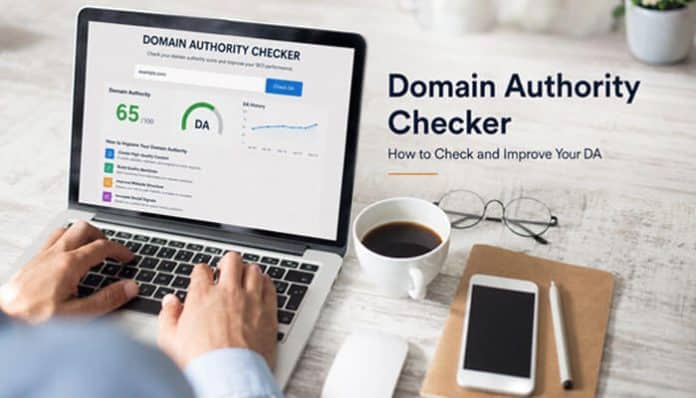

A Domain Authority Checker estimates a website’s backlink strength relative to other domains. SEO professionals use these tools for competitor research, backlink evaluation and authority tracking.
Domain Authority is frequently misunderstood. DA is a proprietary Moz metric—not a Google score. A higher DA may indicate a stronger backlink profile, but it does not guarantee rankings, traffic or sales.
This guide explains how to check Domain Authority, compare relevant competitors and improve the underlying factors without risky link-building tactics.
Quick Answer
A Domain Authority Checker measures a domain’s estimated ranking strength, usually on a scale from 1 to 100. If you specifically need Moz Domain Authority, use Moz Link Explorer or a tool that clearly identifies Moz as its data source.
Enter your root domain, record your DA, linking domains and Spam Score, and compare those results with websites competing for the same search queries.
To improve your DA, publish link-worthy resources, earn editorial links from different relevant domains, recover lost links, maintain a crawlable website and avoid automated link schemes.
Key Takeaways
- Domain Authority is a Moz metric, not a Google ranking factor.
- Moz DA, Ahrefs DR and Semrush Authority Score are different metrics.
- A good DA depends on the scores of relevant competitors.
- Linking-domain diversity is usually more valuable than repeated links from one website.
- Spam Score is a warning metric, not a Google penalty.
- A high DA does not guarantee rankings, traffic or conversions; qualified leads and revenue remain more important outcomes.
How This Guide Was Researched
This guide distinguishes Moz Domain Authority from Ahrefs Domain Rating, Semrush Authority Score, Majestic Flow Metrics and Google’s ranking systems. Its recommendations are based on documentation from Moz, Google Search Central, Ahrefs, Semrush and Majestic.
Authority metrics, tool limits and update schedules can change. Verify important scores directly through the metric provider and record the tool, date and domain scope used.
What Is a Domain Authority Checker?
A Domain Authority Checker is an SEO tool that estimates the relative ranking strength of a domain or subdomain. The term usually refers to a tool that reports Domain Authority, or DA, developed by Moz.
Moz describes DA as a machine learning score designed to predict ranking potential. It runs from 1 to 100 and is most useful for comparing similar websites.
Moz calculates DA using information from its Link Explorer index rather than data taken directly from Google Search Console.
A DA checker may also display linking root domains, total and followed backlinks, Page Authority, Spam Score, new and lost links, anchor text, top-linked pages, DA history and the data-refresh date.
Not every authority checker displays genuine Moz DA. Some use “domain authority” as a general label for a proprietary metric, so always confirm the score’s owner and data source.
What Domain Authority Can Tell You
DA can help you compare backlink profiles, screen outreach prospects, monitor long-term link strength, find competitor link gaps and identify pages attracting external links.
What Domain Authority Cannot Tell You
Domain Authority cannot reliably determine whether a particular page will rank, whether content is accurate, how much qualified traffic a site receives, whether visitors will convert, whether Google has applied a manual action or whether a backlink is natural and useful.
A single number cannot replace reviewing relevance, content quality, organic visibility, link patterns and business performance.
Is Domain Authority a Google Ranking Factor?
No. Moz Domain Authority is not part of Google’s ranking systems.
Google does not use a website’s Moz DA, Ahrefs DR or Semrush Authority Score when ordering search results.
Google uses many signals and systems to determine whether an individual page is relevant and useful. Links can help Google discover pages and understand relationships, but that does not make a third-party authority score a direct ranking factor.
Google’s documentation explains that links are one signal used to discover pages and understand relevance. It also confirms that ranking involves multiple systems rather than one public authority score.
A lower-DA website can outrank a higher-DA competitor when its page better matches search intent, provides stronger first-hand information, has better page-level links or answers the query more clearly.
Think of DA as a third-party estimate of competitive backlink strength—not a Google grade.
Does Domain Authority Affect AI Search Visibility?
There is no evidence that Google AI Overviews or AI Mode directly use Moz DA, Ahrefs DR or another vendor’s authority score.
Google states that its generative search features rely on its core Search ranking and quality systems to retrieve relevant pages.
Strong websites may earn both higher authority scores and more visibility across AI-powered search products because they publish original information, earn citations and become recognized sources. That is a correlation, not proof that AI systems import DA.
For stronger AI search visibility, prioritize original research, accurate citations, clear authorship, first-hand expertise, crawlable pages and information that adds value beyond common summaries.
How Is Domain Authority Calculated?
Moz does not publish a formula that website owners can reproduce. Its system uses Link Explorer data and machine learning to identify relationships between link signals and search-result performance.
Linking Root Domains
Linking root domains are the unique websites linking to your domain. One hundred backlinks from one website represent one linking domain; 100 backlinks from 100 websites provide far greater domain diversity.
Backlink-Profile Strength
A raw backlink count is not enough. The quality, relevance and strength of the linking pages and domains can influence the overall profile.
Machine-Learning Predictions
Moz uses machine learning to estimate how likely a domain is to compete in search results based on information available in its link index.
Logarithmic Scoring
Domain Authority uses a logarithmic scale, so moving from DA 10 to 20 is generally easier than moving from DA 70 to 80.
Relative Scoring
DA is comparative rather than absolute. Your score can change when Moz discovers or removes links, competitors improve, the wider web changes or Moz updates its index and model.
There is no fixed number of backlinks required to reach DA 20, 40 or 60. No trustworthy SEO provider can guarantee a precise DA increase from a set number of placements.
DA vs PA vs DR vs Authority Score
SEO platforms use different crawlers, databases and formulas. Their authority metrics are not expected to match.
| Metric | Provider | Scope | Main Inputs | Best Use |
|---|---|---|---|---|
| Domain Authority | Moz | Domain or subdomain | Moz link index and machine-learning model | Comparing domain ranking strength |
| Page Authority | Moz | Individual page | Page-level link data and predictive model | Comparing specific URLs |
| Domain Rating | Ahrefs | Domain | Strength and distribution of followed backlinks | Reviewing backlink-profile strength |
| Authority Score | Semrush | Domain or page | Link power, organic traffic and spam indicators | Evaluating authority and manipulation patterns |
| Trust Flow | Majestic | URL, subdomain or domain | Proximity to trusted websites in Majestic’s link graph | Evaluating apparent link quality |
| Citation Flow | Majestic | URL, subdomain or domain | Quantity and influence of links | Measuring link power alongside Trust Flow |
Ahrefs defines Domain Rating as a proprietary, logarithmic 0-to-100 measure of backlink-profile strength. It considers linking domains, their DR and how many other websites they link to.
Semrush calculates Authority Score using link power, estimated organic traffic and signs of unnatural linking.
Majestic separates link quantity from apparent quality.
Why Different Tools Show Different Scores
Your website might have DA 35 in Moz, DR 42 in Ahrefs, Authority Score 28 in Semrush and Trust Flow 20 in Majestic.
This does not automatically mean one tool is inaccurate.
The scores differ because each provider has its own crawler, backlink database, update schedule, calculation method, spam checks and treatment of link attributes and domain scopes.
Choose one authority metric for regular reporting. Use the same provider, domain scope and competitor group every time.
Domain Authority vs Domain Age, PageRank and E-E-A-T
Several SEO concepts are incorrectly grouped under the word “authority.”
| Concept | Meaning | Public Google Score? | Important Difference |
|---|---|---|---|
| Domain Authority | Moz’s predictive domain-level metric | No | A comparative third-party score |
| Domain age | Time since a domain was registered or used | No | An old domain is not automatically trustworthy |
| PageRank | Google’s link-analysis concept applied at the page level | No current public score | It is not the same as Moz DA |
| E-E-A-T | Experience, expertise, authoritativeness and trustworthiness | No | Google says it is not one specific ranking factor |
| Topical authority | An SEO concept describing expertise and recognition within a subject | No | It is not a standardized public score |
Domain age should not be confused with Domain Authority. An older domain may have had more time to earn backlinks, but age alone does not prove that its content is useful, its backlink profile is natural or its pages match current search intent.
What Is a Good Domain Authority Score?
There is no universal good DA score.
A score becomes meaningful when it is compared with relevant websites serving the same audience.
A DA of 25 might be competitive for a small regional business but weak for a national finance, technology or health publication.
| Your Position | What It May Mean | Recommended Action |
|---|---|---|
| Well below competitors | Your backlink profile may limit competitive rankings | Study competitor links and create linkable assets |
| Close to competitors | Your domain may be competitive | Improve content relevance and page-level links |
| Above most competitors | Domain-level authority appears favorable | Focus on search intent and user experience |
| High DA but weak rankings | Authority may not be the main problem | Audit content, indexing and technical SEO |
| Low DA but growing traffic | Your current strategy may be working | Continue measuring traffic and conversions |
The fairest benchmark is the median DA of websites that repeatedly rank for your target queries.
Do not compare a small local business with Wikipedia, Forbes or Amazon unless those websites genuinely compete for the same audience and keywords.
Example: Comparing DA With Real Competitors
Suppose your website has a DA of 27 and the sites ranking for your main keywords have scores between 24 and 38.
| Website | DA | Relevant Linking Domains | Organic Visibility | Interpretation |
|---|---|---|---|---|
| Your website | 27 | 85 | Growing | Competitive but needs more relevant links |
| Competitor A | 24 | 62 | Moderate | Lower DA but strong page relevance |
| Competitor B | 33 | 140 | Strong | Useful backlink and content benchmark |
| Competitor C | 38 | 210 | Strong | Strongest direct competitor |
| Unrelated publisher | 75 | 8,000+ | High but unrelated | Not a suitable direct benchmark |
Comparing your DA with the unrelated publisher would provide little practical value. Your realistic target is to strengthen your position against Competitors B and C.
Investigate which competitor pages attract links, which publications mention them, what original resources they publish and which relevant linking domains appear achievable. This turns a Domain Authority Checker result into an actionable SEO strategy.
Can a New or Low-DA Website Rank?
Yes. A new website can rank for relevant, well-matched queries even when its DA is low.
A newer site may compete by targeting an underserved or less competitive query, providing first-hand expertise, publishing original data or serving a specific local audience.
Begin with topics where you can offer a clear advantage rather than waiting to reach an arbitrary DA.
How to Use a Domain Authority Checker

1. Choose the Correct Metric
Use Moz when you specifically need Domain Authority.
Use Ahrefs when your report is based on Domain Rating. Use Semrush when you want Authority Score.
Do not label every website authority metric as DA.
2. Enter the Correct Domain Scope
Check the same scope for every website.
A tool may allow you to evaluate:
- Root domain
- Subdomain
- Subfolder
- Exact URL
A root domain, subdomain and individual page can produce different results. Comparing your root domain with a competitor’s blog subdomain creates an unreliable benchmark.
3. Record More Than DA
Capture a baseline that includes DA, Page Authority, linking domains, new and lost backlinks, Spam Score, organic clicks, impressions, priority rankings and conversions.
4. Build a Relevant Competitor List
Search for five to ten important queries and record which domains appear repeatedly.
Separate direct competitors from news sites, directories, marketplaces, social networks, government pages, educational websites and broad international publishers.
Check the DA of five to ten genuine competitors and calculate the median.
The median is usually more useful than the average because one large domain can distort the result. Use the same tool and domain scope for every competitor, then compare referring domains, most-linked pages and link sources that competitors have but you do not.
5. Inspect the Links Behind the Score
A DA number alone does not provide an SEO strategy.
Open the backlink report and identify competitor pages that earn the most links, topics that attract citations, relevant publications linking to competitors but not to you, and valuable links lost through deleted pages.
6. Monitor Trends at Sensible Intervals
Daily DA checking creates unnecessary noise.
Monthly tracking is sufficient for most websites. Quarterly reporting may work for small sites with limited backlink activity.
Add notes for digital PR campaigns, migrations, product launches, major content updates, redirect changes and backlink losses.
How to Check Domain Authority for Free With Moz
If you want the actual Moz metric, start with Moz Link Explorer.
- Open Moz Link Explorer.
- Enter the root domain you want to check.
- Choose the correct root-domain, subdomain or page scope.
- Record the Domain Authority shown in the overview.
- Review linking domains and inbound links.
- Check top-linked pages and Spam Score where available.
- Repeat the process for relevant competitors.
- Save the date and scope with your results.
Free allowances and account requirements can change. Check Moz’s current product page instead of relying on an old limit quoted by another website.
How to Read Domain Authority Checker Results
A Domain Authority Checker should provide more than one authority number. DA becomes more useful when evaluated alongside Page Authority, linking domains, backlink totals, Spam Score and data freshness.
| Metric | What It Means | What You Should Check |
|---|---|---|
| Domain Authority | Moz’s estimated domain-level ranking strength | Compare it with close competitors using the same tool |
| Page Authority | Estimated strength of an individual URL | Check important articles, service pages and competitor pages |
| Linking domains | Number of unique websites linking to the domain | Look for relevant and reputable sources |
| Total backlinks | Number of individual links pointing to the website | Do not assume more backlinks always mean better quality |
| Followed linking domains | Websites providing at least one followed link | Review relevance and quality, not only link attributes |
| Spam Score | Moz’s estimate of spam-associated characteristics | Use it as a warning for manual review |
| DA trend | Changes in authority over several months | Focus on the long-term direction |
| Last checked | Date the provider last processed the domain | Recent links may not appear in an old snapshot |
Always compare results collected from the same provider, URL scope and date. A root domain should not be compared with an individual competitor page or subdomain.
A high DA does not automatically make a website a valuable backlink source. Check organic traffic, topical relevance, content quality and the strength of the specific linking page.
Which Metrics Matter Most?
For competitor analysis, prioritize:
- Domain Authority
- Relevant linking domains
- Organic search visibility
- Top-linked pages
- Lost and recently earned links
For evaluating a backlink opportunity, prioritize:
- Topical relevance
- Quality of the linking page
- Real organic visibility
- Editorial standards
- Link placement
- Domain Authority
- Spam or manipulation indicators
This order prevents you from selecting an irrelevant or manipulated website simply because it has a high DA.
Why Does a Domain Authority Checker Show No Data?
A Domain Authority Checker may display “no data,” “not found” or a blank score for a new or rarely linked website.
This does not necessarily mean the domain has been penalized or has a DA of zero.
Common reasons include:
- The domain is new and has few discovered backlinks.
- The checker has not added the domain to its index.
- The URL was entered incorrectly.
- The tool is checking a subdomain instead of the root domain.
- Recent backlinks have not been processed.
- The free version does not provide complete data.
Try entering only the root domain, such as example.com, without page paths or tracking parameters. You can also check both the www and non-www versions. If the website is new, recheck it after the provider has had time to discover and process legitimate backlinks.
How to Run a Bulk Domain Authority Check
A bulk Domain Authority Checker evaluates several domains or URLs at once.
Bulk checking is useful for competitor research, digital PR prospecting, backlink audits, outreach evaluation and agency reporting.
Follow these steps:
- Remove duplicate domains and standardize the scope.
- Keep DA, PA and Spam Score in separate columns.
- Record the metric provider and date.
- Sort by topical relevance before authority.
- Manually review the strongest candidates.
| Bulk-Check Field | Why It Matters |
|---|---|
| Domain and scope | Prevents root-domain and page comparisons from being mixed |
| Metric provider | Confirms whether the score is DA, DR or another metric |
| DA or equivalent | Provides an initial comparison point |
| Referring domains | Shows backlink diversity |
| Spam indicators | Flags websites requiring investigation |
| Organic visibility | Indicates whether the site receives search exposure |
| Topical relevance | Shows whether its content matches your subject |
| Contact and notes | Supports responsible outreach |
Do not upload private client, partner or prospect lists to an unfamiliar free checker without reviewing its privacy policy.
Best Domain Authority Checker Tools
The best checker depends on the metric and data you need.
| Tool | Metric | Best For | Main Limitation |
|---|---|---|---|
| Moz Link Explorer | DA, PA and Spam Score | Checking genuine Moz Domain Authority | Free report depth may be limited |
| Ahrefs Website Authority Checker | DR | Fast backlink-strength comparisons | DR is not Moz DA |
| Semrush Website Authority Checker | Authority Score | Combining links, traffic and spam indicators | Authority Score is not Moz DA |
| Majestic Site Explorer | Trust Flow and Citation Flow | Detailed link-quality analysis | Metrics require separate interpretation |
| Google Search Console | No authority score | Reviewing links to your verified website | Cannot analyze competitors |
Google Search Console is valuable even though it is not a Domain Authority Checker.
Its Links report shows:
- Top-linked pages
- Top linking websites
- Internal link totals
- Common linking text
- External links Google has identified
Google Search Console does not provide a complete list of every backlink. Its Links report displays a sample of links known to Google, and some URLs may be omitted or grouped.
Use Search Console alongside a commercial backlink tool because different providers may discover different links.
How to Evaluate a Free DA Checker
Before trusting a free checker, ask:
- Does it identify Moz as the DA source?
- Does it distinguish DA from DR?
- Is the data source explained?
- Is there a privacy policy?
- Does it require unnecessary permissions?
- Does it promise guaranteed rankings?
If the data source is unclear, treat the number as the provider’s own estimate rather than genuine Moz DA.
How to Spot an Inflated or Manipulated DA Score
Some website owners and link sellers attempt to manipulate authority scores.
A high DA should begin your investigation not end it.
Warning signs include:
- High DA but little organic visibility
- Ranking keywords unrelated to the website
- A domain that previously hosted a different business
- Backlinks from unrelated foreign-language websites
- Links from obvious private blog networks
- Large amounts of thin guest-post content
- Sudden backlink spikes without genuine publicity
- Unclear authorship or ownership
- Guaranteed DA increases
No single warning proves manipulation. Review content, organic traffic, domain history, business legitimacy and backlink relevance before making a decision.
How to Improve Domain Authority Safely
You cannot edit DA directly.
You must improve the underlying backlink profile and wait for the checker to discover and process the changes.
1. Publish Assets That Deserve Backlinks
Ordinary articles often struggle to earn links because they repeat information already available elsewhere.
Create resources that give journalists, bloggers and industry professionals a reason to cite your website.
Examples include:
- Original surveys
- Industry research
- Public datasets
- Free calculators
- Templates
- Local market reports
- Original charts
Google recommends creating helpful, reliable and people first content rather than pages produced mainly to manipulate rankings.
2. Earn Links From Relevant Websites
Topical relevance and editorial legitimacy matter more than collecting random high-DA links.
A respected industry publication, local news outlet, university department, professional association or supplier may be more useful than an unrelated high-DA website.
Ethical methods include:
- Pitching original research to journalists
- Providing expert commentary
- Creating resources for professional organizations
- Developing partner or supplier pages
- Appearing on relevant podcasts
- Reclaiming unlinked brand mentions
Personalize outreach. Explain how the resource benefits readers instead of simply asking for a dofollow backlink.
3. Increase Referring-Domain Diversity
One hundred links from one website are not equivalent to links from 100 relevant websites.
Repeated links may provide referral traffic, but new referring domains usually add more diversity.
Track:
- New followed referring domains
- Relevance of linking websites
- Links to internal pages
- Language and country relevance
- Editorial links
- Lost referring domains
4. Recover Lost Link Equity
Backlinks are frequently wasted when pages are deleted or URLs change.
Review lost-link and broken-backlink reports, then:
- Restore a useful page.
- Redirect an obsolete URL to a relevant replacement.
- Ask publishers to update broken URLs.
- Reclaim unlinked brand mentions.
- Fix redirect chains.
Do not redirect every deleted page to the homepage. Redirect users to the closest relevant alternative.
5. Strengthen Topic Coverage
Publishing more content does not automatically raise DA because DA is mainly link-based.
However, strong topic coverage can indirectly help by increasing the number of useful pages capable of earning citations.
A content cluster can include:
- One comprehensive main guide
- Supporting articles
- Original examples
- Expert commentary
- Current statistics
- Contextual internal links
Focus on topics your business genuinely understands.
6. Improve Internal Linking
Internal links do not create external authority and are not a direct shortcut to higher DA.
However, they can:
- Help users discover related pages
- Help search engines find content
- Distribute page-level link equity
- Strengthen important commercial pages
Link from established pages to newer strategic pages using descriptive anchor text.
7. Maintain a Crawlable Website
Technical SEO may not directly create DA points, but it protects the pages and backlinks you have earned.
Check for:
- Accidental
noindextags - Broken pages with backlinks
- Redirect loops
- Redirect chains
- Incorrect canonical tags
- Blocked important pages
- Slow or unstable pages
A strong backlink is less useful when it points to a deleted or incorrectly redirected page.
8. Avoid Link Schemes
Buying large numbers of links, using private blog networks or exchanging links at scale may increase a third-party score temporarily while creating search risks.
Google’s spam policies prohibit links created primarily to manipulate rankings.
Paid advertisements and sponsorship links should use rel="sponsored" or rel="nofollow".
Evaluate link-building campaigns using relevant referring domains, referral traffic, brand visibility, rankings, leads and revenue. Do not judge success only by the number of links delivered.
9. Use the Disavow Tool Carefully
Google states that most websites do not need to use the Disavow Links tool. It should generally be considered only when a website has a considerable number of artificial or low-quality links and those links have caused, or are likely to cause, a manual action.
Incorrect use may harm search performance. Follow Google’s official disavow guidance.
Google’s disavow system and Moz’s DA calculation are separate. Disavowing a backlink does not guarantee that your DA or Spam Score will change.
How Domain Changes and Redirects Affect DA

Changing your domain name can temporarily affect Domain Authority because third-party backlink tools need time to discover the new domain and process redirects.
During a migration, redirect each important old URL to its closest new equivalent instead of sending everything to the homepage. Update internal links and canonicals, submit the new sitemap, verify both Search Console properties, keep redirects active and monitor lost links, indexing and traffic.
Google recommends permanent server-side redirects for genuine domain and URL changes. A redirect tells users and search engines that a page has moved.
Your new domain’s DA may initially appear lower even when the migration is implemented correctly. Moz, Ahrefs and other providers maintain independent indexes, so they may recognize redirects at different times.
Can You Increase DA by Redirecting an Expired Domain?
Redirecting an expired high-DA domain is not a safe shortcut.
Before acquiring an expired domain, investigate:
- Previous content and purpose
- Historical ownership
- Existing backlinks
- Anchor-text patterns
- Previous spam
- Topic relevance
Google defines expired-domain abuse as purchasing and repurposing an expired domain mainly to manipulate rankings with content that provides little value.
A relevant business acquisition or legitimate brand migration is different from buying an unrelated domain only for its old backlinks. See Google’s spam policies.
Does a High Spam Score Mean a Google Penalty?
No. Moz Spam Score is not a penalty issued by Google.
Spam Score identifies characteristics that may be associated with low-quality or penalized websites. A high score should encourage closer investigation, but it does not prove that a website is spammy or that its backlinks are harmful.
Before taking action, review:
- Whether the website publishes original content
- Whether its topics are consistent
- Relevance of its backlinks
- Unusual anchor-text patterns
- Unrelated guest posts
- Actual organic search visibility
Do not remove or disavow a backlink solely because the linking website has a low DA or high Spam Score.
Why Your Domain Authority May Drop or Stop Increasing
A lower DA does not automatically mean Google penalized your website.
Your score may drop or remain unchanged because:
- Moz no longer finds old backlinks.
- Valuable linking pages were deleted.
- Redirects failed during a migration.
- Competitors earned stronger backlinks.
- Moz updated its index.
- Moz adjusted its model.
- You checked a different domain scope.
- Backlinks point to broken pages.
- New links come from websites already linking to you.
- Moz has not discovered the new links.
- New backlinks appear on weak or irrelevant pages.
- Your starting score is already high.
- You are checking too soon or switching between tools.
- Your backlink profile lacks relevant referring-domain diversity.
Compare the date of the change with lost backlinks, migrations, redirects, content deletions and Moz index updates. Then check Google Search Console for changes in clicks, impressions, indexing and manual actions.
If actual search performance remains stable, a small DA fluctuation may not require action.
Investigate the data before purchasing more placements. The solution is usually better relevance, stronger resources and wider editorial coverage—not simply more backlinks.
Common Domain Authority Mistakes
- Treating DA as a Google score instead of a Moz comparison metric.
- Comparing DA 40 with DR 40 as though they use the same formula.
- Chasing an arbitrary DA target without competitor or business context.
- Judging a website by DA without reviewing relevance, content and organic visibility.
- Buying cheap bulk links that provide no traffic or sustainable value.
- Removing every low-DA backlink even when the source is legitimate and relevant.
- Checking DA daily and reacting to normal crawler fluctuations.
- Expecting content to raise a link-based score before it earns external citations.
Metrics to Track Alongside DA
| Metric | What It Shows | Where to Check |
|---|---|---|
| Relevant referring domains | Breadth of editorial coverage | Moz, Ahrefs, Semrush, or Majestic |
| Organic clicks | Actual Google Search traffic | Google Search Console |
| Search impressions | Visibility growth | Google Search Console |
| Non-branded queries | Discovery by new audiences | Google Search Console |
| Ranking URLs | Pages generating visibility | Search Console or SEO tools |
| Top-linked pages | Assets attracting citations | Backlink tools |
| Lost links | Authority that may be recoverable | Backlink-monitoring tools |
| Referral traffic | Visitors arriving through links | Web analytics |
| Leads and sales | Business value created by SEO | Analytics or CRM |
| Conversion rate | Quality of organic traffic | Analytics platform |
A successful campaign may earn ten relevant referring domains, improve a topic cluster and generate qualified leads even if DA rises by only one point.
Frequently Asked Questions
1. Is a Domain Authority Checker free?
Several tools provide limited free checks. Moz Link Explorer reports Moz DA, while Ahrefs and Semrush display their own DR and Authority Score metrics.
2. How accurate is a Domain Authority Checker?
A checker provides an estimate based on its own backlink index and calculation model. It is useful for comparison but cannot predict the exact position of a page.
3. How often should I check Domain Authority?
Monthly checking is enough for most websites. Use the same tool, competitor group and domain scope every time.
4. How long does it take to increase DA?
There is no guaranteed timeframe. Progress depends on backlink quality, referring-domain diversity, when Moz discovers the links and your starting score.
5. Can content improve Domain Authority without backlinks?
Publishing content alone may not directly increase a link-based score. Content can improve DA indirectly when it earns citations from reputable websites.
6. Why Is My DA Different From My DR?
DA is calculated by Moz, while DR is calculated by Ahrefs. They use different crawlers, databases and formulas.
7. Does High DA Guarantee First-Page Rankings?
No. Search intent, content relevance, technical accessibility, page-level backlinks and competition also affect rankings.
8. Do Nofollow Backlinks Increase Domain Authority?
Providers treat link attributes differently. Do not pursue a backlink only for its predicted DA effect. A nofollow link may still provide exposure and referral traffic.
9. Should I Reject Backlinks From Low-DA Websites?
No. Low DA is not proof of spam. Evaluate relevance, content quality, audience and legitimacy.
10. Can Technical SEO Increase DA?
Technical fixes do not create external backlinks. However, they can preserve link equity by fixing broken URLs, redirects, canonical tags and crawlability problems.
Final Thoughts
A Domain Authority Checker is most useful when it helps you make better SEO decisions instead of simply displaying a number.
Use Moz when you specifically need Domain Authority. Compare your website with relevant search competitors and examine the referring domains, pages and content behind each score.
Do not treat DA as a Google ranking factor or a business outcome.
A sustainable strategy should focus on expert-led content, relevant editorial backlinks, diverse referring domains, strong technical foundations, useful internal linking, qualified traffic, leads and revenue.
If these areas improve, your DA may rise over time. However, meaningful traffic, customer engagement and conversions are the results that ultimately matter.