Last Updated: August 26, 2026
A successful Chicago Digital Content Marketing Strategy in 2026 requires much more than publishing blog posts and adding Chicago-related keywords. Businesses now compete for attention across traditional Google results, Google Maps, AI Overviews, AI Mode, social media, video platforms, review websites, email, paid media, and AI-powered recommendation experiences.
Chicago is also a highly competitive local market. The U.S. Census Bureau estimated Chicago’s population at 2,731,585 as of July 1, 2025. Meanwhile, Choose Chicago reported that the city welcomed 56.8 million visitors in 2025, generating a record $21.5 billion in visitor spending.
For local businesses, this creates enormous opportunity—but simply publishing more content is not enough.
The strongest content strategy connects:
- Customer research
- Local SEO
- Technical SEO
- Search-intent optimization
- Google Business Profile
- Neighborhood and service-area targeting
- Original Chicago data
- AI-search visibility
- Video and social media
- Reviews
- Email marketing
- Digital PR
- Paid content distribution
- Conversion optimization
- Revenue attribution
- Content governance
- Continuous measurement and updates
The objective is not just to generate traffic. It is to attract the right Chicago audience, build trust, create demand, and convert visibility into measurable business results.
Quick Answer
A strong Chicago Digital Content Marketing Strategy should combine helpful local content with SEO, Google Business Profile optimization, technical performance, reviews, original expertise, AI-search readiness, social and video distribution, email nurturing, paid amplification, and conversion tracking.
Instead of producing dozens of generic location pages or AI-generated articles, Chicago businesses should concentrate on useful content that answers genuine customer questions, demonstrates real experience, includes local evidence, and supports customers throughout the buying journey.
Key Takeaways
- Understand Chicago customers and search intent first.
- Create unique neighborhood and service-area content.
- Use local data and first-hand insights.
- Maintain strong technical SEO and accurate business information.
- Consider multilingual content where demand exists.
- Optimize for Google Search and AI-powered search.
- Promote content through social, video, email, paid media, and PR.
- Track leads, revenue, and conversions—not rankings alone.
- Use a clear editorial and content-update process.
What Is a Chicago Digital Content Marketing Strategy?
A Chicago Digital Content Marketing Strategy is a structured plan for researching, creating, optimizing, distributing, and measuring digital content designed to attract people or organizations within Chicago and convert them into customers.
It includes much more than blogging.
| Content Type | Main Purpose | Example |
|---|---|---|
| Service pages | Generate leads | Chicago commercial cleaning services |
| Blog articles | Answer questions | How much does local SEO cost in Chicago? |
| Local pages | Capture geographic intent | HVAC services in Lincoln Park |
| Case studies | Demonstrate results | West Loop retailer growth case study |
| Videos | Build visibility and trust | Chicago renovation walkthrough |
| Social posts | Generate awareness | Local project highlights |
| Email content | Nurture prospects | Chicago market update |
| Comparison pages | Support buying decisions | SEO vs PPC for Chicago businesses |
| Research reports | Build authority | Chicago marketing benchmark report |
| FAQs | Remove objections | Pricing and service questions |
| Calculators | Generate engagement | Marketing ROI calculator |
| Customer stories | Strengthen credibility | Chicago client success story |
A content strategy determines:
- Who the content serves
- Which questions it answers
- Which channels will distribute it
- Which keywords and topics matter
- How different pages connect
- What action readers should take
- How success will be measured
Why Chicago Businesses Need a Localized Strategy
A localized Chicago Digital Content Marketing Strategy should reflect the real differences between Chicago audiences, industries, neighborhoods, and buying situations.
Chicago is not one uniform marketplace.
A restaurant in River North, a dental practice in Lakeview, a contractor serving the Northwest Side, and a B2B software company in the Loop may all operate within Chicago, but their customers behave differently.
Customer expectations can vary according to:
- Neighborhood
- Industry
- Price level
- Demographics
- Commuting patterns
- Business vs consumer intent
- Tourist vs resident audiences
- Urgency
- Language
- Seasonality
That is why adding the word “Chicago” to a generic article does not create meaningful local relevance.
Successful content should demonstrate that the company understands the market it serves.
How Local Search Behavior Is Changing
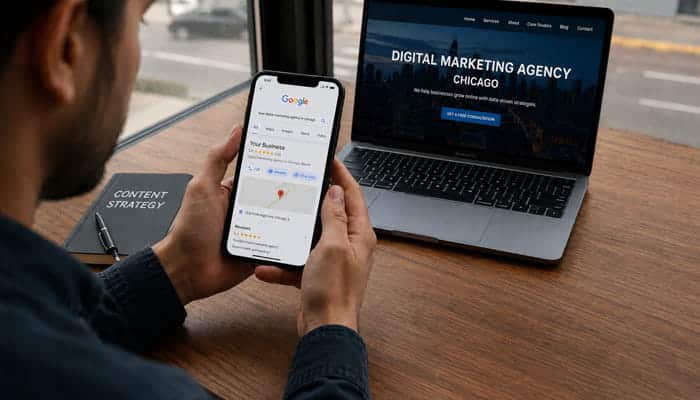
A modern Chicago Digital Content Marketing Strategy must account for the fact that local customers now move between search, maps, reviews, social platforms, video, and AI tools.
The modern local customer journey rarely involves only one search.
A customer may:
- Search Google.
- View Maps results.
- Read Google reviews.
- Visit several websites.
- Check Instagram.
- Watch YouTube videos.
- Search Reddit or another community.
- Ask an AI assistant.
- Search the company name.
- Compare pricing.
- Call or submit a form.
That means a business can no longer treat SEO, social media, reviews, video, and brand reputation as completely separate activities.
They increasingly influence one another.
Build the Strategy Around Customers First
The strongest Chicago Digital Content Marketing Strategy begins with customer needs rather than a spreadsheet of keywords.
Define Your Chicago Target Audience
A successful strategy starts with understanding the people most likely to buy from your business. Before choosing keywords, identify where your customers are located, what problems they are trying to solve, and what information helps them make a decision.
Focus on questions such as:
- Who are your main customers?
- Which Chicago neighborhoods or suburbs matter most?
- What problems make them search online?
- What questions or objections appear before purchase?
- Which platforms, devices, or languages do they use?
Example: Chicago Real Estate
A Chicago real estate company may serve first-time buyers, investors, renters, sellers, luxury buyers, and people relocating to the city. Each audience needs different content.
For example, first-time buyers may need educational guides, while investors may be more interested in neighborhood trends, rental demand, property values, and development activity.
Map Search Intent
Search intent explains what a user wants to accomplish when searching. Matching your content to intent helps attract visitors who are more likely to engage, compare options, or become customers.
| Intent | User Goal | Example |
|---|---|---|
| Informational | Find information | how does local SEO work |
| Commercial | Compare solutions | best Chicago SEO agencies |
| Transactional | Take action | hire Chicago content marketing company |
| Navigational | Find a company | company name Chicago |
| Local | Find nearby provider | plumber near West Loop |
A balanced strategy should include:
- Educational guides for informational searches
- Comparison pages for commercial searches
- Service and landing pages for transactional searches
- Local pages for location-based intent
- Perform a Chicago Competitor and SERP Gap Analysis
Competitor research gives a Chicago Digital Content Marketing Strategy a clearer view of what already ranks and where genuine content gaps remain.
Competitor research helps reveal what already performs well and where useful information is still missing. Instead of simply copying top-ranking pages, look for weaknesses, unanswered questions, and opportunities to provide stronger first-hand or Chicago-specific information.
Check:
- Which websites rank organically and in Maps
- Whether videos, directories, forums, or AI Overviews appear
- Which topics competitors cover well
- Which questions or details are missing
- Whether competitors use original research, images, or case studies
Example
If competing pages about Chicago HVAC maintenance discuss only general maintenance tips, your content could stand out by including:
- Seasonal Chicago maintenance schedules
- Local weather considerations
- Technician insights
- Real project photos
- Local pricing factors
The goal is to be more useful, not simply longer.
Create a Chicago Keyword Strategy
Keyword research should support the Chicago Digital Content Marketing Strategy by connecting local demand with the services, problems, and decisions that matter to customers.
Keyword research should help you understand customer demand, but it should not lead to repetitive or unnatural writing. Build keyword groups around services, problems, locations, and buying intent.
Useful keyword categories include:
- Primary terms such as Chicago content marketing
- Service terms such as Chicago SEO consulting
- Problem-based terms such as how to get more customers in Chicago
- Long-tail terms such as content marketing for Chicago law firms
Long-tail keywords can be especially valuable because they often show more specific intent and may attract highly relevant visitors.
Avoid Keyword Stuffing
Do not repeat the exact focus keyword in every paragraph. Use natural variations so the content remains readable while still clearly covering the topic.
Useful variations include:
- Chicago content strategy
- Local digital marketing
- Chicago SEO strategy
- Content marketing in Chicago
- Chicago business marketing
Google’s current guidance continues to favor useful, original content over pages created mainly to target numerous small keyword variations.
Build Topic Clusters
Topic clusters make a Chicago Digital Content Marketing Strategy more coherent by connecting broad themes with closely related supporting pages.
Topic clusters help organize related content around one broader subject. This creates a clearer site structure, improves internal linking, and helps visitors move naturally from educational content to service pages.
For example, a Chicago Digital Marketing hub could connect to:
- Chicago Local SEO Guide
- Chicago Content Marketing Guide
- Chicago PPC Advertising Guide
- Chicago Social Media Marketing
- SEO vs PPC for Chicago Businesses
Connect each supporting article with relevant internal links instead of publishing isolated posts.
Create Truly Local Chicago Content
Local relevance becomes stronger when a Chicago Digital Content Marketing Strategy uses real market conditions, customer experiences, and city-specific evidence.
Simply adding “Chicago” to a title does not make content locally useful. Strong local content should include information that reflects the real market, customer behavior, climate, regulations, neighborhoods, or business conditions in Chicago.
Useful local elements include:
- Chicago statistics and market data
- Local case studies
- Original photographs
- Neighborhood trends
- Local pricing factors
- Weather or seasonal considerations
- Expert commentary
For example, How Chicago Winters Affect Commercial Roofing is more useful than a generic roofing article if it includes real climate factors, maintenance schedules, and local project examples.
Use Chicago Community Data Instead of Guessing
Reliable community data can make a Chicago Digital Content Marketing Strategy more specific, original, and useful than generic location-based content.
Chicago has 77 official community areas, and local datasets can help businesses create more meaningful neighborhood content. Data about population, housing, employment, transportation, and commuting can reveal real differences between areas.
Marketers can use local data to study:
- Population and household trends
- Employment patterns
- Housing changes
- Transportation and commuting
- Long-term neighborhood development
This can turn a generic topic such as Marketing Tips for Logan Square Businesses into a more original resource based on actual local trends.
Chicago Neighborhood SEO vs Service-Area SEO
A well-planned Chicago Digital Content Marketing Strategy should distinguish neighborhood targeting from service-area targeting because the two serve different search needs.
Neighborhood SEO and service-area SEO are related, but they serve different purposes. Neighborhood pages target specific areas, while service-area SEO is especially important for businesses that travel to customers.
Neighborhood SEO
Create neighborhood pages only when your company genuinely serves the area and can provide unique local information.
A strong page may include:
- Local project examples
- Area-specific testimonials
- Original photos
- Neighborhood FAQs
- Service or response-time details
Avoid duplicating the same page and changing only the neighborhood name.
Service-Area SEO
Service-area businesses include plumbers, HVAC companies, electricians, cleaners, contractors, home healthcare providers, and similar businesses that visit customers.
Google allows service-area businesses to define multiple service areas. Businesses should keep those areas realistic and make sure their Google Business Profile accurately reflects whether customers are actually served at the listed address.
For website content, focus on the most important service areas and create location pages only where you can add real value.
Example Website Structure
Primary service page
/commercial-cleaning/
Chicago page
/commercial-cleaning/chicago/
Useful neighborhood pages
/commercial-cleaning/lincoln-park/
/commercial-cleaning/west-loop/
/commercial-cleaning/hyde-park/
Each location page should contain legitimate local value.
Do not automatically generate hundreds of pages targeting every ZIP code or neighborhood.
Google’s 2026 AI-search guidance warns against creating large numbers of query variations mainly to manipulate rankings or generative AI responses.
Add Multilingual Content Where Demand Exists
For the right audience, multilingual resources can extend a Chicago Digital Content Marketing Strategy to customers who prefer to research or communicate in another language.
Multilingual marketing can be especially relevant in Chicago.
U.S. Census Bureau QuickFacts reports that 35.4% of Chicago residents age five and older spoke a language other than English at home during 2020–2024.
That does not mean every company should translate its entire website.
It means businesses should examine their customer data.
Consider Multilingual Content When
- Existing customers use another language.
- Staff can support customers in that language.
- Search demand exists.
- A meaningful share of the service area uses the language.
- Professional translation or review is available.
Potential content includes:
- Service pages
- FAQs
- Appointment instructions
- Product information
- Videos
- Social posts
- Support resources
- Educational guides
Translations should be accurate and culturally appropriate.
Google recommends separate URLs for language versions in many situations and using hreflang annotations to help Search understand localized versions.
Optimize Google Business Profile
Google Business Profile should work alongside the Chicago Digital Content Marketing Strategy, especially when local visibility and customer actions matter.
Google Business Profile is an important visibility channel for businesses that depend on local customers. Keep the profile complete, accurate, and aligned with how the company operates in the real world.
Pay particular attention to:
- Business name, address, phone number, and website
- Primary and secondary business categories
- Hours, services, and service areas
- Photos, attributes, and business description
Avoid adding artificial keywords to the business name.
For example, if the real business name is Lakefront Plumbing, do not change it to Lakefront Plumbing Best Emergency Plumber Chicago simply to target more keywords.
Maintain Brand and Entity Consistency
Consistent business information strengthens a Chicago Digital Content Marketing Strategy by reducing confusion across search results, directories, social profiles, and the company website.
Customers should encounter the same business identity wherever they find your company online.
Keep these details aligned:
- Business name and logo
- Address and phone number
- Website
- Main services
- Brand description
Pay particular attention when the company moves, changes phone numbers, rebrands, or adds new locations.
Make Reviews Part of the Content Strategy
Customer feedback should support the Chicago Digital Content Marketing Strategy because reviews can influence trust, conversion decisions, and future content topics.
Reviews do more than support reputation. They can influence trust, local visibility, and the expectations potential customers develop before contacting a business.
Create a simple process that encourages genuine feedback:
- Complete the service.
- Follow up with the customer.
- Ask for an honest review.
- Respond professionally.
- Use recurring feedback to improve the business.
Never buy fake reviews or pressure customers to publish misleading feedback.
Reviews can also reveal content opportunities. If customers repeatedly ask the same question, consider answering it through a service page, guide, video, or FAQ.
Build a Technical SEO Foundation
Even excellent content can struggle when search engines cannot efficiently crawl, render, index, or understand the website. Technical SEO therefore supports every other part of a Chicago Digital Content Marketing Strategy.
Regular technical audits should focus on the issues most likely to affect visibility and user experience.
Technical SEO Checklist
Check:
- XML sitemaps and indexing
- Robots.txt and
noindexrules - Broken links and redirect chains
- Duplicate pages and canonical tags
- Mobile usability and HTTPS
- JavaScript rendering and image optimization
- Page speed and Core Web Vitals
- Structured data and server errors
Core Web Vitals
Core Web Vitals measure important aspects of page experience.
| Metric | Good Target | Measures |
|---|---|---|
| LCP | 2.5 seconds or less | Loading performance |
| INP | 200 ms or less | Responsiveness |
| CLS | 0.1 or less | Visual stability |
These metrics should not be viewed as the only SEO goal. A fast website still needs useful content, strong search intent, good architecture, and a clear conversion path.
Manage Canonical URLs Correctly
Duplicate or highly similar URLs can appear because of tracking parameters, filters, sorting, regional versions, or different HTTP and WWW variations.
Canonical tags help indicate which version should be treated as the preferred page.
Make sure your signals agree. For example, avoid placing one URL in the XML sitemap while declaring a different URL as canonical.
Optimize On-Page SEO
On-page optimization helps each page within a Chicago Digital Content Marketing Strategy communicate its topic and purpose clearly to both users and search engines.
On-page SEO helps users and search engines quickly understand what each page covers. The goal is clear organization and relevance—not repeating the focus keyword as often as possible.
Each important page should have:
- A descriptive title tag and clear H1
- Logical H2 and H3 headings
- A concise, readable URL
- A useful meta description
- Relevant images and alt text
- Contextual internal and external link.
For this article, a clean URL could be:
/chicago-content-marketing-strategy/
Write naturally and keep the page focused on the reader’s primary question.
Improve Internal Linking
Internal links give a Chicago Digital Content Marketing Strategy stronger structure by connecting related resources and guiding visitors toward useful next steps.
Internal links create pathways between related pages and help visitors explore a topic in greater depth. They can also show search engines which pages are closely related and which resources are especially important.
For example, a Chicago Digital Marketing Guide could naturally link to:
- Chicago SEO Guide
- PPC Advertising Guide
- Content Marketing Guide
- Google Business Profile Guide
- Marketing Analytics Guide
Use descriptive anchor text rather than generic wording such as click here.
Use Structured Data Where Appropriate
Structured data can provide search engines with clearer information about a page and may make eligible content available for enhanced search features.
Depending on the website, useful Schema.org types can include:
- Organization
- LocalBusiness
- Article
- BreadcrumbList
- Product
- Event
- VideoObject
Only use structured data that accurately represents visible page content. Adding markup does not guarantee higher rankings or a rich result.
FAQs Still Help Users
FAQ sections remain useful when they answer genuine customer questions, remove objections, or make complex pages easier to navigate.
Do not add FAQs simply to increase word count. Focus on questions that potential customers actually ask during research, comparison, or purchase.
Create Content for the Entire Customer Journey
A complete Chicago Digital Content Marketing Strategy should serve customers from initial awareness through evaluation, conversion, retention, and advocacy.
Publishing only informational blog posts can create traffic without creating enough business value.
| Funnel Stage | Customer Need | Useful Content |
|---|---|---|
| Awareness | Understand a problem | Guides and videos |
| Research | Explore solutions | Educational articles |
| Consideration | Compare options | Comparison pages |
| Evaluation | Verify a provider | Case studies and reviews |
| Conversion | Take action | Service and landing pages |
| Retention | Continue relationship | Email and support content |
| Advocacy | Recommend the company | Reviews and referral content |
A page attracting 500 highly qualified visitors may create more value than an unrelated article attracting 20,000 visits.
Build Strong Service Pages
High-intent service pages are a core part of a Chicago Digital Content Marketing Strategy because they connect useful information with commercial action.
Service pages often target visitors with stronger commercial intent than general informational articles. They should make it easy for potential customers to understand the offer and decide whether the company fits their needs.
A strong Chicago service page should clearly explain:
- What the business provides
- Who the service is for
- Where it is available
- How the process works
- What affects pricing
- Why customers should trust the company
- What action the visitor should take next
Avoid vague statements such as “We provide world-class solutions.”
Specific processes, results, examples, experience, and customer proof are far more persuasive.
Publish Original Chicago Case Studies
Original case studies strengthen a Chicago Digital Content Marketing Strategy by showing real problems, processes, and outcomes instead of relying only on marketing claims.
Case studies can strengthen SEO, sales, social content, email campaigns, paid advertising, and conversion pages at the same time.
Challenge
Explain the customer’s original problem.
Strategy
Describe the approach selected to solve it.
Implementation
Show what was actually done.
Results
Provide measurable outcomes when available.
Lessons
Explain what other businesses can learn from the project.
For example:
How a West Loop B2B Company Increased Qualified Organic Leads in Six Months
Real projects and original data are difficult for competitors to duplicate.
Publish Original Research and Data
Original research can give a Chicago Digital Content Marketing Strategy an authority advantage because competitors cannot easily reproduce proprietary findings.
Instead of rewriting statistics from competing websites, create information that other publishers may want to reference.
Potential research topics include:
- Chicago consumer surveys
- Local pricing studies
- Industry benchmarks
- Hiring or employment trends
- Small-business technology adoption
- Marketing-channel comparisons
For example:
Chicago Small Business Digital Marketing Benchmark Report 2026
One strong research project can later become an article, infographic, email campaign, video series, social content, sales resource, and digital PR asset.
Optimize for AI Search in 2026
AI visibility should be treated as an extension of the Chicago Digital Content Marketing Strategy, not as a replacement for helpful content and strong SEO fundamentals.
AI-powered search adds another discovery layer, but the foundation remains useful, accessible, trustworthy content.
Content becomes more valuable when it includes:
- Original expertise
- First-hand experience
- Reliable information
- Unique data
- Clear explanations
- Useful images or videos
Create Non-Commodity Content
A generic article such as 7 Marketing Tips for Chicago Businesses can easily be reproduced.
A genuine study such as:
What We Found After Reviewing 150 Chicago Small-Business Websites
offers something more distinctive if the data, methodology, and analysis are real.
Original information gives readers—and potentially search and AI systems—a reason to reference your page instead of dozens of nearly identical alternatives.
Do Not Chase AEO or GEO Tricks
A sustainable Chicago Digital Content Marketing Strategy should prioritize quality and accessibility over short-lived AEO or GEO tactics.
Terms such as Answer Engine Optimization (AEO) and Generative Engine Optimization (GEO) are increasingly common. However, businesses should not allow terminology to distract them from basic search quality.
Prioritize:
- Crawlable pages
- Useful and accurate information
- Clear website architecture
- First-hand expertise
- Strong brand signals
- Relevant links
- Helpful images and video
- Genuine Chicago relevance
Build content that deserves to be found rather than relying on shortcuts designed for a particular search feature.
Measure AI Search Visibility
Measurement helps show whether a Chicago Digital Content Marketing Strategy is gaining visibility across both traditional and emerging search experiences.
AI-search measurement is still developing, so avoid relying on a single third-party visibility score as proof of performance.
Where appropriate reporting is available, examine:
- Pages receiving AI-search visibility
- Impressions over time
- Device and country patterns
- Pages repeatedly surfaced in generative experiences
Compare those findings with traditional organic traffic, branded searches, leads, and revenue.
Create Video Content
Video can expand a Chicago Digital Content Marketing Strategy by showing real people, projects, expertise, and local context that text alone may not communicate.
Useful formats include:
- Tutorials and demonstrations
- Customer stories
- Project walkthroughs
- Expert interviews
- Neighborhood or local guides
- Behind-the-scenes content
A contractor might publish What Chicago Homeowners Should Check Before Winter, while a restaurant could produce Behind the Scenes at Our West Loop Kitchen.
Repurpose Strong Content
Repurposing allows a Chicago Digital Content Marketing Strategy to get more value from strong research without repeatedly creating content from scratch.
For example, a Chicago Small Business SEO Guide could become:
- A YouTube video
- Several short videos
- LinkedIn and Instagram posts
- An infographic
- An email newsletter
- A downloadable checklist
Repurposing can increase the return from high-quality research without publishing duplicate low-value content.
Build a Chicago Social Media Strategy
Social distribution can extend a Chicago Digital Content Marketing Strategy beyond search and place useful content in the channels customers already use.
| Platform | Often Useful For |
|---|---|
| B2B and professional services | |
| Retail, beauty, restaurants and lifestyle | |
| TikTok | Consumer discovery and short educational videos |
| YouTube | Tutorials, demonstrations and reviews |
| Local communities and consumer audiences | |
| X | News, technology and real-time discussion |
Adapt the presentation to each platform instead of publishing an identical post everywhere.
Use Email to Convert Content Traffic
Email gives a Chicago Digital Content Marketing Strategy a way to continue the relationship after a visitor leaves the website or social platform.
Search and social traffic can disappear after one visit. Email gives businesses an opportunity to maintain the relationship and continue providing useful information after the initial discovery.
Useful email content includes:
- Local or industry updates
- Educational sequences
- Customer stories
- Event invitations
- Product or service updates
- Content roundups
A customer might discover the company through Google but convert weeks later after reading several emails.
Add Paid Content Amplification
Paid promotion can accelerate a Chicago Digital Content Marketing Strategy by placing high-value assets in front of carefully selected audiences.
Organic content can continue creating value over time, but paid distribution can introduce strong assets to relevant audiences immediately.
Useful paid channels may include:
- Google and YouTube Ads
- Meta Ads
- LinkedIn Ads
- Retargeting
- Sponsored newsletters
- Relevant industry publications
For example, a Chicago B2B business could publish an original market report and promote it to local executives, target industries, past website visitors, or decision-makers at selected companies.
Organic + Paid Distribution Model
| Channel | Primary Benefit |
|---|---|
| SEO | Long-term discovery |
| Social | Reach and engagement |
| Retention and nurturing | |
| Paid media | Immediate targeted exposure |
| PR | Authority and links |
| Video | Trust and visibility |
The channels should support one another rather than operate as disconnected campaigns.
Use Digital PR and Local Link Building
Local PR and relevant links can strengthen a Chicago Digital Content Marketing Strategy by increasing authority, reach, and third-party recognition.
Relevant backlinks and media coverage can increase awareness and strengthen the authority of useful content.
Potential Chicago sources include:
- Local media
- Business and industry associations
- Universities and community organizations
- Professional partnerships
- Local events
- Research publications
Instead of purchasing large quantities of weak links, create assets that journalists, organizations, and industry publishers have a legitimate reason to reference.
Connect Content With Chicago Events and Tourism
Chicago’s tourism and events economy can create seasonal content opportunities for businesses that genuinely serve visitors, events, or related industries.
This can be especially useful for:
- Hospitality and restaurants
- Retail and entertainment
- Transportation
- Catering and event services
- Photography
Possible formats include seasonal guides, event-planning resources, visitor information, transportation explainers, and dining content.
Avoid chasing every major Chicago event if it has no real connection to the business.
Optimize for Mobile Users
Mobile usability is critical to a Chicago Digital Content Marketing Strategy because many local customers research, compare, call, and book from smartphones.
Local customers often research businesses while using smartphones. Mobile pages therefore need to make important actions quick and easy.
Visitors should be able to:
- Read and navigate without difficulty
- Tap phone numbers and buttons
- Complete short forms
- View pricing or services
- Book appointments
Avoid intrusive pop-ups, tiny fonts, unnecessarily large images, complicated forms, and hard-to-tap buttons.
A better mobile experience can improve both engagement and conversions.
Make Content Conversion-Friendly
Conversion design ensures a Chicago Digital Content Marketing Strategy produces more than visibility by helping qualified visitors take a useful next step.
Traffic is only one step. Commercial content should help qualified readers understand what to do next.
Useful calls to action include:
- Request a quote
- Schedule a consultation
- Book an appointment
- Get an estimate
- View pricing
- Download a guide
Match the CTA to the visitor’s intent.
An educational guide might offer Download the checklist, while a high-intent service page might use Request a quote.
Track Content at Three Levels
Rankings and traffic show only part of the picture. Measure performance from visibility through actual business outcomes.
| Level | Example Metrics |
|---|---|
| Visibility | Impressions, rankings, AI visibility, video reach |
| Engagement | Clicks, engaged sessions, downloads |
| Business | Leads, bookings, sales, revenue |
You can also monitor calls, form submissions, branded searches, email sign-ups, backlinks, and Google Business Profile actions.
The most valuable metrics are those connected to business objectives.
Measure Content Attribution and Revenue
Revenue attribution shows whether a Chicago Digital Content Marketing Strategy is contributing to business outcomes rather than simply generating visits.
Customer journeys are rarely linear. Someone might read an article, watch a video several days later, search the brand, join an email list, and eventually request a quote.
Connect measurement across:
- GA4 and Google Search Console
- CRM and lead data
- Forms and call tracking
- Booking systems
- UTM campaign parameters
- Revenue data
The better question is not simply Which article received the most traffic?
Ask:
Which content helped influence qualified leads and revenue?
Use Google Search Console Strategically

Google Search Console can reveal which queries and pages are gaining or losing organic visibility. It can also highlight indexing, Core Web Vitals, and other technical issues that may need attention.
Review trends such as:
- Queries and pages gaining visibility
- Pages losing meaningful clicks
- Indexing or technical issues
- Search appearance changes
- AI-search visibility where available
Avoid overreacting to small daily ranking movements. Look for sustained changes and patterns.
Establish Content Governance and Editorial Quality Control
Publishing more content does not automatically create better SEO. A reliable editorial system helps keep information accurate, useful, original, and consistent as production grows.
Recommended Content Workflow
1. Research
Identify the audience, search intent, customer problem, local relevance, and commercial opportunity.
2. Create a Content Brief
Define the topic, target reader, supporting questions, required evidence, internal links, and conversion goal.
3. Draft
Create the article using genuine research, experience, and expertise.
4. Fact-Check
Verify important statistics, dates, prices, laws, quotations, product details, and technical claims.
5. Expert and SEO Review
When necessary, use a qualified specialist. Also review the title, headings, internal links, search intent, images, metadata, and URL.
6. Editorial Review
Remove repetition, keyword stuffing, unsupported claims, generic filler, and awkward AI-generated language.
7. Publish, Measure, and Refresh
Make sure the content is crawlable, measure its performance, and update it when important information changes.
Build a Content Calendar
A content calendar helps businesses maintain consistency without publishing merely for the sake of meeting a quota.
| Week | Content | Main Goal |
|---|---|---|
| Week 1 | Major SEO article | Organic visibility |
| Week 2 | Case study | Trust and conversions |
| Week 3 | Video and social content | Reach |
| Week 4 | Existing-content update | Improve performance |
Adjust the frequency to your available resources and expertise. Quality should remain more important than volume.
Use the 70/20/10 Content Model
One way to balance dependable content with experimentation is the 70/20/10 model.
- 70% proven topics: Established customer questions and demand
- 20% emerging opportunities: New industry developments and trends
- 10% experiments: Calculators, research, interactive tools, new videos, or new platforms
The percentages do not need to be exact.
Refresh Existing Content
Publishing a new article is not always the best next step. An older page may already have backlinks, search visibility, and historical performance that make it worth improving.
Review established pages for:
- Outdated statistics or pricing
- Broken links
- Missing topics
- Weak examples
- Poor internal linking
- Changed search intent
Also replace outdated screenshots and update important regulatory or product information when necessary.
Only change the Last Updated date after making meaningful revisions.
Chicago Content Ideas by Industry
Content opportunities vary significantly by industry. Rather than forcing the same local strategy onto every company, focus on the questions and evidence that matter to each audience.
| Industry | Useful Chicago Content Ideas |
|---|---|
| Restaurants | Neighborhood dining guides, chef stories, seasonal content |
| Real Estate | Market reports, buyer guides, relocation and neighborhood data |
| Law Firms | Illinois legal explainers, FAQs, process guides |
| Home Services | Seasonal maintenance, weather advice, project examples |
| B2B | Industry research, executive interviews, white papers |
| Healthcare | Service explainers, preparation guides, educational videos |
Healthcare, legal, financial, and similarly sensitive content should receive suitable professional review.
Example Chicago Content Funnel
Consider a Chicago commercial cleaning company. Instead of relying on one service page, it could build content around every stage of the decision process.
| Stage | Example Content |
|---|---|
| Awareness | How Often Should Chicago Offices Schedule Deep Cleaning? |
| Research | Office Cleaning Costs in Chicago: What Affects Pricing? |
| Consideration | Daily vs Weekly Commercial Cleaning |
| Evaluation | West Loop Office Cleaning Case Study |
| Conversion | Chicago Commercial Cleaning Services |
| Retention | Monthly Facility Maintenance Checklist |
| Advocacy | Request genuine customer feedback |
Each asset answers a different question and moves the customer closer to—or beyond—the purchase decision.
90-Day Chicago Content Marketing Plan
Days 1–30: Research and Foundation
Start by auditing your current website, technical SEO, competitors, customer questions, Google Business Profile, analytics, and conversion tracking.
Focus on:
- Content and technical SEO gaps
- Keyword intent
- Local opportunities
- Baseline KPIs
Days 31–60: Content Production
Create or improve:
- One cornerstone guide
- Two supporting articles
- One commercial landing page
- One Chicago case study
- Video and social content
Also refresh existing pages with strong potential.
Days 61–90: Distribution and Optimization
Focus on:
- Internal linking
- Social and paid promotion
- Local outreach and reviews
- Better calls to action
- Lead and revenue tracking
- Updating weak content
Do not judge SEO only by page-one rankings within 90 days. Results often build gradually over time.
Suggested Monthly Content Mix
| Content Type | Suggested Quantity | Main Goal |
|---|---|---|
| In-depth SEO articles | 2–4 | Search visibility |
| Case study | 1 | Trust |
| Video | 2–4 | Reach and authority |
| Social posts | 8–16 | Distribution |
| Email newsletter | 1–2 | Retention |
| Content refreshes | 2–4 | SEO improvement |
| Digital PR asset | Quarterly | Authority and links |
A highly researched article can be more valuable than ten generic posts.
How Much Should Chicago Businesses Spend on Content Marketing?
There is no fixed budget. Costs depend on competition, industry, content quality, SEO, video, design, paid promotion, and analytics.
Smaller businesses may prioritize:
- Core service pages
- Google Business Profile
- Local SEO
- Reviews
- A few strong guides
Larger companies may invest more in original research, professional video, case studies, digital PR, paid distribution, and marketing automation.
Budget around business goals, not simply the number of articles published.
How to Choose a Chicago Content Marketing Agency
Choose an agency that understands local search, content quality, measurement, and your target audience.
Ask about:
- Chicago audience and keyword research
- Content creation and fact-checking
- Local and technical SEO
- AI-content quality control
- Case studies and link building
- Lead, revenue, and performance reporting
Be cautious of agencies that guarantee specific Google rankings. No legitimate provider controls Google’s organic search results.
Common Chicago Content Marketing Mistakes
- Publishing generic or low-value AI content
- Creating duplicate neighborhood pages
- Ignoring technical SEO issues
- Focusing only on website traffic
- Neglecting customer reviews
- Providing a poor mobile experience
- Publishing content without promotion
- Ignoring older high-potential pages
- Using weak or unclear calls to action
- Measuring rankings instead of leads and revenue
- Chasing AI-search tricks instead of strong SEO fundamentals
Chicago Content Marketing Audit Table
| Area | Question to Ask | Priority |
|---|---|---|
| Search intent | Does the page answer what users actually want? | High |
| Originality | Does it add something competitors lack? | High |
| Chicago relevance | Is local information genuinely useful? | High |
| Accuracy | Are important claims verified? | High |
| Technical SEO | Can Google crawl and index the page? | High |
| Internal linking | Is it connected to relevant pages? | Medium |
| Conversion | Does it provide a logical next step? | High |
| Multimedia | Would original images or video help? | Medium |
| Authority | Does it demonstrate expertise? | High |
| Freshness | Are facts and statistics current? | Medium |
| Distribution | Is there a promotion plan? | Medium |
| Measurement | Can leads and revenue be tracked? | High |
Chicago Digital Content Marketing Strategy FAQs
1. Why is local SEO important for Chicago businesses?
Local SEO can help companies appear when customers search Google and Maps for nearby services, businesses, and products.
2. Should a business create pages for every Chicago neighborhood?
No. Create neighborhood pages only when each page provides useful, unique local information. Avoid automatically generating near-duplicate pages.
3. How often should a Chicago business publish content?
There is no perfect schedule. Publishing fewer original and well-researched resources is usually more valuable than producing large amounts of weak content simply to maintain frequency.
4. Does AI search replace SEO in 2026?
No. Google’s generative search experiences still depend heavily on established search systems and quality signals, so SEO fundamentals remain important.
5. Can AI-generated content rank on Google?
AI-assisted content can appear in search, but publishing large amounts of low-value or unoriginal content creates greater quality and spam risks.
6. Is multilingual content useful for Chicago businesses?
It can be. Businesses should consider multilingual content when their audience, services, search demand, and support capabilities justify it.
7. What is the difference between neighborhood SEO and service-area SEO?
Neighborhood SEO targets specific local areas through useful location content. Service-area SEO is especially relevant to companies that travel to customers across multiple areas.
8. Should Chicago businesses still use FAQs?
Yes. FAQs remain useful when they answer genuine customer questions and remove barriers to conversion.
Conclusion
A strong Chicago Digital Content Marketing Strategy in 2026 should do more than bring visitors to a website. It should help Chicago businesses reach the right audience, build trust, and turn online visibility into qualified leads and revenue.
The most effective approach combines local SEO, technical SEO, useful service pages, Chicago-specific data, neighborhood and service-area content, reviews, case studies, social media, video, email, digital PR, and paid promotion. These channels work best when they support the same customer journey rather than operating separately.
Businesses should also focus on original, helpful, and trustworthy content instead of publishing large amounts of generic material. Strong SEO fundamentals remain important as AI-powered search experiences continue to expand.
Ultimately, the goal is not simply to rank for more Chicago keywords. It is to become a reliable and locally relevant resource for the customers you want to reach. When content is built around real customer needs and measured against leads, conversions, and revenue, it can support sustainable visibility and long-term business growth.