

Last Updated: July 2026
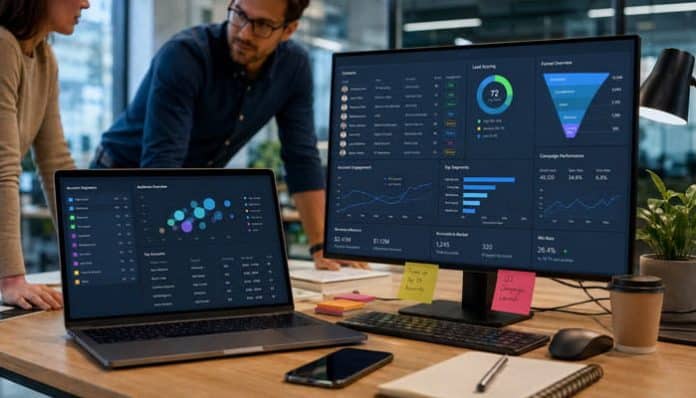
B2B segmentation software helps sales, marketing, revenue operations, and customer success teams group leads, accounts, and customers into meaningful audiences based on company data, buyer behavior, intent signals, lifecycle stage, and revenue potential. In 2026, this is no longer just a “nice-to-have” marketing tool. It is becoming a core part of smarter B2B targeting.
Modern B2B buyers do more independent research, compare vendors privately, involve larger buying groups, and expect relevant digital experiences before they ever speak to sales. Gartner reported in March 2026 that 67% of B2B buyers prefer a rep-free experience, and its research also found that many buyers are using AI during purchase research.
Forrester also reported that the typical B2B buying decision now involves 13 internal stakeholders and nine external influencers, which means companies are rarely selling to one simple decision-maker.
That is why B2B segmentation software matters. It helps businesses move beyond generic email lists and basic CRM filters. Instead of sending the same message to every prospect, teams can build targeted segments based on industry, company size, technology stack, job role, buying committee influence, website behavior, product usage, intent data, and customer value.
This complete guide explains what B2B segmentation software is, how it works, which features matter most, how to use it for account-based marketing, what mistakes to avoid, how to measure results, and how to choose the right platform for smarter targeting in 2026.
Quick Answer: What Is B2B Segmentation Software?
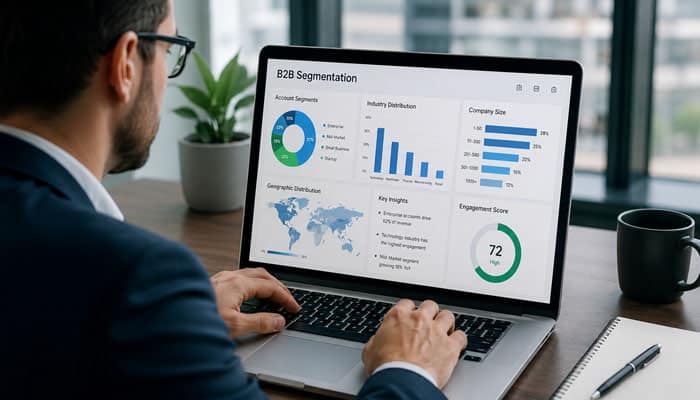
B2B segmentation software is a sales and marketing tool that helps businesses divide leads, accounts, prospects, and customers into smaller groups based on shared business characteristics, behavior, buying signals, and revenue potential.
Instead of treating every lead the same, B2B segmentation software helps teams create focused groups such as:
- Enterprise SaaS accounts with 1,000+ employees
- Healthcare companies researching compliance tools
- Pricing page visitors from target accounts
- Trial users with high product usage
- Existing customers near renewal
- High-value accounts showing buying intent
- Companies using a specific CRM or software platform
The main goal is simple: help your team send the right message to the right account at the right time.
Key Takeaways
- B2B segmentation software helps organize leads, accounts, and customers into targeted groups.
- It improves lead quality, personalization, ABM, sales outreach, retention, and expansion revenue.
- Strong segments combine firmographic, technographic, behavioral, intent, lifecycle, and value-based data.
- In 2026, first-party data, AI-assisted targeting, buying committee segmentation, and privacy-safe personalization matter most.
- Good results depend on clean data, CRM integration, sales-marketing alignment, and continuous measurement.
What Does B2B Segmentation Software Do?
B2B segmentation software helps teams turn raw CRM and marketing data into targeted audience groups. It can organize leads, enrich account details, score buying readiness, track engagement, and sync segments with sales, email, ads, and customer success tools.
A typical platform may help you:
- Build target account lists.
- Segment contacts by role, industry, company size, or buying stage.
- Identify high-fit accounts for ABM.
- Track website, email, webinar, and demo activity.
- Use intent data to find accounts researching related solutions.
- Score leads and accounts based on fit and engagement.
- Personalize campaigns and measure pipeline, renewals, and revenue.
In simple terms, B2B segmentation software helps businesses stop guessing and target the right accounts with better data.
Why B2B Segmentation Software Matters in 2026

B2B buying has changed. Buyers are more informed, more digital, and more selective. They often search online, compare vendors, read reviews, ask peers, use AI tools, and build internal shortlists before they contact a vendor.
This creates a major challenge for sales and marketing teams. If your outreach is broad, irrelevant, or poorly timed, buyers may ignore it. Gartner’s 2025 research found that 73% of B2B buyers actively avoid suppliers that send irrelevant outreach.
Segmentation helps solve this problem by making campaigns more relevant. A CFO may care about ROI and budget control. An IT leader may care about security and integrations. A marketing leader may care about lead quality and attribution. A sales leader may care about pipeline and conversion. A procurement team may care about vendor risk and contract terms.
B2B segmentation software helps your team understand these differences and create targeted messages for each group.
| Segment Type | Example Segment | Best Message Angle |
|---|---|---|
| Firmographic | SaaS companies with 50–200 employees | Growth, automation, scalability |
| Technographic | Companies using Salesforce or HubSpot | Integration and workflow efficiency |
| Behavioral | Visitors who viewed the pricing page | Demo, case study, comparison content |
| Intent-based | Accounts researching sales automation | Problem-aware outreach |
| Lifecycle-based | Leads in consideration stage | Buyer guide or comparison checklist |
| Customer-based | Accounts near renewal | ROI report and success review |
The better your segments are, the easier it becomes to create relevant campaigns, prioritize sales activity, and reduce wasted marketing spend.
How We Researched This B2B Segmentation Software Guide
This guide was created by reviewing current B2B buying behavior, customer segmentation best practices, account-based marketing workflows, CRM segmentation methods, first-party data strategies, privacy requirements, and AI-powered marketing developments.
The article focuses on practical value for business owners, marketers, sales leaders, SaaS teams, agencies, RevOps teams, and customer success teams. The goal is not only to explain what B2B segmentation software does, but also to show how to evaluate it safely and use it for measurable business growth.
The research behind this guide considered several major 2026 realities:
- B2B buyers prefer more self-directed research.
- Buying committees are larger and more complex.
- First-party data is becoming more important.
- AI is changing both buyer research and marketing workflows.
- Privacy and consent expectations continue to shape targeting.
- Sales and marketing teams need better alignment around account quality.
Because of this, the best B2B segmentation software should not only filter contacts by industry or company size. It should help teams understand accounts, buying groups, engagement signals, intent data, customer value, and privacy-safe personalization.
Buying Committee Segmentation: A Missing Layer Many Teams Ignore
One of the most important parts of B2B segmentation in 2026 is buying committee segmentation. In many B2B deals, the final purchase decision is not made by one person. A software purchase may involve a founder, finance leader, IT manager, marketing director, sales leader, procurement team, legal team, department manager, and end users.
That means your segmentation strategy should not only ask, “Which company should we target?” It should also ask, “Who inside that company influences the decision?”
| Buying Committee Member | Main Concern | Best Message Angle |
|---|---|---|
| CEO or Founder | Growth, speed, competitive advantage | Business outcomes and scalability |
| CFO | Cost, ROI, budget control | Savings, revenue impact, payback period |
| IT Leader | Security, integrations, implementation | Technical fit and compliance |
| Marketing Leader | Lead quality, campaign performance | Targeting, personalization, attribution |
| Sales Leader | Pipeline, conversion, sales efficiency | Account priority and outreach timing |
| Procurement Team | Vendor risk, pricing, contract terms | Transparency and reliability |
| End Users | Ease of use, daily workflow | Simplicity, productivity, support |
This is why advanced B2B segmentation software should support role-based, department-based, and account-level segmentation. A strong platform should help marketers create different messages for different members of the buying group while keeping the account strategy connected.
For example, one enterprise account may need several content paths:
- A security guide for IT
- An ROI calculator for finance
- A productivity case study for department leaders
- A vendor comparison document for procurement
- A workflow demo for daily users
This approach is much stronger than sending one generic brochure to every contact inside the same company.
How B2B Segmentation Software Works
Most B2B segmentation tools follow a simple workflow: collect data, enrich records, create segments, score accounts, activate campaigns, and measure results.
1. Data Collection
The software collects information from your CRM, website, forms, email platform, marketing automation system, product analytics, ad platforms, chat tools, sales calls, support tickets, and third-party data sources.
This data may include:
- Company name
- Industry
- Employee count
- Revenue range
- Location
- Website
- Job title
- Department
- Lead source
- Email engagement
- Website activity
- Product usage
- Deal stage
- Customer status
- Renewal date
- Support history
2. Data Enrichment
Many businesses have incomplete CRM records. A lead may have an email address but no company size, industry, revenue range, or technology information. Data enrichment helps fill those gaps.
Enrichment may add:
- Industry category
- Company headquarters
- Annual revenue estimate
- Employee count
- Technology stack
- Funding stage
- Parent company
- LinkedIn company profile
- Business category
- Regional presence
Clean and enriched data makes segmentation more accurate.
3. Segment Creation
Teams create segments using rules, filters, scoring models, or AI-assisted suggestions.
Examples include:
- Healthcare companies with 500+ employees
- Director-level contacts in finance teams
- Accounts that visited the pricing page in the last 30 days
- Customers with low product usage and renewal in 60 days
- Companies using Salesforce and researching CRM migration
- Enterprise accounts with multiple engaged contacts
4. Lead and Account Scoring
The software scores leads or accounts based on fit, engagement, behavior, and buying signals. This helps sales teams prioritize the best opportunities instead of treating every lead equally.
5. Campaign Activation
Once segments are created, teams can activate them in campaigns.
Segments can be used for:
- Email nurture campaigns
- LinkedIn ads
- Google Ads audiences
- Sales sequences
- Website personalization
- Webinar invitations
- Retargeting campaigns
- Customer success workflows
- Renewal campaigns
- Upsell campaigns
6. Performance Tracking
The final step is measurement. Good segmentation software should show which segments are performing best.
Useful metrics include:
- Demo requests
- Lead-to-opportunity conversion
- Pipeline value
- Win rate
- Sales cycle length
- Customer acquisition cost
- Churn rate
- Expansion revenue
- Campaign ROI
First-Party Data and Privacy-Safe Segmentation
In 2026, B2B teams should pay close attention to first-party data. First-party data is information your business collects directly from your own audience, such as website visits, form submissions, webinar registrations, email engagement, CRM activity, product usage, and customer support interactions.
This matters because privacy expectations are increasing, and marketers cannot rely only on third-party tracking. Google’s April 2025 Privacy Sandbox update said Chrome would maintain its current approach to third-party cookie choice instead of rolling out a new standalone third-party cookie prompt, while continuing to enhance tracking protections in Incognito mode.
Even with that change, businesses still need stronger first-party data strategies because browser restrictions, consent rules, and customer trust continue to shape digital targeting.
B2B segmentation software should help teams use privacy-safe data such as:
- CRM lifecycle stage
- Email engagement
- Website page visits
- Content downloads
- Demo requests
- Webinar attendance
- Product usage
- Customer renewal dates
- Support ticket history
- Account ownership
- Consent and communication preferences
Privacy also matters because segmentation may involve personal data. The European Commission explains that EU data protection rules include protections for personal data inside and outside the EU, including GDPR-related safeguards for international data transfers.
The California Attorney General explains that the CCPA gives consumers rights such as knowing what personal information is collected, deleting personal information, opting out of sale or sharing, correcting inaccurate information, and limiting the use of sensitive personal information.
For this reason, businesses should choose segmentation tools with:
- Consent management
- Role-based access
- Data retention controls
- Opt-out handling
- Privacy documentation
- Data processing agreements
- Security controls
- Audit logs
- Clear vendor data sources
Segmentation should improve relevance, but it should not ignore trust, consent, or compliance.
Main Types of B2B Segmentation
Strong segmentation usually combines several data types. Using only one data layer can create incomplete segments. For example, company size may show whether an account fits your market, but it does not show whether the account is ready to buy.
Demandbase describes B2B market segmentation as useful for building stronger go-to-market and ABM campaigns through shared characteristics such as firmographics, intent data, and personas. ZoomInfo also explains that B2B customer segmentation goes beyond basic demographics and often includes firmographic, technographic, behavioral, and intent-based signals.
1. Firmographic Segmentation
Firmographic segmentation groups companies by business characteristics.
Common firmographic filters include:
- Industry
- Company size
- Employee count
- Annual revenue
- Location
- Business model
- Growth stage
- Funding status
- Number of offices
- Parent company or subsidiary status
Example: A cybersecurity company may create separate campaigns for banks, healthcare companies, SaaS companies, and government contractors because each industry has different security concerns.
2. Technographic Segmentation
Technographic segmentation groups companies based on the tools, platforms, and systems they use.
This may include:
- CRM software
- Marketing automation platform
- Cloud provider
- CMS platform
- ERP software
- Analytics tools
- Payment systems
- Cybersecurity tools
- Collaboration software
- E-commerce platform
Example: A software integration company may target businesses using both Salesforce and NetSuite because those companies may need workflow automation between sales and finance systems.
3. Behavioral Segmentation
Behavioral segmentation groups leads or accounts based on actions they take.
Behavioral signals may include:
- Website visits
- Pricing page views
- Email opens
- Email clicks
- Webinar attendance
- Form submissions
- Chatbot conversations
- Demo requests
- Trial usage
- Product logins
- Feature adoption
Behavioral data is valuable because it shows real engagement. A company that visits your pricing page twice in one week may be more sales-ready than a company that downloaded a general checklist six months ago.
4. Intent-Based Segmentation
Intent-based segmentation identifies accounts that may be actively researching a topic, product, competitor, or solution category.
Intent signals may include:
- Searching for related topics
- Reading comparison content
- Visiting review websites
- Engaging with competitor-related content
- Increasing activity around a specific business problem
- Consuming industry-specific educational content
Intent data is useful because it helps sales and marketing teams focus on accounts that may already be in-market.
5. Persona-Based Segmentation
Persona-based segmentation groups contacts by role, department, seniority, responsibility, and decision influence.
Common B2B personas include:
- Founder
- CEO
- CFO
- CMO
- CIO
- Sales director
- Marketing manager
- IT manager
- Operations leader
- Procurement officer
- Customer success manager
- Product leader
This helps your team create messaging that speaks to each buyer’s actual concerns.
6. Lifecycle Stage Segmentation
Lifecycle segmentation groups leads and customers by where they are in the buyer journey.
| Stage | Meaning | Best Content Type |
|---|---|---|
| Awareness | Buyer understands the problem | Educational guide |
| Consideration | Buyer compares solutions | Checklist or comparison article |
| Decision | Buyer is ready to choose | Demo, case study, pricing guide |
| Customer | Buyer has purchased | Onboarding content |
| Renewal | Contract is ending soon | ROI report and success review |
| Expansion | Customer may upgrade | Upsell or cross-sell offer |
Lifecycle segmentation helps prevent mismatched messaging. A new lead may need education, while a high-intent buyer may need a demo invitation.
7. Value-Based Segmentation
Value-based segmentation groups accounts by revenue potential, profitability, retention value, or expansion opportunity.
Examples include:
- High annual contract value accounts
- Strategic enterprise accounts
- Low-value self-service accounts
- Expansion-ready customers
- High-churn-risk accounts
- Customers with strong renewal potential
This helps teams decide where to invest more time, budget, and sales attention.
8. Geographic Segmentation
Geographic segmentation groups accounts by country, region, city, language, sales territory, or market regulation.
This is useful when:
- Pricing differs by region
- Sales teams own different territories
- Compliance rules vary by country
- Messaging needs localization
- Regional events or campaigns are planned
9. Account Tier Segmentation
Account tier segmentation is common in account-based marketing.
| Tier | Account Type | Strategy |
|---|---|---|
| Tier 1 | Highest-value strategic accounts | One-to-one personalization |
| Tier 2 | High-fit growth accounts | Industry or persona-based campaigns |
| Tier 3 | Broader qualified accounts | Automated nurture and retargeting |
This helps companies avoid spending the same effort on every account.
Simple B2B Segmentation Scoring Model
A useful way to make segmentation more practical is to create a scoring model. Instead of treating all leads equally, a scoring model helps teams rank accounts based on fit, behavior, intent, and revenue potential.
| Scoring Category | Example Signal | Score |
|---|---|---|
| Firmographic fit | Right industry, company size, location | 25 points |
| Technographic fit | Uses compatible tools or platforms | 15 points |
| Engagement | Opens emails, attends webinars, downloads guides | 20 points |
| Buying intent | Searches related topics or visits pricing pages | 20 points |
| Revenue potential | High contract value or expansion opportunity | 10 points |
| Sales readiness | Requests demo or replies to outreach | 10 points |
A score above 75 may be considered a sales-ready account. A score between 50 and 75 may need nurturing. A score below 50 may be low priority unless it shows stronger buying intent later.
A stronger scoring model should also include negative scoring.
| Negative Signal | Example Deduction |
|---|---|
| Student or personal email address | -10 points |
| No company website | -10 points |
| Poor-fit industry | -20 points |
| Unsubscribed from emails | -25 points |
| Competitor or vendor contact | -30 points |
| No engagement for 12 months | -15 points |
Negative scoring keeps poor-fit contacts from being passed to sales too early.
Best Features to Look for in B2B Segmentation Software
Not every platform has the same capabilities. Some tools focus on CRM segmentation, some on ABM, some on data enrichment, some on intent data, and some on customer data platforms.
| Feature | Why It Matters |
|---|---|
| CRM integration | Keeps segments connected to sales activity |
| Data enrichment | Adds missing company and contact details |
| Firmographic filters | Helps target companies by business profile |
| Technographic filters | Finds companies using specific tools |
| Behavioral tracking | Tracks real buyer engagement |
| Intent data | Identifies accounts researching relevant topics |
| Lead scoring | Helps prioritize individual contacts |
| Account scoring | Supports ABM and enterprise sales |
| AI segment suggestions | Helps discover audience groups faster |
| Dynamic segments | Updates lists automatically when data changes |
| Workflow automation | Triggers actions based on segment rules |
| Ad audience sync | Sends segments to paid media platforms |
| Reporting dashboard | Measures segment performance |
| Privacy controls | Helps protect customer and prospect data |
HubSpot documentation shows that some modern segment tools allow users to generate segment filters with AI and edit those filters manually, which reflects a wider shift toward AI-assisted audience creation.
Benefits of B2B Segmentation Software
1. Better Targeting
The biggest benefit is improved targeting. Instead of sending every campaign to every contact, teams can target specific industries, company sizes, job roles, behaviors, or buying stages.
For example, a SaaS company can create separate campaigns for startups, mid-market teams, and enterprise accounts.
2. Higher Lead Quality
Segmentation helps teams focus on leads that match the ideal customer profile. This can reduce low-quality leads and improve sales productivity.
A strong lead segment may include:
- Right industry
- Right company size
- Right job role
- Relevant pain point
- Clear buying signal
- Recent engagement
- Suitable budget range
3. Stronger Personalization
Personalized messaging feels more relevant because it speaks to a specific problem.
Instead of saying:
“Improve business operations.”
A stronger segmented message would say:
“Help multi-location healthcare teams reduce manual reporting and improve compliance workflows.”
The second message is more specific, more useful, and more likely to get attention.
4. Better Sales and Marketing Alignment
Segmentation creates a shared language between sales and marketing.
Both teams can agree on:
- Which accounts matter most
- Which industries are priority markets
- Which leads are sales-ready
- Which personas need different messaging
- Which campaigns support each funnel stage
- Which accounts should receive personal outreach
This reduces confusion and improves lead handoff quality.
5. More Effective Account-Based Marketing
B2B segmentation software is especially useful for ABM. Account-based marketing focuses on selected high-value accounts instead of broad audiences.
Segmentation helps ABM teams:
- Build target account lists
- Tier accounts by value
- Match content to buying committees
- Personalize ads by industry
- Alert sales when target accounts show intent
- Track engagement across multiple contacts
- Measure pipeline by account segment
6. Better Customer Retention
Segmentation is not only for new leads. It also helps customer success teams manage current customers.
You can create customer segments for:
- Low product usage
- Renewal in 90 days
- High support ticket volume
- Expansion-ready accounts
- Customers using only one feature
- High-value customers needing executive attention
- Customers with declining engagement
This helps reduce churn and improve customer lifetime value.
7. Smarter Budget Allocation
Marketing budgets are limited. Segmentation helps teams invest more money in high-value audiences and reduce spend on poor-fit audiences.
For example, if enterprise healthcare accounts have a higher win rate than small retail accounts, your team can shift ad spend, content, and sales outreach toward the stronger segment.
B2B Segmentation Software vs CRM Segmentation
Many teams ask whether they need separate segmentation software if they already use a CRM. The answer depends on the complexity of your sales and marketing strategy.
| Comparison Area | CRM Segmentation | B2B Segmentation Software |
|---|---|---|
| Main purpose | Store contacts, deals, and sales activity | Build advanced audience and account segments |
| Data depth | Often based on internal fields | Can include enrichment, behavior, and intent data |
| Best for | Basic lists and pipeline management | Targeting, personalization, ABM, scoring |
| Automation | Depends on CRM setup | Often more advanced and dynamic |
| Data sources | Mostly internal data | Internal, third-party, and behavioral data |
| Ideal users | Sales teams | Marketing, sales, RevOps, customer success |
| Limitation | May lack advanced signals | May require cleaner data and setup |
A CRM can handle basic segmentation. But if your company needs deeper targeting, AI scoring, intent signals, account intelligence, ad sync, or ABM workflows, dedicated B2B segmentation software may be more useful.
Common Use Cases
Use Case 1: Building an Ideal Customer Profile
You can use segmentation software to identify your best customers and find similar companies.
Review your best customers by:
- Revenue
- Profitability
- Retention
- Expansion revenue
- Product usage
- Sales cycle length
- Support needs
- Industry fit
- Company size
- Buying trigger
Then create a target segment that matches those patterns.
Use Case 2: Improving Email Campaigns
Generic email campaigns often perform poorly because they do not match buyer needs. Segmentation allows your team to send different messages based on industry, role, behavior, and funnel stage.
| Segment | Email Angle |
|---|---|
| SaaS founders | Growth, automation, lean team productivity |
| Enterprise IT leaders | Security, compliance, integrations |
| Marketing managers | Lead quality and campaign performance |
| CFOs | ROI, cost control, forecasting |
| Existing customers | Adoption, renewal, upgrade value |
Use Case 3: Prioritizing Sales Outreach
Sales teams can use account scoring to focus on leads most likely to convert.
A high-priority account may show:
- Strong ICP fit
- Recent pricing page visits
- Multiple engaged contacts
- Relevant technology stack
- Active buying intent
- Recent funding or growth signal
- Demo request or direct reply
Use Case 4: Running ABM Campaigns
ABM teams can segment accounts into tiers and personalize campaigns based on account value.
- Tier 1 accounts receive one-to-one campaigns.
- Tier 2 accounts receive industry-based campaigns.
- Tier 3 accounts receive automated nurture campaigns.
This helps teams use time and budget more wisely.
Use Case 5: Reducing Churn
Customer success teams can create churn-risk segments based on product usage, support tickets, low engagement, or renewal timing.
Churn-risk signals may include:
- Low login activity
- Fewer active users
- Missed onboarding steps
- Declining product usage
- Unresolved support tickets
- No response to customer success emails
- Contract renewal approaching
Use Case 6: Finding Upsell and Cross-Sell Opportunities
B2B segmentation software can also identify customers who may be ready for expansion.
Expansion signals may include:
- High product usage
- Multiple departments using the product
- Recent hiring growth
- New office locations
- Interest in advanced features
- Strong renewal history
- Positive customer health score
These accounts may be good candidates for premium plans, add-ons, integrations, or professional services.
Industry-Specific B2B Segmentation Examples
Different industries need different segmentation strategies. A SaaS company, manufacturing supplier, cybersecurity firm, and consulting agency may all use segmentation software differently.
| Industry | Useful Segment | Campaign Idea |
|---|---|---|
| SaaS | Trial users with high product usage | Upgrade campaign |
| Cybersecurity | Finance and healthcare companies | Compliance-focused campaign |
| Manufacturing | Multi-location companies | Supply chain efficiency message |
| HR Tech | Companies hiring rapidly | Recruitment automation campaign |
| Marketing Agency | E-commerce brands with low ad performance | Conversion improvement offer |
| Fintech | Companies using outdated payment systems | Modern payment workflow campaign |
| Consulting | Enterprise accounts with complex operations | Strategy consultation campaign |
| Real Estate Tech | Brokerages with multiple branches | Lead routing and CRM automation |
| EdTech | Schools or training firms with growing enrollment | Learning management workflow campaign |
| Logistics | Companies with multi-region delivery operations | Route efficiency and visibility campaign |
These examples show that segmentation is not only a technical process. It is a business strategy that connects data, buyer needs, and campaign messaging.
Examples of B2B Segmentation Software Categories
B2B segmentation software comes in different types, depending on your goals, data, and sales process.
| Software Category | Best For |
|---|---|
| CRM-based segmentation tools | Basic lead, contact, and account lists |
| Account-based marketing platforms | Targeting high-value B2B accounts |
| Customer data platforms | Combining customer data from multiple sources |
| Sales intelligence tools | Finding company, contact, and buying signals |
| Intent data platforms | Identifying accounts researching related solutions |
| Marketing automation platforms | Email campaigns, nurture workflows, and lead scoring |
| Product analytics tools | Segmenting users by product behavior and usage |
| Customer success platforms | Tracking renewals, health scores, churn risk, and upsells |
Choose the category that matches your team’s main goal, whether that is lead generation, ABM, customer retention, sales outreach, or revenue growth.
1. CRM-Based Segmentation Tools
CRM-based segmentation tools are often the starting point for many businesses. They allow teams to create lists based on contact fields, company details, deal stages, lead source, sales owner, region, industry, and customer status.
These tools are useful when a business needs basic segmentation such as:
- New leads from a specific campaign
- Open opportunities by sales stage
- Customers by region or industry
- Contacts owned by a specific sales rep
- Accounts with upcoming renewal dates
CRM-based segmentation is best for teams that already have clean customer data and want simple, practical audience lists connected to sales activity.
2. Account-Based Marketing Platforms
Account-based marketing platforms are built for companies that target specific high-value accounts instead of broad lead lists. These platforms help teams identify target accounts, organize buying committees, score account engagement, personalize campaigns, and alert sales when key accounts show activity.
ABM segmentation is useful for:
- Enterprise sales
- High-value SaaS deals
- Complex B2B buying committees
- Multi-touch sales and marketing campaigns
- One-to-one or one-to-few personalization
This type of B2B segmentation software is especially helpful when your sales process involves multiple stakeholders and longer decision timelines.
3. Customer Data Platforms
Customer data platforms help businesses combine data from different systems into one customer or account profile. This may include CRM data, website activity, email engagement, product usage, support history, purchase history, and consent preferences.
A customer data platform can help teams create more complete segments such as:
- High-value customers with low product usage
- Accounts that engaged with multiple channels
- Customers with strong expansion potential
- Leads who downloaded content and visited pricing pages
- Accounts with both sales and support activity
This category is best for larger companies that need unified data across marketing, sales, product, and customer success teams.
4. Sales Intelligence Tools
Sales intelligence tools help teams find and enrich company and contact data. They may provide details such as industry, employee count, revenue range, location, job title, department, technology stack, hiring activity, funding signals, and company growth.
Sales teams often use these tools to build better prospecting lists and prioritize outreach.
Useful segments may include:
- Companies in a specific industry
- Accounts with a certain employee count
- Contacts with decision-maker job titles
- Companies using a specific technology
- Businesses showing growth or hiring signals
Sales intelligence tools are helpful when your CRM has missing data or your team needs better account research before outreach.
5. Intent Data Platforms
Intent data platforms help identify accounts that may be actively researching topics related to your product or service. These tools can support demand generation, ABM, sales prioritization, and competitive campaigns.
Intent-based segments may include:
- Companies researching a business problem
- Accounts comparing vendors
- Prospects reading competitor-related content
- Buyers consuming industry-specific content
- Accounts showing increased interest in a solution category
This type of segmentation is useful because it helps teams focus on accounts that may already be closer to a buying decision.
6. Marketing Automation Platforms
Marketing automation platforms help teams create segmented email campaigns, lead nurture workflows, lead scoring rules, retargeting audiences, and lifecycle-based messaging.
These tools are useful for segments such as:
- New subscribers
- Webinar attendees
- Trial users
- Demo request leads
- Inactive leads
- Sales-ready leads
- Customers ready for upsell campaigns
Marketing automation platforms are a strong choice for teams that want to connect segmentation with email campaigns, forms, landing pages, lead scoring, and automated follow-ups.
7. Product Analytics Tools
Product analytics tools are useful for SaaS companies and product-led growth businesses. They help teams segment users based on product behavior, feature usage, login frequency, onboarding progress, activation milestones, and engagement patterns.
Product-based segments may include:
- Trial users who completed setup
- Users who did not activate key features
- Accounts with high product adoption
- Teams with declining usage
- Customers using advanced features
- Free users likely to upgrade
This category helps product, marketing, sales, and customer success teams understand how usage behavior connects to conversion, retention, and expansion.
8. Customer Success Platforms
Customer success platforms help businesses segment existing customers based on health score, renewal date, support activity, product usage, account value, satisfaction, and expansion opportunity.
Customer success segments may include:
- At-risk customers
- Renewal accounts
- High-value accounts
- Customers with low adoption
- Expansion-ready customers
- Customers needing onboarding support
- Accounts with many unresolved tickets
This type of B2B segmentation software is valuable because it helps teams protect revenue after the sale. It is especially useful for subscription businesses, SaaS companies, agencies, and B2B service providers that rely on renewals and long-term customer relationships.
B2B Segmentation Software Evaluation Checklist
Before choosing B2B segmentation software, compare each platform carefully. A tool may look impressive in a demo, but it should also work well in your daily sales and marketing workflow.
Check whether the software can:
- Integrate with your CRM
- Enrich company and contact data
- Support firmographic and technographic segmentation
- Track website, email, and buyer behavior
- Provide intent data or connect with intent data tools
- Score leads and accounts
- Support account-based marketing
- Create dynamic segments automatically
- Sync with email, ads, sales, and customer success tools
- Include privacy, consent, and role-based access controls
- Offer clear reporting and easy data export
- Explain pricing, data sources, onboarding, and support
A good platform should not only create segments. It should help your team activate those segments in real campaigns and measure business results.
How to Choose the Best B2B Segmentation Software
1. Define Your Main Goal
Before comparing tools, decide what you need most.
Do you want to:
- Improve lead quality?
- Build better target account lists?
- Support ABM?
- Enrich CRM data?
- Score accounts?
- Personalize email campaigns?
- Improve retargeting?
- Reduce churn?
- Increase customer expansion?
Your main goal will guide your software choice.
2. Review Your Current Data Quality
Poor data creates poor segments. Before investing in advanced software, check your CRM data.
Look for:
- Duplicate contacts
- Missing company names
- Incomplete job titles
- Outdated email addresses
- Wrong industries
- Missing lifecycle stages
- Poor lead source tracking
- Inconsistent country or region fields
If your CRM data is messy, even the best software will struggle.
3. Check CRM and Marketing Integrations
Your segmentation platform should work smoothly with your current tools.
Common integrations may include:
- Salesforce
- HubSpot
- Microsoft Dynamics
- Zoho
- Pipedrive
- Marketo
- Mailchimp
- ActiveCampaign
- Google Ads
- LinkedIn Ads
- Customer success platforms
- Product analytics tools
If integrations are weak, your team may end up doing manual exports and imports, which can create errors.
4. Test Segment Accuracy
Do not trust a demo alone. Ask the vendor to show real examples using your ideal customer profile.
Check whether the tool can accurately identify:
- Right industries
- Right company size
- Right regions
- Correct job titles
- Relevant technologies
- Active buying signals
- Existing customer segments
5. Understand Pricing
Pricing may depend on:
- Number of contacts
- Number of accounts
- Number of users
- Data enrichment credits
- Intent data access
- AI features
- CRM integrations
- Workflow automation
- Reporting features
- Support level
- Enterprise security needs
Ask how pricing changes as your database grows.
6. Review Privacy and Security
Before uploading customer or prospect data, review:
- Privacy policy
- Data processing agreement
- Security documentation
- Data retention policy
- Consent controls
- Role-based access
- Data deletion process
- Compliance support
- Third-party data sources
This is especially important if your company targets regulated industries such as healthcare, finance, education, or government.
Data Governance and AI Risks in B2B Segmentation
AI is becoming a major part of segmentation. It can suggest high-value segments, detect patterns, speed up campaign planning, and help teams discover audience opportunities faster.
However, AI segmentation should be used carefully. AI can also create problems if the data is inaccurate, biased, outdated, poorly governed, or disconnected from real sales feedback.
Before using AI-powered segmentation, ask:
- Can the team understand why a segment was created?
- Can marketers edit or reject AI suggestions?
- Is sensitive data excluded from targeting rules?
- Are consent preferences respected?
- Is customer data used only for approved purposes?
- Are automated decisions reviewed by humans?
- Is the data source accurate and regularly updated?
- Can sales teams give feedback on segment quality?
- Are AI recommendations tested before campaign launch?
The safest approach is to use AI as a decision-support tool, not as a replacement for human strategy. Strong B2B segmentation still requires clean data, clear goals, privacy controls, sales feedback, and regular performance review.
Metrics to Track After Using B2B Segmentation Software
To prove value, businesses should measure how segmentation affects revenue, pipeline, and customer quality.
| Metric | Why It Matters |
|---|---|
| Lead quality | Shows whether targeting is improving |
| MQL to SQL conversion | Measures marketing-to-sales handoff quality |
| Opportunity creation rate | Shows whether segments create pipeline |
| Sales cycle length | Reveals if better targeting speeds up deals |
| Win rate by segment | Identifies the best-performing audiences |
| Customer acquisition cost | Shows efficiency of campaigns |
| Average contract value | Measures revenue quality |
| Churn rate by segment | Shows which customers are risky |
| Expansion revenue | Tracks upsell and cross-sell potential |
| Campaign ROI | Shows whether segmentation improves returns |
The best B2B segmentation software should make these metrics easy to track. Without measurement, segmentation becomes only a list-building activity instead of a revenue strategy.
Common Mistakes to Avoid
- Creating too many segments at once.
- Relying only on company data without behavior or intent signals.
- Ignoring sales team feedback.
- Not updating old segments regularly.
- Trusting AI scores without human review.
- Forgetting customer retention, renewals, and upsells.
- Tracking clicks instead of pipeline, revenue, win rate, and churn.
Example B2B Segmentation Strategy
Here is a practical example for a B2B SaaS company selling project management software.
| Segment | Criteria | Campaign Idea |
|---|---|---|
| Startup teams | 10–50 employees, fast growth | “Manage projects without hiring more managers” |
| Mid-market agencies | 50–300 employees, marketing services | “Track client work and deadlines in one place” |
| Enterprise operations | 1,000+ employees, multiple departments | “Improve visibility across complex workflows” |
| High-intent accounts | Pricing page visits + demo page visits | Sales outreach with case study |
| At-risk customers | Low usage + renewal in 60 days | Customer success check-in |
| Expansion accounts | High usage + multiple teams | Upgrade recommendation |
This strategy works because each segment has a clear reason to care, a relevant message, and a specific next action.
Who Should Use B2B Segmentation Software?
B2B segmentation software is useful for:
- SaaS companies
- B2B service providers
- Marketing agencies
- Sales teams
- RevOps teams
- Customer success teams
- Enterprise software companies
- B2B e-commerce brands
- Consulting firms
- Cybersecurity companies
- HR tech companies
- Fintech companies
- Manufacturing suppliers
- Professional service firms
It is especially useful for companies with long sales cycles, multiple buyer personas, large contact databases, or account-based marketing strategies.
Who May Not Need Advanced Segmentation Yet?
You may not need advanced software if:
- You have very few leads.
- Your CRM data is mostly empty.
- You do not run email or sales campaigns.
- You sell to a very small niche manually.
- You do not have a clear ICP.
- Your team cannot act on segment insights.
- You do not have enough campaign volume to measure results.
In that case, start with basic CRM cleanup and simple segmentation before investing in a larger platform.
Future of B2B Segmentation Software
The future of B2B segmentation software will likely become more predictive, automated, privacy-aware, and connected to revenue workflows. Instead of manually creating static lists, teams will increasingly use tools that recommend segments, detect buying signals, predict account value, personalize content, and connect directly with sales and customer success actions.
However, the most successful companies will not rely only on automation. They will combine strong data, clear strategy, human judgment, privacy awareness, and continuous testing.
In 2026 and beyond, smarter segmentation will be less about collecting more data and more about using the right data to make better business decisions.
Final Thoughts
B2B segmentation software is one of the most useful tools for companies that want smarter targeting, better lead quality, stronger personalization, more efficient sales outreach, and improved customer retention. It helps businesses move beyond generic campaigns and build focused strategies based on real account data, buyer behavior, buying committee roles, privacy-safe first-party data, and revenue potential.
The best approach is to start with a clear ideal customer profile, clean your CRM data, build a few high-value segments, connect those segments to campaigns, and measure performance over time. When used correctly, B2B segmentation software can support better marketing, better sales conversations, stronger customer success, and higher-quality pipeline.
B2B Segmentation Software FAQs
1. Why is B2B segmentation software important?
It is important because it helps sales and marketing teams target the right accounts, personalize messages, improve lead quality, and reduce wasted outreach.
2. What data is used in B2B segmentation?
Common data includes firmographics, technographics, buyer behavior, intent signals, lifecycle stage, CRM activity, customer value, product usage, and engagement history.
3. Is B2B segmentation software useful for small businesses?
Yes. Small businesses can use it to improve targeting and avoid wasting time on poor-fit leads. However, smaller teams may start with basic CRM segmentation before moving to advanced tools.
4. How does B2B segmentation software help sales teams?
It helps sales teams prioritize high-fit and high-intent accounts, personalize outreach, understand buyer needs, and focus on leads most likely to convert.
5. What is the difference between CRM segmentation and B2B segmentation software?
CRM segmentation usually uses internal contact and deal data, while dedicated segmentation software may include enrichment, intent data, AI scoring, account intelligence, and campaign activation features.
6. Can B2B segmentation software improve ABM campaigns?
Yes. It helps ABM teams build target account lists, score accounts, personalize campaigns, track engagement, and focus resources on high-value opportunities.
7. What should I check before buying B2B segmentation software?
Check CRM integrations, data quality, segmentation features, pricing, automation, reporting, privacy controls, customer support, and whether the tool matches your sales process.