
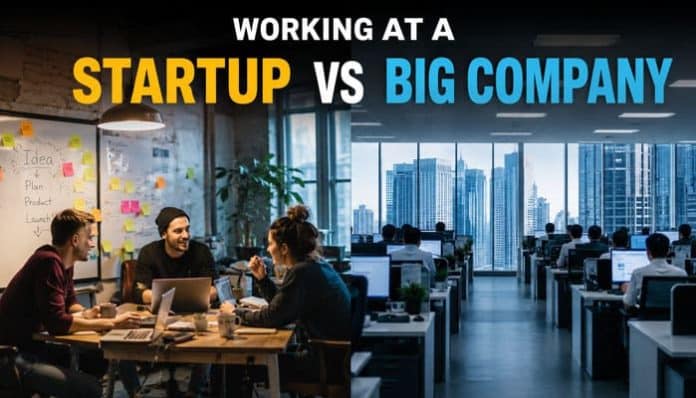

Choosing between working at a startup vs big company is not simply a decision between excitement and stability. It affects how much you earn, what you learn, how quickly you advance, how much responsibility you receive, and how much career and financial uncertainty you must accept.
A startup may give you broad ownership, rapid decision-making, close access to founders, and potentially valuable equity. However, it may also bring unpredictable funding, changing priorities, limited support, and unclear promotion paths.
A big company may offer stronger benefits, formal training, recognizable experience, established processes, and more predictable compensation. The trade-off may include narrower responsibilities, slower decisions, organizational politics, and less visible individual impact.
Neither environment is automatically better. A well-funded startup with strong customer retention and responsible leadership may be more attractive than a declining division inside a famous corporation. Similarly, an innovative corporate team may provide better mentorship and growth than a chaotic startup.
The right choice depends on the actual company, manager, role, compensation package, business outlook, career stage, and level of uncertainty you can comfortably manage.
Quick Answer
When comparing working at a startup vs big company, choose a startup when you value broad responsibility, autonomy, direct impact, faster learning, and possible equity upside—and you can tolerate changing priorities and greater financial risk.
Choose a big company when you prioritize predictable compensation, comprehensive benefits, formal training, specialized expertise, established resources, and clearer career levels.
The strongest offer is not necessarily the one with the highest salary, most impressive title, or largest equity grant. It is the role that provides the best combination of:
- Sustainable compensation
- Strong management
- Transferable skills
- Meaningful responsibilities
- Career progression
- Reasonable workload
- Business stability
- Long-term opportunity
Key Takeaways
- Startups offer broader roles, faster decisions, and greater visibility.
- Big companies provide stronger benefits, structured career paths, and specialist experience.
- Startup equity is uncertain and should not be treated as guaranteed income.
- Job security depends on the company, business unit, and funding stage.
- Compare total compensation, including salary, benefits, bonuses, equity, and costs.
- Manager quality, financial needs, and risk tolerance should guide your decision.
What Counts as a Startup or Big Company?
There is no universal employee-count definition separating a startup from a big company.
A startup is generally a young, growth-oriented business attempting to develop a repeatable and scalable business model. It may be:
- Bootstrapped by its founders
- Financed through customer revenue
- Backed by angel investors
- Funded by venture capital
- Supported by strategic corporate investors
- Preparing for an acquisition or public offering
Startups range from two founders developing an early product to late-stage private companies with hundreds or thousands of employees.
A big company is generally a mature organization with established products, formal departments, larger teams, multiple management levels, and standardized operating systems. It may be publicly traded or privately held.
For this article:
- Startup primarily refers to an early- or growth-stage company facing meaningful product, financial, or market uncertainty.
- Big company refers to an established organization with formal career levels, institutional resources, and greater operational scale.
These categories can overlap. A late-stage startup may operate like a midsize corporation, while a new product team inside a multinational company may work with considerable independence.
How Startup Stage Changes the Employee Experience

A working at a startup vs big company comparison can be misleading because startups vary widely by funding stage. A four-person pre-seed business offers a very different experience from a late-stage company with hundreds of employees.
Carta reported that the median seed-stage company in its 2025 dataset had four employees, while average headcount was about 45 at Series B and 131 at Series D. Compensation, equity, workload, benefits, and job risk generally change as the business grows.
Employee Experience by Company Stage
| Stage | Work Environment | Compensation | Main Opportunity | Primary Risk |
|---|---|---|---|---|
| Pre-seed | Tiny, founder-led team | Lower cash, potentially more equity | Building from zero | Failure to find product-market fit |
| Seed | Early customers and broad roles | Improving salary with uncertain equity | Fast cross-functional learning | Funding and retention risk |
| Series A | Systems and teams begin forming | Better salary and benefits | Early leadership opportunity | Pressure to scale |
| Series B | Departments and specialists expand | Strong cash with less ownership | Leading a growing function | Aggressive targets |
| Series C+ | Mature teams and larger budgets | Corporate-level cash; private equity | Scaling teams and systems | Valuation and liquidity risk |
| Public company | Formal roles and established systems | Salary, bonuses, benefits, and liquid stock | Deep specialization | Restructuring and stock volatility |
Early-Stage Startups
Pre-seed and seed employees often work directly with founders and influence products, pricing, hiring, customer acquisition, and internal processes.
Key advantages include:
- Broad responsibilities
- Faster learning
- Greater visibility
- Direct decision-making access
- Potentially larger equity ownership
Common disadvantages include:
- Limited runway
- Incomplete benefits
- Frequent strategy changes
- Weak management support
- Uncertain customer demand
An early-stage role should be viewed as an investment of your time and career capital—not simply as a job.
Growth-Stage Startups
Series B and later-stage companies may combine startup opportunity with stronger salaries, benefits, teams, and professional support. This can make working at a startup vs big company a less obvious choice.
However, growth-stage startups may also develop management layers, slower approvals, internal politics, aggressive targets, and frequent reorganizations.
Late-Stage Private Companies
A late-stage startup may appear secure because it has raised significant funding or reached a high valuation. However, a high valuation does not guarantee:
- Profitability
- Liquid employee shares
- An upcoming IPO
- Continued valuation growth
- Protection from layoffs
When evaluating working at a startup vs big company, consider the startup’s funding stage, profitability, cash burn, investor terms, and realistic path to liquidity.
How the 2026 Startup Hiring Environment Affects Employees
The startup job market has shifted since the rapid hiring of 2021 and 2022. AI, automation, selective recruitment, and pressure to control spending are encouraging startups to operate with smaller teams.
Carta reported that venture-backed companies made 26,030 hires in January 2026—the slowest January since 2018. Understanding this change is important when comparing working at a startup vs big company.
What Leaner Startup Teams Mean
Smaller teams can give employees:
- Broader responsibilities
- Greater executive visibility
- Direct customer access
- Faster leadership opportunities
- More influence over important decisions
However, lean staffing may also cause:
- Heavy workloads
- Constant context switching
- Limited mentorship
- Fewer promotion opportunities
- Little backup during leave
- Unrealistic productivity expectations
When evaluating working at a startup vs big company, determine whether the startup is efficiently operated or simply understaffed.
Startup Compensation Is Becoming More Role-Specific
Not every startup pays below-market salaries. Carta found that median individual-contributor salaries increased 6.4% over the two years ending in early 2026, while median initial equity grants rose nearly 11%.
Pay growth was stronger for AI and machine-learning engineers, whose median salaries increased 9.1% and equity grants rose 31% between January 2024 and February 2026.
These figures vary by role, company, and location. Therefore, a working at a startup vs big company decision should compare the actual salary, equity, workload, benefits, and career opportunity—not outdated assumptions about startup pay.
Working at a Startup vs Big Company: Quick Comparison
| Factor | Startup | Big Company |
|---|---|---|
| Salary | Varies by stage and funding | Usually follows salary bands |
| Equity | Private options or shares | Often liquid public-company stock |
| Benefits | May be limited | Usually broader and more reliable |
| Job security | Depends on funding and runway | More stable, but layoffs remain possible |
| Role scope | Broad and flexible | Specialized and clearly defined |
| Decision-making | Faster with fewer approvals | Slower and more structured |
| Career growth | Rapid but less predictable | Clearer but often slower |
| Learning | Cross-functional and practical | Specialized and process-driven |
| Individual impact | Highly visible | Shared across larger teams |
| Best suited for | Adaptable, risk-tolerant generalists | Specialists seeking structure and stability |
Salary: Do Startups or Big Companies Pay More?
There is no universal winner when comparing working at a startup vs big company. Compensation depends on the employer’s size, funding, location, job level, available cash, and demand for your skills.
Startup Salary
A startup may offer:
- Lower cash compensation with more equity
- Market-rate salary with moderate equity
- Premium pay for hard-to-find talent
- Revenue-based bonuses
- Salary increases after a funding round
Early-stage startups often conserve cash by offering more ownership. Well-funded startups may match or exceed corporate salaries for engineers, AI specialists, sales leaders, and other high-demand professionals.
Big-Company Salary
Large companies commonly provide:
- Defined salary bands
- Standardized job levels
- Annual bonuses
- Sign-on or retention payments
- Public-company stock
- Formal compensation reviews
These systems improve predictability but may limit negotiation because managers must remain within approved salary ranges.
Compare Total Compensation
When evaluating working at a startup vs big company, compare the complete package—not only base salary.
| Compensation | Startup | Big Company |
|---|---|---|
| Base salary | $135,000 | $150,000 |
| Cash bonus | $0 | $15,000 |
| Retirement contribution | $2,000 | $7,500 |
| Estimated benefit value | $0 | $4,000 |
| Stated equity value | $35,000 | $25,000 |
| Headline package | $172,000 | $201,500 |
Public-company stock normally has a visible market value and can often be sold after vesting. Private startup equity may appear valuable but remain illiquid or eventually become worthless.
Separate compensation into:
- Predictable compensation: Salary, expected bonuses, retirement contributions, and measurable benefits.
- Speculative compensation: Startup equity after vesting, dilution, exercise costs, taxes, and liquidity risk.
A smart working at a startup vs big company decision should be based primarily on predictable compensation. Treat private equity as possible upside—not money available for rent, debt payments, tuition, or essential expenses.
How to Compare Four-Year Compensation
An annual salary comparison can hide the long-term value of bonuses, benefits, retirement contributions, and equity. When evaluating working at a startup vs big company, compare the amount you are likely to receive over four years.
Four-Year Compensation Formula
Four-year offer value = total base salary over four years + total expected bonuses + total employer retirement contributions + estimated benefit value + vested liquid equity − total employee-paid costs
Employee-paid costs may include:
- Insurance premiums and medical expenses
- Commuting or relocation costs
- Stock-option exercise costs
- Sign-on bonus repayments
Keep private startup equity separate because it may never become liquid.
Four-Year Offer Comparison Worksheet
Use this worksheet when comparing working at a startup vs big company:
| Compensation Element | Startup | Big Company |
|---|---|---|
| Four-year base salary | ||
| Expected cash bonuses | ||
| Retirement contributions | ||
| Estimated benefit value | ||
| Sign-on or relocation payments | ||
| Vested liquid equity | ||
| Private startup equity | Show separately | If applicable |
| Employee-paid costs | ||
| Total predictable value | ||
| Total speculative value |
Use Three Equity Scenarios
| Scenario | Possible Outcome |
|---|---|
| Failure | Equity becomes worth $0 |
| Conservative | A modest exit produces limited value after dilution, costs, and taxes |
| Upside | An acquisition, IPO, or liquidity event creates meaningful value |
Base your decision mainly on predictable compensation and treat private equity as possible upside.
Consider the Vesting Cliff
A common four-year grant includes a one-year cliff:
- Leaving before 12 months may result in no vested equity.
- At 12 months, 25% may vest.
- The remainder may vest monthly or quarterly.
- Promotions and acquisitions do not always accelerate vesting.
A reliable working at a startup vs big company comparison should use the equity likely to vest during your expected employment period—not the full headline grant.
Startup Equity vs Big-Company Equity
Equity is one of the most misunderstood parts of working at a startup vs big company.
A startup may present its equity grant as a major part of the offer. However, the number of options alone tells you very little.
You need to understand:
- Your approximate fully diluted ownership percentage
- The company’s fully diluted share count
- The exercise or strike price
- The latest common-stock valuation
- The latest preferred financing price
- The vesting schedule
- Potential future dilution
- Investor liquidation preferences
- The post-termination exercise period
- Transfer restrictions
- Tax treatment
- The realistic possibility of liquidity
How Startup Stock Options Work
Understanding equity is essential when comparing working at a startup vs big company. A startup stock option gives you the right to purchase company shares at a fixed exercise price after the options vest.
The IRS separates stock options into statutory options, including incentive stock options, and nonstatutory options. Tax treatment can differ at exercise and sale, and incentive stock options may create alternative minimum tax exposure.
Startup Equity Example
Assume you receive:
- 20,000 stock options
- $1 exercise price
- Four-year vesting schedule
- Future sale price of $8 per share
If all options vest and you can sell at $8:
Gross spread = 20,000 × ($8 − $1) = $140,000
However, $140,000 is not guaranteed. The final value may be reduced by:
- Exercise costs
- Taxes
- Dilution
- Partial vesting
- Investor preferences
- Transfer restrictions
- A lower exit price
- No liquidity event
- Company failure
Startup equity may become highly valuable, produce a modest return, or become worth nothing.
Preferred Shares vs Employee Common Shares
Investors often receive preferred shares, while employees usually receive common shares or options to buy common shares.
Preferred shares may include:
- Liquidation preferences
- Anti-dilution protection
- Information or board rights
- Conversion rights
- Participation rights
Therefore, the price investors pay for preferred stock does not necessarily represent the value employees will receive for common shares.
Questions to Ask About Startup Equity
When evaluating working at a startup vs big company, ask:
- How many options or shares will I receive?
- What ownership percentage does the grant represent?
- What is the current exercise price?
- What is the vesting schedule and cliff?
- How long can I exercise after leaving?
- What was the latest common-stock valuation?
- Does the company offer tender sales or other liquidity programs?
- Are refresh grants commonly issued?
- What transfer restrictions apply?
- Can I review the equity plan and grant agreement?
Be cautious when a company refuses to explain ownership percentage, exercise costs, vesting terms, or post-employment treatment.
Rule 701 and Private Shares
Private companies may issue employee securities under SEC Rule 701. These securities are generally restricted and may not be freely traded.
Companies exceeding the applicable $10 million sales threshold during a consecutive 12-month period must provide certain additional financial and risk disclosures.
Even vested shares may remain illiquid until an acquisition, IPO, tender offer, or other approved transaction occurs.
Big-Company Equity
Public companies commonly use restricted stock units. RSUs generally convert into company shares after vesting conditions are satisfied.
Employees can usually view the stock’s market price and sell vested shares, subject to:
- Trading windows
- Insider-trading restrictions
- Tax withholding
- Company policies
- Continued-employment conditions
Public-company stock can still rise or fall. A grant described as worth $100,000 may be worth more or less when it vests.
The key difference in working at a startup vs big company is liquidity. Public-company equity is usually easier to value and sell, while startup equity offers uncertain potential upside.
Benefits: Big Companies Usually Have the Advantage
Benefits can significantly affect the real value of a job offer. Large companies usually provide broader and more structured programs because they have dedicated benefits teams and greater bargaining power.
Common big-company benefits include:
- Medical, dental, and vision insurance
- Retirement contributions
- Life and disability coverage
- Paid parental leave
- Tuition or certification support
- Employee stock purchase plans
- Relocation and commuter assistance
BLS data from March 2025 show that larger employers offered much greater access to life insurance and disability benefits than establishments with fewer than 50 workers.
Startups may instead offer:
- Health insurance
- Flexible schedules
- Remote-work support
- Home-office or wellness allowances
- Equity
- Flexible or unlimited paid time off
Unlimited PTO is not always better. Ask how much leave employees actually take and whether workloads allow them to disconnect.
When comparing offers, include insurance costs, retirement contributions, paid leave, bonuses, commuting, and other expenses. Benefits represented 29.9% of total private-industry compensation costs in December 2025, showing why salary alone does not reflect the full package.
Job Stability: Understanding the Real Risks
Job security is a major factor when comparing working at a startup vs big company.
Startups face risks such as:
- Limited funding and cash flow
- Weak customer demand
- Founder or leadership problems
- Heavy dependence on a few customers
- Strong competition
- Failure to reach product-market fit
Startup risk is often existential—the entire company may run out of cash or close.
Large companies usually have stronger cash reserves, diversified revenue, and multiple products. However, employees may still face:
- Layoffs
- Mergers
- Outsourcing
- Division closures
- Leadership changes
- Automation
- Product discontinuation
Corporate risk is often organizational. The company may remain profitable while eliminating your role, team, or business unit.
What Survival Data Show
BLS data show that 51.5% of private establishments launched in the year ending March 2019 were still operating in March 2024, falling to 46.8% by March 2025.
These figures cover new private businesses generally, not only venture-backed startups, but they highlight why financial health matters when evaluating working at a startup vs big company.
How to Evaluate Startup Runway
Ask:
- How much cash does the company have?
- What is its monthly net burn?
- How many months of runway remain?
- Is the company profitable?
- Are customers renewing?
- When was the latest funding round?
- What milestone is required before the next round?
- Does the runway include planned hiring?
Estimated runway = available cash ÷ monthly net cash burn
Example:
- Available cash: $6 million
- Monthly net burn: $400,000
- Estimated runway: 15 months
Runway may be shorter if hiring increases, revenue declines, debt payments become due, or major expenses have been excluded.
How to Evaluate a Big-Company Role
Do not assume a famous company guarantees job security. Investigate whether:
- The division is growing and profitable
- The product is strategically important
- The team has recently reorganized
- Investment is increasing or declining
- The role is new or replacing someone
- The unit depends on one executive sponsor
A reliable working at a startup vs big company decision should examine both the startup’s financial runway and the corporate business unit’s strategic importance.
Career Growth and Promotions
Career growth differs significantly between startups and large companies.
Startup Career Growth
Startup employees often advance by taking on broader responsibilities rather than receiving formal promotions. A marketing manager, for example, may gradually manage content, partnerships, analytics, customer research, and brand strategy.
This can create:
- Faster learning
- Greater visibility
- Early leadership opportunities
- Broader business experience
However, startups may lack formal job levels, salary bands, promotion criteria, management training, and regular performance reviews. Senior-sounding titles may also represent less responsibility than equivalent roles at large companies.
Big-Company Career Growth
Large companies usually offer:
- Defined career levels
- Formal promotion cycles
- Leadership programs
- Internal job opportunities
- Management and specialist tracks
- Structured performance reviews
These systems make career expectations clearer but can slow advancement. Promotions may depend on budgets, available positions, performance ratings, internal visibility, and scheduled review cycles.
Startups may offer faster responsibility, while big companies generally provide clearer and more predictable career paths.
Learning Opportunities: Breadth vs Depth
A key difference between working at a startup vs big company is the type of learning each environment offers.
Startup Learning
Startup employees usually gain broad, hands-on experience across areas such as customer research, product planning, sales, analytics, pricing, and marketing.
This learning is often:
- Fast and practical
- Cross-functional
- Informal
- Driven by immediate business needs
The downside is limited specialist guidance and more learning through trial and error.
Big-Company Learning
Large companies usually provide deeper specialization through experienced teams, formal processes, advanced tools, and large-scale systems.
Employees may gain expertise in:
- Complex technology
- Global operations
- Compliance and security
- Large datasets
- Established professional standards
Startups are often better for broad business knowledge and future founders, while big companies are stronger for specialization and technical depth. Many successful careers combine both experiences.
Responsibility, Culture, and Work-Life Balance
Responsibility and Autonomy
Startup employees often have greater ownership and can directly influence customer satisfaction, revenue, product adoption, and business growth.
They may:
- Choose tools and create processes
- Test ideas quickly
- Work directly with customers
- Make decisions with limited information
- Own complete outcomes
However, greater autonomy may also mean limited guidance.
At a big company, employees usually work within established budgets, systems, brand standards, and approval processes. Decisions may take longer, but these controls help reduce risk at scale.
Culture and Decision-Making
Startup culture is strongly shaped by the founders. Their approach to communication, ethics, feedback, spending, and working hours can affect the entire company.
Startup decisions are usually faster but may change frequently.
Large-company culture varies by manager, department, and business unit. Decisions often require legal, security, budget, and stakeholder approval, making them slower but more structured.
Work-Life Balance
Work-life balance depends more on leadership, staffing, workload, and team expectations than company size.
Startup pressure often increases during fundraising, product launches, customer implementations, and cash-flow problems. Large-company pressure may rise during reporting periods, audits, major releases, and reorganizations.
Before accepting an offer, ask:
- How often does the team work late or on weekends?
- Are employees expected to respond after hours?
- How is work covered during leave?
- What caused the team’s last period of overtime?
- What happens when workload exceeds capacity?
These questions reveal more than simply asking whether the company offers good work-life balance.
Which Is Better at Each Career Stage?
The best choice between working at a startup vs big company often changes as your experience, financial needs, and career goals develop.
Students and Recent Graduates
A big company may offer:
- Formal training
- Experienced managers
- Clear expectations
- Structured feedback
- A large peer network
A startup may be suitable when it provides real responsibility, regular mentorship, and enough resources to support junior employees. Avoid choosing a role only because it offers a senior-sounding title.
Early-Career Professionals
Startups can provide broad experience and help you discover strengths across several functions. Large companies can build specialist skills, professional standards, and recognizable experience.
At this stage, manager quality may matter more than a small salary difference when comparing working at a startup vs big company.
Mid-Career Professionals
A startup may allow you to build a department, influence strategy, hire a team, and earn meaningful equity.
A big company may provide:
- Higher predictable compensation
- Larger budgets
- Internal mobility
- Global experience
- Greater financial stability
Consider savings, debt, healthcare needs, and family responsibilities before accepting additional risk.
Senior Leaders
Startup executives often work without large support teams. They may need to hire employees, interview customers, negotiate contracts, create processes, and present directly to investors.
Senior professionals evaluating working at a startup vs big company should decide whether they enjoy building systems from the beginning or managing established teams and resources.
Which Is Better at Each Career Stage?
The best choice between working at a startup vs big company often changes as your experience, financial needs, and career goals develop.
Students and Recent Graduates
A big company may offer:
- Formal training
- Experienced managers
- Clear expectations
- Structured feedback
- A large peer network
A startup may be suitable when it provides real responsibility, regular mentorship, and enough resources to support junior employees. Avoid choosing a role only because it offers a senior-sounding title.
Early-Career Professionals
Startups can provide broad experience and help you discover strengths across several functions. Large companies can build specialist skills, professional standards, and recognizable experience.
At this stage, manager quality may matter more than a small salary difference when comparing working at a startup vs big company.
Mid-Career Professionals
A startup may allow you to build a department, influence strategy, hire a team, and earn meaningful equity.
A big company may provide:
- Higher predictable compensation
- Larger budgets
- Internal mobility
- Global experience
- Greater financial stability
Consider savings, debt, healthcare needs, and family responsibilities before accepting additional risk.
Senior Leaders
Startup executives often work without large support teams. They may need to hire employees, interview customers, negotiate contracts, create processes, and present directly to investors.
Senior professionals evaluating working at a startup vs big company should decide whether they enjoy building systems from the beginning or managing established teams and resources.
How to Evaluate a Startup Offer
1. Research the Founders
Review their industry experience, reputation, previous companies, hiring record, and relationships with customers and investors. Strong founders should answer difficult questions clearly.
2. Understand the Business
Ask:
- What problem does the company solve?
- Who pays for the product?
- Why do customers choose it?
- What evidence supports product-market fit?
3. Check Customer Traction
Look for:
- Revenue growth
- Customer retention
- Renewal rates
- Usage growth
- Customer references
- Expansion revenue
Rapid customer growth without strong retention may not be sustainable.
4. Assess Funding and Runway
Confirm the company’s:
- Funding stage
- Latest financing date
- Monthly cash burn
- Remaining runway
- Planned hiring
- Progress toward profitability
5. Clarify the Role
Ask what success should look like after 30 days, 90 days, six months, and one year. Confirm your responsibilities, decision-making authority, and available support.
6. Review the Equity
Request both the number of options and the approximate ownership percentage. Check the exercise price, vesting schedule, dilution risk, exercise deadline, and possible liquidity.
7. Examine the Employment Terms
Review:
- Intellectual-property clauses
- Bonus or commission rules
- Severance
- Equity treatment
- Leave policies
- Remote-work expectations
- Repayment obligations
- Restrictive covenants
Seek professional advice when the financial or legal consequences are significant.
How to Evaluate a Big-Company Offer
When comparing working at a startup vs big company, evaluate the actual role, business unit, and manager—not only the employer’s brand.
1. Confirm the Job Level
Ask:
- What is the internal level?
- What are the expectations?
- What is the next promotion level?
- How long do employees usually remain at this level?
The same public title can represent very different responsibilities across companies.
2. Review Total Compensation
Confirm:
- Base salary
- Target and historical bonuses
- Sign-on payments
- Equity and vesting
- Refresh grants
- Retirement contributions
- Benefits and relocation support
- Repayment or clawback terms
A complete working at a startup vs big company comparison should include the entire compensation package.
3. Research the Business Unit
Determine whether the unit is growing, profitable, and strategically important. Ask about recent leadership changes, reorganizations, and why the position is open.
4. Check Internal Mobility
Ask whether employees can move across teams, functions, locations, countries, or management and specialist tracks. Request recent examples.
5. Evaluate the Manager
Your manager can influence workload, feedback, visibility, promotion, and access to important projects.
Ask how the manager:
- Defines success
- Gives feedback
- Handles mistakes
- Supports promotions
- Responds to disagreement
In a working at a startup vs big company decision, manager quality and business-unit health may matter more than the corporate name.
Employment Agreements, Intellectual Property, and Side Projects
Employment terms can be as important as salary. Agreements may cover:
- Confidentiality
- Intellectual-property ownership
- Invention assignment
- Noncompete and non-solicitation clauses
- Freelance work and side projects
- Open-source contributions
- Repayment obligations
- Arbitration
Startup Agreements
Startups may use broad intellectual-property clauses because their value often depends on technology, data, designs, or proprietary processes.
Before joining, document any existing websites, software, content, businesses, or inventions. Confirm in writing whether you can continue activities such as:
- Publishing articles
- Maintaining a website
- Developing unrelated software
- Consulting or teaching
- Running a side business
- Contributing to open-source projects
Big-Company Policies
Large employers may require approval for consulting, public speaking, investments, board roles, open-source work, AI tools, and other outside activities.
Noncompete Clauses
The FTC’s nationwide Noncompete Rule is not enforceable. Whether an individual noncompete applies depends on state law, contract language, and the specific circumstances.
Seek legal advice when an agreement could restrict your ability to join a competitor, start a business, contact customers, or work in your industry.
What Happens If You Leave or Are Laid Off?

Employment terms become especially important when a job ends. Review severance, health coverage, bonuses, equity, accrued leave, and repayment obligations before accepting an offer.
Employment-Exit Comparison
| Exit Issue | Startup | Big Company |
|---|---|---|
| Severance | May be limited or negotiated | More likely to follow a formal policy |
| Advance notice | Often limited | May follow company policy or applicable law |
| Health coverage | Federal COBRA may not apply | COBRA is more likely to apply |
| Unvested equity | Usually forfeited | Usually forfeited |
| Vested options | May require quick exercise | Depends on the equity plan |
| Bonus | Depends on cash and plan terms | Usually governed by written rules |
| Outplacement | Uncommon | More common during major layoffs |
Health Coverage and Layoff Notice
Federal COBRA generally applies to employers with at least 20 employees and may allow temporary continuation of health coverage, although employees can pay up to 102% of the full premium.
The federal WARN Act may require 60 days’ notice for certain large layoffs at covered employers, but many small startups fall outside its scope.
Protect Your Startup Equity
Before leaving, confirm:
- Which options or shares are vested
- The post-employment exercise deadline
- Exercise costs and potential taxes
- Whether unvested awards are cancelled
- Whether former employees can join liquidity events
- Any transfer restrictions
Personal Exit Checklist
Keep a record of:
- Severance terms
- Bonus-payment dates
- Equity-vesting dates
- Option-exercise deadlines
- Health-coverage end dates
- Repayment obligations
- Accrued-leave policies
- Confidentiality and noncompete terms
Reviewing these details early can prevent costly surprises after resignation or termination.
Warning Signs to Avoid
Startup Warning Signs
Be cautious when:
- Leadership avoids discussing runway or customers.
- Growth claims lack measurable evidence.
- Responsibilities are unclear or combine several jobs.
- Long hours are treated as a sign of loyalty.
- Equity terms are not explained clearly.
- Strategy differs depending on whom you ask.
- The company relies heavily on one customer.
- Executive turnover is frequent.
- Senior titles replace fair pay or real authority.
- Leaders dismiss legal, security, or ethical concerns.
- Employees are blamed for leadership failures.
Big-Company Warning Signs
Be cautious when:
- The role has been repeatedly reorganized.
- Performance and promotion criteria are unclear.
- Team turnover is high.
- The position has responsibility but little authority.
- The business unit is losing strategic importance.
- Interviewers describe constant internal conflict.
- Bonus targets are rarely achieved.
- The public title is stronger than the internal level.
- The actual manager is hidden during hiring.
- Employees are expected to remain constantly available.
- The team depends on one senior executive’s support.
Who Should Work at a Startup?
A startup may suit you when:
- You enjoy building systems from zero.
- You can decide with incomplete information.
- You are comfortable with changing priorities.
- You want direct business impact.
- You prefer broad responsibility.
- You can tolerate financial uncertainty.
- You have an adequate emergency fund.
- You understand equity risk.
- You enjoy working closely with founders.
- You do not need every process to be established.
Who Should Work at a Big Company?
A big company may suit you when:
- You prefer defined responsibilities.
- You value structured training.
- You need comprehensive benefits.
- You want predictable compensation.
- You want to develop specialist expertise.
- You enjoy working with large-scale systems.
- You value formal internal mobility.
- You want a recognizable employer brand.
- You prefer established resources.
- You have limited tolerance for business-failure risk.
Personal Financial Readiness Test
Before accepting a startup offer, ask yourself:
- Do I have three to six months of essential expenses saved?
- Could I manage a temporary period without income?
- Does my household depend on my health insurance?
- Do I have high-interest debt?
- Am I preparing for a major purchase?
- Would worthless equity damage my financial plan?
- Could I afford the stock-option exercise cost?
- Can I accept a smaller retirement contribution?
- Does my family understand the risk?
- Could I obtain another suitable job quickly?
You do not need to be wealthy to join a startup. However, your personal financial position should influence the amount of uncertainty you accept.
Moving Between a Startup and Big Company
Choosing one environment does not permanently limit your career.
Moving From a Big Company to a Startup
Show that you can:
- Work without large support teams
- Make decisions with limited information
- Build processes from scratch
- Perform hands-on work
- Adapt to changing responsibilities
- Prioritize with limited resources
Use examples of direct execution rather than coordination alone.
Moving From a Startup to a Big Company
Show that you can:
- Follow formal systems
- Document decisions
- Manage stakeholders
- Handle risk and compliance
- Build repeatable processes
- Measure results consistently
Because startup titles can be unclear, explain your actual scope, including team size, budget, customers, revenue impact, and decision authority.
Career-Sequence Strategies
| Career Goal | Suggested Path |
|---|---|
| Learn formal standards, then build independently | Big company, then startup |
| Gain broad skills, then specialize | Startup, then big company |
| Become a founder | Startup and industry experience |
| Become a specialist | Big company or mature scale-up |
| Pursue equity upside | Carefully selected startup |
| Maximize predictable pay | Profitable large or mature company |
The best path depends on the skills and experience your career currently lacks.
Common Mistakes When Choosing
- Treating startup equity as guaranteed income
- Comparing job titles instead of actual responsibilities
- Ignoring the startup’s funding stage and runway
- Assuming a big company offers complete job security
- Choosing a famous brand over a good manager
- Confusing constant chaos with valuable learning
- Comparing salaries without including benefits and expenses
- Failing to review severance, equity, and repayment terms
- Choosing a role only for a higher short-term salary
- Accepting weak management for promised career growth
- Ignoring workload and work-life balance
- Relying on optimistic company valuations or future funding
Decision Scorecard
Score each offer from 1 to 5.
| Decision Factor | Importance Weight | Startup Score | Big-Company Score |
|---|---|---|---|
| Guaranteed cash compensation | 5 | ||
| Benefits | 4 | ||
| Job stability | 5 | ||
| Manager quality | 5 | ||
| Learning potential | 5 | ||
| Autonomy | 4 | ||
| Promotion potential | 4 | ||
| Work-life balance | 5 | ||
| Mission interest | 3 | ||
| Resume value | 3 | ||
| Network quality | 3 | ||
| Equity upside | 2 | ||
| Location and flexibility | 4 |
Multiply each score by its importance weight.
Example:
- Importance weight: 5
- Offer score: 4
- Weighted score: 20
Use a low or moderate weight for speculative equity. Giving private equity the same importance as guaranteed salary can distort the decision.
Final Thoughts: Startup or Big Company?
The choice between working at a startup vs big company depends on your career goals, financial needs, and tolerance for risk.
A startup may be better when you want:
- Broad responsibilities
- Faster learning
- Direct impact
- Greater autonomy
- Potential equity upside
A big company may be better when you want:
- Reliable benefits
- Predictable compensation
- Formal career paths
- Expert mentorship
- Large-scale experience
Do not choose based only on startup excitement or corporate brand recognition. Evaluate the manager, role, compensation, workload, company health, and learning opportunity.
The best choice is the employer that supports your long-term growth while meeting your current financial and personal needs.
Working At A Startup Vs Big Company FAQs
1. Is Working at a Startup vs Big Company Better for Career Growth?
Working at a startup vs big company offers different growth paths. Startups may provide faster responsibility and broader experience, while big companies usually offer structured promotions, specialist training, and clearer career levels.
2. Which Pays More: A Startup or a Big Company?
Pay depends on the role, funding stage, location, and experience level. Startups may offer lower cash with more equity, while large companies often provide higher bonuses, retirement contributions, and more predictable stock compensation.
3. Is Working at a Startup vs Big Company More Risky?
A startup usually carries greater funding and business-failure risk. A large company may be more financially stable, but employees can still face layoffs, reorganizations, outsourcing, or product closures.
4. Should I Choose Startup Equity Over a Higher Salary?
Choose equity only when the cash salary still covers your financial needs. Startup shares may become valuable, remain illiquid for years, or become worthless, so they should not be treated as guaranteed income.
5. Which Environment Offers Better Work-Life Balance?
When comparing working at a startup vs big company, work-life balance depends mainly on leadership, staffing, deadlines, and team culture. Startups may involve changing workloads, while large companies may create pressure through meetings, reporting cycles, and reorganizations.
6. Is a Startup or Big Company Better for Recent Graduates?
A big company may offer stronger training, mentorship, and clear expectations. A startup can be valuable when the role is well defined, the manager supports junior employees, and the company has sufficient resources.
7. How Does Working at a Startup vs Big Company Affect Your Resume?
A large employer provides recognizable brand experience, while a startup can demonstrate ownership, adaptability, and measurable impact. Recruiters usually care most about the skills developed and results achieved.
8. What Should I Compare Before Accepting an Offer?
Before deciding on working at a startup vs big company, compare salary, bonuses, benefits, equity, job security, manager quality, workload, promotion opportunities, company health, and employment terms.