

Introduction
In 2026, startups don’t win by hiring bigger teams. They win by building smarter, more efficient systems powered by SaaS. As competition intensifies, choosing the top saas tools for startups has become a critical factor that directly impacts growth, efficiency, and scalability.
The reality is clear. Software is now the backbone of every successful startup, with over 80 percent of businesses relying on cloud-based solutions. This makes selecting the top saas tools for startups not just a technical decision, but a strategic one that determines long-term success.
In today’s competitive environment, choosing the best saas tools for startups and building a strong startup software stack can significantly influence how fast a business grows and scales.
This leads to one important conclusion:
- Choosing the top saas tools for startups is no longer optional
- It is a critical growth decision
The right top saas tools for startups can:
- Automate repetitive workflows and save hundreds of hours
- Replace multiple roles, reducing the need for large teams
- Lower operational and infrastructure costs significantly
- Enable faster product launches and quicker scaling
- Provide real-time data for smarter decision-making
Studies consistently show that SaaS adoption improves operational efficiency, with most organizations reporting better performance after switching to cloud-based tools.
At the same time, the SaaS ecosystem is evolving rapidly. The global SaaS market is now worth hundreds of billions of dollars and continues to grow at a strong pace, driven by AI, automation, and cloud innovation.
For startups, this creates both opportunity and complexity:
- Thousands of tools are available
- New platforms are launched every month
- Choosing the wrong stack can waste time and budget
- Choosing the right stack can accelerate growth significantly
This is why modern startups are not just using tools. They are building strategic SaaS stacks aligned with their stage, goals, and long-term growth plans.
Whether you are:
- A solo founder validating an idea
- A startup building an MVP
- A scaling company optimizing growth
Your success depends on selecting the top saas tools for startups that match your exact needs.
This guide is designed to help you make the right decisions.
Inside this article, you will discover:
- The 25 best SaaS tools for startups in 2026
- How to choose tools based on your startup stage
- Complete SaaS stack architecture used by modern startups
- Cost breakdowns and budgeting strategies
- Real-world SaaS stack examples
- Latest SaaS trends shaping the future
By the end, you will have a clear, actionable blueprint to build a powerful SaaS stack that helps you scale faster, smarter, and more efficiently using the right tools for scaling startups.
What Are SaaS Tools for Startups
SaaS tools for startups are cloud-based software solutions delivered over the internet that allow businesses to operate, manage, and scale without building complex systems from scratch.
Instead of investing time and resources into development, startups can access ready-to-use platforms through a subscription model. This enables faster execution, lower upfront costs, and greater flexibility.
In today’s competitive digital landscape, the top saas tools for startups act as the operational backbone of modern businesses. They empower founders to launch faster, operate leaner, and compete globally from day one.
These tools support every critical business function:
- Manage projects and workflows efficiently
- Communicate and collaborate with teams in real time
- Acquire, engage, and retain customers
- Track finances, payments, and cash flow
- Automate repetitive tasks and business processes
What makes SaaS tools especially powerful for startups is their flexibility and scalability, especially when integrated into a well-structured startup tech stack.
They are:
- Cloud-based and accessible from anywhere
- Easy to integrate with other tools
- Continuously updated without manual effort
- Scalable as your startup grows
Unlike traditional software, SaaS tools eliminate the need for:
- Heavy upfront investment
- Ongoing maintenance and infrastructure
- Long development cycles
This allows founders to focus on high-impact priorities:
- Validating ideas
- Building products
- Acquiring customers
- Scaling revenue
Many of these platforms are also highly effective saas tools for small businesses, making them versatile across different stages of growth.
In simple terms, SaaS tools act as the operational engine of a startup, enabling small teams to achieve results that previously required large organizations.
In 2026, SaaS is not just a convenience. It is a core growth strategy. Startups that leverage the right tools gain a clear competitive advantage by moving faster, reducing costs, and making smarter, data-driven decisions.
How to Choose the Top SaaS Tools for Startups
Choosing the top saas tools for startups is not just about features. It is about selecting the right combination of tools that align with your startup’s stage, goals, and long-term growth strategy.
A well-planned approach to selecting the best saas tools for startups helps you build a strong startup software stack that supports efficiency, scalability, and long-term success.
A well-structured SaaS stack can significantly improve efficiency, reduce operational costs, and accelerate scaling. On the other hand, choosing the wrong tools can create unnecessary complexity, slow down workflows, and increase expenses.
To build a powerful and scalable SaaS stack, focus on the following key factors:
1. Scalability
Your tools should grow with your business and support long-term expansion.
- Choose platforms that support increasing users, data, and workflows
- Avoid tools that require migration as you scale
- Look for flexible pricing and upgrade options
Scalable tools are essential when selecting the top saas tools for startups, as they ensure long-term efficiency and reduce migration costs.
2. Integration
Your SaaS tools should work together seamlessly within your startup tech stack.
- Choose tools with strong native integrations
- Use APIs or automation platforms like Zapier to connect systems
- Avoid tools that create data silos
Strong integration improves workflow efficiency and transforms individual tools into a connected system.
3. Ease of Use
Simple tools drive faster adoption and higher productivity.
- Choose platforms with intuitive and user-friendly interfaces
- Avoid tools that require extensive onboarding or training
- Ensure your team can use tools effectively from day one
Easy-to-use platforms are a key part of the top saas tools for startups, especially for small teams and early-stage founders.
4. Pricing and Cost Efficiency
Managing costs is critical when building a scalable SaaS stack.
- Start with free or affordable plans
- Upgrade only when your needs grow
- Avoid paying for unused features
Many of the top saas tools for startups also work well as saas tools for small businesses, offering flexible pricing for different growth stages.
5. AI Capabilities
AI is a major driver of efficiency in modern SaaS platforms.
- Choose tools with built-in AI features
- Use AI for automation, analytics, and content creation
- Prioritize tools that improve productivity through intelligent workflows
AI-powered platforms are becoming essential tools for scaling startups in 2026 and beyond.
6. Reliability and Support
Reliable tools ensure uninterrupted operations and consistent performance.
- Choose platforms with high uptime and performance
- Check the availability of customer support
- Look for tools with regular updates and improvements
Reliable tools reduce downtime and strengthen your overall SaaS ecosystem.
7. Security and Compliance
Protecting data is a critical part of your SaaS strategy.
- Choose tools that follow industry security standards
- Look for features like encryption and access control
- Ensure compliance with relevant regulations if required
Strong security is essential when selecting the top saas tools for startups, especially when handling sensitive data.
8. Customization and Flexibility
Every startup operates differently, so flexibility is key.
- Choose tools that allow workflow customization
- Look for features that adapt to your processes
- Avoid rigid tools that limit growth
Flexible tools help you build a scalable startup software stack that evolves with your business.
Top SaaS Tools for Startups (2026 List)
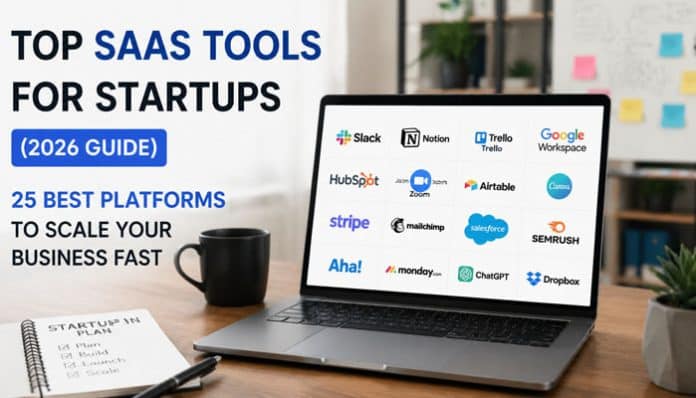
Choosing the top saas tools for startups is essential for building a scalable, efficient, and growth-focused business. In 2026, startups rely on a combination of tools across multiple functions to streamline operations, improve productivity, and accelerate growth.
The best approach is not to use more tools—but to use the right SaaS tools for startups that integrate well and align with your business goals.
Below are the best SaaS tools for startups, categorized by function to help you build a powerful and well-balanced SaaS stack.
Quick Comparison of Top SaaS Tools for Startups
| Category | Tools | Best For |
|---|---|---|
| Productivity | Notion, ClickUp, Trello, Asana | Task & project management |
| Communication | Slack, Zoom, Loom, Microsoft Teams | Team collaboration |
| CRM & Sales | HubSpot, Salesforce, Pipedrive, Zoho CRM | Lead & sales management |
| Marketing | Ahrefs, SEMrush, Mailchimp, Canva | Growth & visibility |
| AI Tools | ChatGPT, Jasper, Copy.ai, Claude | Automation & content |
| Finance | Stripe, QuickBooks, Xero | Payments & accounting |
| Development | GitHub, Figma, Linear | Product building |
| Automation | Zapier, Make | Workflow automation |
| Support | Zendesk, Intercom, Freshdesk | Customer experience |
This table helps you quickly identify the top saas tools for startups based on your needs.
Productivity and Project Management Tools
These are some of the top saas tools for startups for managing tasks, workflows, and team collaboration.
- Notion
- ClickUp
- Trello
- Asana
These tools help startups:
- Organize tasks and workflows
- Manage projects efficiently
- Improve team collaboration
- Track progress in real time
Strong project management tools ensure clarity, accountability, and faster execution.
Communication and Collaboration Tools
Effective communication is essential, especially for remote and distributed teams.
- Slack
- Zoom
- Loom
- Microsoft Teams
These tools help startups:
- Communicate in real time
- Conduct virtual meetings
- Share updates asynchronously
- Reduce communication gaps
Better communication leads to faster decisions and higher productivity.
CRM and Sales Tools
CRM platforms are among the most critical top saas tools for startups for managing customer relationships and driving revenue.
- HubSpot
- Salesforce
- Pipedrive
- Zoho CRM
These tools help startups:
- Manage leads and sales pipelines
- Track customer interactions
- Automate sales processes
- Improve conversion rates
A strong CRM system directly impacts revenue growth.
Marketing and SEO Tools
Marketing tools are essential for acquiring users and scaling visibility, and teams that lean heavily on outbound email often pair them with a sender-reputation service like Warmy so their campaigns actually land in the inbox.
- Ahrefs
- SEMrush
- Mailchimp
- Canva
These tools help startups:
- Perform keyword research and SEO optimization
- Run marketing campaigns
- Design visual content
- Build email marketing funnels
Marketing tools drive consistent growth and brand visibility.
AI Tools for Startups
AI-powered platforms are now core components of the top saas tools for startups in 2026.
- ChatGPT
- Jasper
- Copy.ai
- Claude
These tools help startups:
- Generate content quickly
- Automate repetitive tasks
- Improve customer interactions
- Enhance productivity across teams
AI tools provide a major competitive advantage.
Finance and Payment Tools
Efficient financial management is critical for startup sustainability.
- Stripe
- QuickBooks
- Xero
These tools help startups:
- Process payments securely
- Manage accounting and expenses
- Track cash flow
- Generate financial reports
Financial tools ensure stability and informed decision-making.
Development and Product Tools
These tools are essential for building, launching, and improving your product.
- GitHub
- Figma
- Linear
These tools help startups:
- Manage code and development workflows
- Design user interfaces and experiences
- Track bugs and product issues
- Collaborate across product teams
Strong product tools improve development speed and product quality.
Automation Tools
Automation is a key pillar of the top saas tools for startups, enabling efficiency without increasing team size.
- Zapier
- Make
These tools help startups:
- Automate workflows across multiple apps
- Reduce repetitive manual tasks
- Save time and operational effort
- Improve overall efficiency
Automation allows startups to scale faster with fewer resources.
Customer Support Tools
Customer support tools are essential for retention, satisfaction, and long-term growth.
- Zendesk
- Intercom
- Freshdesk
These tools help startups:
- Manage customer queries efficiently
- Provide real-time support
- Improve customer satisfaction
- Build strong customer relationships
Great support tools increase retention and brand loyalty.
SaaS Tools by Startup Stage
Choosing the top saas tools for startups depends heavily on your startup stage. The tools you use at the idea stage are very different from those needed during growth.
Using the right tools at the right time helps you:
- Reduce unnecessary costs
- Avoid complexity
- Scale more efficiently
- Improve productivity
Each stage of a startup requires a different SaaS stack based on goals, team size, and operational needs.
Quick Overview of SaaS Tools by Stage
| Startup Stage | Focus | Recommended Tools |
|---|---|---|
| Idea Stage | Validation & planning | Notion, Canva, ChatGPT, Google Workspace |
| MVP Stage | Build & launch | Stripe, Webflow/Framer, Zapier, PostHog |
| Growth Stage | Scale & optimize | HubSpot, Slack, Ahrefs, Intercom |
This breakdown helps you choose the top saas tools for startups based on your current stage.
Idea Stage
At the idea stage, your focus is validation, research, and planning. You do not need complex tools—only simple and flexible platforms that help you organize and test your ideas quickly.
Recommended Tools
- Notion
- Canva
- ChatGPT
- Google Workspace
These Tools Help You
- Organize ideas and create documentation
- Design basic visuals and presentations
- Conduct research and generate content
- Collaborate and manage files
Goal
- Validate your idea and build a strong foundation
At this stage, simplicity, speed, and low cost matter more than advanced features.
MVP Stage
At the MVP stage, your goal is to build, launch, and test your product as quickly as possible. Speed and feedback are critical.
Recommended Tools
- Stripe
- Webflow or Framer
- Zapier
- PostHog
These Tools Help You
- Accept payments and validate market demand
- Build and launch websites or landing pages
- Automate workflows between tools
- Track user behavior and product analytics
Goal
- Launch quickly and achieve product-market fit
Focus on speed, experimentation, and real user feedback.
Growth Stage
At the growth stage, your focus shifts to scaling operations, optimizing performance, and increasing revenue. You need more advanced tools that support automation and team collaboration.
Recommended Tools
- HubSpot
- Slack
- Ahrefs
- Intercom
These Tools Help You
- Manage customer relationships and sales pipelines
- Improve team communication and collaboration
- Scale marketing and SEO strategies
- Provide customer support and engagement
Goal
- Automate workflows and scale revenue efficiently
At this stage, integration, automation, and scalability become essential.
Complete SaaS Stack Architecture
To effectively use the top saas tools for startups, it is essential to understand how a complete SaaS stack is structured. A well-designed stack is not just a collection of tools—it is a system of interconnected layers that work together to build, run, and scale your startup efficiently.
Modern startups rely on a layered architecture where each component serves a specific function. This structure ensures scalability, flexibility, and seamless integration across the entire system.
Quick Overview of SaaS Stack Layers
| Layer | Purpose | Common Tools |
|---|---|---|
| Frontend | User interface | React, Next.js |
| Backend | Business logic | Node.js, Python |
| Database | Data storage | PostgreSQL |
| Authentication | User access control | Clerk |
| Payments | Transactions | Stripe |
| Analytics | Data insights | PostHog |
This architecture helps you choose the top saas tools for startups more strategically.
Frontend Layer
The frontend is the user-facing part of your product where customers interact with your application.
Common Technologies
- React
- Next.js
Key Benefits
- Creates fast and responsive user interfaces
- Improves user experience and engagement
- Supports modern web application development
A strong frontend ensures better user experience and higher retention.
Backend Layer
The backend handles business logic, workflows, and server-side operations.
Common Technologies
- Node.js
- Python
Key Benefits
- Manages application logic and processes
- Handles integrations and data processing
- Ensures performance and scalability
A reliable backend powers your entire application.
Database Layer
This layer stores and manages all your application data.
Common Technology
- PostgreSQL
Key Benefits
- Securely stores structured data
- Supports scaling as data grows
- Enables fast and efficient data retrieval
A well-structured database is critical for performance and reliability.
Authentication Layer
Authentication ensures secure access to your platform.
Common Tool
- Clerk
Key Benefits
- Manages user login and access control
- Enhances security and trust
- Simplifies authentication setup
Strong authentication protects users and builds credibility.
Payments Layer
This layer handles transactions and revenue generation.
Common Tool
- Stripe
Key Benefits
- Enables secure online payments
- Supports subscriptions and billing models
- Simplifies global transactions
A robust payment system is essential for monetization.
Analytics Layer
Analytics tools help you understand user behavior and improve your product.
Common Tool
- PostHog
Key Benefits
- Tracks user activity and engagement
- Provides actionable insights
- Helps optimize product and growth strategies
Data-driven decisions lead to faster and smarter growth.
Why SaaS Stack Architecture Matters
Understanding this architecture helps startups:
- Choose the top saas tools for startups more effectively
- Build scalable and efficient systems
- Avoid unnecessary complexity and tool overlap
- Improve performance, security, and integration
SaaS Tools vs SaaS Tech Stack
When selecting the top saas tools for startups, it is essential to understand the difference between SaaS tools and a SaaS tech stack. Many founders confuse these concepts, but they serve completely different roles in building and running a startup.
Understanding this distinction helps you make smarter decisions about both operations and product development.
Quick Comparison: SaaS Tools vs SaaS Tech Stack
| Feature | SaaS Tools | SaaS Tech Stack |
|---|---|---|
| Purpose | Run business operations | Build the product |
| Usage | Day-to-day activities | Development and infrastructure |
| Technical Skills | No coding required | Requires developers |
| Setup | Ready-to-use | Needs configuration and coding |
| Examples | Slack, HubSpot, Notion | React, Node.js, PostgreSQL |
This comparison makes it easier to choose the top saas tools for startups while building the right tech foundation.
SaaS Tools
SaaS tools are cloud-based platforms used to run and manage your business operations efficiently.
Key Characteristics
- Used for daily business activities
- No coding or technical expertise required
- Ready-to-use and accessible via the cloud
- Easy to integrate with other tools
Examples
- Slack for communication
- HubSpot for CRM and marketing
- Notion for project management
SaaS tools help startups operate faster, reduce manual work, and avoid building internal systems.
SaaS Tech Stack
A SaaS tech stack refers to the technologies used to build your product or application.
Key Characteristics
- Used for product development and infrastructure
- Requires developers and technical expertise
- Includes frameworks, programming languages, and databases
- Supports scalability and performance
Examples
- React for frontend development
- Node.js for backend systems
- PostgreSQL for database management
The tech stack defines how your product is built, maintained, and scaled.
Why This Difference Matters
Understanding the difference between SaaS tools and a tech stack helps startups:
- Choose the top saas tools for startups for business operations
- Build the right technical foundation for product development
- Avoid confusion between tools and technologies
- Make better strategic and investment decisions
In simple terms, SaaS tools run your business, while the tech stack builds your product.
SaaS Cost Breakdown for Startups
Budgeting is a critical part of choosing the top saas tools for startups. Many startups overspend on tools they do not fully use, which can slow growth and reduce overall efficiency.
Understanding how SaaS costs change at each stage helps you plan smarter, control expenses, and scale your business sustainably.
Quick SaaS Cost Overview by Stage
| Startup Stage | Monthly Cost | Focus | Tool Types |
|---|---|---|---|
| Idea Stage | $0 – $50 | Validation | Basic tools, AI tools |
| MVP Stage | $50 – $300 | Build & launch | Payment, automation, analytics |
| Growth Stage | $300 – $2000 | Scale & optimize | CRM, marketing, support |
This breakdown helps you allocate your budget while selecting the top saas tools for startups.
Idea Stage
At the idea stage, your focus should be on validation and planning. There is no need to invest heavily in tools at this point.
Estimated Monthly Cost
- $0 to $50
Typical Spending Includes
- Basic productivity tools
- Design and documentation tools
- Free AI tools
Keep costs minimal while testing your idea and building a foundation.
MVP Stage
At the MVP stage, your goal is to build and launch your product quickly. This requires investing in tools that support development, automation, and user feedback.
Estimated Monthly Cost
- $50 to $300
Typical Spending Includes
- Website or product-building tools
- Payment processing platforms
- Automation tools
- Analytics tools
Focus only on tools that directly support product launch and validation.
Growth Stage
At the growth stage, your startup begins to scale operations, increase revenue, and expand teams. Your SaaS stack becomes more advanced and integrated.
Estimated Monthly Cost
- $300 to $2000
Typical Spending Includes
- CRM and sales tools
- Marketing automation platforms
- Customer support systems
- Advanced analytics and integration tools
Costs increase, but so do efficiency, automation, and revenue potential.
Cost Optimization Tips for Startups
To maximize ROI from the top saas tools for startups, follow these best practices:
- Start with free or low-cost plans whenever possible
- Upgrade only when your business needs it
- Avoid paying for unused features
- Regularly audit your SaaS subscriptions
- Focus on tools that provide clear value
Smart budgeting ensures long-term sustainability and prevents unnecessary expenses.
Example Startup SaaS Stack
Understanding how successful companies use the top saas tools for startups becomes much easier when you look at real-world examples. These SaaS stack examples show how tools are selected based on team size, budget, and growth stage.
Instead of guessing which tools to use, you can model your stack based on proven startup setups.
Quick Comparison of Startup SaaS Stacks
| Startup Type | Focus | Key Tools |
|---|---|---|
| Solo Founder | Build & validate | Notion, Stripe, Supabase, Vercel |
| Funded Startup | Scale & optimize | HubSpot, Salesforce, AWS, Slack |
This comparison helps you choose the top saas tools for startups based on your current situation.
Solo Founder SaaS Stack
A solo founder needs simple, cost-effective, and flexible tools to build and launch quickly without relying on a large team.
Recommended Stack
- Notion for project management and documentation
- Stripe for handling payments and subscriptions
- Supabase for backend and database management
- Vercel for hosting and deployment
Why This Works
- Minimal cost and easy setup
- Covers essential business and product needs
- Enables rapid development and testing
- Reduces dependency on large teams
Goal
- Build, launch, and validate quickly with minimal resources
This setup is ideal for early-stage founders who want to move fast and stay lean.
Funded Startup SaaS Stack
Funded startups require more advanced and scalable tools to manage teams, optimize operations, and drive revenue growth.
Recommended Stack
- HubSpot for CRM and marketing automation
- Salesforce for advanced sales management
- AWS for infrastructure and scalability
- Slack for team communication
Why This Works
- Supports larger teams and complex workflows
- Enables automation and data-driven decision-making
- Scales efficiently with business growth
- Improves collaboration across departments
Goal
- Optimize operations and scale revenue efficiently
This setup is ideal for startups focused on rapid growth and scaling.
Key Takeaways
The top saas tools for startups vary depending on your stage, team size, and business goals.
The most successful startups:
- Start with a lean and simple stack
- Add tools only when necessary
- Focus on integration and scalability
- Continuously optimize their SaaS stack
Choosing the right stack at the right time can significantly accelerate your startup’s growth.
How to Integrate SaaS Tools
Choosing the top saas tools for startups is only the first step. The real value comes from how effectively these tools work together as a connected system.
Proper SaaS integration ensures smooth workflows, reduces manual work, and improves overall efficiency. Without integration, even the best tools can create silos, slow down processes, and increase operational complexity.
Best Practices for SaaS Integration
To maximize the value of the top saas tools for startups, follow these proven strategies:
- Use automation platforms like Zapier or Make to connect different tools
- Leverage APIs to create custom integrations when needed
- Choose tools with built-in integrations to simplify setup
- Avoid using too many tools that do not connect with each other
A well-integrated SaaS stack reduces friction and improves productivity.
Benefits of Proper Integration
A strong integration strategy delivers measurable advantages:
- Eliminates repetitive manual tasks
- Improves data flow across all tools
- Saves time and operational effort
- Enhances overall team productivity
Integration transforms individual tools into a unified and scalable system.
Security SaaS Tools for Startups
Security is a critical factor when selecting the top saas tools for startups. As startups handle user data, payments, and sensitive information, strong security practices are essential for building trust and ensuring compliance.
Top Security SaaS Tools
- Cloudflare
- Auth0
- Snyk
- Okta
What These Tools Help You Do
- Protect websites and applications from cyber threats
- Manage user authentication and access control
- Identify and fix security vulnerabilities
- Ensure data protection and compliance
Strong security tools protect your business and build credibility with customers and investors.
Quick Comparison of Security Tools
| Tool | Best For | Key Use Case |
|---|---|---|
| Cloudflare | Website security | DDoS protection, CDN |
| Auth0 | Authentication | User login and identity |
| Snyk | Security testing | Vulnerability detection |
| Okta | Identity management | Access control and SSO |
These tools strengthen your SaaS stack and protect critical business operations.
Analytics Tools for Startups
Data plays a vital role in selecting and optimizing the top saas tools for startups. Without analytics, startups cannot measure performance, understand users, or make informed decisions.
Top Analytics Tools
- Google Analytics
- PostHog
- Mixpanel
- Amplitude
What These Tools Help You Do
- Track user behavior and engagement
- Measure product performance
- Identify growth opportunities
- Optimize marketing and conversion strategies
Data-driven startups make faster, smarter, and more profitable decisions.
Quick Comparison of Analytics Tools
| Tool | Best For | Key Use Case |
|---|---|---|
| Google Analytics | Website tracking | Traffic and user insights |
| PostHog | Product analytics | User behavior tracking |
| Mixpanel | Event tracking | Conversion analysis |
| Amplitude | Growth analytics | Product optimization |
Analytics tools turn data into actionable growth strategies.
No-Code and Low-Code SaaS Tools
No-code and low-code platforms are essential components of the top saas tools for startups, especially for founders without technical backgrounds.
These tools allow startups to build, launch, and test products quickly without writing complex code.
Top No-Code and Low-Code Tools
- Webflow
- Bubble
- Glide
- Airtable
What These Tools Help You Do
- Build websites and applications without coding
- Launch products faster and validate ideas quickly
- Reduce development costs
- Create prototypes and MVPs efficiently
These tools empower founders to build and launch quickly without relying heavily on developers.
Quick Comparison of No-Code Tools
| Tool | Best For | Use Case |
|---|---|---|
| Webflow | Website creation | Landing pages and marketing sites |
| Bubble | App development | Full web applications |
| Glide | Mobile apps | Simple mobile solutions |
| Airtable | Data management | Backend workflows |
No-code tools enable faster execution and innovation.
SaaS Trends in 2026
The landscape of the top saas tools for startups is evolving rapidly, driven by innovation, AI advancements, and changing business needs. Startups that stay ahead of these trends gain a strong competitive advantage in speed, efficiency, and scalability.
Key Trends Shaping SaaS in 2026
- AI-first platforms transforming workflows, automation, and decision-making
- SaaS consolidation, where fewer tools offer more powerful features
- Vertical SaaS tools tailored for specific industries and niches
- Growth of micro SaaS solutions solving highly targeted problems
Adopting these trends helps startups build smarter, faster, and more scalable systems.
Quick Trend Overview
| Trend | Impact on Startups |
|---|---|
| AI-first SaaS | Automates workflows and boosts productivity |
| SaaS consolidation | Reduces tool overload and costs |
| Vertical SaaS | Provides industry-specific solutions |
| Micro SaaS | Solves niche problems efficiently |
These trends are shaping the future of the top saas tools for startups.
Why SaaS Tools Are Important
The top saas tools for startups play a critical role in modern business success by enabling lean operations and faster growth.
Key Benefits
- Faster scaling without heavy infrastructure
- Lower operational and hiring costs
- Automation of repetitive tasks
- Better, data-driven decision-making
SaaS tools allow startups to operate efficiently, compete globally, and grow sustainably.
Common Mistakes to Avoid When Choosing SaaS Tools
When selecting the top saas tools for startups, many founders make avoidable mistakes that lead to inefficiency, wasted budget, and slow growth.
Understanding these common issues will help you build a more effective and scalable startup software stack.
1. Using Too Many Tools
Adding too many tools too early can create confusion and unnecessary complexity.
- Managing multiple platforms increases operational difficulty
- Teams struggle to keep workflows organized
- Productivity decreases due to tool overload
Focus on a lean SaaS stack with only essential tools that solve real problems.
2. Ignoring Integrations
Tools that do not work together create serious inefficiencies.
- Lack of integration leads to data silos
- Manual work increases across teams
- Accuracy and workflow speed decrease
Always choose tools that integrate seamlessly within your startup tech stack.
3. Overpaying Early
Spending too much on tools in the early stage can drain your budget.
- Premium plans are often unnecessary in the beginning
- Many startups use only a small percentage of paid features
- Early overspending limits financial flexibility
Start with free or basic plans and upgrade gradually as your needs grow.
4. Choosing Complex Tools
Complex tools can slow down your team and reduce efficiency.
- Require extensive training and onboarding
- Increase friction in daily workflows
- Reduce adoption across teams
Choose simple, user-friendly tools that your team can use easily and effectively.
How to Build the Perfect SaaS Stack
Building the top saas tools for startups stack is a step-by-step process. The goal is to create a system that supports growth, improves efficiency, and avoids unnecessary complexity.
A well-planned approach helps you build a scalable startup software stack that evolves with your business and supports long-term success.
A well-structured SaaS stack allows startups to move faster, reduce costs, and scale sustainably.
Step 1: Start Simple
In the early stage, focus only on essential tools.
- Use only the tools you truly need
- Focus on solving immediate problems
- Avoid adding tools without clear use cases
A simple SaaS stack is easier to manage, more efficient, and cost-effective.
Step 2: Validate Your Idea
Before investing in advanced tools, validate your product or service.
- Use basic tools to test your idea
- Gather feedback from real users
- Focus on achieving product-market fit
Validation ensures you are building something people actually need.
Step 3: Add Automation
Once your workflows are stable, start introducing automation into your startup tech stack.
- Use tools like Zapier or Make to automate processes
- Reduce repetitive manual tasks
- Improve operational efficiency
Automation is one of the most effective ways to scale using the top saas tools for startups.
Step 4: Scale Gradually
As your startup grows, expand your SaaS stack strategically.
- Upgrade tools based on real needs
- Add advanced features only when required
- Continuously optimize your tool stack
Scaling gradually helps you avoid unnecessary costs and maintain a clean, efficient system.
Conclusion:
Choosing the top saas tools for startups is one of the most important decisions in your startup journey. The tools you select will directly impact how efficiently you operate, how quickly you scale, and how effectively you compete in today’s fast-moving digital landscape.
The right top saas tools for startups help you streamline operations, automate repetitive tasks, and reduce unnecessary costs. Instead of relying on large teams or complex systems, startups can build lean, efficient, and scalable businesses from the very beginning.
Building the best saas tools for startups strategy also means creating a strong startup software stack that supports long-term growth, flexibility, and performance.
Beyond efficiency, SaaS tools enable smarter decision-making. With access to real-time data, automation, and integrated workflows, founders can focus more on growth strategies rather than day-to-day operational challenges.
However, success is not about using as many tools as possible. It is about choosing the right tools that solve real problems and align with your startup’s stage and goals. A simple, well-integrated startup tech stack will always outperform a complex and overloaded system.
As your startup grows, your SaaS stack should evolve with it. Start small, validate your needs, and scale your tools gradually based on real requirements. This approach ensures you are always using the most effective tools for scaling startups without wasting resources.
In the end, the top saas tools for startups are more than just software. They become the foundation of your operations and a powerful growth engine that helps you scale faster, smarter, and more efficiently.
FAQs About Top SaaS Tools for Startups
1. What are the top saas tools for startups in 2026?
The top saas tools for startups in 2026 include platforms like Notion, Slack, HubSpot, Stripe, Zapier, and ChatGPT. These tools help startups manage operations, automate workflows, and scale efficiently.
2. How do I choose the top saas tools for startups?
To choose the top saas tools for startups, focus on scalability, ease of use, integrations, pricing, and AI capabilities. The best tools should align with your startup stage and business goals.
3. Are free SaaS tools enough for startups?
Yes, many of the top saas tools for startups offer free plans that are powerful enough for early-stage startups. You can upgrade as your business grows and needs more advanced features.
4. How many SaaS tools should a startup use?
Most startups should begin with 5 to 10 tools. Using too many tools early can create complexity, so focus on essential top saas tools for startups and expand gradually.
5. What is the best SaaS stack for early-stage startups?
The best stack includes top saas tools for startups like Notion for organization, Canva for design, ChatGPT for content, and Google Workspace for collaboration.
6. Why are SaaS tools important for startups?
The top saas tools for startups are important because they reduce costs, automate processes, improve productivity, and allow startups to scale faster without large teams.
7. Can SaaS tools replace employees in startups?
Yes, many top saas tools for startups can automate tasks such as marketing, customer support, and data analysis, reducing the need for large teams in early stages.
8. What are the biggest mistakes when choosing SaaS tools?
Common mistakes include using too many tools, ignoring integrations, overpaying early, and choosing complex platforms. Selecting the right top saas tools for startups helps avoid these issues.
People Also Ask (PAA) – Top SaaS Tools for Startups
1. What are the best SaaS tools for startups in 2026?
The top saas tools for startups in 2026 include Notion, Slack, HubSpot, Stripe, Zapier, and ChatGPT. These tools help startups manage operations, automate workflows, and scale efficiently.
2. Which SaaS tools are essential for early-stage startups?
Essential top saas tools for startups at the early stage include Notion for organization, Canva for design, ChatGPT for content creation, and Google Workspace for collaboration and communication.
3. How do startups build a SaaS tech stack?
Startups build a SaaS tech stack by combining the top saas tools for startups across key areas such as productivity, communication, CRM, marketing, and automation, based on their goals and growth stage.
4. Are SaaS tools necessary for startups?
Yes, the top saas tools for startups are essential because they reduce costs, automate operations, and enable startups to scale faster without relying on large teams or complex infrastructure.
5. What is the difference between SaaS tools and a tech stack?
SaaS tools are used to run business operations, while a tech stack is used to build the product. Understanding this difference helps startups choose the top saas tools for startups while building the right technical foundation.
6. How much do SaaS tools cost for startups?
The cost of the top saas tools for startups typically ranges from 0 to 50 dollars per month at the idea stage, 50 to 300 dollars at the MVP stage, and 300 to 2000 dollars during the growth stage.
7. Can SaaS tools help startups scale faster?
Yes, the top saas tools for startups help automate workflows, improve efficiency, and provide real-time insights, enabling startups to scale faster and operate more effectively.
8. What are the most common SaaS tools used by startups?
Some of the most common top saas tools for startups include Notion, Slack, HubSpot, Stripe, Zapier, Google Analytics, and Canva, as they cover essential business functions.
9. How many SaaS tools should a startup use?
Most startups should begin with 5 to 10 top saas tools for startups that cover essential operations and gradually expand their SaaS stack as their needs grow.
10. What are the biggest mistakes when choosing SaaS tools?
Common mistakes when selecting the top saas tools for startups include using too many tools, ignoring integrations, overpaying early, and choosing complex platforms that reduce team efficiency.