

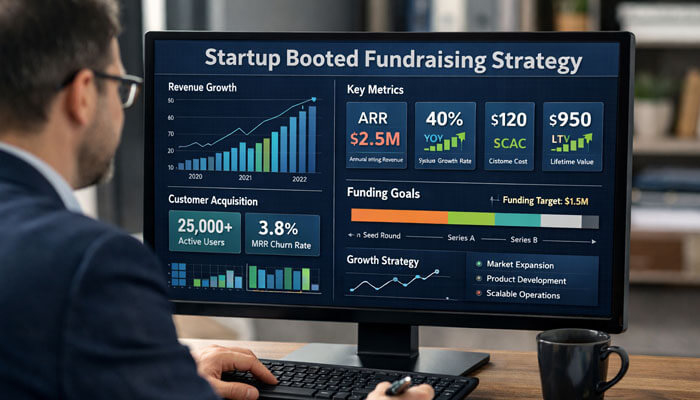
The startup ecosystem in 2026 is shifting away from aggressive venture-capital dependency toward lean, revenue-driven growth. As funding markets become more selective and investor expectations rise, many founders are adopting a startup booted fundraising strategy focused on profitability, capital efficiency, and long-term ownership.
Instead of raising large funding rounds immediately, modern startups increasingly validate demand, monetize early, and scale using customer revenue. AI automation tools, no-code platforms, remote operations, and lower infrastructure costs have made it possible for small teams to build scalable companies without massive upfront investment.
This shift is redefining how startups grow. A startup booted fundraising strategy is no longer viewed as a temporary survival tactic — it is becoming a strategic business model built around sustainability, operational discipline, and founder control.
This guide explains how startup booted fundraising strategy works, why it is growing rapidly in 2026, the advantages and risks involved, proven funding models, key financial metrics, real-world examples, and practical frameworks founders can use to scale sustainably without heavy venture capital dependence.
What Is Bootstrapped Startup Funding?
Bootstrapped startup funding is a business strategy where founders use personal savings, early revenue, reinvested profits, and lean operations to grow a company instead of relying heavily on external investors.
Rather than prioritizing valuations and fundraising rounds, bootstrapped startups focus on:
- Revenue generation
- Profitability
- Operational efficiency
- Sustainable scaling
- Customer retention
- Long-term ownership
The goal is to create a financially healthy business capable of funding its own growth.
Unlike traditional venture-backed startups that often prioritize rapid expansion and market capture, bootstrapped businesses usually grow at a pace supported by actual cash flow.
This model has become increasingly attractive because founders now have access to:
- AI productivity tools
- No-code development platforms
- Global freelance talent
- Affordable cloud infrastructure
- Organic digital marketing channels
- Subscription-based business models
These advantages significantly reduce startup costs and lower the barrier to building scalable businesses.
Why Startup Booted Fundraising Strategy Is Growing Rapidly
Several major shifts in the startup ecosystem are driving founders toward revenue-first growth models.
That shift is pushing more founders toward a different mindset: profitability creates power. A Startup booted fundraising strategy reflects this change by focusing on revenue, control, and long-term resilience rather than depending heavily on external capital.
- Capital is available — but costly in equity
- Investors demand rapid scaling and aggressive targets
- Burn-heavy startups struggle in uncertain markets
Companies like Mailchimp, Basecamp, and Zoho have shown that sustainable, revenue-driven growth can outperform venture-backed hype. Intuit said its Mailchimp acquisition was worth about $12 billion, while Zoho states that it has never taken investor money and remains privately held and profitable. Basecamp has also long positioned itself around bootstrapped, profitable business building.
One major shift in 2026 is that founders increasingly view profitability as leverage rather than waiting for investor validation before building sustainable businesses. Many startups now prioritize operational efficiency, recurring revenue, and customer retention because funding environments have become more competitive and equity dilution is more expensive than in previous years.
As a result, revenue-first startup growth is becoming a core strategy among modern digital businesses.
Recent startup ecosystem trends show that many founders are becoming more cautious about aggressive burn-heavy scaling models. Economic uncertainty, rising acquisition costs, and increased investor scrutiny have pushed startups toward capital-efficient operations and revenue sustainability.
At the same time, AI-powered productivity tools continue reducing startup operating costs, allowing smaller teams to achieve output levels that previously required significantly larger organizations.
The Strategic Shift: Revenue Before Valuation
| Traditional VC Model | Startup Booted Fundraising Strategy |
|---|---|
| Raise first | Earn first |
| Focus on valuation | Focus on margins |
| Scale fast | Scale sustainably |
| Investor-driven | Customer-driven |
| Burn capital | Preserve capital |
In a booted model, revenue is proof — not projections.
Is a Startup Booted Fundraising Strategy Better Than VC Funding?
A Startup booted fundraising strategy is often better for founders who want to retain control, preserve long-term ownership, and grow at a sustainable pace. Venture capital, on the other hand, is usually a better fit for startups that need rapid scaling, large upfront investment, or aggressive market expansion.
The right choice depends on your business model, growth goals, and risk tolerance. Many of the strongest founders use a booted phase to build leverage first, then raise capital only when the economics are already proven.
When Should You Use a Startup Booted Fundraising Strategy?
This strategy works best when:
✔ Your product can launch with low capital
✔ You can monetize early
✔ Your industry is not capital-intensive
✔ You value independence and control
✔ You prioritize sustainable growth
Best Fit Industries:
- SaaS products
- Digital platforms
- Online education
- Consulting + tech hybrids
- Niche marketplaces
Not Ideal For:
- Biotech startups
- Heavy hardware businesses
- Infrastructure-intensive companies
Who Should NOT Use a Startup Booted Fundraising Strategy?
This strategy may not be suitable if:
- Your business requires heavy upfront capital, such as biotech or manufacturing
- You need rapid market capture before competitors establish dominance
- Your product depends on deep R&D investment before commercialization
- Regulatory approvals require large funding early in the business lifecycle
In these cases, waiting for revenue alone may slow down execution too much.
Real Examples of Startup Booted Fundraising Strategy
1. Mailchimp
Mailchimp grew for years without outside investment by focusing on customer needs, recurring revenue, and operational discipline. Its long-term success culminated in Intuit’s roughly $12 billion acquisition, making it one of the strongest examples of bootstrapped scale.
2. Zoho Corporation
Zoho says it has never taken money from investors and describes itself as privately held and profitable. That independence helped it focus on long-term product development rather than short-term shareholder pressure.
3. Basecamp
Basecamp has long aligned itself with the idea of bootstrapped, profitable business building. Its reputation shows that a focused product, a smaller team, and disciplined growth can still create a durable company without VC dependence.
These examples strengthen the article’s authority and show that the model works in real companies, not just theory.
Step-by-Step Startup Booted Fundraising Strategy Framework
Step 1: Validate Demand Before Building
Avoid wasting time and money on untested ideas.
- Build a landing page
- Run pre-orders
- Conduct customer interviews
- Test willingness to pay
Validation reduces risk and protects capital.
Step 2: Monetize Early
Booted startups do not wait for perfection.
Early Revenue Methods:
- Paid beta programs
- Service-based income
- Pilot partnerships
- Subscription pre-sales
Step 3: Build Recurring Revenue
Recurring income creates stability and predictability.
Focus on:
- Subscription models
- Retention strategies
- Upselling and cross-selling
- Membership communities
Retention is cheaper than acquisition.
Step 4: Operate Lean by Design
Efficiency is your competitive advantage.
- Remote-first teams
- Automation tools
- Freelancers and contractors
- Minimal overhead
Step 5: Reinvest With Precision
Reinvest profits into:
- Customer acquisition
- Product improvements
- Systems that increase LTV
Avoid:
- Vanity expenses
- Premature scaling
Many early-stage founders underestimate how much operational simplicity affects long-term survival. In practice, lean teams often move faster, adapt more efficiently, and maintain healthier cash flow compared to heavily staffed startups with large burn rates.
This is one reason why many bootstrapped startups remain profitable while heavily funded competitors struggle with sustainability during uncertain economic cycles.
The 5 Core Pillars of Startup Booted Fundraising Strategy
Although every founder approaches growth differently, most successful booted startups share several common operational principles. These pillars help businesses maintain sustainability, improve capital efficiency, and scale without becoming overly dependent on external funding.
1. Revenue Validation
Successful startups validate real market demand before scaling aggressively. Instead of relying only on projections or investor assumptions, founders focus on generating early customer interest, testing willingness to pay, and building products that solve genuine problems.
2. Capital Efficiency
Booted startups prioritize disciplined spending and carefully evaluate every expense based on measurable business impact. This approach helps preserve cash flow, extend operational runway, and reduce unnecessary financial pressure during early-stage growth.
3. Lean Operations
Smaller teams, automation tools, remote workflows, and streamlined systems allow startups to operate efficiently with lower overhead costs. Lean operations often improve agility, decision-making speed, and long-term sustainability.
4. Recurring Revenue
Predictable recurring revenue creates stronger financial stability and supports sustainable scaling. Subscription models, customer retention strategies, memberships, and long-term client relationships help startups maintain consistent cash flow over time.
5. Strategic Optionality
One of the biggest advantages of a startup booted fundraising strategy is flexibility. Founders maintain greater control over business decisions and can choose whether to remain independent or raise external funding later from a stronger negotiating position.
Startup Booted Fundraising Timeline
- Month 0–2: Idea validation and customer research
- Month 2–4: MVP development and early monetization
- Month 4–8: Build recurring revenue and refine product
- Month 8–18: Scale sustainably using reinvested profits
- 18+ Months: Consider external funding if it meaningfully accelerates a proven model
This timeline helps founders set realistic expectations and avoid rushing into fundraising too early.
Cost Structure in a Startup Booted Fundraising Strategy
A Startup booted fundraising strategy usually keeps costs lean by focusing only on what is essential in the early stage. Instead of spending heavily from the beginning, founders often prioritize tools and activities that directly support product validation, customer acquisition, and revenue generation.
- Product development using MVP tools or no-code platforms
- Basic marketing through SEO, content, and organic channels
- Software subscriptions for analytics, CRM, payments, and email
- Freelancers instead of premature full-time hiring
A practical early-stage cost range is often around $500 to $5,000, depending on the business model, founder skill set, and whether the startup is service-based, no-code, or software-led. This is not a universal rule, but it is a realistic low-cost starting range for many lean digital businesses.
Proven Booted Funding Models
1. Personal Capital Model
Use personal savings or existing income to fund the startup.
✔ Best for: Solo founders testing ideas quickly
2. Revenue-Driven Model
Generate income from day one to fund growth.
✔ Best for: SaaS and service-based startups
3. Hybrid Model
Build the startup while maintaining another income stream.
✔ Best for: Risk-conscious founders
4. Partnership Model
Leverage partnerships for funding, distribution, or growth.
✔ Best for: Founders with strong networks
Tools for Startup Booted Fundraising Strategy
- Analytics: Google Analytics
- Payments: Stripe
- CRM: HubSpot
- Email marketing: Mailchimp
- No-code tools: Webflow, Bubble
These tools help reduce manual work, keep costs lean, and improve execution speed.
Financial Discipline: Your Biggest Advantage
The Startup Booted Fundraising Strategy depends on strong financial control.
Key Practices:
- Track cash flow weekly
- Maintain 3–6 months runway
- Separate personal and business finances
- Forecast conservatively
- Avoid unnecessary debt
Cash clarity prevents business failure.
According to reputable startup-failure reporting, running out of funding and cash flow problems remain among the most common reasons startups collapse, which is exactly why revenue-first strategies matter so much for long-term survival.
Marketing Without Big Budgets
Booted startups rely on organic growth channels:
- SEO and content marketing
- Founder-led branding
- Community building
- Email marketing
- Referral programs
These channels create compounding growth without requiring large ad budgets.
In 2026, organic distribution has become one of the most valuable advantages for bootstrapped startups. Founders who build SEO-driven content, founder-led branding, niche communities, and educational media often reduce customer acquisition costs significantly compared to startups relying entirely on paid advertising.
Hiring Strategy in a Booted Startup
One common mistake many founders make is hiring too aggressively before revenue becomes predictable. In many early-stage startups, operational complexity often grows faster than customer demand, creating avoidable financial pressure.
Hiring too early kills profitability.
Start With:
- Freelancers
- Contractors
- Automation tools
Hire Full-Time Only When:
- Revenue supports it
- ROI is measurable
- The role directly unlocks growth
Startup Booted Fundraising Strategy vs Bootstrapping
While both approaches focus on self-funding, a startup booted fundraising strategy is more structured and revenue-driven. Traditional bootstrapping can sometimes be survival-focused, while booted fundraising emphasizes strategic growth, reinvestment, margin discipline, and stronger negotiating leverage later.
Psychological Reality of Booted Founding
Many bootstrapped founders eventually realize that emotional resilience becomes just as important as technical execution. Without continuous investor validation, consistency and long-term discipline often become major competitive advantages.
Founders often face:
- Slow early growth
- Financial pressure
- Self-doubt
- Decision fatigue
Without investor validation, confidence must come from customers, revenue, and execution discipline.
Pros and Cons of Startup Booted Fundraising Strategy
Advantages:
- Full ownership and control
- No investor pressure
- Sustainable growth
- Strong financial discipline
- Better long-term profitability
Disadvantages:
- Slower scaling
- Limited capital access
- Personal financial risk
- Harder to compete with well-funded startups
Risks of a Startup Booted Fundraising Strategy
Potential Downsides:
- Slower growth
- Limited R&D capacity
- Personal financial exposure
- Competitive pressure from funded startups
The trade-off is independence, control, and capital efficiency.
Bootstrapped Startup vs Venture-Funded Startup
| Area | Bootstrapped Startup | Venture-Funded Startup |
|---|---|---|
| Growth Style | Sustainable | Aggressive |
| Ownership | Founder-Controlled | Diluted |
| Burn Rate | Lower | Higher |
| Profitability Focus | Early | Often Delayed |
| Hiring Pace | Controlled | Rapid |
| Investor Pressure | Minimal | High |
| Flexibility | Higher | Lower |
When Should You Raise External Funding?
Booted fundraising does not mean avoiding investors forever.
Raise capital when:
- Product-market fit is proven
- Revenue is stable
- Unit economics are strong
- Scale opportunities justify the trade-off
Raising from strength usually improves both negotiating leverage and founder optionality.
Key Metrics That Matter (Not Vanity Metrics)
Focus on real business health:
- Revenue Growth Rate
- Gross Margins
- Customer Retention
- Lifetime Value (LTV)
- Customer Acquisition Cost (CAC)
- Cash Runway
These metrics define real business quality — not valuation hype.
Common Startup Booted Fundraising Strategy Mistakes
- Scaling too early — Growth without revenue creates cash burn
- Ignoring pricing strategy — Underpricing weakens sustainability
- Lack of financial tracking — Poor visibility leads to avoidable mistakes
- Overbuilding products — Teams waste time before validating demand
- Avoiding smart funding forever — Sometimes external capital is useful once the business is ready
Startup Booted Fundraising Strategy Checklist
Before you start, make sure:
- You have validated real demand
- You can monetize early
- Your costs are low and controlled
- You clearly understand your target audience
- You have a focused growth plan
- You know which metrics you will track weekly
- You are willing to scale at the speed your cash flow supports
The Bootstrapped Founder Playbook
- Validate before building
- Monetize early
- Reinvest strategically
- Protect ownership
- Scale sustainably
- Raise capital only from strength
Common Myths About Startup Booted Fundraising Strategy
Myth 1: Bootstrapped startups cannot scale
Many successful companies have achieved large-scale growth without relying heavily on venture capital by focusing on profitability and operational efficiency.
Myth 2: Venture capital guarantees success
Funding can accelerate growth, but poor financial discipline and weak product-market fit still cause many funded startups to fail.
Myth 3: Lean teams cannot compete with larger companies
Modern automation tools, remote operations, and AI productivity systems allow smaller startups to operate far more efficiently than in previous years.
Myth 4: Profitability slows innovation
In many cases, sustainable revenue gives founders more flexibility to experiment without constant investor pressure.
Startup Booted Fundraising Strategy FAQs