


Last Updated: August 25, 2026
Seeing an Emissions System Problem warning on your dashboard can be confusing, especially when the car still seems to drive normally. The message does not identify one specific failed component. Instead, it generally means the vehicle’s onboard diagnostic system has detected a malfunction that could affect emissions, engine operation, or an emissions-related control system.
The cause can be relatively minor, such as a loose fuel cap or small evaporative-emissions leak. It can also involve an oxygen sensor, engine misfire, fuel injector, mass airflow sensor, EGR system, exhaust leak, diesel particulate filter, DEF/SCR system, wiring fault, catalytic converter, or control software.
The most important point is that an Emissions System Problem is a warning category, not a final diagnosis.
Modern vehicles use onboard diagnostics to monitor emissions-related systems. When the computer detects certain malfunctions, it can illuminate the Malfunction Indicator Lamp, store a Diagnostic Trouble Code, and save operating information that helps technicians investigate what happened.
This guide explains what an Emissions System Problem means, common causes and symptoms, whether it is safe to keep driving, how OBD-II diagnosis works, gasoline versus diesel and hybrid differences, repair costs, recalls and TSBs, emissions testing, warranties, and what to do if the warning remains after a repair.
Key Takeaways
- An Emissions System Problem is a warning, not a final diagnosis.
- OBD codes point to a fault area but do not always identify the failed part.
- Common causes include EVAP leaks, misfires, sensor faults, and catalytic-converter problems.
- Diesel vehicles may also have DPF, DEF, SCR, or NOx-sensor issues.
- Hybrid vehicles can still develop gasoline-engine emissions faults.
- A flashing check-engine light or exhaust leak can require urgent attention.
- Clearing codes does not repair the underlying problem.
- Check recalls, TSBs, software updates, and warranty coverage before costly repairs.
- Some major emissions components may be covered for up to 8 years or 80,000 miles under federal warranty rules.
Emissions System Problem at a Glance
| Question | Quick Answer |
|---|---|
| What does it mean? | The vehicle detected an emissions-related malfunction |
| Is it one specific problem? | No |
| Can a loose fuel cap cause it? | Yes, on applicable vehicles |
| Can a sensor cause it? | Yes |
| Can a misfire cause it? | Yes |
| Can a catalytic converter cause it? | Yes |
| Can diesel emissions equipment cause it? | Yes |
| Can software contribute? | Yes, in some cases |
| Can I drive with it? | Sometimes, depending on symptoms |
| Is a flashing light serious? | Yes |
| Should I replace the part named by the code? | Not without proper diagnosis |
| Can clearing the code fix it? | No |
| Could it fail an emissions inspection? | Yes |
| Could the repair be under warranty? | Possibly |
What Is the Vehicle Emissions System?
The vehicle emissions system is not one part.
It is a network of engine-management, fuel, intake, exhaust, sensor, and pollution-control components designed to keep the engine operating efficiently while reducing harmful pollutants.
Depending on the vehicle, the system may monitor or control:
| Component or System | Main Function |
|---|---|
| Catalytic converter | Converts harmful exhaust pollutants into less harmful substances |
| Oxygen sensor | Measures oxygen in the exhaust |
| Air-fuel ratio sensor | Provides mixture information to the engine computer |
| EVAP system | Prevents gasoline vapors from escaping |
| Purge valve | Controls fuel-vapor flow into the engine |
| Vent valve | Controls airflow through the EVAP system |
| Mass airflow sensor | Measures incoming airflow |
| Fuel injectors | Deliver controlled amounts of fuel |
| Spark plugs and ignition system | Support proper combustion |
| EGR system | Recirculates exhaust gases on applicable vehicles |
| Exhaust system | Routes gases through emissions components |
| DPF | Traps diesel particulate matter |
| SCR system | Helps reduce diesel NOx emissions |
| DEF system | Supplies reductant for SCR operation |
| NOx sensors | Monitor nitrogen-oxide levels |
| PCM/ECM | Controls engine and emissions operation |
| OBD system | Detects and records emissions-related faults |
EPA documentation identifies catalyst efficiency, oxygen sensors, misfire detection, fuel delivery, evaporative-emissions controls, EGR, and other electronic systems among the functions monitored by OBD-II.
Not every vehicle uses every component.
System design varies according to:
- Fuel type
- Engine design
- Model year
- Manufacturer
- Emissions certification
- Hybrid system
- Diesel technology
- Market or country
That is why two vehicles showing similar emissions warnings can require completely different repairs.
Does an Emissions System Problem Differ on Gasoline, Diesel and Hybrid Vehicles?
Yes. An Emissions System Problem can mean different things depending on the vehicle’s powertrain.
A gasoline vehicle, diesel truck, plug-in hybrid, and battery-electric car do not use identical emissions-control technology.
| Vehicle Type | Common Emissions-Related Areas |
|---|---|
| Gasoline | EVAP, oxygen sensors, catalytic converter, ignition misfire, fuel control, MAF, EGR |
| Diesel | DPF, SCR, DEF, NOx sensors, EGR, exhaust-temperature sensors |
| Hybrid | Gasoline-engine emissions systems plus hybrid control strategies |
| Plug-in hybrid | Combustion-engine emissions system when the engine operates |
| Battery-electric | No conventional tailpipe emissions-control system |
Gasoline Vehicles

Gasoline-powered cars commonly rely on:
- Catalytic converters
- Oxygen or air-fuel ratio sensors
- EVAP systems
- Fuel-injection controls
- Ignition systems
- Misfire monitoring
- EGR on applicable engines
- Intake sensors
- Airflow sensors
Many common P-codes and check-engine warnings originate in these systems.
Diesel Vehicles
Modern diesel engines can use a more complicated exhaust after-treatment system.
Depending on the vehicle, important components can include:
- Diesel Particulate Filter (DPF)
- Selective Catalytic Reduction (SCR)
- Diesel Exhaust Fluid (DEF)
- NOx sensors
- Exhaust-gas temperature sensors
- EGR components
- Diesel oxidation catalyst
- Differential-pressure sensors
What Is a DPF?
A Diesel Particulate Filter captures particulate matter or soot in the exhaust.
The vehicle periodically attempts to remove accumulated soot through a process known as regeneration.
A DPF-related warning may be associated with:
- Excessive soot accumulation
- Failed regeneration
- Pressure-sensor faults
- Exhaust-temperature sensor faults
- EGR problems
- Excessive short-trip driving
- Underlying engine faults producing abnormal soot levels
Do not assume the filter itself must be replaced. The reason it became overloaded should also be investigated.
What Are SCR and DEF?
Selective Catalytic Reduction uses a reductant commonly Diesel Exhaust Fluid to reduce nitrogen-oxide emissions.
EPA states that since 2010, nearly all on-road diesel trucks and many types of nonroad equipment have used DEF as part of SCR systems. The OBD system can monitor the SCR system for conditions such as low DEF and system faults.
Possible diesel emissions warnings can therefore involve:
- DEF level
- DEF quality
- DEF pump
- DEF injector
- NOx sensor
- SCR efficiency
- Wiring
- Exhaust temperature
- DPF operation
Can a Diesel Emissions Fault Reduce Power?
Yes.
Certain SCR or DEF problems have historically caused diesel vehicles to enter progressively restricted operating modes or derates.
EPA has recently worked with manufacturers on revised strategies and software updates intended to reduce severe DEF-related derating while maintaining emissions compliance. Its July 2026 information also discusses proposed changes for future vehicles.
A diesel Emissions System Problem therefore should not automatically be approached using the same troubleshooting checklist as a gasoline vehicle.
Hybrid and Plug-In Hybrid Vehicles
A hybrid still contains an internal-combustion engine.
It can therefore experience many conventional emissions problems, including:
- Oxygen-sensor faults
- Catalyst-efficiency faults
- Misfires
- Fuel-control problems
- EVAP leaks
- EGR problems
- Intake problems
The difference is that the gasoline engine may operate only intermittently.
A plug-in hybrid may travel for part of a trip using electricity and later start its combustion engine.
The U.S. Department of Energy notes that hybrid and plug-in hybrid vehicles can produce tailpipe emissions when their combustion engines operate, while running only on electricity produces no tailpipe emissions.
Intermittent engine operation can also affect when certain emissions monitors complete their self-tests.
What About Fully Electric Vehicles?
A battery-electric vehicle has no gasoline or diesel engine and therefore no conventional tailpipe exhaust-emissions system.
The Department of Energy states that all-electric vehicles produce zero direct tailpipe emissions.
That does not mean EVs have zero total environmental impact. Electricity production and vehicle manufacturing can still create life-cycle emissions.
An EV can display warnings involving:
- High-voltage battery
- Drive motor
- Charging system
- Cooling system
- Thermal management
- Power electronics
- 12-volt electrical system
Those warnings should not automatically be interpreted using a conventional gasoline Emissions System Problem diagnosis.
How Does the Emissions System Problem Warning Work?
Most modern U.S. light-duty vehicles use OBD-II, or second-generation onboard diagnostics.
OBD-II monitors emissions-related operation and can recognize malfunctions in monitored systems.
When a qualifying problem occurs, the vehicle computer may:
- Detect the abnormal condition.
- Store a Diagnostic Trouble Code.
- Record engine operating information.
- Illuminate the Malfunction Indicator Lamp.
- Display a manufacturer-specific dashboard message.
EPA describes OBD as a monitoring and fault-detection system used on 1996-and-newer model-year vehicles. When an emissions malfunction is detected, the system can illuminate the MIL and store a DTC and operating conditions in memory.
Dashboard wording can include:
- Check Engine
- Service Engine Soon
- Emissions System Problem
- Check Emission System
- Emission Control System Fault
- Engine System Fault
The exact text depends on the manufacturer.
Is an Emissions System Problem the Same as the Check Engine Light?
Often, yes.
The common check-engine light is formally called the Malfunction Indicator Lamp, or MIL.
Some vehicles illuminate only the engine-shaped symbol. Others display a written message such as Emissions System Problem along with the MIL.
For example, Honda documentation identifies Emissions System Problem as a message associated with the malfunction indicator lamp on certain models. Honda states that the indicator can illuminate when the emissions-control system has a problem and can blink when an engine-cylinder misfire is detected.
The wording therefore does not necessarily represent an entirely separate dashboard system.
12 Common Causes of an Emissions System Problem
There is no single universal cause. These are among the most common areas technicians investigate.
| Cause | Common Clues | Potential Severity |
|---|---|---|
| Loose or damaged fuel cap | Warning after refueling | Low |
| EVAP leak | EVAP code, little drivability change | Low-Moderate |
| Purge or vent valve | EVAP codes, hard start after refueling | Moderate |
| Oxygen sensor | Fuel-economy change, sensor codes | Moderate |
| Engine misfire | Shaking, flashing MIL | High |
| Spark plug or ignition fault | Misfire, hesitation | Moderate-High |
| MAF or intake problem | Lean/rich codes, rough idle | Moderate |
| Fuel injector or fuel delivery | Misfire, fuel smell, poor power | Moderate-High |
| EGR system | Rough running, EGR codes | Moderate |
| Exhaust leak | Noise, sensor irregularities | Moderate-High |
| Catalytic converter | P0420/P0430 | Moderate-High |
| Wiring or software issue | Intermittent or recurring codes | Variable |
1. Loose or Damaged Fuel Cap
A loose, missing, damaged, or poorly sealed fuel cap can prevent the EVAP system from maintaining proper pressure or vacuum.
If an Emissions System Problem appears soon after refueling, checking the cap is a sensible first step. However, an EVAP code can also come from other leaks or components.
2. EVAP System Leak
The Evaporative Emission Control System, or EVAP, prevents gasoline vapors from escaping.
Possible faults include:
- Cracked hoses
- Damaged seals
- Faulty purge or vent valves
- Charcoal-canister problems
- Fuel-tank pressure sensor faults
- Electrical issues
A small leak may trigger a warning without noticeably affecting how the vehicle drives.
How Are EVAP Leaks Found?
Technicians may use:
- Visual inspection
- Scan-tool commands
- Pressure or vacuum testing
- Smoke testing
Smoke testing is especially useful for locating very small leaks.
3. Faulty Purge Valve
The purge valve controls fuel-vapor flow from the charcoal canister into the engine.
A faulty valve may cause:
- EVAP codes
- Rough idle
- Hard starting
- Problems after refueling
- Abnormal fuel trims
RepairPal’s August 2026 U.S. estimate for purge-valve replacement is about $207-$248.
4. Oxygen or Air-Fuel Ratio Sensor Problem
These sensors monitor exhaust conditions and help the engine computer manage fuel mixture and catalytic-converter performance.
Possible symptoms include:
- Check-engine warning
- Poor fuel economy
- Rough running
- Rich or lean operation
- Failed emissions inspection
A sensor-related code does not automatically prove the sensor itself has failed. Wiring faults, exhaust leaks, intake leaks, and fuel-system problems can produce similar results.
RepairPal’s August 2026 estimate for oxygen-sensor replacement is $438-$523.
5. Engine Misfire
A misfire occurs when one or more cylinders do not burn the air-fuel mixture correctly.
Possible causes include:
- Spark plugs
- Ignition coils
- Fuel injectors
- Vacuum leaks
- Fuel-pressure problems
- Low compression
- Mechanical engine faults
Symptoms may include shaking, rough idle, hesitation, poor acceleration, fuel smell, or a flashing MIL.
A severe misfire is important because unburned fuel can overheat and damage the catalytic converter.
6. Spark Plug or Ignition Problem
Worn spark plugs or faulty ignition components can cause incomplete combustion and misfires.
Related problems may involve:
- Ignition coils
- Coil boots
- Wiring
- Connectors
- Control circuits
RepairPal’s August 2026 estimate for spark-plug replacement is approximately $284-$397, depending on the vehicle.
7. Mass Airflow Sensor or Intake Problem
The Mass Airflow Sensor, or MAF, measures incoming air.
Incorrect airflow data can cause:
- Rough idle
- Hesitation
- Poor acceleration
- Hard starting
- Poor fuel economy
- Lean or rich codes
A MAF code can also result from an intake leak, vacuum leak, damaged duct, contaminated sensor, or wiring issue.
RepairPal’s August 2026 replacement estimate is $274-$380.
8. Fuel Injector or Fuel-Delivery Problem
A clogged, leaking, or electrically faulty injector can cause:
- Misfire
- Rough idle
- Fuel smell
- Hard starting
- Reduced power
- High fuel consumption
Other causes may involve the fuel pump, pressure regulator, pressure sensor, wiring, or contaminated fuel.
9. EGR System Problem
The Exhaust Gas Recirculation, or EGR, system helps control emissions on applicable engines.
Possible faults include:
- Carbon buildup
- Blocked passages
- Faulty valve
- Sensor problems
- Vacuum leaks
- Wiring faults
Symptoms may include rough idle, hesitation, pinging, reduced efficiency, or EGR-related codes.
10. Exhaust Leak
An exhaust leak can interfere with sensor readings and emissions-system operation.
Possible causes include:
- Cracked manifold
- Failed gasket
- Rusted pipe
- Damaged flex joint
- Loose connection
Common signs include ticking, hissing, louder exhaust, exhaust smell, and oxygen-sensor or fuel-trim codes.
11. Catalytic Converter Efficiency Problem
The catalytic converter reduces harmful exhaust pollutants.
Common catalyst-efficiency codes include:
- P0420
- P0430
However, these codes do not automatically mean the converter must be replaced.
Possible underlying causes include:
- Long-term misfire
- Incorrect fuel mixture
- Oil consumption
- Coolant entering combustion
- Exhaust leaks
- Sensor faults
RepairPal’s August 2026 U.S. estimate for catalytic-converter replacement is $2,293-$2,468, so confirming the root cause first is important.
12. Wiring, Connector or Electrical Problems
Electrical faults can also trigger an Emissions System Problem.
Common examples include:
- Corroded connectors
- Broken wires
- Loose grounds
- Damaged harnesses
- Short or open circuits
- Water intrusion
- Rodent damage
Replacing a sensor will not solve the problem if its wiring or circuit is actually at fault.
Warning Signs of an Emissions System Problem
The warning itself may be the only symptom, but you may also notice:
- Check-engine or flashing engine light
- Rough idle or engine shaking
- Hesitation or reduced acceleration
- Poor fuel economy
- Hard starting or stalling
- Fuel or exhaust smell
- Unusual exhaust smoke
- Reduced engine power
- Diesel derate
- Failed emissions inspection
The severity depends on the underlying fault and how the vehicle is behaving.
Can an Exhaust Leak Be Dangerous?
Yes. An exhaust leak can become dangerous if exhaust gases enter the passenger compartment.
Vehicle exhaust can contain carbon monoxide, which is colorless and odorless. The CDC advises having exhaust leaks checked because even a small leak can allow carbon monoxide to build up inside a vehicle.
Possible symptoms include:
- Headache
- Dizziness
- Weakness
- Nausea
- Confusion
If occupants feel ill while inside a running vehicle, move to fresh air and seek urgent medical help.
An Emissions System Problem combined with a suspected exhaust leak should be treated seriously.
Steady vs Flashing Emissions Warning
A steady warning and a flashing warning should not be treated the same way.
| Warning Situation | What It May Indicate | Recommended Action |
|---|---|---|
| Light briefly appears at startup | Normal system check | Usually normal |
| Steady MIL | Emissions fault stored | Diagnose soon |
| Warning after refueling | Possible EVAP or fuel-cap fault | Inspect cap if applicable |
| Flashing MIL | Severe misfire | Reduce load and seek service promptly |
| Warning plus severe shaking | Active misfire | Treat as urgent |
| Warning plus major power loss | Significant engine or emissions fault | Stop safely and assess |
| Warning plus overheating | Critical engine issue | Stop safely |
| Warning plus low oil pressure | Critical lubrication issue | Stop engine safely |
EPA explains that while a steady illuminated MIL generally indicates that service is needed, a flashing light can indicate a severe level of engine misfire.
Manufacturer instructions should always take priority.
Can You Drive With an Emissions System Problem?
Sometimes, but it depends on the symptoms.
A vehicle with a steady warning, normal engine temperature, normal oil pressure, no severe shaking, no major power loss, and no strong fuel smell may often be driven carefully while diagnosis is arranged.
That does not mean the warning should be ignored indefinitely.
An unresolved fault can lead to:
- Higher emissions
- Reduced fuel economy
- Catalyst damage
- Poor performance
- Failed emissions testing
- More expensive repairs
Stop Driving or Seek Immediate Assistance If:
- The warning is flashing continuously
- The engine is shaking severely
- There is major power loss
- The engine repeatedly stalls
- You smell strong raw fuel
- The engine is overheating
- Oil pressure is low
- Smoke appears
- You suspect exhaust gases are entering the cabin
- The owner’s manual says not to continue driving
What Should You Do When an Emissions System Problem Appears?
Use a step-by-step approach instead of replacing parts immediately.
Step 1: Check the Warning
Determine whether the MIL is steady or flashing. A flashing light is more urgent.
Step 2: Check Other Warning Lights
Look for:
- Temperature warning
- Oil-pressure warning
- Charging-system warning
- Reduced-power warning
- Hybrid-system warning
Multiple warnings can indicate a more serious problem.
Step 3: Check How the Vehicle Runs
Notice whether the vehicle has:
- Shaking or rough idle
- Poor acceleration
- Hard starting
- Stalling
- Unusual smells
- Lower fuel economy
- Louder engine or exhaust noise
Step 4: Check the Fuel Cap
If the warning appeared after refueling and the vehicle has a conventional fuel cap:
- Park safely.
- Turn off the engine.
- Make sure the cap is secure.
- Check the seal for visible damage.
Step 5: Scan the Vehicle
An OBD-II scanner may show:
- Stored codes
- Pending codes
- Permanent codes
- Freeze-frame data
- Readiness status
- Live data
Record the codes before clearing them.
Step 6: Diagnose the Cause
Further testing may include:
- Wiring inspection
- EVAP smoke testing
- Fuel-pressure testing
- Sensor testing
- Fuel-trim analysis
- Misfire checks
- Compression testing
- Exhaust-leak testing
Step 7: Repair and Verify
Repair the confirmed cause rather than replacing a part based only on its code description. Afterward, confirm that the warning does not return and the relevant OBD monitor completes successfully.
Common OBD-II Codes Related to Emissions Problems
| Code | General Meaning | Areas to Investigate |
|---|---|---|
| P0101 | MAF range/performance | MAF, intake, wiring |
| P0130 series | Oxygen-sensor fault | Sensor, wiring, exhaust |
| P0171 | Lean Bank 1 | Intake leak, MAF, fuel delivery |
| P0174 | Lean Bank 2 | Intake leak, MAF, fuel delivery |
| P0300 | Random/multiple misfire | Ignition, fuel, vacuum, compression |
| P0301-P0302 | Cylinder misfire | Plug, coil, injector, compression |
| P0401 | EGR flow insufficient | EGR valve, passages, control |
| P0420 | Catalyst efficiency Bank 1 | Catalyst, sensors, engine condition |
| P0430 | Catalyst efficiency Bank 2 | Catalyst, sensors, engine condition |
| P0440 | General EVAP fault | EVAP system |
| P0442 | Small EVAP leak | Hose, cap, valve, seal |
| P0455 | Large EVAP leak | Cap, hose, disconnected line |
| P0456 | Very small EVAP leak | Seal, hose, or valve leak |
What a Code Does Not Tell You
A trouble code points to a fault condition, not necessarily the failed part.
For example:
- P0420 does not automatically mean the catalytic converter needs replacement.
- P0171 does not automatically mean the oxygen sensor is bad.
- P0101 does not automatically mean the MAF sensor failed.
- P0442 does not automatically mean the fuel cap is the cause.
Codes should guide diagnosis, not replace it.
Generic vs Manufacturer-Specific OBD Codes
OBD-II includes standard codes, but manufacturers may also provide vehicle-specific codes and enhanced data.
A basic scanner may show only part of the picture, while manufacturer-level tools can provide:
- Additional codes
- Enhanced live data
- Misfire counters
- EVAP commands
- SCR or DEF data
- Hybrid-system information
- Bidirectional testing
Manufacturer-specific diagnosis is especially useful when the code is vague, several warning systems appear, previous repairs have failed, or diesel and hybrid systems are involved.
How a Mechanic Diagnoses an Emissions System Problem
Professional diagnosis usually includes more than simply reading a code.
1. Retrieve Diagnostic Data
The technician checks:
- Stored, pending, and permanent DTCs
- Freeze-frame data
- Readiness monitors
- Manufacturer-specific information
2. Review Freeze-Frame and Live Data
This may include:
- Engine speed
- Vehicle speed
- Fuel trims
- Coolant temperature
- Oxygen-sensor readings
- MAF data
- Misfire data
- NOx or DPF readings
3. Inspect the Vehicle
A visual inspection may reveal:
- Broken wires
- Damaged connectors
- Vacuum leaks
- Intake cracks
- Exhaust leaks
- Corrosion
- Rodent damage
4. Perform System-Specific Tests
Depending on the fault, testing may involve:
- EVAP smoke machine
- Multimeter
- Fuel-pressure gauge
- Compression tester
- Leak-down tester
- Manufacturer scan tool
5. Check Technical Information
Technicians may also review:
- TSBs
- Recalls
- Warranty extensions
- Service campaigns
- Software updates
A DTC should be treated as a starting point, not automatic proof that a particular component must be replaced.
How Much Does Emissions System Diagnosis Cost?
RepairPal’s August 7, 2026 U.S. estimate for check-engine-light diagnosis and testing is $122-$233.
Actual prices vary by:
- Vehicle
- Location
- Repair shop
- Diagnostic complexity
- Specialized equipment required
Code Scan vs Full Diagnosis
| Service | What It Usually Provides |
|---|---|
| Basic code scan | Retrieves trouble codes |
| Diagnostic inspection | Finds why the code appeared |
| EVAP smoke test | Locates vapor leaks |
| Electrical testing | Checks circuits and signals |
| Live-data analysis | Evaluates sensor behavior |
| Mechanical testing | Tests pressure, compression, or leaks |
| Manufacturer-level diagnosis | Accesses enhanced vehicle-specific data |
A basic code scan is useful, but it is not the same as a complete diagnosis.
Emissions System Problem Repair Costs
Costs vary widely depending on the actual fault.
| Repair | Approximate U.S. Estimate |
|---|---|
| Check-engine diagnosis | $122-$233 |
| Purge valve replacement | $207-$248 |
| Mass airflow sensor replacement | $274-$380 |
| Spark-plug replacement | $284-$397 |
| Oxygen-sensor replacement | $438-$523 |
| Catalytic-converter replacement | $2,293-$2,468 |
RepairPal estimates are current through August 7, 2026 and exclude taxes, fees, location differences, and related repairs.
Actual prices may be higher on luxury vehicles, performance models, engines with difficult access, vehicles with multiple converters, and complex diesel emissions systems.
Use these figures as general estimates, not guaranteed repair prices.
Why Do Honda Vehicles Show “Emissions System Problem”?
The phrase Emissions System Problem is especially familiar to Honda owners because Honda uses that wording on certain dashboard systems.
Honda documentation states that the Malfunction Indicator Lamp can:
- Come on when an emissions-control problem is detected
- Blink when an engine-cylinder misfire is detected
- Display the message Emissions System Problem
Depending on model and year, similar warnings may appear on the:
- Honda Pilot
- Honda Passport
- Honda Civic
- Honda Accord
- Honda CR-V
- Honda Odyssey
- Honda Ridgeline
There is no single universal Honda Emissions System Problem repair. Possible causes include misfires, EVAP faults, sensor problems, fuel-system issues, wiring faults, catalyst problems, or other engine-management concerns.
Because instructions vary by model and year, always check the owner’s manual, especially if the MIL is flashing.
Why Is the Emissions System Problem Still On After a Repair?
A warning may remain after repair for several reasons.
The OBD System Has Not Rechecked the Fault
Some monitors only run under certain conditions, such as:
- Specific engine temperatures
- Fuel levels
- Highway driving
- Cold starts
- Stop-and-go operation
The warning may disappear only after the required self-test completes successfully.
The Original Diagnosis Was Incomplete
If the warning quickly returns, the replaced part may not have been the real cause.
For example:
- A sensor code may come from damaged wiring
- A lean code may come from an intake leak
- A catalyst code may result from a misfire
- An EVAP code may come from a hose or valve
More Than One Fault Exists
Repairing one problem does not automatically fix other stored faults.
A Permanent Trouble Code Remains
Some vehicles store Permanent Diagnostic Trouble Codes, or PDTCs.
These cannot simply be erased with a scanner or battery disconnect. They clear only after the OBD system confirms that the fault has been repaired.
A remaining code therefore does not always mean the repair failed.
Will an Emissions System Problem Cause an Emissions-Test Failure?
It can.
Many inspections check:
- MIL status
- Trouble codes
- Readiness monitors
- OBD communication
- Permanent codes
Rules vary by state or country, but an active emissions-related warning can increase the risk of failing an OBD-based inspection.
What Are OBD Readiness Monitors?
Readiness monitors show whether the vehicle has completed specific emissions self-tests.
Common monitor areas include:
- Misfire
- Fuel system
- Catalyst
- EVAP
- Oxygen sensors
- EGR
- Secondary air
A monitor may show:
- Ready
- Not Ready
- Unsupported
Does “Not Ready” Mean Something Is Broken?
No.
Not Ready usually means the self-test has not completed yet.
This can happen after:
- Clearing codes
- Disconnecting the battery
- Resetting the computer
- Recent repairs
Do Not Clear Codes Just Before an Emissions Test
Clearing codes does not repair the problem.
It can also reset readiness monitors, meaning the vehicle may need more driving before the tests return to Ready status.
Permanent trouble codes may also remain until the vehicle confirms the repair itself.
Could an Emissions System Repair Be Covered by Warranty?
Possibly.
Before paying for an expensive repair, check:
- Federal emissions warranty
- Manufacturer warranty
- State emissions warranty
- Warranty extensions
- Recalls
- Service campaigns
Under U.S. federal rules, certain major emissions components may be covered for 8 years or 80,000 miles, whichever comes first.
These include:
- Catalytic converter
- Electronic emissions-control computer
- Onboard emissions diagnostic computer
Coverage varies by vehicle, mileage, failure type, manufacturer, and location.
Check Recalls, TSBs and Software Updates Before Paying for Repairs
Before authorizing an expensive Emissions System Problem repair, check for:
- Emissions recalls
- Safety recalls
- Technical Service Bulletins
- Warranty extensions
- Service campaigns
- Software updates
Emissions and Safety Recalls
EPA provides emissions-recall information, while NHTSA offers VIN-based safety recall searches.
Not every vehicle of the same model is necessarily included because some recalls apply only to specific production ranges.
What Is a TSB?
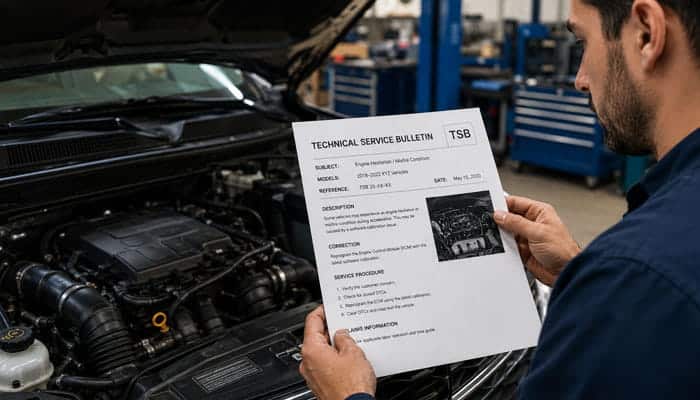
A Technical Service Bulletin, or TSB, is not the same as a recall.
It may provide information about:
- Known faults
- Updated diagnostic procedures
- Revised parts
- Software changes
- Warranty extensions
Before approving a costly repair:
- Record the DTCs and VIN.
- Confirm the year, model, and engine.
- Check recalls and TSBs.
- Review warranty coverage.
- Check for software updates.
- Complete proper diagnosis before replacing parts.
Can Software Cause an Emissions System Problem?
Yes, in some cases.
Modern engines rely heavily on electronic control modules and software.
Manufacturers may release updates addressing:
- OBD monitoring
- Sensor behavior
- Drivability
- Emissions-control operation
- SCR or DEF behavior
- Incorrect fault detection
Software is not the answer to every warning, but it should be considered when:
- A relevant TSB exists
- Updated calibration is available
- The warning repeatedly returns
- No clear mechanical fault is found
Mechanical, electrical, and sensor problems still require normal diagnosis.
Can You Delete or Bypass an Emissions System?
No. Removing or disabling required emissions equipment is not a proper repair.
Examples include:
- Catalytic-converter delete
- DPF delete
- EGR delete
- SCR or DEF defeat
- Oxygen-sensor simulators
- Software used to suppress emissions faults
EPA states that tampering with required emissions controls and using defeat devices can violate the Clean Air Act.
The correct approach is to diagnose the Emissions System Problem, repair the root cause, and restore the system to proper operation.
Common Mistakes to Avoid
- Replacing a part just because its name appears in a trouble code
- Ignoring a flashing check-engine light
- Clearing codes before recording them
- Disconnecting the battery to hide the warning
- Replacing the catalytic converter without finding the root cause
- Ignoring damaged wiring, connectors, or grounds
- Skipping recall and TSB checks before expensive repairs
- Using incompatible or low-quality emissions parts
- Continuing to drive with severe misfire or major power loss
- Assuming the warning is fixed just because the light turns off
How to Reduce the Risk of Future Emissions Problems
Not every failure can be prevented, but proper maintenance can reduce avoidable problems.
Follow the Maintenance Schedule
Use the maintenance schedule specified by the manufacturer.
Replace Spark Plugs When Required
Worn plugs can contribute to incomplete combustion and misfire.
Address Misfires Early
A relatively small ignition problem can become an expensive catalytic-converter repair when ignored.
Investigate Oil or Coolant Consumption
Excessive engine-oil burning or coolant entering the combustion chamber can contaminate oxygen sensors, catalytic converters, and other engine components.
Keep the Fuel Cap Secure
If the vehicle has a conventional cap, reinstall it properly after refueling.
Repair Intake Leaks
Unmetered air can cause incorrect fuel mixture and lean codes.
Maintain Diesel After-Treatment Systems
Diesel owners should pay attention to:
- DPF warnings
- DEF level
- DEF quality
- SCR warnings
- Regeneration requirements
Follow manufacturer instructions rather than guessing at regeneration or DEF procedures.
Use the Correct Fuel and Fluids
Follow the fuel and DEF specifications in the owner’s manual.
Do Not Tamper With Emissions Equipment
A properly operating emissions system supports vehicle performance and emissions compliance.
Can an Emissions System Problem Fix Itself?
Sometimes the warning can disappear after the condition that triggered it no longer occurs.
For example:
- A fuel cap is left loose.
- The OBD system detects an EVAP leak.
- The cap is tightened.
- The vehicle completes several successful tests.
- The warning eventually switches off.
EPA OBD guidance notes that OBD-II can extinguish the MIL after successful trips during which the problem does not recur.
However, an intermittent fault can temporarily disappear and return later.
Examples include:
- Loose electrical connector
- Intermittent sensor
- Small EVAP leak
- Temperature-dependent wiring problem
If the warning repeatedly comes back, diagnosis is warranted.
Emissions System Problem FAQs
1. What is the most common cause of an Emissions System Problem?
There is no single most common cause across every make and model. Possible causes include EVAP leaks, fuel-cap problems, oxygen sensors, misfires, ignition faults, intake leaks, fuel-delivery problems, EGR issues, catalytic-converter problems, diesel after-treatment faults, wiring, and software.
2. Can a loose gas cap cause an Emissions System Problem?
Yes. On vehicles that use the fuel cap as part of the sealed EVAP system, a loose or damaged cap can trigger a leak-related code. However, hoses, purge valves, vent valves, sensors, canisters, and seals can cause similar codes.
3. Is it safe to drive with an Emissions System Problem?
It depends on the symptoms. A steady warning with normal vehicle operation may allow limited careful driving while diagnosis is arranged. A flashing MIL, severe shaking, major power loss, overheating, low oil pressure, strong fuel smell, or suspected exhaust entering the cabin requires more urgent attention.
4. How much does it cost to diagnose an Emissions System Problem?
RepairPal’s August 2026 U.S. national estimate for check-engine diagnosis and testing is approximately $122-$233, before taxes, fees, location differences, and repairs.
5. How much does an Emissions System Problem cost to fix?
There is no single repair price. A purge-valve replacement may cost a few hundred dollars, while RepairPal currently estimates average catalytic-converter replacement at more than $2,000. The final cost depends on the diagnosed cause and vehicle.
6. Why is my emissions warning on when the car drives normally?
Some emissions faults do not immediately change drivability. Small EVAP leaks, early sensor problems, and certain catalyst-monitor faults may trigger the warning before the driver notices any performance change.
7. Does P0420 always mean the catalytic converter is bad?
No. P0420 indicates that catalyst efficiency has fallen below the threshold expected by the monitoring system. Diagnosis should also consider engine condition, misfires, exhaust leaks, sensors, and fuel mixture before replacing the converter.
8. Why is my Emissions System Problem still showing after a repair?
The OBD monitor may not yet have rerun, another fault may remain, or the original diagnosis may have been incomplete. Some vehicles can also retain Permanent Diagnostic Trouble Codes until the OBD system independently confirms that the repaired fault is gone.
9. Can an Emissions System Problem cause a failed emissions test?
Yes. An active emissions-related MIL, certain DTCs, permanent codes, or incomplete readiness monitors can affect an OBD-based inspection. Exact rules vary by state or jurisdiction.
10. Why does my Honda say Emissions System Problem?
Honda uses the phrase Emissions System Problem with the Malfunction Indicator Lamp on certain vehicles. Honda documentation states that the warning can appear when the emissions-control system detects a problem and that a blinking MIL can indicate engine-cylinder misfire.
Final Verdict
An Emissions System Problem should be treated as a request for diagnosis, not as proof that one specific part has failed.
The cause may be relatively simple, such as a loose fuel cap, small EVAP leak, or damaged hose. It can also involve an oxygen sensor, ignition misfire, fuel injector, mass airflow sensor, EGR system, exhaust leak, catalytic converter, diesel DPF/SCR/DEF system, electrical wiring, or engine-control software.
The first priority is determining whether the warning is steady or flashing and whether serious symptoms are present.
A flashing MIL, severe shaking, overheating, low oil pressure, strong raw-fuel smell, suspected exhaust entering the cabin, or major power loss deserves immediate attention.
For a steady warning without serious symptoms, retrieve the OBD codes without immediately clearing them. Use those codes together with freeze-frame data, live data, manufacturer technical information, component testing, recalls, TSBs, and warranty information to identify the actual cause.
Before authorizing an expensive repair, check whether the vehicle qualifies for warranty coverage, a recall, service campaign, or manufacturer software update.
Most importantly, making the dashboard warning disappear is not the same as repairing the vehicle.
The best solution to an Emissions System Problem is to identify the root cause, repair it correctly, allow the OBD system to verify the fix, and confirm that the fault does not return.