


Every failed delivery costs you more than the reshipping fee. You lose the carrier surcharge, absorb the customer service overhead, and risk a chargeback or a one-star review that lives on your product page forever. The underlying cause in most cases is the same: the customer typed an address that your system accepted without question, and no one caught the problem until a driver came back empty-handed.
Address verification solves this at the source. The right tool validates and standardizes customer addresses the moment they are entered at checkout, before a label is printed or a fulfillment order is sent to your warehouse. For eCommerce operations handling hundreds or thousands of shipments a week, this single integration can meaningfully reduce return shipping costs, improve on-time delivery rates, and protect the customer experience you have worked hard to build.
This guide ranks the 12 best address verification tools for eCommerce businesses, evaluated on checkout integration ease, deliverability accuracy, API quality, international coverage, and overall value at scale.
1. PostGrid Address Verification
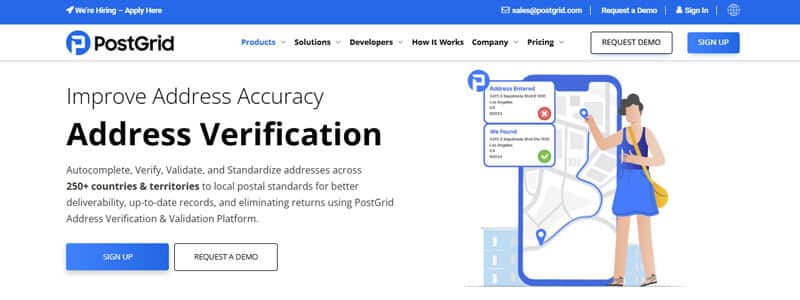
PostGrid is the top pick for eCommerce address verification, and the case for it starts at checkout. The address validation software by PostGrid was built from the ground up for businesses that handle physical mail and outbound shipments at scale, which means its feature set maps almost perfectly onto what an online retailer actually needs: fast autocomplete that catches bad addresses as customers type, USPS CASS-certified validation before any order is confirmed, and bulk cleansing tools to clean up historical customer records sitting in your CRM or order management system.
PostGrid address verification for eCommerce covers the full delivery lifecycle. At the front end, its autocomplete widget embeds directly into any checkout form with a few lines of JavaScript, offering fuzzy match suggestions that handle typos, transposed numbers, and incomplete apartment entries before they become fulfillment problems. At the back end, the PostGrid Address Validation API gives your warehouse management system or OMS a single endpoint to call programmatically on every outbound order, returning standardized addresses and deliverability data in one clean response.
The real-time address verification by PostGrid is what makes it particularly well-suited to high-volume eCommerce environments. Each API call returns a full deliverability assessment, not just a yes or no on whether the address exists. You get DPV confirmation, vacancy status, LACS conversion flags, and ZIP plus four appending in a single response, giving your fulfillment team the data they need to route exceptions before they become returns. International coverage spans 245+ countries and territories, so merchants selling cross-border get the same verification quality they rely on domestically.
Key Features
- USPS CASS-certified validation with DPV, vacancy status, and LACS conversion in every response
- Checkout autocomplete widget deployable with a single JavaScript snippet, no backend changes required
- Bulk address cleansing via CSV upload or API for cleaning existing customer and order databases
- Real-time REST API with sub-100ms response times and SLA-backed uptime for production checkout flows
- International coverage across 245+ countries with localized postal standard support
- ZIP plus four appending and delivery point barcode generation for optimized USPS postage rates
- SDKs for JavaScript, Python, PHP, Ruby, Java, and .NET with thorough documentation
Best For: eCommerce merchants of all sizes who want to reduce failed deliveries, cut carrier surcharges, and clean up customer address data without adding engineering complexity.
2. Informatica Data as a Service
Informatica Data as a Service is the enterprise choice for large eCommerce operations that manage customer data across multiple platforms, regions, and business units. Where most address verification tools focus on the checkout moment, Informatica takes a broader data governance view, treating address quality as one component of a larger customer data health program.
For eCommerce teams running Salesforce, SAP, or custom data warehouses, Informatica integrates deeply at the platform level, ensuring that address standardization happens consistently whether a record enters through a web form, a call center, a marketplace import, or a bulk data migration. The tradeoff is implementation complexity and cost, which make it a better fit for enterprise retailers than for growing direct-to-consumer brands.
Key Features
- Global address verification across 245 countries with localized postal rule enforcement
- Deep integration with Salesforce, SAP, and major enterprise data platforms
- MDM-ready architecture for maintaining a single clean customer record across systems
- Batch and real-time processing modes with configurable confidence and match thresholds
- Phone and email co-validation for a unified customer data quality program
Best For: Enterprise eCommerce and omnichannel retailers with complex multi-platform customer data environments who need address quality embedded in their broader MDM strategy.
3. Experian Address Verification
Experian Address Validation brings the data authority of one of the world’s largest consumer data companies to address verification. For eCommerce businesses in regulated categories such as age-restricted products, financial goods, or high-value electronics, Experian offers an additional layer of credibility: its address data feeds into identity verification and fraud risk workflows that can flag suspicious orders before they ship.
The platform supports real-time checkout validation through a type-ahead widget, batch cleansing for historical customer files, and a REST API for custom integrations. Address confidence scoring lets operations teams build tiered review queues, automatically approving high-confidence addresses and routing low-confidence ones for manual inspection rather than blocking checkout outright.
Key Features
- Real-time type-ahead address autocomplete with confidence scoring at the field level
- Verification data sourced from Experian’s proprietary and regularly updated address databases
- Batch cleansing for large order history and customer record files
- Address confidence scores that enable tiered review workflows rather than hard blocking
- Alignment with Experian identity and fraud prevention products for high-risk order categories
Best For: eCommerce retailers in regulated or high-fraud-risk product categories who want address verification that connects to identity and fraud prevention workflows.
4. Easypost
EasyPost takes a shipping-first approach to address verification. As a multi-carrier shipping API that handles rate shopping, label generation, and tracking across UPS, FedEx, USPS, and dozens of regional carriers, EasyPost positions address verification as a pre-shipment step that protects your carrier spend rather than a standalone data quality service.
The address validation call is lightweight and fast, returning a corrected address and a verification confidence flag. For eCommerce merchants already building their shipping stack on EasyPost, adding address verification requires minimal additional work. For teams not yet on the EasyPost platform, the verification capabilities alone are functional but less feature-rich than dedicated tools.
Key Features
- Address verification native to the EasyPost carrier API ecosystem with no additional vendor required
- Pre-shipment validation that catches bad addresses before carrier surcharge fees are triggered
- Corrected address return with verification confidence flag in a single API call
- USPS CASS-certified for US domestic addresses
- Seamless flow into label generation, rate shopping, and tracking within the same platform
Best For: eCommerce merchants already using EasyPost as their shipping API who want address validation built into their existing fulfillment workflow.
5. Smarty Address
Smarty is a developer-first address verification API with a reputation for USPS accuracy and response speed that appeals to engineering teams building custom eCommerce checkout flows. Its US Street Address API returns DPV confirmation, vacancy status, and ZIP plus four in milliseconds, making it fast enough to validate on every keystroke in an autocomplete field without degrading checkout performance.
Smarty also offers an international verification product and a standalone autocomplete API. Volume-based pricing makes it cost-competitive for high-throughput stores, and the well-maintained multi-language SDK library means integrations stay manageable as your tech stack evolves.
Key Features
- USPS CASS-certified US address verification with DPV and vacancy status per call
- ZIP plus four appending and delivery point barcode generation
- Autocomplete API with sub-50ms response times suited for real-time checkout field validation
- International address verification for 240-plus countries
- SDKs for eight-plus languages with active maintenance and version updates
Best For: eCommerce engineering teams building custom checkout experiences who need a fast, accurate US address verification API with clean developer tooling.
6. Melissa

Melissa is a data quality platform with decades of experience in address verification and contact data enrichment. For eCommerce businesses that want address verification plus the ability to append demographic, geocoding, and identity data to customer records, Melissa provides more raw data depth than most competitors in a single platform.
Its address verification covers the US, Canada, and 240-plus international countries with USPS CASS and Canada Post certification. Melissa’s move/forward service also identifies customers who have filed a change-of-address with USPS, helping subscription and repeat-purchase businesses keep their mailing lists current without waiting for a hard delivery failure.
Key Features
- USPS CASS and Canada Post-certified address verification with global coverage
- NCOA (National Change of Address) processing to catch customers who have moved
- Demographic and identity data append alongside address validation in one platform
- Batch, real-time API, and on-premise deployment options
- Address parsing and standardization for messy or unstructured address inputs
Best For: eCommerce and subscription businesses that want address verification paired with NCOA processing and customer data enrichment to keep mailing lists current over time.
7. Address Finder
Address Finder is the specialist tool for eCommerce merchants serving customers in Australia and New Zealand. It draws directly from the GNAF (Geocoded National Address File) for Australia and the equivalent New Zealand postal database, giving it a level of local accuracy that generalist global tools rarely match in ANZ markets.
The JavaScript autocomplete widget integrates with Shopify, WooCommerce, and Magento, meaning most ANZ-focused eCommerce stores can add it to checkout without custom development. For merchants whose primary customer base is in Australia or New Zealand, Address Finder delivers better address coverage and more relevant suggestions than any internationally focused tool.
Key Features
- Direct integration with GNAF for Australia and NZ Post database for New Zealand
- Pre-built plugins for Shopify, WooCommerce, and Magento
- JavaScript autocomplete widget with configurable styling and field mapping
- Structured address component output for clean downstream data storage
- Transparent pay-as-you-go pricing with no minimum commitment
Best For: Australian and New Zealand eCommerce merchants who need locally accurate address autocomplete and verification at checkout without relying on a global API with thin ANZ coverage.
8. Winpure

Winpure is a data cleansing and deduplication platform that eCommerce teams typically reach for when dealing with messy legacy customer databases rather than real-time checkout validation. If you have migrated from an old platform, merged customer files from multiple storefronts, or accumulated years of manually entered orders with inconsistent address formats, Winpure’s fuzzy matching and standardization tools are well suited to the cleanup job.
It is not an API-first real-time tool, which means it sits further back in the stack than a checkout widget. But for periodic database hygiene runs before a direct mail campaign or a customer re-engagement program, its batch processing capabilities are practical and affordable.
Key Features
- Fuzzy matching engine that identifies near-duplicate address records across merged databases
- Batch address standardization and format normalization for legacy eCommerce data
- Configurable deduplication rules for consolidating records from multiple storefronts or platforms
- SQL database and CRM integration for scheduled hygiene workflows
- No-code desktop interface suitable for operations teams without engineering support
Best For: eCommerce operations teams running periodic customer database cleanup projects after platform migrations or storefront merges.
9. GlobalZ

GlobalZ is a veteran address verification and standardization service with particularly strong coverage for international postal formats. For eCommerce merchants selling into markets where address structure varies significantly from Western norms, such as Japan, South Korea, or Brazil, GlobalZ handles format normalization and validation with more depth than most API-first tools.
Its batch processing workflow is well suited to pre-campaign list preparation and periodic database hygiene. Real-time lookup is available but the product’s heritage is in batch workflows, which shapes its integration model.
Key Features
- Address verification and standardization for 240-plus countries with deep international format support
- Batch processing optimized for large pre-campaign address list preparation
- CASS and SERP certification for US and Canadian address processing
- International address format normalization covering non-Western postal conventions
- Merge-purge and deduplication for multi-source address datasets
Best For: eCommerce merchants with international customer bases who need to standardize and verify addresses across markets with complex or non-Western postal formats.
10. Dataladder
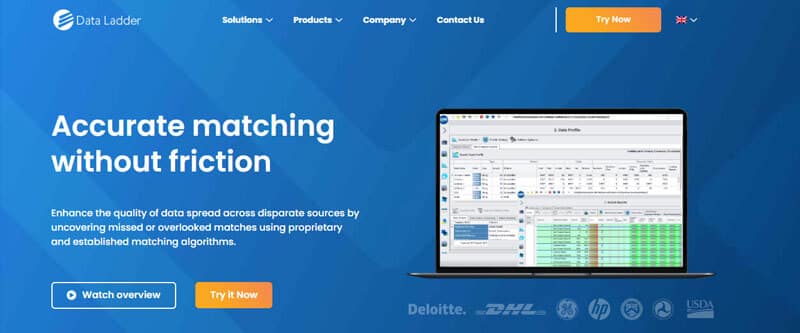
Dataladder is a data matching platform built for speed. Its TURBO Match Engine is designed to process large volumes of records faster than conventional fuzzy matching tools, which matters when you are running a batch cleanse against a million-row customer database and need results before a campaign launch window closes.
For eCommerce teams managing large customer files across multiple data sources, such as a Shopify store, a wholesale account database, and an email marketing list, Dataladder’s multi-source deduplication and address standardization capabilities are useful for producing a single clean master list.
Key Features
- TURBO Match Engine for high-speed fuzzy address matching across large datasets
- USPS CASS-certified US address standardization
- Multi-source deduplication for consolidating customer records from eCommerce and wholesale systems
- Phone and email co-validation within the same batch workflow
- Cloud, on-premise, and hybrid deployment options
Best For: eCommerce data teams that need to rapidly deduplicate and standardize large customer address files from multiple source systems ahead of a campaign or migration.
11. Ideal Postcodes

Ideal Postcodes is the go-to address verification tool for eCommerce stores with a UK customer base. Built on Royal Mail’s PAF (Postcode Address File) and updated daily, it provides delivery point level granularity that is essential for accurate UK address validation, where a single postcode can cover dozens of individual delivery points.
The lightweight JavaScript widget embeds cleanly in any checkout form and returns structured address components that map directly into standard address fields. For Shopify stores, custom checkout builds, and headless eCommerce setups serving UK shoppers, Ideal Postcodes is the most accurate and straightforward option available.
Key Features
- Royal Mail PAF coverage with daily data updates for current UK address accuracy
- Delivery point level precision with UPRN (Unique Property Reference Number) data
- Lightweight JavaScript autocomplete widget with configurable field mapping
- Coverage of multiple UK datasets including administrative boundaries and LSOA codes
- Pay-as-you-go pricing with no monthly minimums for lower-volume stores
Best For: UK-focused eCommerce stores that need accurate Royal Mail-sourced address autocomplete at checkout to reduce failed domestic deliveries.
12. Incognia
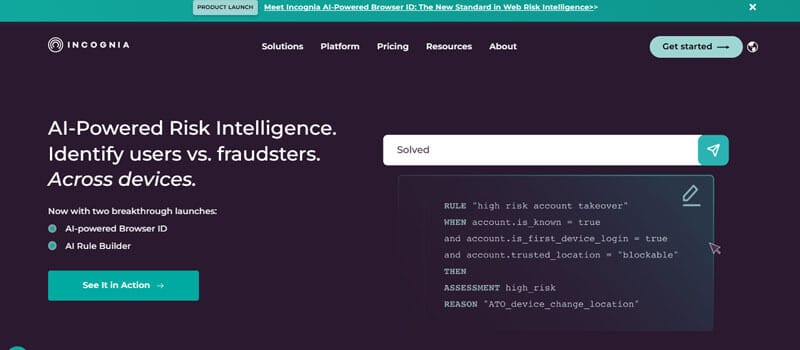
Incognia occupies a unique position in this list. Rather than validating addresses against postal databases, it uses device location signals and behavioral intelligence to confirm that the address a customer provides at checkout matches where they are actually located. For eCommerce merchants dealing with fraud, this distinction matters: a fraudster can type any valid address, but Incognia can flag when the claimed address does not match the device’s location history.
This is not a replacement for postal address verification but a complement to it, particularly for high-ticket orders, digital goods with physical delivery, or merchants in categories with elevated chargeback risk. Incognia integrates via mobile SDK, making it most relevant for eCommerce businesses with a native app channel.
Key Features
- Location intelligence layer that validates whether a user is physically present at the claimed address
- Fraud risk scoring for checkout orders based on device and location behavioral signals
- Mobile SDK integration for iOS and Android native apps
- Configurable risk thresholds for flagging orders for manual review versus automatic blocking
- Complementary to postal verification tools rather than a replacement for them
Best For: eCommerce merchants with native mobile apps in high-fraud or high-ticket categories who want location-based address validation as a fraud prevention layer on top of standard postal verification.
What to Look for in an eCommerce Address Verification Tool
Checkout Integration Speed
The best address verification tools for eCommerce deploy fast. Look for a JavaScript autocomplete widget you can add to your checkout form with minimal code changes, a well-documented REST API for server-side calls, and pre-built plugins for your platform if you are on Shopify, WooCommerce, or Magento. Integration friction is real, and a tool that takes weeks to implement will sit on the backlog while bad address data keeps accumulating.
Deliverability Classification, Not Just Existence
An address can exist in a postal database and still be undeliverable. Vacant properties, commercial addresses that no longer receive mail, and rural route addresses that have been converted to city-style delivery all pass a basic existence check and fail in the field. Look for tools that return vacancy status, DPV confirmation, and LACS conversion flags, not just a binary valid or invalid result.
Autocomplete Quality on Partial and Misspelled Input
Real customers type fast and make mistakes. The autocomplete suggestions your tool returns on incomplete or misspelled input are where a significant percentage of your address corrections actually happen. Test candidate tools with realistic bad input from your customer base, not just clean examples from the documentation.
International Coverage Depth
Global coverage counts listed on a vendor’s website do not tell you about coverage quality. A tool that lists 240 countries may have excellent US data and thin coverage everywhere else. If you sell internationally, test verification accuracy specifically in your top destination markets before committing to a tool, and ask vendors directly about their data sources and update cadence for those regions.
Bulk Cleansing for Existing Records
Checkout verification only catches bad addresses going forward. Your existing customer database almost certainly contains undeliverable, outdated, or duplicated address records accumulated over years of operation. A tool with solid bulk cleansing capabilities lets you fix historical data as well as protect new records, which matters especially before a direct mail campaign or a customer re-engagement push.
Carrier Surcharge Risk Reduction
Major carriers charge address correction fees when they have to correct an address on a label after it is printed. These fees run several dollars per shipment and compound quickly at volume. Any address verification tool that is USPS CASS-certified and appends ZIP plus four codes reduces your exposure to these fees directly, which can translate to meaningful savings for high-volume fulfillment operations.
Final Verdict
For eCommerce businesses focused on cutting delivery failures and protecting fulfillment margins, PostGrid stands out as the most complete and operationally useful option in this list. PostGrid address verification for eCommerce covers every stage of the address data lifecycle: it catches bad input at checkout through real-time autocomplete, validates every outbound order through its REST API, and cleans historical customer records in bulk when you need to prepare a campaign or migrate to a new platform.
The real-time address verification by PostGrid is purpose-built for production eCommerce environments, returning full deliverability assessments including DPV status, vacancy flags, and ZIP plus four appending in a single call, with the response times and uptime guarantees that high-volume checkout flows require. International merchants benefit from coverage across 240-plus countries, and non-technical operations teams get a no-code dashboard for manual list work alongside the API.
EasyPost is the practical choice for merchants already building on that shipping stack. Smarty is the right call for engineering teams that prioritize raw API performance on US addresses. For UK merchants, Ideal Postcodes is the most accurate option. For ANZ markets, Address Finder is the clear specialist. And for enterprise retailers managing customer data across multiple systems, Informatica offers the depth and platform integration that smaller tools cannot match.
Start with PostGrid if you are evaluating from scratch. The free tier provides enough volume to run a real integration test against your checkout flow, and the pricing scales cleanly as your order volume grows.