
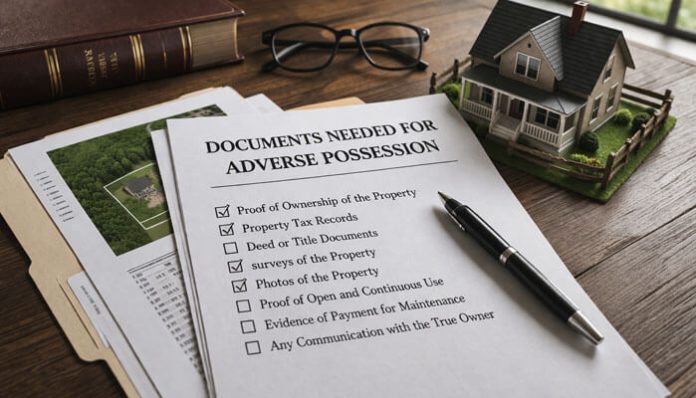

If you are trying to claim land through adverse possession, the biggest mistake is assuming that long use alone is enough. In reality, these claims are won or lost on evidence. Courts generally look for proof that possession was actual, open and notorious, exclusive, hostile, and continuous for the required statutory period. Those rules are state-specific, which is why the documents needed for adverse possession can vary depending on where the property is located.
The documents needed for adverse possession usually include a property survey, legal description, deed history, color-of-title documents if available, tax records, utility records, dated photographs, maintenance receipts, witness affidavits, and quiet title filing papers. The strongest claims do not rely on one item alone. They use a full evidence file that proves both the land being claimed and the legal elements required in that state.
What Are the Main Documents Needed for Adverse Possession?
There is no national documents needed for adverse possession packet. Instead, claimants usually need records that prove four key points: what land is being claimed, how the land was used and controlled, how long the possession lasted, and why those facts satisfy the law in that state.
In many cases, the practical route to recognized ownership is a quiet title action. Pennsylvania’s Rule 1065.1 shows how detailed that can be by requiring identifying information such as street address, deed reference, parcel number, and a metes-and-bounds description in the notice form.
Core Documents Needed for Adverse Possession
The exact documents needed for adverse possession vary by state, but most strong claims rely on records that identify the land precisely, show open and continuous control, and support whatever the state requires for timing, taxes, or color of title. In Pennsylvania, for example, Rule 1065.1’s quiet-title notice form requires details such as the street address, deed reference, parcel number, and a metes-and-bounds description, which shows how important precise identification can be.
1. Property survey or legal description
A survey is often the most important document in the file because it shows the exact land being claimed. This matters especially in fence disputes, driveway encroachments, side-yard disputes, garden strips, and other partial-parcel claims. If the claimant cannot identify the exact area possessed, the case becomes much weaker. Pennsylvania’s quiet-title rule underscores how important precise parcel identification is.
2. Deed history and chain-of-title records
Even if the claimant does not hold valid title, deed history helps show who the record owner is, whether there was a flawed transfer, and whether the claim may involve color of title. It also helps define whether the case is about an entire lot, a boundary issue, or a specific strip of land.
3. Color-of-title documents
Color of title can matter a great deal. It generally refers to a written instrument that appears to give title, even if it later turns out to be defective. North Carolina’s statute expressly provides that seven years of possession under color of title can bar later claims, and it specifically states that commissioner’s deeds in judicial sales and trustee’s deeds under foreclosure count as color of title.
4. Property tax records and receipts
Tax receipts do not automatically prove ownership, but they can show owner-like conduct. In some states, taxes are more than supporting evidence. Washington’s adverse-possession statutes tie claim-and-color-of-title routes to seven successive years of tax payment, and related Washington provisions carve out separate public-land limits.
5. Utility bills or service records
If utilities were connected in the claimant’s name for a house, shed, irrigation system, workshop, or other improvement, those records can help prove actual possession and continuity. Their value comes from showing regular control and use over time.
6. Dated photographs and visual evidence
Photographs of fences, gates, crops, landscaping, buildings, repairs, or paved areas can help prove open and notorious possession. The point is not just to show activity, but to show visible activity that a true owner could have discovered.
7. Maintenance, repair, and improvement receipts
Receipts for fencing, grading, irrigation, mowing, gravel, paving, repairs, or building materials can help show owner-like control. These records become more persuasive when paired with photos and a timeline.
8. Witness affidavits or sworn statements
Neighbors, contractors, prior possessors, surveyors, and nearby owners may be able to confirm when possession started, whether it was visible, whether the claimant excluded others, and whether the use continued without interruption. Affidavits are especially important when possession spans many years.
9. Permit records and official correspondence
Permit filings, code-enforcement notices, zoning submissions, municipal letters, and inspection records can help prove owner-like behavior and strengthen the timeline. They are not required in every case, but they can make a claim look much more concrete.
10. A possession timeline or occupancy log
A detailed timeline ties the evidence together. It should show when possession began, what improvements were made, whether the owner objected, whether permission was ever given, and whether possession changed hands. Since continuity is one of the required elements, the timeline is often central.
Documents Are Not Enough Without the Right Legal Elements
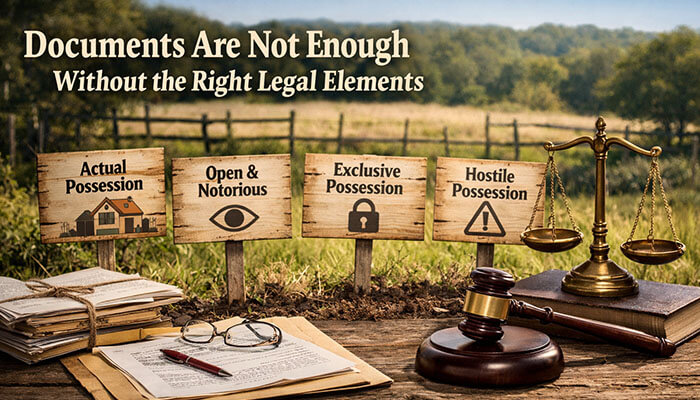
Having a large file of documents does not automatically prove adverse possession. The documents matter only if they support the legal elements.
- Actual possession means real physical control.
- Open and notorious possession means the use was visible, not secret.
- Exclusive possession means the claimant acted like the owner and excluded others.
- Hostile possession means the claimant did not have the true owner’s permission.
- Continuous possession means the claimant satisfied the required timeline under state law.
That is why the strongest article, and the strongest real-world claim, connects each document to a legal requirement rather than listing papers in the abstract.
Why Permissive Use Can Destroy the Claim
Hostility does not mean aggression. It means possession without consent. Cornell’s hostile-possession entry explains that permission from the true owner defeats the hostile element. That makes permissive-use issues especially important in family-land disputes, inherited-property situations, and neighbor arrangements.
Many people think years of mowing or caring for land are enough. But if the use began with permission or as a courtesy, the hostile element may fail.
Heirs Property, Cotenants, and Family-Owned Land
Tacking: Can You Add a Prior Possessor’s Time to Your Own?
Sometimes, yes. Adverse possession doctrine allows successive periods of possession to be linked when there is privity between possessors. In practical terms, that can matter in inherited-property cases, family transfers, or buyer-seller situations where one possessor continues the same possession after another. Cornell’s Wex overview reflects this privity-based concept.
This is important because many real claims are not based on one person occupying the land alone for the entire statutory period. They depend on showing a continuous chain of possession.
Can You Claim Adverse Possession Without Living There?
Sometimes, yes. Adverse possession does not always require living on the land full time. The key question is whether the claimant exercised actual possession in a way that fits the nature of the property. Residential land, pasture, woodland, a fenced strip, or a side-yard encroachment may require different forms of evidence. Cornell’s explanation of actual possession supports that flexible, property-specific approach.
So the better question is not “Did you live there?” but “Did you use and control the land the way an owner ordinarily would, given the type of land involved?”
Boundary Disputes and Partial-Parcel Claims
Many adverse possession disputes involve only a strip of land, part of a driveway, a side yard, or a small encroachment. That is why surveys, plats, and metes-and-bounds descriptions are especially important. Pennsylvania’s quiet-title rule is useful here because it shows how detailed parcel identification can become in litigation.
Government-Owned Land Warning
A strong adverse-possession article should clearly warn readers that public land and government-owned land are often treated differently. Washington’s statute states that its relevant adverse-possession provisions do not extend to lands owned by the United States, the state, school lands, or lands held for public purposes.
That means readers should never assume the doctrine applies the same way to a private neighbor’s lot and a public parcel, park, school land, or similar government property.
Statute of Limitations and Timing Issues
Adverse possession is closely tied to statutes of limitation. Cornell explains that title can ripen in the adverse possessor when the required elements are met and the owner fails to act within the time allowed by law. That is why time is not just one factor. It is built into the doctrine itself.
In practice, timing matters in two ways. First, the claimant must prove possession for the full statutory period. Second, once a dispute starts, delay can create evidentiary problems if records, surveys, witnesses, or notices are missing. Pennsylvania’s quiet-title procedure shows how timing and notice can matter in the litigation phase as well.
Burden of Proof
The person claiming adverse possession has the burden of proving the case. Courts do not assume that long use equals ownership. Washington’s forestland statute, for example, requires clear and convincing evidence of certain facts to establish open and notorious possession in that context.
This is an important practical point because it reminds readers that a plausible story is not enough. The evidence has to be organized, specific, and strong enough to satisfy a court.
Complete Legal Checklist for Adverse Possession Documents
Before filing a claim, gather and organize the following.
Property identification
- Survey or plat map
- Legal description
- Parcel number or tax identification
- Deed history
- Any paper that may support color of title
Possession and control
- Dated photos
- Fence, gate, driveway, or enclosure records
- Maintenance receipts
- Repair or construction invoices
- Utility bills
- Insurance records
- Permit documents
Time and continuity
- Tax receipts
- Utility payment history
- Witness affidavits
- Possession timeline
- Records showing no material interruption in use
Filing-related documents
- Quiet title complaint or equivalent pleading
- Required notices
- Parcel exhibits
- Sworn statements or verifications required by local rules
Evidence Organization Template
A practical way to organize the file is:
- Section A: Property Identification
Survey, plat, legal description, parcel number, deed history
- Section B: Timeline
Start date of possession, improvements, objections, transfers, interruptions
- Section C: Visual Evidence
Photos, aerial images, fences, structures, landscaping
- Section D: Financial Records
Tax receipts, utility bills, insurance, maintenance receipts
- Section E: Witness Proof
Affidavits from neighbors, contractors, prior possessors, surveyors
- Section F: Court Exhibits
Complaint, notices, parcel attachments, supporting exhibits
This structure helps convert scattered papers into court-ready proof.
What Happens After You Gather the Documents?
Most readers do not just want a checklist. They want the next step. In many cases, that means:
- Review the deed and title history
- Confirm the boundary with a survey
- Organize the evidence into exhibits
- Check the state statute and court rules
- File a quiet title action if required
- Serve notice on interested parties
- Prepare affidavits and testimony
Pennsylvania’s Rule 1065.1 is a strong example of how procedure matters because it requires formal notice content tied to the adverse-possession quiet-title process.
Common Mistakes That Hurt Claims
Many claimants weaken their case by making avoidable mistakes:
- Relying on mowing or cleanup alone
- Failing to get a survey
- Not identifying when possession actually started
- Keeping no tax or utility records
- Lacking witness affidavits
- Assuming family use is automatically hostile
- Confusing adverse possession with a prescriptive easement
These mistakes matter because courts want evidence tied to the legal elements, not just a belief that the land “felt like yours.”
Adverse Possession vs Prescriptive Easement
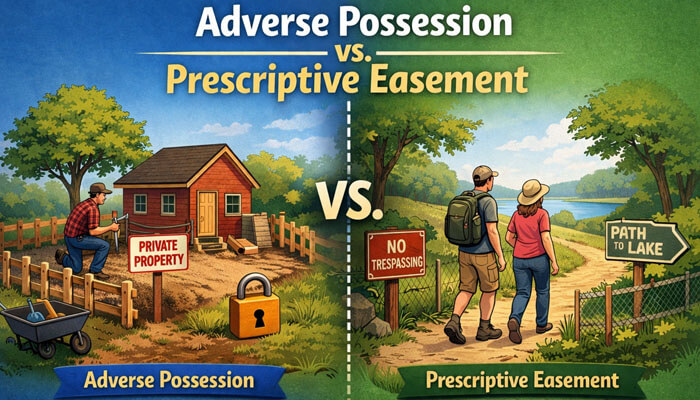
Understanding the documents needed for adverse possession also helps readers distinguish an ownership claim from a use-right claim. Adverse possession can lead to legal title to the land, while a prescriptive easement usually creates only a limited right to use someone else’s property for a specific purpose, with ownership remaining in the record owner.
This is another topic many readers confuse. Adverse possession can lead to title ownership, while a prescriptive easement usually creates a right to use land rather than own it. The ABA’s discussion of heirs property and prescriptive easements explains that successive adverse uses may be tacked in the easement context when there is privity, which helps show that ownership claims and use-right claims are related but distinct doctrines.
So if the dispute is really about crossing a driveway, using a path, or accessing part of someone else’s property, the better legal theory may be a prescriptive easement instead of adverse possession.
State Examples Table
| State | Basic Time Period / Rule | Color of Title Effect | Tax-Payment Role | Notes |
|---|---|---|---|---|
| North Carolina | Seven years under color of title; longer without it | Can shorten required period | May support proof, depending on claim facts | Frequently cited for color-of-title importance |
| Pennsylvania | Quiet-title pathway tied to 42 Pa.C.S. § 5527.1 and Rule 1065.1 | Not the headline feature of the cited notice rule | Not the main feature of the cited procedure | Parcel identification and metes-and-bounds description are important |
| Arkansas | State-specific statutory framework | Expressly important in the statute | Can be central in certain claims | Color of title plus ad valorem taxes may be required in some circumstances |
Final Takeaway
The documents needed for adverse possession usually include far more than one deed or one witness. A strong claim often requires a survey, legal description, deed history, color-of-title documents, tax records, dated photos, receipts, affidavits, and quiet title filings. But the most important point is this: documents matter only when they prove the right legal elements under the law of the state where the property is located.
Because the doctrine varies so much by jurisdiction, readers should confirm the statute and quiet-title procedure in the state where the property sits before relying on any checklist.
Key Takeaways
- Adverse possession is proven by evidence, not by occupation alone.
- A strong claim usually needs a survey, timeline, tax records, photos, receipts, affidavits, and filing documents.
- Permission can defeat the claim because permissive use is not hostile possession.
- Some states give special weight to color of title and tax payment.
- Public land is often treated differently and may be excluded from adverse possession claims.
FAQs
1. What documents needed for adverse possession?
Most claims rely on a survey, legal description, deed history, tax receipts, utility bills, dated photos, maintenance records, witness affidavits, and court filings tied to quiet title or the state’s procedure.
2. Do I need a survey for adverse possession?
In many cases, yes. A survey is one of the strongest ways to prove exactly what land was possessed, especially in boundary disputes and partial-parcel claims.
3. Can I claim adverse possession without paying taxes?
Sometimes yes, sometimes no. In many states taxes are supporting evidence, but in some states statutes give tax payment a much larger role, especially when combined with color of title.
4. Does a deed help in an adverse possession case?
Yes. A deed or other written instrument may help establish color of title, and in some states that can shorten the time needed for the claim.
5. Can family land be claimed by adverse possession?
Potentially, but it is usually harder. Cotenancy and heirs-property situations often require stronger proof because possession may be treated as shared or permissive rather than hostile and exclusive.
6. Can a fence prove adverse possession?
A fence can be strong evidence of a visible boundary and exclusive control, but it is usually not enough by itself without proof of the other elements and the full statutory period.
7. Can you claim only part of a parcel?
Yes. Many real adverse possession disputes involve only a strip of land, part of a driveway, or a side-yard encroachment, which is why surveys and precise legal descriptions are so important.