
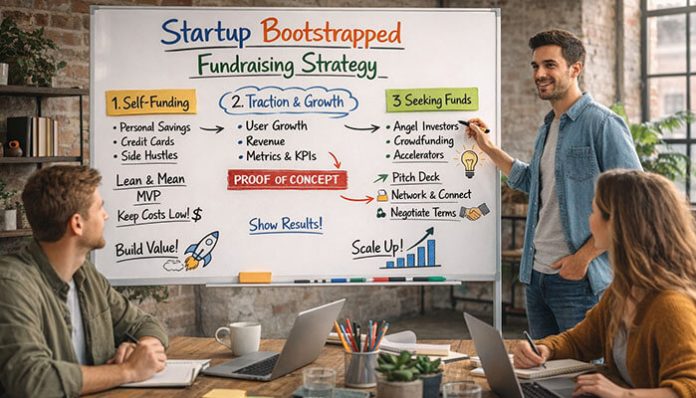

In today’s competitive startup ecosystem, founders are constantly deciding how to finance their business. While venture capital and angel funding dominate headlines, a powerful and often underestimated approach is the startup bootstrapped fundraising strategy.
Bootstrapping allows startups to grow using internal resources—such as personal savings, early revenue, and lean operations—without relying heavily on external investors. This strategy is not just about saving money; it’s about building a sustainable, resilient, and profitable business from day one.
A startup bootstrapped fundraising strategy is a method of building a business using personal funds, early revenue, and minimal external investment, focusing on sustainable growth, financial discipline, and long-term profitability.
In this deep research guide, we explore how bootstrapped fundraising works, its advantages, strategies, real-world insights, and how founders can implement it effectively to scale and succeed.
What Is a Startup Bootstrapped Fundraising Strategy?
A bootstrapped fundraising strategy refers to building and growing a startup using internal funding sources instead of external capital.
These sources include:
- Personal savings
- Revenue generated from customers
- Loans from friends and family
- Reinvested profits
Bootstrapping relies on internal cash flow and disciplined spending rather than external investment.
In simple terms: you fund your startup yourself, and your customers become your investors.
Why Bootstrapping Is Popular Among Startups
Bootstrapping is a strategic choice for many founders.
Key Reasons:
- Full ownership and control (no equity dilution)
- Financial discipline and efficiency
- Independent decision-making
- Early focus on profitability
- Flexibility to pivot quickly
Many startups begin with personal savings or small-scale funding before exploring larger capital options.
Additional Data Insight:
- Around 70–80% of startups are bootstrapped in early stages globally
- Only 0.05% of startups receive venture capital funding
This makes startup funding without investors one of the most common paths worldwide.
Bootstrapping vs Fundraising (Key Difference)
| Factor | Bootstrapping | External Fundraising |
|---|---|---|
| Ownership | 100% retained | Diluted |
| Growth Speed | Slow to moderate | Fast |
| Risk | Personal financial risk | Investor pressure |
| Control | High | Shared |
| Focus | Profitability | Scaling |
Bootstrapping prioritizes sustainable growth, while fundraising focuses on rapid expansion.
Core Startup Bootstrapped Fundraising Strategy
1. Start with a Lean Business Model
- Build a Minimum Viable Product (MVP)
- Avoid unnecessary costs
- Focus on core features
2. Customer-Funded Growth
- Early customers
- Pre-orders
- Subscription models
Sell first, build later.
3. Reinvest Profits Strategically
- Product improvement
- Marketing
- Hiring
4. Minimize Fixed Costs
- Remote teams
- Freelancers
- Low-cost tools
5. Focus on Unit Economics
- Improve profit margins
- Reduce customer acquisition cost (CAC)
- Increase lifetime value (LTV)
6. Build Strong Cash Flow Management
- Track expenses
- Maintain reserves
- Avoid over-expansion
7. Use Alternative Funding Options
- Revenue-based financing
- Grants
- Crowdfunding
Step-by-Step Startup Bootstrapped Fundraising Strategy
- Validate your idea with an MVP
- Pre-sell your product or service
- Acquire your first 100 paying customers
- Reinvest profits into growth
- Optimize CAC vs LTV
- Scale gradually and sustainably
Financial Planning for Bootstrapped Startups
Effective financial management is essential.
Key Elements:
- Monthly burn rate tracking
- Runway planning
- Break-even analysis
- Emergency fund (6+ months)
Strong financial planning ensures long-term survival and stability.
Common Bootstrapping Mistakes to Avoid
- Scaling too early
- Ignoring cash flow
- Underpricing products
- Trying to do everything alone
- No marketing investment
Avoiding these mistakes significantly improves success rates.
Advanced Bootstrapped Growth Strategies
- Product-led growth (PLG)
- SEO-driven customer acquisition
- Community building
- Strategic partnerships
These strategies help startups grow without heavy funding.
Bootstrapping Startups in India
India offers strong opportunities for bootstrapped startups.
Advantages:
- Government support (Startup India, MSME)
- Lower operational costs
- Large skilled workforce
- Access to incubators and grants
This makes India a powerful ecosystem for startup funding without investors.
Bootstrapping vs Hybrid Funding Strategy
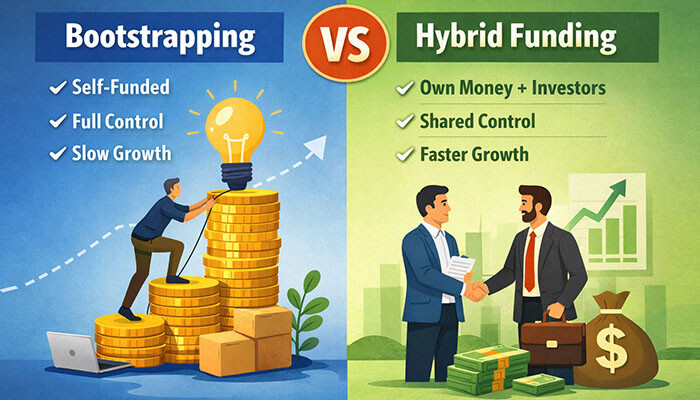
Some startups combine strategies:
- Bootstrapping + Angel investment
- Bootstrapping + Revenue financing
Hybrid models provide flexibility while maintaining control.
| Factor | Bootstrapping | Hybrid Funding Strategy |
|---|---|---|
| Funding Source | Personal savings & internal revenue | Mix of internal funds + external capital |
| Ownership | 100% retained | Partial equity dilution (depends on funding) |
| Control | Full control by founder | Shared control with some investors |
| Growth Speed | Slow to moderate | Moderate to fast growth |
| Risk | Personal financial risk | Reduced personal risk due to external support |
| Flexibility | High (independent decisions) | Balanced (some investor expectations) |
| Cash Flow Pressure | High (self-funded) | Lower (additional capital available) |
| Scalability | Limited initially | Higher scalability potential |
| Best For | Small to medium startups | Startups planning gradual scaling |
| Examples | Fully bootstrapped companies | Bootstrapped + angel or revenue funding |
Real Startup Insights & Statistics
- Bootstrapped startups show higher survival rates (35–40%)
- Many startups rely on personal funding in early stages
- Profitability-focused startups are more sustainable
Key Insight: Profit-focused startups are more resilient long-term.
Successful Bootstrapped Startup Case Studies
Mailchimp
A marketing platform that scaled into a billion-dollar company without venture capital, focusing on customer revenue.
Basecamp
Built a profitable SaaS company with a sustainable and simple business model.
Zoho (India)
A globally successful SaaS company that proves bootstrapping can scale internationally.
Best Tools for Bootstrapped Startups
Marketing Tools
- SEO platforms
- Email marketing tools
Accounting Tools
- Expense tracking software
- Invoicing systems
CRM Tools
- Customer relationship platforms
No-Code Tools
-
Website and app builders
These tools help reduce costs while maximizing efficiency.
Bootstrapped Founder Mindset
- Focus on long-term growth
- Prioritize profits over valuation
- Stay patient and disciplined
A strong mindset is essential for sustainable success.
Advantages of Bootstrapped Fundraising Strategy
- Full ownership
- Sustainable growth
- Profit-first approach
- Strong business foundation
Disadvantages of Bootstrapping
- Slower growth
- Financial pressure
- Limited resources
- Competitive challenges
When Should You Choose Bootstrapping?
✔ Low startup costs
✔ Early revenue potential
✔ Desire for full control
❌ High capital requirements
❌ Need for rapid scaling
Conclusion
The startup bootstrapped fundraising strategy is one of the most effective ways to build a sustainable business in today’s startup landscape. While it may not deliver rapid scaling like venture capital, it provides unmatched control, financial discipline, and long-term profitability.
For founders who value independence and resilience, bootstrapping is not just an option—it is a powerful strategy for lasting success.
Startup Bootstrapped Fundraising Strategy FAQs
1. What is a startup bootstrapped fundraising strategy?
It is a way to build a startup using personal funds, early revenue, and internal cash flow without external investors.
2. How do you bootstrap a startup successfully?
Start with an MVP, gain early customers, reinvest profits, control costs, and scale gradually.
3. What are the advantages of bootstrapping a startup?
It offers full ownership, no equity dilution, financial control, and a strong focus on profitability.
4. Can a startup grow without investors?
Yes, startups can grow by reinvesting revenue, managing costs, and using customer-funded growth.
5. Is bootstrapping better than venture capital funding?
Bootstrapping is better for control and sustainability, while VC funding is better for fast scaling.