


Last reviewed: August 1, 2026
Understanding what requirements apply when transmitting Secret information is essential for federal employees, military personnel, cleared contractors and other authorized individuals who handle classified national security information.
Secret information cannot be sent through ordinary email, consumer cloud storage, personal messaging applications or a shipping service selected merely for convenience. Before transmission, the sender must verify the classification and markings, confirm the recipient’s authorization and need-to-know, choose an approved transmission method, protect the material against unauthorized access and ensure that it reaches an authorized recipient.
Under Executive Order 13526, Secret is a formal U.S. classification level applied to information whose unauthorized disclosure could reasonably be expected to cause serious damage to national security. It is not simply another term for private, confidential or commercially sensitive information.
Quick Answer
When transmitting Secret information, the sender must:
- Confirm the classification, markings and handling restrictions.
- Verify the recipient’s eligibility, nondisclosure agreement, need-to-know and storage capability.
- Obtain required authorization and follow agency or contractor procedures.
- Use an approved classified system for electronic transmission.
- Use two protective enclosures for physical transmission outside a facility.
- Select an authorized courier, postal, commercial-carrier or government transmission method.
- Maintain custody, tracking, tamper protection and receipt controls.
- Apply additional requirements to international transfers and specially controlled information.
- Immediately report loss, tampering, incorrect delivery or possible compromise.
Federal rules require classified information to be transmitted in a manner that makes tampering detectable, prevents inadvertent access and provides reasonable assurance of timely delivery to the intended recipient. The sender must also ensure that the recipient is authorized and can store the material properly.
What Is the Correct Answer to the Common Security-Awareness Question?
People searching what requirements apply when transmitting Secret information may be looking for the correct answer to a CDSE training question about USPS Priority Mail Express.
The two correct statements are:
- External street-side collection boxes are prohibited.
- Block 11-B, the Waiver of Signature and Indemnity, must never be executed.
| Answer choice | Correct? | Why |
|---|---|---|
| External street-side collection boxes are prohibited | Yes | Classified parcels must follow approved handoff procedures |
| Block 11-B must never be executed | Yes | The required signature must not be waived |
| A Registered Mail receipt is always required | No | Registered Mail is only one authorized method |
| USPS Registered Mail is never permitted | No | It is permitted for applicable Secret material |
These answers apply to the training question and do not independently authorize Priority Mail Express for an actual classified shipment.
Current ISOO guidance states that USPS Registered Mail is the authorized USPS method for collateral Secret-and-below information at this time because of the Express Mail signature issue. Always follow current agency, DoD component or security-office instructions before mailing classified information.
Here, collateral Secret generally means Secret information that is not subject to additional controls such as SCI, SAP, COMSEC, NATO or Foreign Government Information.
Key Takeaways
- Secret is an official U.S. national-security classification level.
- Access requires more than a clearance; eligibility, need-to-know and proper authorization also matter.
- Electronic transmission must use an authorized classified system.
- Physical transmission generally requires two protective enclosures.
- The outer enclosure must not reveal classified contents.
- Street-side collection boxes and waived signature controls are prohibited.
- Special rules may apply to SCI, SAP, COMSEC, NATO and Foreign Government Information.
- Any suspected loss or compromise must be reported immediately.
What Does Secret Information Mean?
To understand what requirements apply when transmitting Secret information, it helps to first know what Secret means under U.S. classification rules.
The United States uses three main classification levels:
| Classification level | Expected harm from unauthorized disclosure |
|---|---|
| Confidential | Damage to national security |
| Secret | Serious damage to national security |
| Top Secret | Exceptionally grave damage to national security |
Executive Order 13526 defines these classification levels.
Secret has a specific national-security meaning and does not automatically include all sensitive or private information.
Examples of information that may require protection but are not automatically classified Secret include:
- Trade secrets
- Confidential contracts
- Medical records
- Personally identifiable information
- Controlled Unclassified Information
- Export-controlled information
- Financial or business records
These categories may be protected under different laws, regulations or security frameworks.
Secret Information vs. Controlled Unclassified Information
Understanding the difference between Secret information and CUI helps clarify what requirements apply when transmitting Secret information.
| Feature | Secret information | CUI |
|---|---|---|
| Status | Classified | Unclassified |
| Access | Eligibility, NDA and need-to-know | Lawful government purpose |
| Electronic systems | Authorized classified systems | Systems meeting CUI requirements |
| Physical transmission | Classified transmission procedures | CUI safeguarding procedures |
| Main framework | Executive Order 13526 and 32 CFR Part 2001 | Executive Order 13556 and 32 CFR Part 2002 |
CUI may be sensitive, but it is not classified national security information. Secret information therefore requires stricter handling, transmission and access controls.
What Counts as Transmitting Secret Information?
To understand what requirements apply when transmitting Secret information, remember that transmission includes more than mailing a document.
It may involve:
- Classified email or approved data networks
- Secure voice, chat, fax or videoconferencing
- Direct authorized person-to-person communication
- Couriers or approved postal and commercial carriers
- Physical movement of classified documents, media or equipment
The correct method depends on the classification level, destination, format, recipient and applicable agency procedures.
Transmission vs. Transportation of Secret Information
Understanding this distinction helps explain what requirements apply when transmitting Secret information.
In CDSE DoD terminology, transmission means sharing classified information through authorized communications systems, while transportation means physically moving classified material from one location to another.
Government-wide rules use transmission more broadly to include both electronic and certain physical delivery methods.
| Activity | Category | Example |
|---|---|---|
| Sending a file on a classified network | Transmission | Classified electronic message |
| Using secure voice or fax | Transmission | Authorized communication |
| Direct authorized disclosure | Direct contact | Person-to-person sharing |
| Hand-carrying a classified document | Transportation | Courier movement |
| Shipping classified equipment | Transportation | Approved physical transfer |
Electronic transmission requires an authorized communications environment, while physical transportation may require secure packaging, courier controls, tracking and approved storage.
What Requirements Apply When Transmitting Secret Information?
To understand what requirements apply when transmitting Secret information, follow nine core rules covering authorization, recipient access, approved systems, packaging, delivery and incident reporting.
Federal baseline vs. DoD procedures: Executive Order 13526 and 32 CFR Part 2001 set government-wide requirements. CDSE explains DoD procedures, while cleared contractors must also follow 32 CFR Part 117, DD Form 254 and applicable Cognizant Security Agency instructions.
1. Confirm the Classification, Markings and Handling Restrictions
A key part of what requirements apply when transmitting Secret information is confirming that the material is correctly classified and marked before it is sent.
Check for:
- Overall and portion classification markings
- Classification source or authority
- Declassification instructions
- Dissemination controls
- Special warning notices
Do not assume information is unclassified simply because similar material has appeared publicly.
Mark Transmittal Documents Correctly
A cover memo, routing sheet or electronic message must reflect the highest classification of its attached or enclosed material.
When appropriate, use markings such as:
- Unclassified When Classified Enclosure Removed
- Upon Removal of Attachments, This Document Is [Classification Level]
The marking depends on what classification remains after the attachment is removed.
Check for Additional Controls
Secret information may also involve SCI, SAP, COMSEC, NATO information, Foreign Government Information, Restricted Data or other dissemination restrictions that require stricter procedures.
Never remove, downgrade or change classification markings without proper authority.
2. Verify the Recipient’s Eligibility, Need-to-Know and Storage Capability
A security clearance alone does not authorize access to every Secret document.
Before transmission, confirm that the recipient has:
- Current access eligibility
- A signed nondisclosure agreement
- A valid need-to-know
- Required program or compartment access
- Approved storage or system capability
A Top Secret clearance does not automatically create access to all Secret information. Mission requirements, dissemination controls and program access still apply.
The sender should also verify the recipient’s identity, delivery address and availability of an authorized receiving official.
3. Obtain Authorization and Follow Local Procedures
Secret information should be transmitted only for an authorized government, mission or contractual purpose.
Follow instructions from the applicable:
- Federal agency or DoD component
- Facility Security Officer
- Cognizant Security Agency
- Program or Special Security Officer
- Government Contracting Activity
Before dispatch, confirm that the transfer is authorized, the recipient can receive and store the information, the carrier or courier is approved and any required receipt or contingency procedure is in place.
Sender Training Requirements
Personnel handling classified information may require:
- Initial and annual security training
- Courier or hand-carrier briefings
- Specialized security training
- Derivative-classification training
Cleared contractors must also follow 32 CFR Part 117, their DD Form 254 and applicable contract-security requirements.
4. Use an Approved Classified System for Electronic Transmission
Secret information may be transmitted electronically only through systems authorized for the applicable classification level and information category.
Approved methods may include:
- Classified networks
- Authorized cryptographic systems
- Secure voice or fax systems
- Approved classified conferencing platforms
Encryption alone does not make a commercial service suitable for classified information.
Do not use:
- Personal or ordinary email
- Consumer cloud storage
- Public file-sharing services
- Personal messaging apps
- Public videoconferencing tools
- Personal devices
- Unapproved removable media
- Public AI services
Voice, Chat and Video
Classified calls, chats or video meetings require an authorized system, authorized participants, need-to-know and a location protected against unauthorized viewing or overhearing.
Can Secret Information Be Entered Into AI?
Only an AI system and operating environment specifically approved for classified information may be used.
ISOO Notice 2026-01 prohibits agency personnel from entering classified information into internet-enabled AI systems, infrastructure outside agency control or environments not accredited for classified handling.
Therefore, public AI tools and ordinary commercial AI accounts must not be used for Secret information.
5. Use Two Protective Enclosures for Physical Transmission
Physical transmission of Secret information outside a facility generally requires two protective enclosures.
Both must:
- Conceal the contents
- Show evidence of tampering
- Protect the material during transit
The inner enclosure carries classification and recipient information. The outer enclosure must not reveal that the package contains classified material.
| Packaging element | Inner enclosure | Outer enclosure |
|---|---|---|
| Sender’s address | Required | Required |
| Recipient’s address | Required | Required |
| Recipient identification | Mailing address and applicable attention line | Follow agency procedures |
| Classification marking | Required | Must not appear |
| Tamper protection | Required | Required |
| Concealment | Required | Required |
Recipient identification on the outer wrapper varies by procedure. Federal rules permit a name within an attention line, while current CDSE DoD guidance generally uses office codes, numbers or phrases and limits individual names except in specified overnight-delivery situations.
Always follow the applicable agency or component instructions.
Why Double Wrapping Matters
The inner enclosure informs authorized recipients of the classification. The outer enclosure prevents unauthorized people from learning that classified information is inside.
Do not place terms such as Secret, Classified, SCI or SAP on the outer wrapper.
Authorized alternatives may apply to bulky equipment, specialized containers, diplomatic pouches or approved locked-briefcase procedures.
6. Select Only an Authorized Transmission Method
A core part of what requirements apply when transmitting Secret information is choosing a method approved for the classification level, destination and information type.
Authorized methods may include:
- Approved classified networks
- Direct contact between authorized people
- Government couriers
- Designated couriers or hand carriers
- USPS Registered Mail under current procedures
- Approved commercial carriers or overnight services
Not every authorized method is available in every situation. Agency or security-office approval may still be required.
How Is the Appropriate Method Selected?
Consider:
| Factor | Question |
|---|---|
| Classification | Is the method approved for Secret information? |
| Information type | Does it contain SCI, SAP, COMSEC, NATO or FGI? |
| Destination | Is it domestic, overseas or foreign-government controlled? |
| Format | Is it electronic, paper, media or equipment? |
| Recipient | Will an authorized person be available? |
| Storage | Can the destination secure it immediately? |
| Timing | Is routine or approved overnight delivery required? |
Common Transmission Methods
| Method | Secret information? | Main condition |
|---|---|---|
| Approved classified network | Yes | Authorized for the classification level |
| Secure voice or fax | Yes | Approved system and authorized users |
| Government courier | Yes | Courier procedures followed |
| Hand carrier | Yes | Authorization and continuous protection |
| USPS Registered Mail | Generally yes | Current agency procedures apply |
| Priority Mail Express | Only where currently authorized | Do not rely on training material alone |
| Commercial overnight delivery | Sometimes | Agency or CSA approval required |
| First-Class Mail | No | Not approved for Secret material |
| Street-side collection box | No | Prohibited |
Current USPS Requirements
Although federal rules and CDSE training discuss Express Mail procedures, ISOO’s current public guidance states that USPS Registered Mail is, at this time, the authorized USPS method for collateral Secret-and-below information because of the Express Mail signature issue.
Always confirm current instructions with the responsible agency, DoD component or security office.
Never Waive Required Signature Controls
Do not:
- Use street-side or unattended collection boxes
- Select “No Signature Required”
- Use release or signature-waiver options
- Leave classified packages through an unattended delivery process
The package must move through an approved handoff and receipt process.
Commercial Overnight Delivery
Commercial carriers may be used only through an approved arrangement.
Requirements may include:
- Agency or CSA approval
- In-transit tracking
- Package-integrity controls
- Delivery to a verified address
- Receipt by an authorized person
Standard overnight procedures do not apply to some specially controlled information, including COMSEC, NATO information and Foreign Government Information.
7. Maintain Continuous Protection, Tracking and Receipt Controls
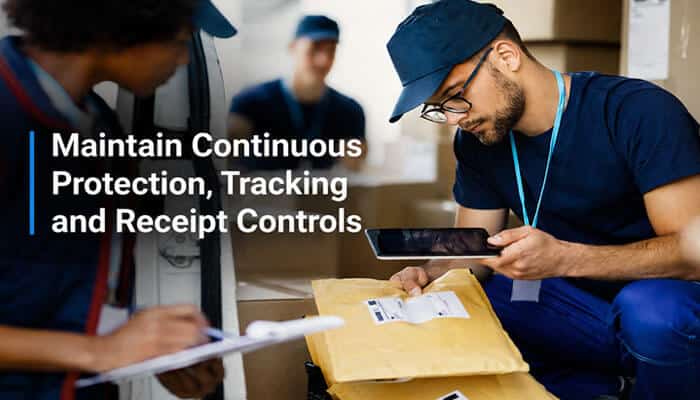
Couriers and hand carriers must maintain continuous protection of Secret information and make direct delivery.
Courier Responsibilities
An authorized courier may need to:
- Complete a security briefing
- Carry identification and authorization
- Keep the material in personal possession
- Follow the approved route
- Arrange approved storage if necessary
- Deliver only to an authorized recipient
- Obtain acknowledgment of receipt
- Report delays, loss or suspicious activity immediately
What Couriers Must Avoid
Do not:
- Put Secret material in checked baggage
- Leave it unattended in a vehicle
- Store it in an ordinary hotel room
- Give it to an unauthorized person
- Leave it at a reception desk
- Discuss classified contents in public
Special procedures also apply when classified material is carried on commercial aircraft.
Receiving Responsibilities
The receiving organization should:
- Restrict access to authorized personnel
- Inspect the package for tampering
- Confirm the contents
- Secure the material immediately
- Provide required acknowledgment
- Report any suspected compromise
If the intended recipient is unavailable, follow the approved contingency procedure rather than leaving the material unattended.
8. Apply Additional Rules to International and Special-Category Transfers
International transmission of classified information usually requires additional approval and government-controlled channels.
Transfers to foreign governments may require:
- Government-to-government transmission
- Foreign-disclosure approval
- Approved couriers or transportation plans
- Controlled transfer points
- Signed receipts
- Export or customs authorization
Classified information sent to U.S. facilities overseas must also use approved government methods and remain under required U.S. control.
Special Categories Require Separate Review
Standard collateral Secret procedures may not be sufficient for:
- SCI
- SAP information
- COMSEC
- NATO information
- Foreign Government Information
- Restricted Data
- Formerly Restricted Data
- Cryptographic or specially controlled technical material
The controlling authority, program office or security guide must determine the correct transmission method.
9. Immediately Report Loss, Tampering or Possible Compromise
Another critical part of what requirements apply when transmitting Secret information is immediate reporting when information may have been lost, exposed or sent incorrectly.
Report incidents such as:
- Secret information sent through unclassified email
- Uploading classified material to an unauthorized cloud or AI system
- Delivery to the wrong address or person
- Broken packaging or missing material
- Loss of courier control
- Use of an unauthorized carrier
- A classified discussion over an unsecured system
- A suspected data spill
Do not wait for proof that an unauthorized person actually viewed the information.
What to Do After Discovering a Problem
- Stop further transmission or disclosure.
- Protect the material from additional access.
- Notify the designated security official immediately.
- Follow instructions for isolating affected systems or packages.
- Preserve relevant logs, receipts and tracking records.
- Do not delete evidence or contact unauthorized recipients unless instructed.
- Cooperate with the security investigation.
The goal is to contain the incident quickly and limit any potential damage.
Is There an Emergency Exception?
When considering what requirements apply when transmitting Secret information, federal rules provide a narrow emergency exception—but individual employees cannot invoke it on their own.
An agency head or authorized designee may permit limited disclosure during an imminent threat to life or defense of the homeland.
The authorization should generally:
- Limit disclosure to the minimum necessary
- Limit the number of recipients
- Use the most secure available government channel
- Provide safeguarding instructions
- Brief recipients on nondisclosure responsibilities
- Obtain signed nondisclosure agreements
- Notify the originating agency within 72 hours when possible, and no later than 30 days
This exception does not apply simply because a deadline is urgent, an approved system is unavailable or a faster commercial method seems convenient.
Only an appropriately authorized official may approve emergency disclosure.
Secret Transmission Decision Table
Use this table as a quick guide; always follow current agency procedures.
| Situation | Starting point | Verify |
|---|---|---|
| Electronic Secret document | Approved classified system | Authorization, recipient access, markings |
| Secret call | Secure voice system | Participants, need-to-know, secure location |
| Hand-carrying material | Authorized courier procedure | Briefing, custody, storage |
| Domestic mailing | Approved USPS procedure | Double wrapping, signature, receipt |
| Commercial overnight delivery | Agency/CSA-approved service | Approval, tracking, authorized recipient |
| Cleared contractor | Contract/NISP procedures | Facility eligibility and storage |
| Overseas or foreign transfer | Approved government channel | Disclosure approval and route |
| COMSEC, NATO or FGI | Category-specific method | Special restrictions |
| Emergency | Authorized emergency procedure | Official approval and reporting |
| Transmission error | Immediate security reporting | Containment and notification |
Who Is Responsible at Each Stage?
Understanding what requirements apply when transmitting Secret information also means knowing who is responsible at each stage.
| Participant | Main responsibility |
|---|---|
| Sender | Verify classification, recipient, need-to-know, address, storage and transmission method |
| Security office | Interpret policy, approve procedures, brief couriers and handle incidents |
| Classification authority | Resolve classification and marking questions |
| Courier or hand carrier | Maintain continuous protection and direct delivery |
| Carrier or messenger | Meet approved tracking and delivery requirements |
| Receiving official | Inspect, secure and acknowledge the material |
| Information-system personnel | Maintain authorized systems and security controls |
| Originating agency | Control disclosure and provide classification guidance |
| Program/foreign-disclosure office | Approve restricted or international transfers |
| Cognizant Security Agency | Oversee applicable contractor safeguards |
The sender must confirm that the recipient is authorized and able to safeguard the material, while the receiving organization must inspect, secure and acknowledge it according to applicable procedures.
Pre-Transmission Checklist
Classification and Marking
- Classification and markings are correct.
- Dissemination controls and special categories are reviewed.
- The originating agency permits disclosure.
Sender Authorization
- The sender has current eligibility and required training.
- Any courier designation or written approval is current.
- Incident procedures are understood.
Recipient Verification
- Identity, eligibility and need-to-know are confirmed.
- Required program or compartment access is verified.
- Approved Secret storage and an authorized receiving official are available.
Electronic Transmission
- The system is authorized for Secret information.
- All participants and locations are approved.
- Attachments and communications are marked correctly.
Physical Packaging
- Two protective enclosures are used when required.
- The inner enclosure carries required classification and recipient information.
- The outer enclosure does not reveal classified contents.
- Packaging, sealing and delivery address are verified.
Delivery and Accountability
- The transmission method and carrier are authorized.
- No external collection box or signature waiver is used.
- Tracking and receipt procedures are in place.
- A contingency plan exists for delayed or failed delivery.
Common Mistakes When Transmitting Secret Information
- Assuming encryption alone makes a system approved.
- Treating a clearance as unlimited access.
- Failing to verify need-to-know and storage capability.
- Revealing classified contents on the outer package.
- Using an unauthorized carrier or shipping method.
- Waiving required signature controls.
- Using street-side or unattended collection boxes.
- Leaving Secret material unattended.
- Using ordinary phones, public AI tools or unapproved systems.
- Ignoring special handling rules for SCI, SAP, COMSEC, NATO or FGI.
- Relying on outdated procedures.
- Delaying reports of suspected loss or compromise.
Frequently Asked Questions
1. What requirements apply when transmitting Secret information?
When considering what requirements apply when transmitting Secret information, the sender must verify classification, markings, recipient eligibility, need-to-know, storage capability and the approved transmission method. Electronic transmission requires an authorized classified system, while physical transmission may require secure packaging and receipt controls.
2. Can Secret information be sent through regular email?
No. Personal email, commercial email and unclassified government email are not approved for Secret information. An authorized classified system must be used.
3. Can Secret information be sent through USPS?
Only through a currently authorized USPS procedure. Current ISOO public guidance identifies USPS Registered Mail as the authorized USPS method for applicable collateral Secret-and-below information. Always confirm current agency instructions before mailing classified material.
4. Is a security clearance enough to receive Secret information?
No. The recipient generally must also have a valid need-to-know, an approved nondisclosure agreement and any required program or compartment access.
5. Does Secret information require double wrapping?
Physical transmission outside a secure facility generally requires two protective enclosures. The inner wrapper carries required classification markings, while the outer wrapper must not reveal the classified contents.
6. Can Secret information be entered into ChatGPT or another AI tool?
Not unless the AI system and its environment are specifically authorized for the classified information. Public or ordinary commercial AI services must not be used to process Secret information.
7. What happens if Secret information is sent to the wrong person?
The incident should be reported immediately to the designated security official. Further disclosure should be stopped where possible, the information protected and relevant evidence preserved.
8. Can Secret information be sent through FedEx, UPS or another carrier?
Only through an approved agency or Cognizant Security Agency arrangement that meets applicable tracking, delivery, signature and security requirements. An ordinary retail shipping account does not provide authorization.
Conclusion
So, what requirements apply when transmitting Secret information?
The sender must confirm that the information is properly classified and marked, verify the recipient’s eligibility and need-to-know, ensure that the destination can safeguard it and select a method currently authorized for the classification, information category and destination.
Electronic information must remain on approved classified systems. Physical material generally requires two protective enclosures, tamper protection, authorized custody and confirmed receipt.
External collection boxes are prohibited, and required signature controls must not be waived.
Additional restrictions apply to couriers, commercial carriers, overseas facilities, foreign governments, special-access information and other controlled categories.
Any loss, delay, tampering, incorrect delivery or possible unauthorized disclosure must be reported immediately.
