



If your internet feels slow, unstable, or inconsistent, a Google Speed Test can be a useful starting point for checking your connection performance. A speed test can help you understand whether slow browsing, buffering, gaming lag, video-call problems, or large-download delays may be related to your internet connection.
One important clarification is that Google Speed Test is not the name of one universal standalone speed-testing product. The term is commonly used to describe Google’s available internet speed-testing experiences. Google also provides a built-in speed test through the Google Home app for compatible Google Wifi and Nest Wifi systems.
The Google Home speed test measures the connection between your router or primary Wi-Fi point and Google’s servers. That is different from measuring the wireless connection between a particular phone or laptop and the router.
A useful internet speed test is about more than finding the highest Mbps number. Your actual online experience can also depend on download speed, upload speed, latency, jitter, packet loss, Wi-Fi signal strength, network congestion, device limitations, router performance, VPNs, and server location.
This guide explains how to run a Google Speed Test, how to understand your results, what counts as a good internet speed, why different speed tests produce different numbers, and how to troubleshoot a slow or unreliable connection.
Google Speed Test at a Glance
| Question | Quick answer |
|---|---|
| What does a speed test measure? | Network performance under specific testing conditions |
| Main measurements | Download and upload speed |
| Speed unit | Mbps |
| Other important measurements | Latency, jitter, and packet loss |
| Best test for ISP troubleshooting | Wired Ethernet test |
| Why can results change? | Congestion, Wi-Fi, device, server, and routing differences |
| Is one test enough? | No, especially for troubleshooting |
| Does Wi-Fi affect results? | Yes |
| Does a VPN affect results? | It can |
| Does high download speed guarantee good gaming? | No |
| Best approach | Compare repeated tests under consistent conditions |
What Is Google Speed Test?
Google Speed Test is a commonly searched term for checking internet connection performance using Google’s speed-testing tools.
For compatible Nest Wifi Pro, Nest Wifi, and Google Wifi networks, Google provides a speed test through the Google Home app. It measures download and upload performance between the router or primary Wi-Fi point and Google’s servers.
This does not necessarily measure the Wi-Fi speed of your individual device. For example, a router may receive 900 Mbps, while a laptop gets 750 Mbps near the router and only 200 Mbps in a distant room.
Why Google Speed Test Results Can Vary
Results can change because of:
- Server location and network routing
- ISP congestion
- Wi-Fi signal strength
- Device or router limitations
- Other network activity
- VPNs
- Testing methodology
Therefore, different speed-test results do not automatically mean one test is inaccurate.
How Does a Google Speed Test Work?
An internet speed test transfers test data between your network and a test server and measures how quickly the data can be transmitted.
The main measurements are:
- Download speed
- Upload speed
- Latency or ping
- Jitter
- Packet loss, when supported
The result is normally expressed in megabits per second (Mbps).
For example, a result of 100 Mbps means the test measured approximately 100 megabits of data transfer per second under those testing conditions.
It does not mean every website, application, streaming service, or file download will always operate at exactly 100 Mbps.
How to Run a Google Speed Test
You can test your general internet connection or use the built-in test for compatible Google Wifi and Nest Wifi networks.
How to Test Internet Speed Online
- Open a web browser.
- Search for a reputable internet speed test.
- Start the test and wait for it to finish.
- Record download, upload, and latency results.
For troubleshooting, run multiple tests under similar conditions.
How to Run a Speed Test in Google Home
For compatible Google Wifi or Nest Wifi networks, open the Google Home app and go to:
Home → Wi-Fi → Network Preference → Run speed test
Important Distinction
The Google Home test measures the connection between your router or primary Wi-Fi point and Google’s servers. It does not necessarily measure your device’s Wi-Fi speed.
To troubleshoot slow Wi-Fi, test the device both near the router and in the problem area.
How We Evaluate Internet Speed Tests
We evaluate speed-test results using the core measurements that affect real-world connectivity, including download speed, upload speed, latency, jitter, packet loss, Wi-Fi conditions, and testing consistency.
For ISP troubleshooting, we recommend comparing repeated wired and wireless results rather than relying on a single measurement.
A reliable evaluation should consider both the measured number and the conditions under which that number was produced.
What Does a Google Speed Test Measure?
Download Speed
Download speed measures how quickly data can be received from internet servers.
It is measured in Mbps.
Download performance affects activities such as:
- Streaming movies and TV
- Browsing websites
- Downloading applications
- Downloading games
- Loading large webpages
- Receiving files
- Using cloud applications
Higher download speed generally provides more capacity for simultaneous high-bandwidth activities.
Upload Speed
Upload speed measures how quickly your network can send data to an internet server.
Upload speed matters for:
- Video calls
- Voice calls
- Live streaming
- Cloud backups
- Uploading photos
- Uploading videos
- Sending large files
- Remote-work applications
For example, a 500 Mbps download / 20 Mbps upload connection can be excellent for downloading content while providing substantially less capacity for large uploads.
Latency or Ping
Latency measures the time required for data to travel through a network and receive a response.
It is generally measured in milliseconds (ms).
Lower and more consistent latency is especially useful for:
- Online gaming
- Video conferencing
- Voice calls
- Remote desktop
- Real-time collaboration
A connection can have extremely high download speed and still feel sluggish if latency is high.
Jitter
Jitter describes changes in latency over time.
For example:
Stable latency:
20 ms → 21 ms → 19 ms → 22 ms
Unstable latency:
20 ms → 90 ms → 35 ms → 180 ms
High jitter can contribute to:
- Gaming problems
- Choppy video calls
- Voice-call problems
- Delays
- Real-time application instability
Packet Loss
Packet loss occurs when data packets fail to reach their intended destination.
Significant packet loss can cause:
- Game disconnects
- Frozen video calls
- Choppy audio
- Retransmissions
- Unstable applications
- Connection interruptions
This is why a high Mbps result does not necessarily mean the connection is healthy in every respect.
Download Speed vs. Upload Speed
| Feature | Download | Upload |
|---|---|---|
| Data direction | Internet → You | You → Internet |
| Important for | Streaming and downloads | Backups and uploads |
| Video calls | Receiving video | Sending video |
| Cloud storage | Downloading files | Uploading files |
| Gaming | Updates and downloads | Sending game data |
| Higher is generally better | Yes | Yes |
Modern internet usage makes upload speed increasingly important because cloud storage, video conferencing, remote work, content creation, and large file transfers all require upstream bandwidth.
What Is a Good Internet Speed?
There is no single internet speed that is ideal for everyone.
The right speed depends on:
- Number of people using the network
- Number of connected devices
- Streaming quality
- Gaming
- Video conferencing
- File transfers
- Cloud backups
- Remote work
- Smart-home devices
- Simultaneous usage
The following figures are general guidelines rather than universal minimum requirements. Actual requirements vary by application, video quality, device, network conditions, and the number of simultaneous users.
| Download speed | General use |
|---|---|
| Under 3 Mbps | Basic browsing; video may load slowly |
| 3 Mbps+ | Basic browsing and standard-definition activities |
| 7 Mbps+ | Around one HD video stream under suitable conditions |
| 13 Mbps+ | Several lighter HD activities under suitable conditions |
| 25 Mbps+ | Multiple everyday HD activities |
| 50 Mbps+ | 4K streaming plus other activities |
| 100 Mbps+ | Multiple demanding activities simultaneously |
These figures should be treated as approximate guidance, not guarantees.
Is 100 Mbps Fast?
For many households, 100 Mbps is a good everyday internet speed.
It can support activities such as:
- HD streaming
- 4K streaming
- Video calls
- Online gaming
- Web browsing
- Large downloads
- Multiple connected devices
However, a household with many simultaneous high-bandwidth users may benefit from more capacity.
The important question is not simply whether 100 Mbps is “fast.” The question is whether it provides enough capacity for your household’s simultaneous activities.
Is 500 Mbps Fast?
Yes. 500 Mbps provides substantial bandwidth for most home users.
A 500 Mbps connection can provide enough capacity for many simultaneous activities, assuming your router, devices, Wi-Fi, and network equipment can deliver that performance.
A household might simultaneously:
- Stream 4K video
- Attend video meetings
- Play online games
- Download large files
- Use cloud services
- Connect smart-home devices
without necessarily exhausting a 500 Mbps connection.
Is 1 Gbps Fast?
Yes.
1 Gbps = 1,000 Mbps.
Because 8 bits equal 1 byte:
1,000 Mbps ÷ 8 = 125 MB/s
That is a theoretical conversion. It does not mean every download will reach 125 MB/s.
Actual performance can be limited by:
- Server performance
- Router hardware
- Wi-Fi
- Ethernet equipment
- Computer storage
- Network congestion
- Protocol overhead
What Is a Good Upload Speed?
There is no universal minimum upload speed, but these broad ranges can help you interpret your results:
| Upload Speed | General Interpretation |
|---|---|
| 5–10 Mbps | Basic video calls and occasional uploads |
| 10–25 Mbps | Comfortable for many everyday users |
| 25–50 Mbps | Good for remote work, cloud backups, and frequent uploads |
| 50–100+ Mbps | Useful for creators, large-file transfers, and heavy upload workloads |
Your actual requirements depend on the applications you use and how many people are uploading simultaneously.
A 20 Mbps upload speed may be perfectly adequate for one household but restrictive for a content creator who regularly uploads large video files.
What Is a Good Ping or Latency?
Lower latency is generally better for interactive applications.
| Latency | General experience |
|---|---|
| Under 20 ms | Excellent responsiveness |
| 20–50 ms | Very good |
| 50–100 ms | Generally usable |
| 100–150 ms | Noticeable delay may occur |
| 150+ ms | Often problematic for real-time applications |
These are general guidelines, not guarantees.
Gaming performance also depends on jitter, packet loss, server distance, Wi-Fi stability, and the game’s network architecture.
How to Understand Your Google Speed Test Results
A speed-test result should be evaluated based on both speed and connection quality.
| Download Result | General Interpretation |
|---|---|
| Under 10 Mbps | Light use; multiple activities may be difficult |
| 10–25 Mbps | Suitable for lighter household use |
| 25–100 Mbps | Good for many everyday households |
| 100–500 Mbps | Fast for most households |
| 500 Mbps–1 Gbps | Very high bandwidth for most homes |
| 1 Gbps+ | Useful for high-demand households and workloads |
These are broad guidelines. A 50 Mbps connection with low latency and no packet loss can sometimes provide a better experience than a faster but unstable connection.
Example of a Good Speed-Test Result
Download: 312 Mbps
Upload: 42 Mbps
Latency: 18 ms
This indicates plenty of bandwidth, good upload capacity, and generally responsive performance, assuming the connection is stable.
Example of a Fast but Unstable Result
Download: 450 Mbps
Upload: 15 Mbps
Latency: 120 ms
Although the download speed is high, elevated latency and lower upload capacity may affect gaming, calls, and demanding uploads.
Higher Mbps does not automatically mean better internet performance.
Mbps vs. MB/s: What’s the Difference?
This is one of the most common internet-speed misunderstandings.
Mbps
Mbps means megabits per second.
MB/s
MB/s means megabytes per second.
Because:
8 bits = 1 byte
you can approximately convert Mbps to MB/s by dividing by 8.
Example: 100 Mbps
100 ÷ 8 = 12.5 MB/s
Therefore, a 100 Mbps connection has a theoretical transfer rate of approximately 12.5 megabytes per second.
Actual file-transfer rates can be lower because of network overhead, server limitations, congestion, and other factors.
Why Is My Google Speed Test Slower Than My Internet Plan?
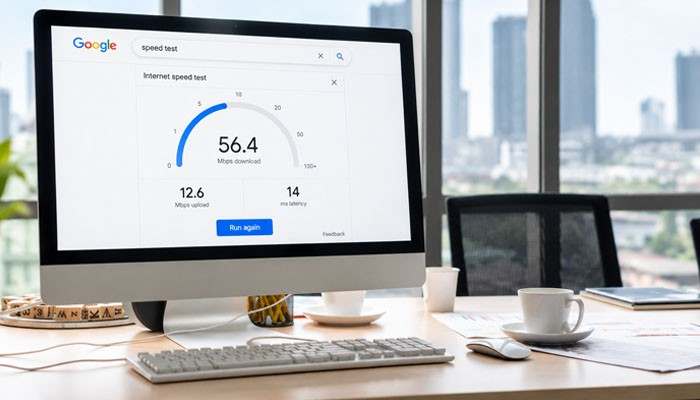
Suppose your internet plan is advertised as 500 Mbps, but a speed test shows 350 Mbps.
That does not automatically mean your ISP is failing to provide the service.
Possible explanations include:
- Wi-Fi limitations
- Device limitations
- Router limitations
- Network congestion
- Other devices using bandwidth
- VPN routing
- Ethernet limitations
- Server location
- Network routing
- Test methodology
The key question here is whether your connection is consistently underperforming after local limitations have been ruled out.
For example, if a laptop over Wi-Fi repeatedly gets 350 Mbps while a wired computer gets close to the expected plan speed, the Wi-Fi connection is the more likely limitation.
For ISP troubleshooting, perform controlled Ethernet tests, minimize other network traffic, test more than once, and compare the results with your plan.
Why Do Different Speed Tests Give Different Results?
Different speed tests can produce different numbers because they may use different:
- Servers
- Server locations
- Network routes
- Testing protocols
- Numbers of connections
- Measurement methods
- Infrastructure
For example, a test against a nearby server may produce a different result from a test against a distant server.
ISP peering and congestion can also influence the route between your network and a particular test server.
The key point is that different speed-test results do not automatically mean that one service is inaccurate. They may simply be measuring your connection under different network conditions.
When comparing performance over time, use the same testing service and similar testing conditions whenever possible.
Why Does My Speed Test Change Throughout the Day?
Internet performance can change throughout the day, often because of network congestion.
For example:
| Time | Result |
|---|---|
| 8 AM | 480 Mbps |
| 1 PM | 450 Mbps |
| 7 PM | 310 Mbps |
| 11 PM | 470 Mbps |
If this pattern repeats, especially during evening hours, it may indicate peak-period congestion.
However, one unusually low result is not enough to establish a pattern. For better evidence, run tests at similar times across several days.
How to Get the Most Accurate Speed-Test Result
For ISP troubleshooting, use consistent testing conditions.
1. Test Over Ethernet
Connect your computer directly to the router with Ethernet to reduce Wi-Fi variables.
2. Stop Other High-Bandwidth Activities
Pause streaming, downloads, cloud backups, uploads, and software updates during the test.
3. Pause Unnecessary Devices
Other connected devices can compete for bandwidth.
4. Disable Your VPN Temporarily
A VPN can affect routing, speed, and latency.
5. Run Several Tests
Don’t rely on a single result.
6. Test at Different Times
Testing at different times can reveal possible congestion.
7. Test More Than One Device
If only one device is slow, the problem may be specific to that device.
Ethernet vs. Wi-Fi Speed Test
Testing wired and wireless connections separately can help identify where the problem occurs.
| Test | What It Helps Determine |
|---|---|
| Ethernet | Internet and router performance |
| Wi-Fi near router | Wireless performance with a strong signal |
| Wi-Fi far from router | Coverage and signal-related issues |
| Different device | Device-specific limitations |
Example
Suppose you get:
- Ethernet: 930 Mbps
- Wi-Fi near router: 780 Mbps
- Bedroom Wi-Fi: 190 Mbps
This suggests the internet connection is fast, while Wi-Fi conditions are limiting performance in the bedroom.
In this case, a faster internet plan may not solve the problem.
Why Is Wi-Fi Slower Than Ethernet?
Wi-Fi performance can be affected by:
- Distance from the router
- Walls
- Floors
- Building materials
- Wireless interference
- Router hardware
- Device hardware
- Wi-Fi frequency
- Network congestion
Newer devices and wireless standards can generally provide higher performance than older equipment.
The 2.4 GHz band can also behave differently from 5 GHz, particularly with respect to range, interference, and achievable performance.
How to Improve Slow Wi-Fi
If your wired connection is fast but Wi-Fi is slow, try these steps.
Move Closer to the Router
Distance can significantly affect wireless performance.
Place the Router in a Better Location
An open, central location is generally preferable to hiding the router behind objects or placing it on the floor.
Reduce Physical Obstructions
Walls and dense materials can weaken wireless signals.
Check Mesh Placement
If you use a mesh network, the connection between mesh points matters as well.
Restart Your Network
Restarting network equipment can sometimes resolve temporary connectivity problems.
Check the Device
An older phone, laptop, or wireless adapter may not support the same Wi-Fi performance as newer hardware.
What Is a Mesh Wi-Fi Speed Test and How Does It Differ?
A mesh test is different from an internet speed test.
An internet speed test generally measures performance between your network and an internet server.
A mesh test evaluates the connection between the primary Wi-Fi point and additional mesh points.
Internet Speed Test
Router/Wi-Fi point → Internet server
Mesh Test
Primary Wi-Fi point → Additional Wi-Fi point
This distinction is important in larger homes.
A fast internet connection can still provide poor performance in a room if the mesh point serving that room has a weak connection to the primary point.
What If My Speed Is Good but My Internet Still Feels Slow?
A high Mbps result does not guarantee a responsive or stable connection.
Potential causes include:
- High latency
- Jitter
- Packet loss
- DNS problems
- Wi-Fi instability
- Slow website or application servers
- Device performance problems
- Browser extensions
- Background processes
For example, imagine:
Download: 800 Mbps
Upload: 500 Mbps
Those numbers look excellent.
But if the connection experiences significant latency spikes or packet loss, gaming and video calls can still perform poorly.
This is why internet speed and connection quality are related but not identical.
What If Download Speed Is Good but Upload Speed Is Poor?
Some internet plans intentionally provide much higher download speeds than upload speeds.
For example:
500 Mbps download / 20 Mbps upload
may be normal for an asymmetric broadband plan.
However, if your plan promises substantially higher upload performance and repeated tests consistently fall far below that level, investigate the connection.
Upload speed is especially important for:
- Cloud backups
- Video uploads
- Live streaming
- Video conferencing
- Large file transfers
- Remote work
Does a VPN Affect Google Speed Test Results?
Yes.
A VPN can affect:
- Download speed
- Upload speed
- Latency
- Routing
The effect depends on the VPN server, distance, congestion, encryption, and device performance.
If you’re diagnosing your normal internet connection, temporarily test without the VPN.
Does a Speed Test Use Internet Data?
Yes.
A speed test transfers test data to measure your connection.
The amount of data consumed depends on the testing service, test duration, connection speed, and testing method.
If you have a strict mobile-data allowance, avoid unnecessary repeated tests.
Can a Speed Test Prove Your ISP Is Slow?
Not by itself.
One speed test is only a snapshot of your connection under particular conditions.
For stronger evidence:
- Test over Ethernet.
- Stop bandwidth-heavy activities.
- Disable your VPN.
- Run multiple tests.
- Test at different times.
- Test more than one device.
- Record your results.
- Compare the results with your service plan.
- Check for outages.
- Contact your ISP if the problem persists.
A repeated pattern is much more useful than one unusually low result.
How to Compare Your Speed Test With Your ISP Plan
Suppose your plan provides:
500 Mbps download / 50 Mbps upload
You perform these tests:
| Test | Download | Upload |
|---|---|---|
| Ethernet – morning | 490 Mbps | 48 Mbps |
| Ethernet – afternoon | 475 Mbps | 47 Mbps |
| Ethernet – evening | 460 Mbps | 45 Mbps |
| Wi-Fi – bedroom | 180 Mbps | 25 Mbps |
The wired results are close to the plan’s advertised speeds, while the bedroom Wi-Fi results are significantly lower.
This pattern suggests that Wi-Fi performance, rather than ISP bandwidth, may be the main issue.
What If My Speed Is Consistently Low?
If repeated Ethernet tests remain significantly below the performance you expect, investigate the network from the physical connection outward.
Check the Ethernet Cable
A cable or network component can limit connection performance.
For higher-speed connections, make sure the cable and other network equipment support the required speed.
Check Router Ports
Verify that your router and other network equipment support your internet plan.
Restart the Modem and Router
A restart can sometimes resolve temporary networking problems.
Test Another Computer
This helps determine whether the issue is specific to one device.
Contact Your ISP
If multiple wired tests remain substantially below expected performance after you’ve ruled out local equipment, your ISP may need to investigate the connection.
Why Is My Internet Slow at Night?
Peak-hour congestion is one possible explanation.
More people may be using the network during busy periods, which can affect performance.
To investigate:
- Test in the morning.
- Test in the afternoon.
- Test during evening hours.
- Repeat across several days.
- Compare Ethernet results.
If the same slowdown consistently occurs at similar times, you have stronger evidence of a time-related performance pattern.
Google Speed Test for Mobile Internet
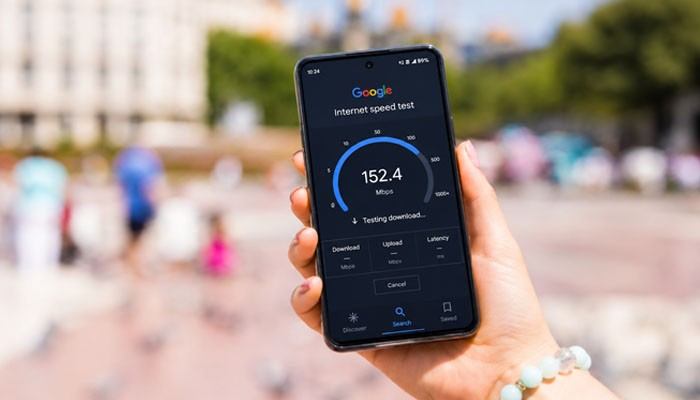
You can also test mobile internet performance from a smartphone using a browser-based speed-testing service.
For a useful mobile test:
- Turn off Wi-Fi.
- Confirm mobile data is enabled.
- Run the speed test.
- Record download speed.
- Record upload speed.
- Record latency if available.
- Repeat in different locations.
Mobile performance can change because of:
- Signal strength
- Network congestion
- Location
- Indoor coverage
- Device capabilities
- Cellular technology
- Carrier network conditions
A mobile speed-test result therefore represents performance at a particular time and place.
Why Is My Real Download Slower Than My Speed Test?
This question is different from asking why the speed test itself is slower than your internet plan.
A speed test measures performance between your connection and a particular test server.
A real download may come from a completely different server.
The file server could have:
- Limited capacity
- High traffic
- Geographic distance
- Routing limitations
- Server-side restrictions
Your own device can also become the bottleneck.
Therefore, a 500 Mbps speed test does not guarantee that every download will operate at 500 Mbps.
The speed test measures the capacity observed during its own test, while an actual download depends on the complete path between your device and the server hosting the file.
Why Is My Speed Test Slower Than My Real-World Internet?
The reverse can also happen: your normal browsing or downloads may feel faster than the number reported by a particular speed test.
In this case, the issue may be specific to the test path rather than your general internet experience.
A particular test server may be:
- Far away
- Congested
- Reached through a less efficient route
Meanwhile, the websites and services you normally use may be delivered through nearby content-delivery networks.
This is why a speed test should be treated as a measurement of your connection under specific conditions, rather than a universal score for the entire internet.
Google Speed Test vs. ISP Speed Test
Both can be useful, but they may answer slightly different questions.
| Feature | Google-related test | ISP speed test |
|---|---|---|
| Measures connection performance | Yes | Yes |
| Server infrastructure | Depends on Google’s testing service | Often provider-controlled |
| Can vary by server | Yes | Yes |
| Useful for troubleshooting | Yes | Yes |
| Useful for checking ISP network | Yes | Often particularly useful |
For troubleshooting, comparing an external test with an ISP-provided test can provide additional context.
Google Speed Test vs. Other Speed Tests
There is no universal rule that one speed test is always “correct.”
Different platforms may use:
- Different servers
- Different protocols
- Different network paths
- Different numbers of connections
- Different measurement methods
The best approach is to use a reputable testing service consistently when comparing performance over time.
If you’re diagnosing an ISP problem, using more than one test can provide additional evidence.
Does Internet Speed Affect Online Gaming?
Yes, but extremely high download speed is not necessarily the most important factor.
Gaming can be affected by:
- Ping
- Latency
- Jitter
- Packet loss
- Connection stability
- Server location
- Wi-Fi performance
If your connection already has sufficient bandwidth, upgrading from one high-speed tier to an even higher tier may not significantly reduce game latency.
Does Internet Speed Affect Video Calls?
Yes.
Video calls use both download and upload bandwidth.
A weak upload connection can affect the video and audio you send to other participants.
Latency and jitter can also cause:
- Delays
- Choppy audio
- Frozen video
- Synchronization problems
For video conferencing, a stable connection can be more important than simply having the highest possible Mbps number.
When Should You Run a Google Speed Test?
A speed test is useful when:
- Websites suddenly load slowly.
- Videos keep buffering.
- Games experience unusual lag.
- Video calls become unstable.
- Downloads take longer than usual.
- You upgraded your internet plan.
- You installed a new router.
- You changed your Wi-Fi setup.
- One room has much slower Wi-Fi.
- You suspect an ISP problem.
You do not need to run speed tests constantly. Test when you have a specific reason to evaluate your connection.
How Many Times Should You Run a Speed Test?
For a quick check, one test may be enough.
For troubleshooting, use a more structured approach:
- Three tests close together
- Three tests at different times
- At least one Ethernet test
- At least one Wi-Fi test
- A test on another device if necessary
Look for a consistent pattern, not simply the highest or lowest number.
Common Google Speed Test Mistakes
- Testing only once — A single test may be affected by temporary congestion.
- Testing over weak Wi-Fi — Poor Wi-Fi can reduce your results.
- Using the internet during the test — Downloads and streaming can consume bandwidth.
- Ignoring upload speed — Upload speed matters for video calls, cloud backups, and remote work.
- Looking only at download speed — Latency, jitter, and packet loss also affect performance.
- Ignoring server location — Different servers can produce different results.
- Assuming the fastest result is correct — Results can vary depending on testing conditions.
Google Speed Test Troubleshooting Decision Tree
If your internet seems slow, use this process:
Step 1: Run a speed test
↓
Is the result lower than expected?
No: Check latency, packet loss, Wi-Fi stability, or the specific application.
Yes: Continue.
↓
Step 2: Test over Ethernet
Ethernet is fast: Wi-Fi is likely the problem.
Ethernet is also slow: Continue.
↓
Step 3: Test at another time
Only slow during busy periods: Congestion may be involved.
Always slow: Continue.
↓
Step 4: Test another device
Only one device is slow: Investigate that device.
Multiple devices are slow: Continue.
↓
Step 5: Check router, modem, cables and ISP
If repeated wired tests remain significantly below expected performance, contact your ISP.
Google Speed Test Privacy: What Data Can Be Collected?
Privacy depends on the specific testing service and infrastructure being used.
Different speed-testing services can have different privacy practices.
Some testing systems use third-party measurement infrastructure and may collect technical information associated with the test, such as network information or an IP address.
A speed test is designed to measure connection performance. That does not mean it is necessarily monitoring your normal browsing activity.
If privacy is important to you, review the current privacy documentation of the specific speed-testing service before running a test.
What Does 45 Mbps Mean?
A result of 45 Mbps means the test measured approximately 45 megabits per second under those testing conditions.
To convert it to megabytes per second:
45 ÷ 8 = 5.625 MB/s
So 45 Mbps is approximately 5.6 MB/s under an ideal mathematical conversion.
Real file transfers can be slower because of network overhead, server limitations, congestion, and other factors.
What Does 500 Mbps Mean?
A 500 Mbps connection has a theoretical byte rate of:
500 ÷ 8 = 62.5 MB/s
That does not mean every download will reach 62.5 MB/s.
The actual rate depends on the entire network path.
What Does 1 Gbps Mean?
A 1 Gbps connection equals:
1,000 Mbps
Theoretical conversion:
1,000 ÷ 8 = 125 MB/s
Actual transfer performance depends on:
- Network equipment
- Wi-Fi or Ethernet
- Server performance
- Network congestion
- Device hardware
- Protocol overhead
Frequently Asked Questions About Google Speed Test
1. What Is Google Speed Test?
Google Speed Test is a commonly searched term for checking internet performance using Google’s available speed-testing experiences. Google provides a built-in speed test through the Google Home app for compatible Google Wifi and Nest Wifi networks.
2. How Do I Run a Google Speed Test?
For compatible Google Wifi or Nest Wifi networks, open Google Home and go to Home → Wi-Fi → Network Preference → Run speed test. For general internet testing, use a reputable browser-based speed-testing service.
3. Is 100 Mbps Fast Enough?
For many individuals and households, 100 Mbps is enough for browsing, streaming, video calls, gaming, and multiple connected devices. Larger households with heavy simultaneous usage may need more bandwidth.
4. What Is a Good Ping for Gaming?
Lower and more consistent latency is generally better for gaming. However, gaming performance also depends on jitter, packet loss, server location, and Wi-Fi stability.
5. Why Do Different Speed Tests Show Different Results?
Different tests may use different servers, locations, network routes, and testing methods, so their results can vary.
6. Why Is My Internet Slower at Night?
Peak-hour congestion can reduce internet performance. Testing at different times over several days can help identify whether your connection consistently slows during busy periods.
7. Should I Test With Wi-Fi or Ethernet?
Use Ethernet when troubleshooting your ISP connection because it eliminates many wireless variables. Use Wi-Fi when checking the wireless performance you experience in different areas of your home.
8. Does a Faster Internet Plan Always Improve Wi-Fi?
No. If your internet connection is already fast but Wi-Fi coverage is poor, upgrading your plan may not help. Router placement, Wi-Fi hardware, interference, and mesh configuration can be more important.
Final Thoughts: Is Google Speed Test Reliable?
A Google Speed Test can be a useful starting point for evaluating internet performance, but the result should always be interpreted in context.
A speed test measures your connection under specific conditions. The result can be influenced by:
- Wi-Fi quality
- Device capabilities
- Router hardware
- Network congestion
- Server location
- Internet routing
- VPNs
- Other connected devices
- Testing methodology
For the most useful diagnosis, start with an Ethernet test, stop other bandwidth-heavy activities, temporarily disable your VPN, run multiple tests, compare different times of day, and then test Wi-Fi separately.
Most importantly, don’t judge your entire internet connection by download speed alone. Upload speed, latency, jitter, packet loss, Wi-Fi coverage, and consistency can all affect how your connection performs in real-world use.
If repeated wired tests remain substantially below the performance you expect from your plan, contact your ISP and provide your recorded results.
The goal of a Google Speed Test isn’t simply to find the largest Mbps number. The real goal is to determine whether your internet connection is fast, stable, and reliable enough for the way you actually use it.
