
Last Updated: August 14, 2026
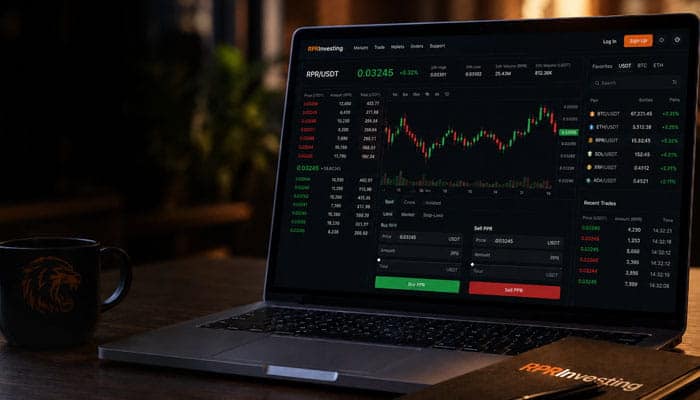
The RPRInvesting Exchange Guide from RipRoar, published in August 2026, describes RPRInvesting as an exchange with cryptocurrencies, stablecoins, selected tokenized equities, fiat funding, margin trading, an OTC desk, API access, multiple order types and security controls.
But RPRInvesting.com tells a different story. Its own article describes RPRs as Real Property Rights represented as digital tokens tied to fractional interests in physical property, while its official-information page identifies RPRInvesting.com as an independent publication and information resource rather than clearly presenting it as a regulated financial exchange.
There is another layer: RipRoar separately uses “RPRInvesting” to describe a rules-based trading method built around entries, stops, position sizing and trading discipline.
So before asking whether RPRInvesting has attractive fees, strong security or interesting investment opportunities, traders need to answer a more fundamental question:
What exactly is the product, who legally operates it, and what does an investor actually own?
That is the focus of this guide.
Rather than repeating platform descriptions as established facts, this RPRInvesting Exchange Guide from RipRoar separates what the websites claim from what investors should independently verify. It also examines property-token ownership, securities rules, liquidity, fees, custody, smart contracts, platform failure and investor protection.
Quick Answer
The RPRInvesting Exchange Guide from RipRoar explains trading basics such as KYC, order types, fees, liquidity, security and API controls.
However, RipRoar describes RPRInvesting as an exchange, while RPRInvesting.com presents RPRs as fractional real-estate tokens and also identifies itself as an independent information resource.
Before depositing money or sharing identity documents, traders should verify
- Legal operating entity
- Regulatory status
- Asset ownership rights
- Fees and withdrawal rules
- Custody arrangements
- Secondary-market restrictions
- Investor protections
- What happens if the issuer or platform fails
Key Takeaways
- The RPRInvesting Exchange Guide from RipRoar describes crypto, tokenized assets, margin, OTC trading and API access.
- RPRInvesting.com also describes RPRs as fractional real-estate tokens.
- RPRInvesting is used online to mean different things, including an exchange, trading method and information resource.
- Token ownership does not automatically equal direct property ownership.
- KYC does not prove a platform is regulated.
- Liquidity depends on both buyer demand and resale restrictions.
- REITs may offer easier diversification and public-market liquidity.
- SIPC, FDIC and private insurance provide different protections.
- Investors should verify fees, custody, legal rights, debt and exit terms before investing.

What Does “RPRInvesting” Actually Refer To?
This should be the first question readers answer.
At least three different meanings appear across the material reviewed.
| Source | How RPRInvesting Is Presented |
|---|---|
| RipRoar exchange article | Trading exchange/platform |
| RipRoar trading article | Rules-based trading methodology |
| RPRInvesting.com official page | Independent publication/information resource |
| RPRInvesting.com RPR guide | Real Property Rights/fractional real-estate tokens |
RipRoar’s trading article describes RPRInvesting as a method built around price, patterns, clear entries, stop placement, position sizing and trading journals.
RPRInvesting.com’s property-focused article instead describes RPRs as digital tokens representing fractional ownership in physical property and discusses a marketplace for buying and reselling those interests.
Meanwhile, RPRInvesting.com’s official-information page identifies the site as a publication and information resource.
Those descriptions should not automatically be merged into a single legal product.
A reader should distinguish between:
content brand → investment methodology → trading platform → financial security → property token.
Each category creates different legal, financial and operational questions.
RPRInvesting Exchange Guide from RipRoar: What Is Verified and What Still Needs Evidence?
A financial review should distinguish between a website making a claim and independent evidence establishing that claim.
| Claim | Current Status |
|---|---|
| RipRoar published an RPRInvesting exchange guide | Verified |
| RipRoar describes crypto and stablecoin support | Verified as a RipRoar claim |
| RipRoar describes selected tokenized equities | Verified as a RipRoar claim |
| RipRoar mentions margin trading and OTC services | Verified as a RipRoar claim |
| RipRoar mentions maker/taker fee tiers | Verified as a RipRoar claim |
| RipRoar mentions cold storage | Verified as a RipRoar claim |
| RipRoar mentions an insurance fund | Verified as a RipRoar claim |
| RPRInvesting.com describes RPRs as property tokens | Verified as an RPRInvesting.com claim |
| RPRInvesting.com calls itself an information resource | Verified |
| Legal entity operating the described exchange | Needs independent verification |
| Regulatory registration of the exchange | Needs independent verification |
| Exact live trading pairs | Needs independent verification |
| Exact current fee percentages | Needs independent verification |
| Actual OTC liquidity | Needs independent verification |
| Cold-storage percentage and custodian | Needs independent verification |
| Insurance-fund size and exclusions | Needs independent verification |
| Legal ownership structure of an RPR | Needs independent verification |
| Live RPR secondary-market volume | Needs independent verification |
| Smart-contract addresses | Needs independent verification |
That distinction matters enormously when real money or identity documents are involved.
The Legal-Entity Question Comes Before the Trading Features
For readers using the RPRInvesting Exchange Guide from RipRoar, the legal-entity question should come before supported assets, spreads or trading apps.
A safer review starts elsewhere:
Who receives your money?
If an investor wires $50,000 to an account, it is not enough to know that a website uses the RPRInvesting or RipRoar name.
Questions should include:
- What is the company’s exact legal name?
- Where is it incorporated?
- Who owns or controls it?
- What entity appears in the customer agreement?
- Who operates the marketplace?
- Who issues the investment?
- Who is the custodian?
- Which regulator oversees the relevant activity, if applicable?
This becomes particularly important when public-facing legal information appears inconsistent.
For example, the material reviewed for this article contains different location and legal references across RPRInvesting.com pages.
Website inconsistencies do not automatically indicate misconduct. Pages may be outdated, poorly edited or based on older templates.
But inconsistent information is a legitimate reason to establish the correct legal counterparty before transferring money or sensitive documents.
KYC Does Not Mean “Regulated”
The RPRInvesting Exchange Guide from RipRoar describes KYC procedures involving identification, a selfie and proof of address. RPRInvesting.com’s property-token material also refers to identity verification.
KYC can sound reassuring, but identity verification and regulatory authorization are different matters.
A company can ask customers to prove who they are without that process establishing that a particular securities offering, brokerage service or exchange has been registered or approved.
For U.S. brokerage firms and investment professionals, FINRA’s BrokerCheck is a free tool for researching professional and firm backgrounds.
A sensible order of operations is:
- Identify the legal entity.
- Determine which regulatory framework should apply.
- Verify relevant registrations or exemptions.
- Read the product and privacy documents.
- Then provide sensitive KYC information where appropriate.
KYC proves something about the customer. It does not automatically prove something about the investment.
Fees: Look Beyond the Number Beside the Trade Button
The RPRInvesting Exchange Guide from RipRoar describes maker/taker pricing and says fees can decline as trading volume increases. It also refers to spreads for fiat conversion.
Those concepts are familiar, but they are not enough to establish the true cost of trading.
A complete fee review should consider:
| Cost | Why It Matters |
|---|---|
| Maker fee | Cost when adding qualifying liquidity |
| Taker fee | Cost when removing liquidity |
| Bid-ask spread | Difference between available buy and sell prices |
| Fiat conversion spread | Cost of converting currencies |
| Deposit charge | Cost of funding |
| Withdrawal fee | Cost of moving money or assets out |
| Network fee | Blockchain transfer cost |
| Margin interest | Ongoing leverage expense |
| Liquidation charge | Possible cost of forced liquidation |
| OTC spread | Cost embedded in large block trades |
| Platform fee | Possible recurring service charge |
| Property-management fee | Relevant to tokenized real estate |
| Asset-management fee | Reduces distributions |
| Token-administration fee | Possible digital-asset expense |
Suppose an investor makes a $10,000 purchase with a 0.20% transaction charge.
The visible fee is:
$10,000 × 0.20% = $20
But if spread and slippage add another 0.50%, that represents:
$10,000 × 0.50% = $50
The economic cost has already reached about $70 before accounting for funding, conversion, withdrawal or network charges.
A serious RPRInvesting Exchange Guide from RipRoar should therefore focus on all-in transaction cost, not merely the headline trading fee.
Order Types — Familiar Names, Different Risks
The RPRInvesting Exchange Guide from RipRoar lists market, limit, stop-loss and OCO orders. Each behaves differently during volatile markets.
Market Orders
A market order prioritizes execution rather than price.
If liquidity is thin, a large order may fill across several price levels, creating slippage.
Limit Orders
A limit order gives traders more control over the buying or selling price.
The downside is simple.
Stop Orders
A stop order becomes a market order once the stop price is reached.
The final execution price can therefore be worse than the stop price during sharp market moves.
Stop-Limit Orders
A stop-limit order becomes a limit order after the stop price is triggered.
It provides more price control but may not execute if the market moves beyond the limit.
Stop order offers better execution probability but less price certainty.
Stop-limit order offers better price control but less execution certainty.
Liquidity Matters More Than the Number of Assets Listed
When evaluating the RPRInvesting Exchange Guide from RipRoar, remember that listing many assets does not guarantee strong liquidity.
The important question is not simply whether a token can be traded, but how much can be bought or sold near the displayed price.
| Metric | Why It Matters |
|---|---|
| Bid-ask spread | Immediate trading cost |
| Order-book depth | Amount available near current price |
| Daily volume | Overall trading activity |
| Slippage | Price impact of larger trades |
| Market-maker activity | Potential liquidity consistency |
| Withdrawal availability | Whether assets can leave the venue |
| Secondary-market activity | Important for property tokens |
| OTC depth | Relevant for large trades |
For example, two markets may both show a token at $100. One might have $500,000 available near that price, while another has only $2,000.
For a large buyer, those are very different markets.
Fast Execution Needs Measurable Evidence
The RPRInvesting Exchange Guide from RipRoar describes the exchange as using a low-latency matching engine.
For most investors, a few milliseconds may not matter. For algorithmic traders, however, execution speed can be important.
Useful evidence would include
- Median order acknowledgment time
- Median fill latency
- Uptime
- Peak throughput
- API rate limits
- Outage history
- Order rejection rates
Without measurable data, “low latency” remains mainly a feature claim.
Security — 2FA Is Only the Beginning
The RPRInvesting Exchange Guide from RipRoar says the platform supports two-factor authentication, cold storage, withdrawal whitelisting and security alerts.
Those features are useful, but their implementation matters.
CISA identifies FIDO/WebAuthn as a phishing-resistant authentication approach. Investors should also check
- Whether withdrawal addresses can be whitelisted
- Whether new addresses have a withdrawal delay
- Whether password changes temporarily restrict withdrawals
- Whether API withdrawals are disabled by default
- Whether active sessions can be reviewed
- Whether devices can be remotely revoked
- Whether phishing-resistant authentication is available
Security should be judged as a complete system rather than by the presence of “2FA” or “cold storage” alone.
Cold Storage Does Not Answer the Custody Question
In the RPRInvesting Exchange Guide from RipRoar, cold storage describes a security method, but it does not explain the full custody structure.
Investors should still determine
- What percentage of assets is stored offline
- Who controls the private keys
- Whether custody is internal or outsourced
- Whether customer assets are segregated
- Whether reserves are independently verified
- Whether creditors could reach customer assets after insolvency
- How cold-wallet withdrawals are approved
Cold storage can improve security, but it does not automatically establish ownership, segregation or bankruptcy protection.
API Trading Can Automate Mistakes Too
The RPRInvesting Exchange Guide from RipRoar describes API access with different permission levels.
Traders using automated systems should
- Use separate API keys for different applications
- Enable only necessary permissions
- Avoid withdrawal access where possible
- Restrict access by IP
- Keep API keys out of public code
- Rotate and revoke unused keys
- Monitor API activity
- Set independent position and loss limits
- Test systems with small amounts first
Automation can reduce emotion, but a software error can also execute mistakes much faster.
Margin Trading Changes the Risk Profile
If margin trading is available as the RPRInvesting Exchange Guide from RipRoar describes, leverage can significantly increase both gains and losses.
Suppose an investor contributes $2,000 but controls a $10,000 position.
That represents 5× leverage.
A 2% adverse move equals
$10,000 × 2% = $200
That is already a 10% decline relative to the trader’s $2,000 capital before fees and financing costs.
Before using leverage, verify
| Question | Why It Matters |
|---|---|
| Maximum leverage | Determines exposure |
| Initial margin | Required to open a trade |
| Maintenance margin | Required to keep it open |
| Liquidation threshold | Determines forced-close risk |
| Borrowing rate | Reduces returns |
| Liquidation fee | Adds extra cost |
| Cross vs isolated margin | Determines capital at risk |
Leverage can increase profits, but it can magnify losses just as quickly.
What About the Real-Property Version of RPRInvesting?
The RPRInvesting Exchange Guide from RipRoar becomes more complicated when real estate enters the picture.
RPRInvesting.com’s article describes RPR as Real Property Rights, with digital tokens representing fractional interests in physical properties.
That differs from RipRoar’s exchange article, which focuses more on crypto, stablecoins, tokenized equities and trading infrastructure.
Readers should therefore avoid assuming every reference to RPRInvesting describes the same financial product.
The key question is
What legally connects the token to the property?
How Would an RPR Token Represent Property Ownership?
This is one of the biggest unanswered questions surrounding the RPRInvesting Exchange Guide from RipRoar.
Calling something “fractional ownership” does not explain what the investor legally owns.
| Possible Structure | What the Investor Might Own |
|---|---|
| Direct fractional title | Recorded interest in real estate |
| LLC/SPV interest | Interest in an entity owning the property |
| Security token | Blockchain representation of a security |
| Revenue-sharing interest | Contractual right to income |
| Custodial entitlement | Indirect interest held through another party |
| Synthetic token | Economic exposure without direct ownership |
| Portfolio token | Interest in multiple properties |
The SEC’s 2026 tokenization statement explains that tokenized securities can use different structures and that investor rights depend on the underlying legal arrangement.
Before treating an RPR token as direct property ownership, investors should determine
- Who legally owns the property
- What the token actually represents
- Who issues the token
- Who maintains the ownership record
- Whether voting rights exist
- How rental distributions are calculated
- Who can refinance or sell the property
- What happens if the issuer fails
- Whether ownership can still be proven if the platform closes
The blockchain is only the technology layer.
The legal documents determine the investor’s actual rights.
RPRs vs. REITs vs. Real-Estate Crowdfunding
The RPRInvesting Exchange Guide from RipRoar is easier to evaluate when RPRs are compared with more familiar real-estate investments.
RPRInvesting.com suggests RPRs may allow investors to choose individual properties, while publicly traded REITs generally provide exposure to a broader portfolio.
| Feature | Property Token | Public REIT | Crowdfunding |
|---|---|---|---|
| Property selection | Often individual | Usually portfolio based | Deal dependent |
| Minimum | Offering dependent | Can be one share | Platform dependent |
| Liquidity | Secondary-market dependent | Generally exchange traded | Often limited |
| Pricing | Venue dependent | Public market pricing | Often periodic |
| Diversification | May be concentrated | Often diversified | Varies |
| Regulation | Structure dependent | Public-security framework | Offering dependent |
| Blockchain | Usually required | No | Usually no |
Property-specific tokens may give investors more control over which building they choose.
However, fractional ownership does not automatically mean diversification.
What Securities Registration or Exemption Would an RPR Use?
A major question in the RPRInvesting Exchange Guide from RipRoar is how an RPR would be legally offered if it represents an economic interest in income-producing real estate.
Possible U.S. structures may include
- Registered securities offering
- Regulation A
- Regulation Crowdfunding
- Regulation D
- Another applicable exemption
- A structure determined not to be a security
Investors should confirm the actual structure through offering documents rather than assumptions.
Regulation D
Regulation D includes private-placement exemptions such as Rules 504 and 506.
Rule 506(c) can allow general solicitation, but purchasers must generally be accredited investors and the issuer must verify that status.
Private securities may also carry resale restrictions.
Regulation Crowdfunding
Eligible issuers can currently raise up to $5 million in 12 months under Regulation Crowdfunding, subject to SEC requirements and use of a registered intermediary.
Regulation A
Regulation A currently allows
- Tier 1 up to $20 million
- Tier 2 up to $75 million
Documents Worth Checking
| Document | What It May Establish |
|---|---|
| Form D | Regulation D notice |
| Form C | Regulation Crowdfunding disclosure |
| Form 1-A | Regulation A offering statement |
| Prospectus | Offering terms and risks |
| Subscription agreement | Investor rights and restrictions |
| LLC operating agreement | Rights in a property entity |
| Property deed | Legal property owner |
| Appraisal | Estimated property value |
| Financial statements | Financial condition |
| Smart-contract audit | Technical review |
One point is especially important
A Form D does not mean an investment is SEC approved.
KYC identifies the investor.
Offering documents explain what the investor is actually buying.
How to Evaluate an RPR Property Before Looking at Projected Yield
In the RPRInvesting Exchange Guide from RipRoar, projected return and appraisal data should be treated only as a starting point.
A stronger property review should examine
| Metric | What to Check |
|---|---|
| Purchase price | Comparable property sales |
| Appraised value | Appraiser and valuation date |
| Net operating income | Actual vs projected NOI |
| Occupancy | Current and historical vacancy |
| Tenant concentration | Dependence on major tenants |
| Lease expiration | Upcoming renewal risk |
| Property expenses | Taxes, insurance and maintenance |
| Debt | Mortgage and other borrowing |
| Loan-to-value | Level of leverage |
| Interest rate | Fixed or floating |
| Capital expenditure | Major future repairs |
| Cash reserves | Funds available for unexpected costs |
| Title and liens | Ownership and competing claims |
| Exit strategy | Sale, refinancing or long-term hold |
A projected 12% return can look attractive, but it means little if the assumptions behind occupancy, expenses, debt or tenant stability are weak.
For example, a building may appear fully occupied while one tenant provides most of the rent and has a lease expiring soon.
That concentration risk may not appear in the headline yield.
Why Property Yield May Not Equal Investor Return
A key point in the RPRInvesting Exchange Guide from RipRoar is that property yield and investor return are not the same.
Imagine a building generating
Annual rent $120,000
Operating expenses $40,000
Net operating income would be
$120,000 − $40,000 = $80,000
If the property is valued at $1 million
Cap rate = $80,000 ÷ $1,000,000 = 8%
That does not mean investors automatically receive an 8% cash return.
Other costs may include
- Mortgage interest
- Platform and management fees
- Reserves
- Vacancy costs
- Legal expenses
- Capital expenditure
The return flow may look like
Gross rent → Operating expenses → NOI → Debt and reserves → Platform costs → Investor distribution
Investors should therefore check exactly what a marketed “yield” represents.
Secondary-Market Liquidity Has Two Risks
The RPRInvesting Exchange Guide from RipRoar should consider both market liquidity and legal transferability.
A seller may find a buyer but still face restrictions on resale.
These can include
- Holding periods
- KYC requirements
- Accredited-investor rules
- Jurisdiction limits
- Approved wallets
- Transfer-agent approval
Investors should ask
Can I find a buyer?
and
Am I legally allowed to sell to that buyer?
Both affect liquidity.
The Smart Contract Matters Too
If the assets in the RPRInvesting Exchange Guide from RipRoar are blockchain-based, investors should examine the technology as well as the property.
Important questions include
- Which blockchain hosts the token?
- What is the official contract address?
- Has the contract been audited?
- Can transfers be frozen?
- Can new tokens be created?
- Who controls administrative permissions?
- Can investors self-custody?
- What happens if private keys are lost?
Another key question is
Which record controls if the blockchain balance and legal ownership register disagree?
Blockchain may improve recordkeeping, but it does not replace legal agreements, transfer rules or property law.
Tokenized Equities Require the Same Ownership Test
The RPRInvesting Exchange Guide from RipRoar says selected tokenized equities are supported.
But “tokenized stock” can describe different structures.
A token may represent an actual security, an indirect entitlement or another form of economic exposure.
Before buying, investors should check
- Who issued the token
- Who owns the underlying share
- Whether the token is redeemable
- Whether dividends and voting rights apply
- What happens if the intermediary fails
- Whether the token represents direct ownership or synthetic exposure
A token using a listed company’s name should not automatically be treated as equivalent to owning its ordinary shares.
SIPC, FDIC and an Exchange Insurance Fund Are Different
The RPRInvesting Exchange Guide from RipRoar describes an insurance fund for certain losses.
That should not be confused with SIPC or FDIC protection.
SIPC
SIPC can protect qualifying cash and securities at a failed SIPC-member brokerage.
The limit is generally $500,000 per customer, including $250,000 for cash.
It does not protect normal investment losses.
FDIC
FDIC insurance applies to eligible bank deposits.
The standard limit is generally $250,000 per depositor, per insured bank, per ownership category.
Private Insurance
| Protection | Generally Covers |
|---|---|
| FDIC | Eligible insured-bank deposits |
| SIPC | Certain missing brokerage cash and securities |
| Private insurance | Events covered by the policy |
| Exchange insurance fund | Losses covered by platform rules |
Before relying on an exchange fund, check its coverage limits, exclusions, administrator and claims process.
The word insurance alone does not establish protection.
Platform Failure Is Different From Property Failure
The RPRInvesting Exchange Guide from RipRoar should also consider what happens if the platform fails while the property itself remains healthy.
This creates two different risks
Asset risk when the property performs badly.
Platform risk when the company connecting investors to the property fails.
Investors should know
- Who maintains the ownership register
- Who legally owns the building
- Whether the property is held in a separate SPV
- Who collects rent and pays investors
- Whether backup servicing exists
- What happens during bankruptcy
A healthy property cannot eliminate every risk created by the platform structure.
Property Valuation Creates Another Risk
For readers of the RPRInvesting Exchange Guide from RipRoar, tokenization does not guarantee an accurate real-time property value.
A building appraised at $10 million today might sell for more or less tomorrow.
Values can change because of
- Interest rates
- Vacancies
- Lease renewals
- Comparable sales
- Building condition
- Financing conditions
A token may trade continuously while the underlying property is valued only periodically.
That can create a gap between token market price and estimated net asset value.
Debt Can Magnify Property-Token Losses
Another risk in the RPRInvesting Exchange Guide from RipRoar is leverage.
Suppose
Property value = $10 million
Mortgage debt = $7 million
Equity value is
$3 million
If the property falls 15% to $8.5 million while debt remains $7 million, equity falls to
$1.5 million
The property declined 15%, but equity declined 50%.
That is why property-token investors should examine debt as carefully as rental income.
What Happens When the Property Is Sold?
In the RPRInvesting Exchange Guide from RipRoar, the exit strategy matters as much as the purchase.
Investors should know who can approve a sale and how proceeds are distributed.
Governing documents should explain
- Voting requirements
- Management authority
- Sale expenses
- Debt repayment
- Distribution of proceeds
- Token redemption
A good entry price matters, but so does knowing how the investment eventually ends.
Tax Reporting Should Not Be an Afterthought
Tokenized real estate can create different tax obligations depending on what the investor owns, where they live and how the investment is structured.
Possible income may include
- Rental income
- Dividends
- Partnership distributions
- Interest
- Capital gains
- Token-sale proceeds
An LLC interest, for example, may be taxed differently from publicly traded stock.
A platform dashboard is not a substitute for understanding the legal entity and tax documents. Larger investors should consider professional tax advice.
12-Step Due-Diligence Process Before Funding an RPRInvesting-Type Platform
The RPRInvesting Exchange Guide from RipRoar should be used as a starting point for verification.
Step 1: Identify the Legal Operator
Confirm the exact legal company name, not just the brand or domain.
Step 2: Identify the Product
Determine whether you are buying crypto, a tokenized security, an LLC/SPV interest, property rights or another instrument.
Step 3: Verify Regulation
Check the relevant official regulatory databases. For U.S. brokerage firms, FINRA BrokerCheck can be useful.
Step 4: Check Securities Filings
Use SEC EDGAR where appropriate.
A filing does not mean SEC approval.
Step 5: Read the Offering Documents
Check legal rights, fees, restrictions, risks, voting rights and exit terms.
Step 6: Verify the Property
Review title, appraisal, debt, occupancy, leases, expenses and financial statements.
Step 7: Verify the Token
Confirm the blockchain, contract address, token supply, transfer rules and audit status.
Step 8: Calculate All-In Costs
Include trading fees, spreads, management costs, withdrawals, financing and property expenses.
Step 9: Test Liquidity
Review order-book depth, trading volume or resale history.
A secondary market does not guarantee an instant exit.
Step 10: Test Withdrawals
Where appropriate, test a small withdrawal before committing more capital.
Step 11: Understand Failure Scenarios
Know what happens if the property, issuer, platform, custodian, smart contract or liquidity fails.
Step 12: Size the Risk
Even a legitimate investment can lose money. Due diligence reduces uncertainty, not investment risk.
Warning Signs Traders and Investors Should Not Ignore
No single warning sign proves fraud, but several unresolved issues should lead to deeper checks.
| Warning Sign | Why It Matters |
|---|---|
| Legal entity unclear | Accountability is uncertain |
| Registration cannot be verified | Regulatory status may be unclear |
| “SEC approved” claim based on Form D | Form D does not mean SEC approval |
| Guaranteed returns | Investments always involve risk |
| Exact fees unavailable | True costs are difficult to calculate |
| Withdrawal rules unclear | Access to funds may be limited |
| Insurance details missing | Protection may be misunderstood |
| Token rights undefined | Ownership may be unclear |
| Smart-contract address unavailable | Token is harder to verify |
| Property title or debt missing | Underlying risk may be hidden |
| Pressure to deposit quickly | Limits proper due diligence |
| Secondary-market volume unavailable | Liquidity may be overstated |
Investor.gov warns that Form D can be misrepresented as proof of SEC approval when it is only a notice filing.
What RipRoar Gets Right
RipRoar’s guide includes several useful general principles.
It encourages traders to
- Check liquidity
- Improve account security
- Restrict withdrawal destinations
- Understand order types
- Manage API permissions
- Use smaller positions when testing
- Keep trading records
The key distinction is between general trading advice and platform-specific claims.
For example
“Use two-factor authentication” is general advice.
“This exchange stores most assets offline” is a platform-specific claim that needs evidence.
What RPRInvesting.com Gets Right and What Still Needs Verification
RPRInvesting.com’s property-focused material raises useful questions about
- Property quality
- Occupancy
- Projected yield
- Liquidity
- Diversification
However, property tokens should still be compared carefully with conventional alternatives such as publicly traded REITs.
A token may allow investors to choose a specific property, but that benefit must be weighed against concentration, legal, technology, custody and liquidity risks.
Who Might Find the RPRInvesting Exchange Guide from RipRoar Useful?

Beginner Traders
Useful for learning market orders, limit orders, liquidity, KYC, fees and account security.
Crypto Traders
Useful for evaluating custody, withdrawals, liquidity, wallets and APIs.
Tokenized-Asset Investors
These investors need to understand both the blockchain token and the legal rights behind it.
Real-Estate Investors
They should focus on debt, leases, NOI, occupancy, expenses, management and valuation.
Is RPRInvesting Safe?
Based on the material reviewed, there is not enough independently verified information to label the described exchange simply safe or unsafe.
RipRoar describes security features such as 2FA, cold storage, withdrawal whitelisting and an insurance fund.
However, questions remain about the legal entity, product structure and regulatory status.
RPRInvesting Exchange Guide from RipRoar: Final Verification Scorecard
| Question | What to Verify |
|---|---|
| Who operates the exchange? | Legal entity/customer agreement |
| Who issues the RPR tokens? | Offering documents |
| Who owns the property? | Deed/title records |
| What does an RPR represent? | Subscription or operating agreement |
| What exemption applies? | Relevant securities filings |
| Who holds customer funds? | Custody agreement |
| What are the exact fees? | Official fee schedule |
| Can tokens be resold? | Transfer restrictions |
| Is there real liquidity? | Volume and trading history |
| What blockchain is used? | Contract documentation |
| Has the contract been audited? | Independent audit |
| Is SIPC or FDIC protection relevant? | Confirmed eligibility |
| What does private insurance cover? | Actual policy terms |
| What happens if the platform fails? | Bankruptcy and servicing terms |
If these questions can be answered with reliable documentation, investors can begin evaluating the investment itself.
If they cannot, the missing information becomes part of the risk.
Final Thoughts: What Traders Really Miss
The biggest takeaway from the RPRInvesting Exchange Guide from RipRoar is that traders should look beyond features such as order types, API access, cold storage and account security.
The more important question is what RPRInvesting actually represents. RipRoar describes it as an exchange, while other material uses the name for a trading method and for Real Property Rights linked to fractional real-estate interests.
Because these descriptions differ, investors should verify the legal operator, regulatory status, custody, fees, withdrawal rules and the exact asset they are buying.
Property-token and tokenized-equity investors should also confirm ownership rights, income or dividend rights, resale restrictions and what happens if the issuer or platform fails.
Ultimately, the RPRInvesting Exchange Guide from RipRoar is best used as a starting point for research. Independent verification remains essential before committing money.