


Last updated: July 31, 2026
Learning how to increase upload speed can make video calls clearer, cloud backups faster and livestreams more reliable. It can also reduce the time required to upload YouTube videos, send large attachments, publish website files or synchronize business data.
A slow upload does not necessarily mean your entire internet connection is slow. Your download speed may be excellent while the upload side is restricted by your internet plan. Weak Wi-Fi, competing devices, background cloud backups, outdated router firmware, damaged cables, VPN routing, browser problems and an overloaded destination server can also reduce performance.
This guide explains how to diagnose the real bottleneck and provides 17 practical ways to make your upload speed faster without buying unnecessary equipment.
Quick Answer
To increase upload speed, pause background transfers and run several speed tests through a direct Ethernet connection. If Ethernet is fast but Wi-Fi is slow, improve your router placement, frequency band and channel settings. If every wired device is slow, check your plan’s upload limit, restart the modem and contact your internet service provider.
The fastest fixes usually include:
- Restarting the modem and router
- Using Ethernet instead of Wi-Fi
- Moving closer to the router
- Switching to 5 GHz or 6 GHz Wi-Fi
- Pausing cloud backups
- Disconnecting unnecessary devices
- Updating router firmware
- Disabling an unnecessary VPN
- Configuring Quality of Service or Smart Queue Management
- Checking cables, ports and network adapters
Key Takeaways
- Upload speed controls how quickly data leaves your device.
- Internet plans often provide lower upload than download speeds.
- Wi-Fi interference and background apps can reduce performance.
- Ethernet is usually best for large uploads and livestreaming.
- Latency, jitter, packet loss and bufferbloat also affect quality.
- Fast speed tests do not guarantee fast uploads to every website.
- Contact your ISP if all devices remain slow over Ethernet.
What Is Upload Speed?
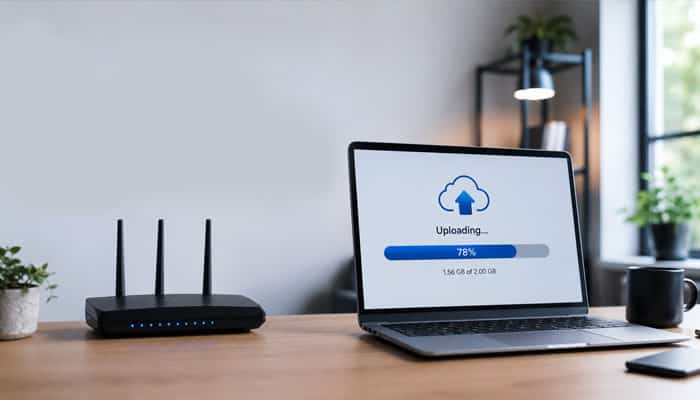
Upload speed measures how quickly your device sends data to the internet. It affects activities such as:
- Sending email attachments
- Uploading YouTube videos
- Backing up files to cloud storage
- Sharing documents through Google Drive or Dropbox
- Joining video calls
- Livestreaming
- Uploading website files or security-camera footage
When learning how to increase upload speed, it is important to understand that internet providers measure speed in megabits per second (Mbps), while file sizes are usually measured in megabytes or gigabytes.
Megabits vs Megabytes
| Measurement | Abbreviation | Purpose |
|---|---|---|
| Megabit | Mb | Internet speed |
| Megabyte | MB | File size |
| Gigabit | Gb | High-speed connections |
| Gigabyte | GB | Storage and large files |
Eight megabits equal approximately one megabyte. Therefore, a 40 Mbps upload connection has a theoretical transfer rate of about 5 MB per second.
Actual upload performance may be lower because of Wi-Fi interference, congestion, encryption, network overhead and limits imposed by the receiving service.
Upload Speed vs Download Speed
Download speed measures how quickly data reaches your device, while upload speed measures how quickly data leaves it.
| Activity | Mainly download | Mainly upload |
|---|---|---|
| Streaming video | Yes | Minimal |
| Loading websites | Yes | Minimal |
| Downloading apps | Yes | No |
| Sending attachments | Minimal | Yes |
| Cloud backups | Minimal | Yes |
| Uploading videos | No | Yes |
| Livestreaming | Some | Yes |
| Video calls | Yes | Yes |
| Online gaming | Yes | Yes |
Many cable, DSL and fixed-wireless plans are asymmetrical, meaning download speed is much higher than upload speed. For example, a plan may offer 500 Mbps download but only 20 Mbps upload.
Fiber plans are more likely to provide equal speeds in both directions. When learning how to increase upload speed, always check the upstream limit included with your internet plan first.
What Is a Good Upload Speed in 2026?
A good upload speed depends on your activity, the number of users and how much bandwidth is being shared.
| Activity | Recommended upload speed |
|---|---|
| Browsing and small attachments | 3–5 Mbps |
| HD video calls | 5–10 Mbps |
| Online gaming | 3–10 Mbps with low latency |
| Multiple remote workers | 15–30 Mbps |
| Cloud backups | 10–20 Mbps or more |
| Large video uploads | 20–50 Mbps or more |
| 720p livestreaming | 8–12 Mbps |
| 1080p livestreaming | 15–25 Mbps |
| 4K livestreaming | About 36–42 Mbps |
| Several creators or a small office | 50–200 Mbps or more |
Zoom may require up to 3.8 Mbps upstream for sending 1080p video. YouTube recommends about 10–12 Mbps for 1080p livestreaming and 30–35 Mbps for 4K, plus extra headroom for stability.
When deciding how to increase upload speed, choose a connection that provides more bandwidth than your activity requires, especially when multiple people or devices share the network.
How Long Should an Upload Take?
Use this formula to estimate the ideal transfer time:
Upload time in minutes = File size in GB × 8,000 ÷ Upload speed in Mbps ÷ 60
| Upload speed | Approximate time for 1 GB | Approximate time for 10 GB |
|---|---|---|
| 5 Mbps | 26 minutes 40 seconds | 4 hours 27 minutes |
| 10 Mbps | 13 minutes 20 seconds | 2 hours 13 minutes |
| 20 Mbps | 6 minutes 40 seconds | 1 hour 7 minutes |
| 50 Mbps | 2 minutes 40 seconds | 26 minutes 40 seconds |
| 100 Mbps | 1 minute 20 seconds | 13 minutes 20 seconds |
| 300 Mbps | 27 seconds | 4 minutes 27 seconds |
These figures assume that the connection maintains its full measured speed throughout the transfer. Real uploads usually take longer.
For example, a platform may scan or process the file while receiving it. Network congestion, encryption, Wi-Fi interference and retransmitted packets can also increase the total time.
Why Is My Upload Speed So Slow?
Slow uploads usually come from your internet plan, Wi-Fi network, connected devices, hardware or the service receiving the file. Identifying the cause is the first step in learning how to increase upload speed effectively.
Your Internet Plan Has a Low Upload Limit
Your connection cannot consistently exceed the upload speed included with your plan. A new router may improve Wi-Fi performance, but it cannot turn a 10 Mbps upload allowance into 100 Mbps.
Check the plan’s detailed upload specification instead of relying only on the advertised download speed.
Too Many Devices Are Uploading
Upload bandwidth is shared across all connected devices. Common background users include:
- Cloud backups
- Google Drive, Dropbox and OneDrive
- Security cameras
- Automatic phone backups
- Video calls
- Livestreaming software
- Operating-system updates
A 20 Mbps connection may work well for one person but become unstable when several devices upload at the same time.
Wi-Fi Is Reducing Performance
Walls, distance, nearby networks and crowded Wi-Fi channels can reduce upload speed.
Test the connection through Ethernet. If Ethernet is fast but Wi-Fi is slow, focus on router placement, frequency bands and channel settings.
The Upload Service Is Slow
A fast internet connection does not guarantee that every website will accept files at the same rate.
Uploads may slow because of:
- Server congestion
- Account limits
- Browser problems
- Security scanning
- File processing
- Platform outages
Try the same file on another service to determine whether the destination is the bottleneck.
One Device Has a Problem
A single computer or phone may upload slowly because of outdated drivers, malware, power-saving settings, old Wi-Fi hardware or security software.
Test the upload from another device on the same network. If the second device is faster, troubleshoot the original device rather than the ISP.
Why Is Upload Speed Slow but Download Speed Fast?
Fast downloads and slow uploads are common because many internet plans are asymmetrical. However, Wi-Fi problems, background apps, VPNs and ISP issues can also reduce upload performance.
| Possible cause | How to identify it |
|---|---|
| Low upload limit | Check your plan’s upstream speed |
| Background synchronization | Pause Drive, OneDrive, Dropbox and iCloud |
| Wi-Fi interference | Compare Wi-Fi with Ethernet |
| Competing devices | Disconnect other devices and retest |
| Bufferbloat | Compare idle and loaded latency |
| ISP problem | All devices remain slow over Ethernet |
| Platform limit | Speed tests are fast but one service is slow |
| VPN routing | Speed improves after disconnecting the VPN |
| Device or cable issue | Another device uploads faster |
Quick Diagnostic Order
To understand how to increase upload speed, follow these steps:
- Check your plan’s upload limit.
- Pause cloud backups.
- Test through Ethernet.
- Try another device.
- Disconnect the VPN temporarily.
- Test another speed-test server or upload service.
- Check loaded latency and packet loss.
- Contact the ISP if all wired devices remain slow.
This process helps identify the real bottleneck and prevents unnecessary router or plan upgrades.
How to Test Upload Speed Correctly
One speed test is not enough to identify the cause of a slow connection. To understand how to increase upload speed, test under controlled conditions.
- Pause downloads, backups and updates.
- Close unnecessary apps and browser tabs.
- Ask other users to stop streaming or uploading.
- Restart the modem and router.
- Connect one computer through Ethernet.
- Run at least three speed tests.
- Record upload speed, download speed and latency.
- Repeat the test over Wi-Fi near the router.
- Test at different times of day.
- Upload the same file to another service.
Use the same device and test server when comparing results so you can see whether each change improves performance.
How to Interpret the Results
| Test result | Likely cause |
|---|---|
| Ethernet and Wi-Fi are slow | ISP, modem or plan problem |
| Ethernet is fast but Wi-Fi is slow | Signal, interference or router settings |
| Only one device is slow | Driver, software or hardware issue |
| All devices slow down at night | ISP congestion or heavy network use |
| Speed test is fast but one website is slow | Platform or application limit |
| Small files work but large files fail | Storage limit, timeout or unstable connection |
| Calls freeze despite good Mbps | Latency, jitter, packet loss or bufferbloat |
Upload Speed Is Not the Whole Story
Mbps shows how much data your connection can upload, but it does not measure overall network quality. When learning how to increase upload speed, also check latency, jitter, packet loss and performance under load.
| Measurement | What it means | Poor results may cause |
|---|---|---|
| Upload speed | Data sent per second | Slow transfers and backups |
| Latency | Time data takes to travel and return | Delayed responses |
| Loaded latency | Latency while the network is busy | Lag during uploads |
| Jitter | Changes in packet arrival time | Robotic or unstable audio |
| Packet loss | Data that fails to arrive | Frozen video and failed transfers |
How to Test Loaded Upload Latency
- Run a latency test while the network is idle.
- Record the result.
- Start uploading a large file.
- Test latency again during the upload.
- Stop the upload and compare the results.
If latency rises sharply only while uploading, your connection may be experiencing bufferbloat.
What Is Bufferbloat?
Bufferbloat happens when a router or modem stores too much data in its queue during heavy network use.
A large upload may continue at full speed, while smaller packets from video calls, gaming and web browsing are delayed. This can make the connection feel slow even when the Mbps result looks good.
Common signs include:
- Ping rising sharply during uploads
- Video calls freezing during cloud backups
- Games lagging while files synchronize
- Websites responding slowly during transfers
- Livestreams dropping frames or producing robotic audio
When learning how to increase upload speed, also check for bufferbloat. Smart Queue Management can reduce loaded latency by controlling how traffic is queued during large uploads.
17 Proven Ways to Increase Upload Speed
The best way to learn how to increase upload speed is to test one change at a time. Start with simple fixes such as restarting your equipment and using Ethernet before changing advanced router settings or upgrading your internet plan.
1. Restart Your Modem and Router
Restarting network equipment can clear temporary errors and refresh the connection to your ISP.
- Turn off and unplug the modem and router.
- Wait about 60 seconds.
- Reconnect the modem first.
- Wait for its connection lights to stabilize.
- Reconnect the router.
- Test the upload speed again.
Do not press the factory-reset button unless you are ready to erase Wi-Fi passwords, parental controls and other custom settings.
2. Use an Ethernet Connection
Ethernet usually provides a faster and more stable connection than Wi-Fi because it avoids:
- Weak wireless signals
- Crowded channels
- Thick walls
- Nearby interference
- Distance from the router
Use Ethernet for large cloud backups, livestreams, video meetings, website uploads and business file transfers.
Also check the full wired connection. An old cable, 100 Mbps port, slow USB adapter or docking station can limit performance.
3. Move Closer to the Router
Wi-Fi becomes weaker as distance and physical obstructions increase.
Place the router:
- Near the centre of the property
- Above floor level
- In an open area
- Away from concrete walls and metal objects
- Away from microwave ovens and electronics cabinets
For large homes, consider a properly positioned mesh system or wired access point. A Wi-Fi extender will not work well if it receives an already weak signal.
4. Switch to 5 GHz or 6 GHz Wi-Fi
The 2.4 GHz band offers longer range but is often crowded. The 5 GHz and 6 GHz bands usually provide higher speeds for nearby compatible devices.
Use:
- 2.4 GHz: distant smart-home devices
- 5 GHz: laptops, phones, meetings and large uploads
- 6 GHz: nearby devices needing maximum capacity
Higher-frequency bands may have more difficulty passing through walls, so router placement still matters.
5. Optimize Wi-Fi Channels and Router Settings
Nearby networks using the same channels can reduce wireless performance.
Start with the router’s channel setting on Auto. If performance remains poor, use a trusted Wi-Fi analyzer to identify congestion.
Useful settings include:
- 20 MHz channel width on 2.4 GHz
- Automatic channel width on 5 GHz and 6 GHz
- All supported Wi-Fi bands enabled
- WMM enabled for voice and video traffic
- Current wireless security settings
Your home network should normally have only one DHCP server.
Also check for double NAT, which occurs when both an ISP gateway and a second router manage network address translation. You may need to place the ISP gateway in bridge mode or the second router in access-point mode.
Record the original settings before making advanced changes.
6. Update Router Firmware
Router firmware updates can improve:
- Security
- Stability
- Device compatibility
- Wireless performance
- Connection reliability
Check for updates through the manufacturer’s application or router administration page. Enable automatic updates when available, and do not disconnect power during installation.
7. Pause Cloud Backups and Synchronization
Cloud applications can quietly consume most of your available upload bandwidth.
Check:
- Google Drive
- OneDrive
- Dropbox
- iCloud Photos and Drive
- Adobe Creative Cloud
- Smartphone photo backups
- Website backup software
- NAS synchronization
Pause them temporarily and repeat the speed test.
If performance improves, schedule backups outside working hours or set an upload limit inside the application. Also check that the application has not been accidentally configured with a very low upload-speed cap.
8. Stop Uploads From Other Devices
Another device may be consuming the connection even when your computer appears idle.
Check the router’s connected-device list for:
- Phones uploading photos
- Security cameras
- Smart doorbells
- Laptops synchronizing files
- Game consoles
- Home servers
- Peer-to-peer applications
- Unknown devices
Disconnect devices temporarily and reconnect them one at a time.
If you find unknown equipment, change the Wi-Fi password and review the router’s security settings.
9. Schedule Large Transfers Outside Busy Hours
Upload speed may fall when household members or nearby ISP customers are heavily using the network.
Schedule large, non-urgent transfers for:
- Early morning
- Late evening
- Office off-hours
- Periods without video calls
- Times when fewer cameras or devices are active
Scheduling does not increase your plan’s maximum speed, but it reduces competition for available bandwidth.
10. Limit Windows Delivery Optimization
Windows Delivery Optimization can share update files with other computers.
To review it in Windows 11:
- Open Settings.
- Select Windows Update.
- Open Advanced options.
- Select Delivery Optimization.
- Turn off Allow downloads from other devices when sharing is unnecessary.
This does not stop normal Windows updates. It only prevents your computer from uploading update components to other PCs.
11. Disconnect an Unnecessary VPN or Proxy
A VPN can reduce upload speed because it encrypts traffic and sends it through another server.
Performance may fall when:
- The VPN server is far away
- The server is overloaded
- The protocol is inefficient
- The device struggles with encryption
Disconnect the VPN temporarily and retest.
If the speed improves:
- Choose a closer server
- Try another protocol
- Update the VPN application
- Use split tunnelling when appropriate
Do not bypass a company-required VPN when handling confidential information.
12. Configure QoS and Smart Queue Management
Quality of Service, or QoS, allows the router to prioritize important traffic such as:
- Video meetings
- Livestreams
- Gaming
- Security cameras
- Cloud backups
- Large transfers
Give real-time applications higher priority and background transfers lower priority.
Use realistic upload and download figures. Incorrect QoS settings can accidentally limit the connection.
Use Smart Queue Management for Bufferbloat
Smart Queue Management, or SQM, controls how traffic is queued when the connection becomes busy.
It may appear as:
- Adaptive QoS
- Active Queue Management
- Traffic shaping
- Anti-bufferbloat
- CAKE
- FQ-CoDel
Configure SQM using the stable speed you normally receive, not the highest result from one test. The limit is often set slightly below the actual maximum.
A good setup may reduce the peak speed-test result slightly while delivering:
- Lower loaded latency
- More stable video calls
- Fewer dropped livestream frames
- Better gaming responsiveness
- Fairer bandwidth sharing
Avoid running several overlapping traffic-management systems unless the router manufacturer recommends it.
13. Update Network Drivers and Reset the Connection
Outdated or corrupted network drivers may cause one computer to upload slowly while other devices work normally.
On Windows:
- Install available Windows updates.
- Open Device Manager.
- Expand Network adapters.
- Find the Wi-Fi or Ethernet adapter.
- Check the manufacturer’s website for a newer driver.
Advanced users can also run these commands from an administrator Command Prompt:
netsh winsock reset
netsh int ip reset
ipconfig /release
ipconfig /renew
ipconfig /flushdns
Restart the computer afterward.
Use Windows Network Reset only after simpler solutions fail because it removes and reinstalls network adapters and may require VPN software to be configured again.
14. Check Ethernet Cables, Ports and Adapters
Inspect the complete wired path, including:
- Ethernet cables
- Connector clips
- Router ports
- Wall sockets
- Network switches
- USB adapters
- Docking stations
- Powerline adapters
Try another cable and router port. During testing, connect directly instead of using a questionable dock, wall coupler or powerline adapter.
Also check the negotiated link speed. A gigabit-capable device connected at only 100 Mbps may have a cable, port or adapter problem.
15. Reduce File Size and Improve the Transfer Method
Compression does not increase the connection’s Mbps rate, but it can reduce the amount of data you need to upload.
Before transferring files:
- Combine related documents in a ZIP archive
- Resize oversized images
- Export videos with an efficient codec
- Remove unnecessary audio tracks
- Avoid excessive video bitrates
- Split files when a platform has size limits
Files such as JPEG, MP4 and ZIP are already compressed, so additional compression may provide little benefit.
Many Small Files vs One Archive
Thousands of small files may upload more slowly than one archive because each file requires separate metadata, permission and processing steps.
When suitable:
- Combine related files
- Preserve the folder structure
- Check that the service accepts the archive
- Encrypt confidential files
- Keep the originals until the upload is verified
For important transfers, use a service that supports resumable uploads.
16. Check Malware, Antivirus and Firewall Settings
Malware and unwanted applications can create hidden network traffic.
Run a trusted security scan when:
- Upload usage remains high after applications close
- Unknown traffic appears in the router
- The device becomes unusually hot or slow
- Unexpected apps or extensions appear
- Performance changed after installing software
Security tools may also inspect legitimate uploads and reduce performance.
Do not permanently disable antivirus or firewall protection. Instead:
- Update the security software.
- Confirm that the upload destination is legitimate.
- Review firewall logs.
- Create a narrow application exception if necessary.
- Restore any protection disabled during testing.
17. Contact Your ISP or Upgrade the Plan
Contact your internet provider when:
- Wired tests remain far below the expected upload speed
- Every device is affected
- The problem continues after restarting the equipment
- Upload speed drops close to zero
- The modem disconnects repeatedly
- Packet loss appears over Ethernet
Prepare:
- Your internet-plan name
- Advertised upload speed
- Dated test results
- Ethernet and Wi-Fi comparisons
- Modem and router models
- Times when the issue occurs
- Relevant modem lights or error logs
Ask the ISP to check:
- Upstream signal levels
- Line noise
- Modem provisioning
- Account configuration
- Upstream channels
- Local congestion
- Service outages
- Modem compatibility
If your plan provides too little upstream capacity, consider a higher upload tier, symmetrical fiber, business internet or another provider.
Always complete a wired test before upgrading. A more expensive plan will not fix weak Wi-Fi, an old network adapter or a damaged cable.
These 17 methods explain how to increase upload speed by addressing the internet plan, router, Wi-Fi connection, device, applications and destination service rather than relying on one universal fix.
How to Fix Slow Uploads in a Browser
When speed tests are normal but browser uploads remain slow, update the browser, close unused tabs and test the file in a private window.
To improve performance:
- Disable unnecessary extensions temporarily
- Clear the website’s cache and cookies
- Try another supported browser
- Use the platform’s desktop application
- Check the service-status page
- Confirm that your account has enough storage
- Prevent the computer from sleeping
- Test one small file before uploading a large batch
When learning how to increase upload speed, testing another browser or application helps determine whether the problem is your internet connection or the upload platform.
How to Increase Upload Speed on Windows
To improve upload speed on Windows:
- Pause OneDrive and other synchronization tools.
- Review Delivery Optimization settings.
- Check Task Manager for apps using the network.
- Install Windows and network-driver updates.
- Test with Ethernet.
- Disconnect an unnecessary VPN.
When learning how to increase upload speed, run the Network and Internet troubleshooter before resetting TCP/IP or Winsock. Use Windows Network Reset only as a final step because it reinstalls network adapters and may require VPN software to be configured again.
How to Increase Upload Speed on a Mac
To improve upload speed on a Mac:
- Pause iCloud Drive and Photos.
- Disconnect an unnecessary VPN.
- Test another Wi-Fi band.
- Restart the Mac and router.
- Install macOS updates.
- Compare Wi-Fi with Ethernet.
When learning how to increase upload speed, check synchronization apps, network filters and adapters if only the Mac is slow. If every device is affected, investigate the router, modem, internet plan or ISP.
How to Increase Mobile Upload Speed on 4G or 5G
To improve mobile upload speed:
- Move near a window or outdoors.
- Compare mobile data with Wi-Fi.
- Toggle Airplane Mode for about 10 seconds.
- Pause photo backups.
- Disconnect an unnecessary VPN.
- Review Data Saver or Low Data Mode.
- Keep the upload app open and updated.
- Test at another time or location.
When learning how to increase upload speed on mobile, remember that 5G is not always faster than 4G. Performance depends on signal strength, congestion, network bands and carrier coverage.
How to Increase Upload Speed for YouTube
Use Ethernet, pause competing transfers and upload one large video at a time. Export the video with a suitable codec and bitrate, keep your browser or YouTube app updated and check the platform’s service status if uploads suddenly slow down.
Uploading and processing are separate stages. YouTube may continue creating HD or 4K versions after the transfer finishes, so slow processing does not necessarily indicate a poor upload connection.
How to Increase Upload Speed for Google Drive
To improve Google Drive uploads:
- Restart Drive for desktop.
- Pause competing backups.
- Check local and Google Account storage.
- Review Drive’s upload-rate limit.
- Update the application.
- Compare the browser with the desktop client.
If synchronization still fails, check firewall, proxy and antivirus settings, reconnect your account and review permission or bandwidth errors. Google Drive cannot accept additional files when account storage is full.
How to Improve Upload Performance for Livestreaming

Livestreaming needs stable bandwidth, low packet loss and manageable latency. Use Ethernet, select a nearby ingest server and leave about 20% upload headroom instead of setting the encoder to your highest speed-test result.
If the stream remains unstable:
- Lower the bitrate, resolution or frame rate.
- Pause cloud backups.
- Close unnecessary applications.
- Monitor dropped frames.
- Test realistic video and audio before going live.
Professional livestreams should also have a backup internet connection.
Why Did My Upload Speed Suddenly Drop?
A sudden slowdown may be caused by a background backup, software update, automatic VPN connection, damaged cable, router change, platform outage or ISP problem.
Restart the modem and router, pause synchronization and check the service status. Then test with:
- Ethernet
- Another device
- Another cable or port
- A different upload service
Also review recent software or hardware changes. If every wired device has almost no upload speed while downloads remain normal, save your test results and ask the ISP to check upstream signals, provisioning and outages.
Can Wi-Fi 6, Wi-Fi 6E or Wi-Fi 7 Increase Upload Speed?
A newer Wi-Fi standard can improve upload performance when the wireless network is the bottleneck.
Potential benefits include:
- Greater local network capacity
- Better handling of many connected devices
- Access to additional frequency bands
- More efficient use of airtime
- Faster communication between compatible equipment
However, newer Wi-Fi cannot increase the upload limit supplied by the ISP.
A Wi-Fi 7 router connected to a 20 Mbps upstream plan will remain limited to approximately that internet upload rate.
An upgrade is most useful when Ethernet tests are fast but wireless results are substantially slower. The router, computer or phone, network adapter and chosen band must all support the relevant features.
Should You Replace Your Router?
Consider replacing your router when it:
- No longer receives security updates
- Cannot support your internet plan’s speed
- Has only 100 Mbps Ethernet ports
- Disconnects frequently
- Provides poor coverage
- Overheats or struggles with many devices
- Lacks 6 GHz, multi-gigabit ports or useful traffic controls
When learning how to increase upload speed, replace the router only after testing another device, upload service and Ethernet connection. One slow website does not automatically mean the router is faulty.
Upload-Speed Troubleshooting Table
| Situation | Best test | Recommended action |
|---|---|---|
| Every device is slow | Direct Ethernet | Check the plan, modem and ISP |
| Ethernet fast, Wi-Fi slow | Test beside router | Change placement, band or channel |
| One computer is slow | Test another device | Update drivers or reset networking |
| One application is slow | Try another service | Check application settings or status |
| Slow during backups | Pause synchronization | Schedule or limit backup traffic |
| Slow only with VPN | Disconnect VPN | Change server or protocol |
| Slow in the evening | Test at different times | Investigate congestion |
| Fast test but upload fails | Try a smaller file | Check limits, storage and firewall |
| Calls lag during uploads | Test loaded latency | Configure QoS or SQM |
| Mobile upload will not start | Switch connection | Check application and data settings |
Upload-Speed Fixes You Should Avoid
When learning how to increase upload speed, avoid risky tweaks that may reduce security or create new network problems.
Unknown Internet Booster Apps
Avoid untrusted “speed booster” tools that make unexplained changes or install unwanted software. Use tools provided by your operating system, router or device manufacturer.
Permanently Disabling Security
Do not leave antivirus or firewall protection disabled. If testing reveals a conflict, create a limited exception for the trusted application instead.
Random MTU Changes
Incorrect MTU settings can break websites, VPNs and file transfers. Change them only when your ISP or network administrator recommends a specific value.
Unverified Registry Tweaks
Generic Windows registry “speed hacks” may reduce stability. Start with official updates, drivers and built-in troubleshooting tools.
Factory-Resetting the Router First
A factory reset erases passwords and custom settings. Restart the router first and back up its configuration before resetting it.
Expecting DNS to Increase Upload Speed
Changing DNS may improve how quickly a website begins loading, but it normally does not increase the sustained speed of an active file upload.
Common Upload-Speed Mistakes
Avoid these mistakes:
- Buying a router before testing Ethernet
- Assuming download and upload speeds are equal
- Relying on one speed test
- Using the full upstream capacity for a livestream
- Ignoring cameras and automatic phone backups
- Disabling security protection permanently
- Positioning an extender in a weak-signal area
- Changing several settings simultaneously
- Confusing video processing time with upload time
- Expecting compression to change the Mbps result
Make one change at a time, repeat the same test and record the result.
Frequently Asked Questions
1. Why is my upload speed slower than my download speed?
Many cable, DSL and fixed-wireless plans are asymmetrical, meaning they provide more download bandwidth than upload bandwidth. Check your plan’s stated upstream speed first.
2. Can I increase upload speed without upgrading my plan?
Yes. Improving Wi-Fi coverage, pausing background transfers, replacing damaged cables and disconnecting an unnecessary VPN can recover lost performance. However, these fixes cannot exceed the ISP’s upload limit.
3. Does Ethernet improve upload speed?
Ethernet can improve upload speed and stability when Wi-Fi interference, weak signals or crowded channels are the bottleneck. It does not increase the maximum speed included with your plan.
4. Why does my upload speed suddenly drop to zero?
Possible causes include an ISP upstream fault, unstable Wi-Fi, router overload, a damaged cable, VPN interruption or a platform outage. Test another device and upload service through Ethernet.
5. Why does my internet lag during large uploads?
A large transfer may saturate the upstream connection and cause bufferbloat. Limiting the upload rate or configuring QoS or Smart Queue Management can improve responsiveness.
6. Is 20 Mbps upload speed good?
A stable 20 Mbps upload speed is usually suitable for remote work, video calls and cloud backups on a lightly shared network. High-resolution livestreaming or several cloud cameras may require more.
7. Does changing DNS increase upload speed?
Usually not. DNS may affect how quickly a website connection begins, but sustained upload performance depends on bandwidth, routing, network quality and the receiving server.
8. How can I increase upload speed without buying equipment?
To learn how to increase upload speed without spending money, use Ethernet, move closer to the router, switch Wi-Fi bands, pause cloud backups, disconnect unused devices and test without a VPN.
Conclusion
Understanding how to increase upload speed begins with identifying the real bottleneck. The problem may come from the internet plan, Wi-Fi coverage, a device, background traffic, router queue management or the service receiving the file.
Start with controlled Ethernet tests. If wired performance is normal, improve the router’s placement, band, channel and settings. If the entire network remains slow, pause competing traffic, inspect the modem and contact the ISP.
Do not change every setting at once. Make one adjustment, repeat the same test and compare the result. This process reveals which fix genuinely improves upload performance and helps you avoid unnecessary equipment or plan upgrades.