

The ChatGPT File Upload Limit determines how large a file can be, how many files you can upload, how much text a document can contain and how much storage your account can use.
The headline limit is 512MB per file, but that number does not apply equally to every upload. Images are limited to 20MB each, spreadsheets generally have an approximate 50MB limit, and text-based documents must stay below two million tokens. Free users also face a daily upload allowance, while broader usage is controlled through a rolling three-hour rate limit.
ChatGPT can work with PDFs, Word documents, presentations, spreadsheets, structured data and images. However, a file may still fail even when it is below the maximum size because upload rates, Project capacity, storage limits, account permissions and document complexity all matter.
This guide explains the current ChatGPT file size limits, supported formats, daily and rolling upload allowances, Project restrictions, Library storage, reset timing and the best ways to fix an “upload limit reached” error.
Quick Answer: What Is the ChatGPT File Upload Limit?
Here are the most important limits at a glance:
| Upload category | Current documented limit |
|---|---|
| Maximum size for one general file | 512MB |
| Text and document files | 2 million tokens per file |
| CSV files and spreadsheets | Approximately 50MB |
| Images | 20MB per image |
| General upload-rate limit | Up to 80 files every 3 hours |
| Free-plan file allowance | 3 file uploads per day |
| Shared storage per end user | 25GB |
| Shared storage per organization | 100GB |
| Files uploaded to a Project at one time | 10 files |
| Free Project capacity | 5 files per Project |
| Go and Plus Project capacity | 25 files per Project |
| Pro, Business, Enterprise and Edu Project capacity | 40 files per Project |
| Custom-GPT knowledge files | Up to 20 files |
| Free Library storage | 500MB |
| Go Library storage | 4GB |
| Plus and Business Library storage | 20GB |
| Pro Library storage | 100GB |
OpenAI may lower upload-rate limits during periods of high demand. Failed uploads can sometimes count toward the rate allowance, and ChatGPT does not currently provide a live counter showing how many rolling uploads remain.
Key Takeaways
- The 512MB limit is an overall ceiling, not the usable limit for every file type.
- Text documents must also remain below two million tokens.
- Images are limited to 20MB each.
- Spreadsheets generally cannot exceed approximately 50MB.
- Free users currently receive three file uploads per day.
- The general rate limit is up to 80 files during a rolling three-hour period.
- OpenAI does not promise one fixed daily upload total for every paid plan.
- Project capacity is separate from chat and account upload limits.
- A custom GPT can currently hold up to 20 knowledge files.
- Files saved in Library use a separate plan-based storage allowance.
- Starting a new chat does not reset account-wide rate or storage limits.
- Uploading a file successfully does not guarantee that ChatGPT analyzes every page, chart or spreadsheet cell.
What Is the ChatGPT File Upload Limit?
The ChatGPT File Upload Limit is not a single restriction. It is a group of limits that control different parts of the upload process.
These include:
- Per-file size limit: The maximum number of megabytes allowed for one file.
- Token limit: The maximum amount of text ChatGPT can process from one document.
- File-type limit: Lower restrictions for images, spreadsheets and other categories.
- Upload-rate limit: How many files can be uploaded during a particular period.
- Conversation limit: How many attachments a specific conversation can accept.
- Project or GPT limit: How many reference files can be stored in a workspace.
- Storage limit: How much total file storage an account or organization can use.
An upload must pass every applicable restriction.
For example, a 300MB PDF is below the general 512MB ceiling. It could still be rejected if the extracted text exceeds two million tokens. Similarly, a 25MB image is far below 512MB but exceeds the separate 20MB image limit.
How ChatGPT File Upload Limits Work Together
The ChatGPT File Upload Limit includes four separate restrictions. A file must meet every applicable limit before ChatGPT can process it.
| Limit type | What it controls | Example |
|---|---|---|
| Per-file limit | File size or token count | 512MB or two million document tokens |
| Upload-rate limit | Recent upload activity | Up to 80 files every three hours |
| Workspace limit | Files stored in a Project or GPT | 25 files in a Plus Project |
| Storage limit | Total stored-file space | Library and account storage caps |
These limits work independently. A 10MB PDF may fail after the rolling upload allowance is exhausted, while a small file may be rejected because its Project is already full.
Which Limit Is Causing the Error?
| Situation | Likely cause |
|---|---|
| A large PDF fails immediately | Size or token limit |
| New uploads fail after several successes | Rolling rate limit |
| Files work in chats but not Projects | Project capacity |
| All uploads fail | Storage limit or service issue |
| An image fails but a larger PDF works | 20MB image limit |
| Only part of a file is analyzed | File complexity |
| A cloud file is missing | Permission or sync issue |
A .gdoc file is rejected |
Unsupported format |
Identifying the correct ChatGPT File Upload Limit saves time. Compressing a file will not restore an exhausted upload allowance, and waiting will not create space in a full Project.
ChatGPT Maximum File Size
The general ChatGPT File Upload Limit is 512MB per file, but lower limits apply to certain formats.
| File category | Limit | Additional restriction |
|---|---|---|
| General supported file | 512MB | Overall maximum |
| PDF, DOCX and TXT | 512MB | Also limited to two million tokens |
| CSV, XLS and XLSX | About 50MB | Depends partly on row size |
| PNG, JPG, JPEG and GIF | 20MB | Static images only |
| Custom-GPT knowledge file | 512MB | Up to 20 files per GPT |
A file below 512MB may still fail because of its token count, format, structure, storage usage or remaining upload allowance.
What Is the Two-Million-Token Document Limit?
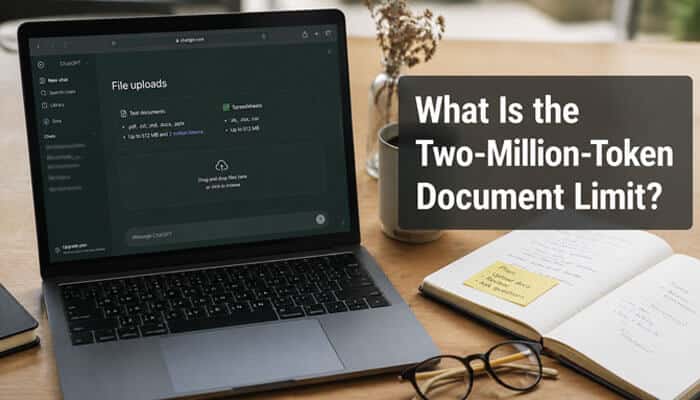
The ChatGPT File Upload Limit for text documents includes a maximum of two million tokens per file, in addition to the 512MB size limit. This token restriction does not apply to spreadsheets.
A token is a small unit of text that may represent:
- A full word
- Part of a word
- Punctuation
- A number or special character
There is no exact conversion between tokens, pages and file size. The total depends on language, formatting, tables, repetition, metadata and OCR content. As a result, a small text-heavy file may contain more tokens than a larger presentation with fewer words.
Why a PDF Below 512MB May Still Fail
A 200MB PDF can remain below the general size limit but still exceed two million tokens if it contains thousands of dense, text-heavy pages.
To stay within the ChatGPT File Upload Limit, divide very long documents into logical sections, such as:
- Individual chapters or volumes
- Reports organized by year
- Main report and appendices
- Contracts and supporting exhibits
- Research paper and supplementary material
Splitting by topic is better than using random page ranges because each file remains organized and easier for ChatGPT to analyze.
ChatGPT Daily File Upload Limit
The ChatGPT File Upload Limit includes both daily and rolling restrictions:
- Free users: three file uploads per day
- General rate limit: up to 80 uploads every three hours
- Temporary reductions may apply during peak periods
- Failed uploads can sometimes count toward the rolling limit
ChatGPT Free File Upload Limit
Free users currently receive three file uploads per day. This allowance is separate from normal text-message limits, so users may still send messages after reaching the file-upload cap.
A Free Project can store five files, but the daily three-upload restriction may prevent users from filling it in one day.
ChatGPT Plus File Upload Limit
OpenAI does not publish one guaranteed daily total for Plus accounts. Plus users receive higher access than Free users, but uploads may still be affected by:
- Rolling three-hour limits
- Peak-period reductions
- Failed upload attempts
- File-size and storage limits
- Project capacity
- Selected model or service conditions
Therefore, the ChatGPT File Upload Limit for Plus should not be described as a fixed number of daily uploads.
ChatGPT Pro, Business and Enterprise Limits
Pro, Business, Enterprise and Edu plans generally provide higher Project capacity. However, OpenAI does not publish one universal daily upload total for all paid plans. Managed workspaces may also apply administrator-controlled security, retention and feature policies.
ChatGPT Upload Limits by Plan
| Plan | Upload allowance | Project capacity | Library storage |
|---|---|---|---|
| Free | 3 uploads per day | 5 files | 500MB |
| Go | No fixed daily total published | 25 files | 4GB |
| Plus | Higher access; rolling limits apply | 25 files | 20GB |
| Pro | Higher paid access | 40 files | 100GB |
| Business | Workspace limits apply | 40 files | 20GB |
| Enterprise | Workspace policies apply | 40 files | Plan or workspace dependent |
| Edu | Workspace policies apply | 40 files | Plan or workspace dependent |
Project and Library limits are separate from daily or rolling upload allowances.
When Does the ChatGPT File Upload Limit Reset?
OpenAI does not publish one universal reset time for every ChatGPT File Upload Limit.
The general allowance of up to 80 files every three hours uses a rolling window. This means uploads become available again gradually as earlier files move outside the three-hour period.
For example, files uploaded between 1:00 p.m. and 2:00 p.m. may begin clearing between 4:00 p.m. and 5:00 p.m. The full allowance does not necessarily reset at one exact time.
Free users have a separate three-file daily limit, but OpenAI does not confirm whether it resets at local midnight, UTC midnight or another fixed time.
Does the Limit Reset at Midnight?
The paid ChatGPT File Upload Limit should not be described as resetting at midnight.
Avoid unsupported claims such as:
- “ChatGPT Plus always resets at midnight.”
- “All limits reset every three hours at a fixed time.”
- “Every paid user receives exactly 640 uploads per day.”
- “Starting a new chat resets the limit.”
The 640-upload figure is only a theoretical calculation. Peak-period reductions, failed attempts and other restrictions can lower actual availability.
How Many Files Can You Upload in One Chat?
OpenAI does not publish one guaranteed attachment count for every ordinary ChatGPT conversation.
The practical number can depend on:
- Subscription plan
- Selected model
- File size
- Upload type
- Workspace configuration
- Remaining rate allowance
- Account capabilities
- Amount of accompanying text
Conversation limits should not be confused with Project or custom-GPT capacity.
| Question | Relevant restriction |
|---|---|
| How many files can I upload recently? | Daily or rolling rate limit |
| How many files can this chat accept? | Conversation-level capacity |
| How many files can remain in a Project? | Project file capacity |
| How many files can a custom GPT retain? | Knowledge-file capacity |
OpenAI also states that the number of images accepted in a conversation can vary based on image size and the amount of text accompanying them.
Does Starting a New Chat Reset the Upload Limit?
Starting a new conversation does not reset the account-wide ChatGPT File Upload Limit.
A new chat may help when:
- The current conversation has too many attachments
- Old files are no longer relevant
- ChatGPT is mixing information from multiple documents
- The chat has become too large or complex
- You want to use a different model or workflow
However, it will not bypass:
- The Free daily upload allowance
- The rolling three-hour rate limit
- Shared or Library storage caps
- Project file capacity
- Per-file size restrictions
A new chat can improve context and organization, but it does not guarantee additional file uploads.
ChatGPT Project File Upload Limits
Projects organize related chats, instructions and files in one workspace. They are useful for research, content creation, studying, financial analysis and client projects.
The ChatGPT File Upload Limit for Projects depends on your subscription:
| Plan | Files per Project |
|---|---|
| Free | 5 |
| Go | 25 |
| Plus | 25 |
| Pro | 40 |
| Business | 40 |
| Enterprise | 40 |
| Edu | 40 |
Users can create unlimited Projects, but only ten files can be uploaded to a Project at one time.
Project Capacity Is Not an Upload-Rate Limit
A Plus Project may store 25 files, but this does not mean all 25 can always be uploaded immediately. Other restrictions still apply:
- Only ten files can be added at once
- Recent uploads may count toward the rolling rate limit
- Shared storage limits remain active
- Every file must meet its size and format restrictions
Creating another Project provides a separate workspace, but it does not reset account-wide upload or storage usage.
How to Stay Within Project Limits
- Remove duplicate or outdated files
- Combine closely related notes
- Use clear file names and version numbers
- Separate archived and current documents
- Consolidate related spreadsheet tabs
- Create separate Projects for unrelated topics
Managing files carefully helps you stay within the ChatGPT File Upload Limit without creating oversized or difficult-to-analyze documents.
Custom-GPT Knowledge File Limit
A custom GPT can use uploaded documents as a reusable knowledge base for:
- Product documentation
- Employee handbooks
- Editorial guidelines
- Research reports
- Policies and training materials
- FAQs and internal references
The ChatGPT File Upload Limit for custom GPT knowledge currently allows up to 20 files, with a maximum size of 512MB per file. Supported formats may depend on the selected model and whether Data Analysis is enabled.
How to Improve Knowledge Retrieval
- Use text-focused documents
- Add clear headings
- Remove duplicate information
- Separate unrelated topics
- Avoid complex layouts
- Put rules and behavior in GPT instructions
- Specify how sources should be cited
- Test the GPT after updating files
Knowledge files provide reference material, while instructions control how the custom GPT responds.
ChatGPT Library Storage Limits
ChatGPT Library stores uploaded and generated files for later reuse. Its storage is separate from the daily ChatGPT File Upload Limit and normal chat limits.
Library is available on the web for Free, Go, Plus, Pro and Business users and is rolling out to Enterprise, Edu and Healthcare workspaces. Managed workspaces may apply their own availability and retention policies.
Library Storage by Plan
| Plan | Library storage |
|---|---|
| Free | 500MB |
| Go | 4GB |
| Plus | 20GB |
| Business | 20GB |
| Pro | 100GB |
Users can check total usage and remaining capacity in the Storage area.
Library Storage vs Shared Storage Caps
OpenAI documents two related limits:
- Plan-based Library storage, such as 500MB for Free and 100GB for Pro
- Shared caps of 25GB per user and 100GB per organization across chats, Projects and custom-GPT knowledge
Because these limits apply to different storage surfaces, the Storage page and account error message are the best indicators of your remaining capacity.
Does Deleting a Chat Delete Its Files?
Not always. Files saved in Library are managed separately from conversations. Deleting a chat may not remove its files, so you must delete them directly from Library to free storage.
What File Types Does ChatGPT Support?
ChatGPT supports common documents, spreadsheets, presentations, structured data and images. The ChatGPT File Upload Limit also depends on whether the format is supported by the selected model, plan and workspace.
Supported File Types
| Category | Common formats | Typical uses |
|---|---|---|
| Documents | PDF, DOCX, TXT | Summarization, comparison and extraction |
| Presentations | PPTX | Slide review and outlining |
| Spreadsheets | XLS, XLSX, CSV, TSV | Calculations, cleaning and charts |
| Structured data | JSON, XML, YAML | Inspection, conversion and validation |
| Text files | MD, TXT | Content and documentation analysis |
| Static images | PNG, JPG, JPEG, GIF | Screenshot and visual analysis |
OpenAI also lists PDF, CSV, XLS, XLSX, JSON, XML, YAML and Markdown for supported data-analysis workflows.
Native .gdoc files are not supported through standard direct uploads. Export Google Docs as PDF or DOCX first.
Formats That May Need Conversion
- Google Sheets to XLSX or CSV
- Google Slides to PPTX or PDF
- Proprietary documents to DOCX or PDF
- Oversized images to compressed JPEG or PNG
- Scanned documents to searchable PDFs using OCR
Converting unsupported or complex files can reduce their size and help ChatGPT analyze the content more accurately.
ChatGPT Image Upload Limit
The ChatGPT File Upload Limit for images is 20MB per file. Supported static formats include:
- PNG
- JPEG
- JPG
- Non-animated GIF
Video files are not supported through the standard image-input feature. The number of images accepted in one conversation can vary based on file size and accompanying text.
Image Limitations
ChatGPT may analyze images less accurately when they contain:
- Small or blurry text
- Rotated content
- Complex diagrams
- Crowded layouts
- Colour-dependent charts
- Many small objects
- Important information stored only in metadata
How to Improve Image Analysis
- Crop unnecessary areas
- Keep text upright and readable
- Compress images without reducing clarity
- Upload charts separately
- Provide exact figures as text
- Split tall screenshots into smaller sections
- Explain what ChatGPT should examine
Preparing images carefully helps you stay within the ChatGPT File Upload Limit and improves analysis accuracy.
Direct Uploads vs Google Drive, OneDrive and SharePoint
The ChatGPT File Upload Limit can differ between direct uploads and connected cloud services.
| File source | How ChatGPT accesses it | Key limitation |
|---|---|---|
| Computer or mobile device | Uploaded directly | Standard ChatGPT limits apply |
| ChatGPT Library | Reused from saved files | Library and account limits may apply |
| Google Drive | Accessed through an authorized connection | Depends on permissions |
| OneDrive | Accessed through a Microsoft connection | Only authorized files are available |
| SharePoint | Retrieved through the SharePoint app | Maximum file size is 100MB |
ChatGPT can only access files you are permitted to view, and workspace administrators may restrict connected apps.
Does the 512MB Limit Apply to Connected Files?
No. The 512MB ChatGPT File Upload Limit applies to direct uploads, while connected services may have lower limits.
For example, SharePoint currently supports files up to 100MB. A 300MB document may meet ChatGPT’s direct-upload limit but still be too large for SharePoint.
Cloud synchronization can also take time, so some files may not appear immediately.
Can ChatGPT Read Images Inside PDFs?
Whether ChatGPT can read images inside PDFs depends on your plan and how the file is uploaded.
ChatGPT Enterprise supports visual retrieval for PDFs attached to prompts, allowing it to analyze text, charts, diagrams and embedded images.
However:
- PDFs stored as Project files use text-only retrieval
- PDFs used as custom-GPT knowledge use text-only retrieval
- PDFs attached during an Enterprise Project conversation can use visual retrieval
- PDFs uploaded while using a published GPT can use visual retrieval
- Other plans generally extract only digital text from document files
Visual PDF retrieval is currently limited to ChatGPT Enterprise. For other plans, upload important charts, scanned pages or diagrams separately as image files.
This distinction matters when evaluating the ChatGPT File Upload Limit, because a successful PDF upload does not guarantee that embedded visuals will be analyzed.
Why ChatGPT May Not Analyze the Entire Uploaded File
A successful upload does not guarantee that ChatGPT will analyze every page, worksheet, chart or passage. The ChatGPT File Upload Limit controls whether a file can be uploaded, but file structure and complexity affect how completely it can be processed.
Problems are more likely with:
- Large scanned PDFs
- Workbooks with many unrelated sheets
- Complex multi-column layouts
- Merged cells or several tables on one sheet
- Important data stored only in images
- Long appendices or repeated content
For spreadsheets, use clear column headings, one record per row and a simple table structure.
Signs the Full File Was Not Analyzed
ChatGPT may have missed content if it:
- Discusses only the first pages
- Ignores later worksheets or appendices
- Reports incorrect row counts or totals
- Says information is missing when it is present
- Gives vague descriptions of charts
- Confuses multiple attachments
How to Improve File Analysis
Ask ChatGPT to inspect the file structure before summarizing it.
For a spreadsheet:
Review all worksheets, list their names, columns and row counts, then analyze Revenue, Costs and Forecast. Note anything unreadable.
For a long PDF:
List the main headings, tables and appendices before summarizing the document. State which sections could not be inspected reliably.
For more accurate results:
- Split large files into logical sections.
- Request page, row or worksheet references.
- Compare extracted totals with the original.
- Upload numerical data as a spreadsheet instead of an image.
- Ask ChatGPT to show its calculation method.
- Verify important quotations and figures.
Staying within the ChatGPT File Upload Limit helps the file upload successfully, but clear formatting and focused prompts improve the quality of the analysis.
What Can ChatGPT Do With Uploaded Files?
Within the ChatGPT File Upload Limit, uploaded files can support four main tasks: synthesis, transformation, extraction and data analysis.
Synthesis
ChatGPT can combine information to create a new result, such as:
- Comparing reports or contract versions
- Analyzing survey results or annual data
- Turning research notes into an outline
Transformation
ChatGPT can reorganize or rewrite existing content, including:
- Simplifying a research paper
- Converting a presentation into a report
- Turning notes into an article or study guide
Extraction
ChatGPT can locate specific information, such as:
- Dates, quotations and monetary amounts
- Matching spreadsheet rows
- Headings, action items and records
Data Analysis
ChatGPT can also analyze structured data, perform calculations and create tables or charts. Clear headings, one record per row and focused prompts usually produce better results.
Why Does ChatGPT Say “Upload Limit Reached”?
The message does not always mean that the newest file is too large.
Common Causes
| Cause | What it means |
|---|---|
| Rolling rate exhausted | Too many recent uploads |
| Free daily allowance used | Three uploads have been consumed |
| Storage full | Account or Library storage is unavailable |
| File too large | The upload exceeds its category limit |
| Document too text-heavy | It exceeds two million tokens |
| Project full | The Project has reached its file capacity |
| GPT knowledge full | The custom GPT has reached its knowledge-file limit |
| Connected-app restriction | A cloud source has a lower limit or permission issue |
| Temporary service problem | Upload processing is degraded |
Failed upload attempts can sometimes count toward the upload-rate limit, so repeatedly retrying the same file may make the problem worse.
How to Fix the ChatGPT Upload Limit Reached Error

If you see a ChatGPT File Upload Limit error, follow these steps:
1. Check Your Account
Confirm that you are using the correct personal or workspace account and that the expected subscription is active.
2. Identify the Limit
The issue may involve:
- File size or token count
- Image or spreadsheet limits
- Recent upload activity
- Project or custom-GPT capacity
- Library storage
- Connected-app restrictions
3. Check the File Size
Use these limits:
- General file: 512MB
- Text document: 512MB and two million tokens
- Spreadsheet: approximately 50MB
- Image: 20MB
- SharePoint file: 100MB
4. Let the Rolling Window Clear
If you uploaded several files recently, stop retrying and allow earlier uploads to move outside the rolling three-hour period.
5. Review Storage
Open Library and check the Storage area. Delete unnecessary Library files directly, because removing a chat may not delete its saved files.
6. Remove Old Project or GPT Files
Delete duplicate drafts, obsolete policies, outdated knowledge sources and other files you no longer need.
7. Compress or Split the File
- Compress embedded images
- Remove duplicate pages
- Export a smaller PDF
- Separate appendices
- Keep only relevant worksheets
- Split long documents by chapter
8. Convert Unsupported Formats
Export:
- Google Docs as DOCX or PDF
- Google Sheets as XLSX or CSV
- Google Slides as PPTX or PDF
9. Start a New Chat
A cleaner conversation may help when the existing chat contains too much context. However, it will not reset account-wide upload or storage limits.
10. Check OpenAI Service Status
If correctly sized files suddenly fail, check whether an active service issue is affecting uploads.
11. Contact Support
Include your account email, screenshot, date, time zone, browser or app, device and request ID when available.
Following these steps can help identify and resolve the specific ChatGPT File Upload Limit causing the error.
How to Reduce a File Before Uploading
Reducing file size can help you stay within the ChatGPT File Upload Limit and improve processing.
PDF Files
- Compress images
- Remove blank pages
- Separate appendices
- Use a reduced-size export
- Apply OCR to scanned pages
- Split long PDFs by chapter or topic
Word Documents
- Compress embedded pictures
- Remove comments and tracked changes
- Delete unnecessary objects
- Save a clean DOCX copy
- Divide very long documents
Spreadsheets
- Delete unused rows, columns and worksheets
- Use clear headers and one record per row
- Avoid merged cells and unrelated tables
- Export only relevant data as CSV
- Split records by year, region or category
Images
- Reduce dimensions and compress the file
- Crop unnecessary areas
- Use optimized JPEG or PNG
- Split tall screenshots
- Keep important text clear and upright
Presentations
- Compress images
- Remove embedded videos
- Delete unused slide masters
- Split large presentations
- Export as PDF when slide design is not important
These steps reduce upload size while keeping the most useful content intact.
Best Practices for Uploading Files to ChatGPT
Following these practices can help you work efficiently within the ChatGPT File Upload Limit and improve response quality.
Upload Relevant Files
Use focused documents rather than large files containing unrelated information.
Use Clear File Names
Good examples include:
2026-Q2-Revenue-by-Region.xlsxEmployee-Handbook-July-2026.pdfWebsite-SEO-Audit-Final.docx
Avoid vague names such as newfile.xlsx or scan001.pdf.
Write a Specific Prompt
Explain:
- What information you need
- Which pages, sheets or columns matter
- The required output format
- Whether calculations or quotations are needed
- How ChatGPT should handle uncertainty
Request Source References
Ask for page numbers, worksheet names or section headings, then verify important information against the original file.
Separate Instructions From Sources
Use prompts or Project instructions to define the task and uploaded files as supporting evidence.
Verify Important Results
Double-check legal, medical and financial information, calculations and exact quotations. Complex tables, scans and unclear formatting can be misread.
Maintain a File Inventory
For Projects and custom GPTs, track:
- File name and purpose
- Version and upload date
- Replacement file
- Whether the information is current
Good file management reduces duplication, prevents outdated sources from affecting answers and helps you stay within the ChatGPT File Upload Limit.
File Privacy, Retention and Deletion
The ChatGPT File Upload Limit is separate from file privacy and retention rules.
Files saved to Library are managed separately from chats, so deleting a conversation may not delete its Library files. Project and custom-GPT files are usually retained until the Project or GPT is deleted, after which they are generally scheduled for permanent deletion within 30 days, subject to legal, security or de-identification exceptions.
Files uploaded in Temporary Chat are not saved to Library or chat history. They are not used to improve OpenAI’s models, although a copy may be retained for up to 30 days for safety purposes.
For personal ChatGPT accounts, uploaded content may be used to improve models when Improve the model for everyone is enabled. This setting can be turned off under Data Controls.
Before uploading confidential files:
- Remove unnecessary personal information
- Redact passwords and login credentials
- Exclude private keys
- Confirm that you have permission to upload the content
- Follow workplace security policies
- Review ChatGPT Data Controls
- Use the appropriate managed workspace
- Consider Temporary Chat when long-term storage is unnecessary
Understanding these rules helps users manage files safely while staying within the ChatGPT File Upload Limit.
ChatGPT File Upload Limit vs OpenAI API File Limit
ChatGPT and the OpenAI API are separate products with separate billing and usage systems. A ChatGPT Plus, Pro or Business subscription does not include unlimited API usage.
The API Files endpoint currently allows individual files of up to 512MB and total storage of up to 2.5TB per API project. Endpoint-specific rules may also apply; for example, Batch API input files must use JSONL and cannot exceed 200MB.
| Feature | ChatGPT | OpenAI API |
|---|---|---|
| Billing | Subscription or workspace plan | Separate usage-based billing |
| General individual file limit | 512MB | 512MB |
| Rate limits | Based on ChatGPT plan and account usage | Based on API project and endpoint |
| Storage | Library and shared account limits | API project storage |
| File purpose | Conversation, Project or GPT use | Endpoint-specific processing |
Developers should consult the documentation for the API endpoint they are using rather than applying ChatGPT’s consumer limits to an API application.
Why Do Official OpenAI Pages Show Different Limits?
OpenAI updates ChatGPT frequently, so a general Help Center article may temporarily show older figures than a dedicated feature page.
For example:
- The general File Uploads FAQ may list an older Plus Project limit
- The dedicated Projects page currently lists 25 files for Go and Plus
- The general FAQ may show an older custom-GPT file count
- The dedicated GPT-building page currently allows 20 knowledge files
When ChatGPT File Upload Limit figures differ, prioritize:
- The page dedicated to the specific feature
- The most recently updated official documentation
- The limit displayed inside your account
- Your workspace administrator’s policies
For this reason, any article covering the ChatGPT File Upload Limit should include a visible Last Updated date.
Common Misunderstandings About ChatGPT Upload Limits
- Assuming every file can be as large as 512MB
- Believing paid users receive unlimited uploads
- Thinking the 80-file allowance resets at midnight
- Expecting a new chat to reset upload limits
- Assuming deleting a chat also deletes Library files
- Believing every successfully uploaded file is analyzed completely
ChatGPT File Upload Limit FAQs
1. Why did I reach the ChatGPT File Upload Limit after only a few uploads?
Failed attempts, recent uploads, full storage or Project capacity may count toward the restriction. Check your file size, recent activity and available storage before trying again.
2. Does the ChatGPT File Upload Limit apply separately to each conversation?
Some attachment restrictions may depend on the conversation, but rolling upload rates and account storage apply across chats. Starting a new conversation does not reset account-wide limits.
3. Can compressing a file help with the ChatGPT File Upload Limit?
Yes. Compressing images, removing unnecessary pages and splitting large documents can help when the file exceeds a size or token restriction. It will not fix an exhausted rate allowance.
4. Does the ChatGPT File Upload Limit include failed upload attempts?
OpenAI states that failed attempts can sometimes count toward the rolling upload allowance. Repeatedly retrying the same file may therefore delay successful uploading.
5. Is the ChatGPT File Upload Limit different on mobile and desktop?
The documented file-size and account limits generally apply across platforms. However, available upload options may vary by app version, device, plan and workspace settings.
6. Does reusing a Library file affect the ChatGPT File Upload Limit?
Library storage is separate from daily attachment limits, but attaching and processing a saved file may still be affected by current account usage and feature restrictions.
7. Can OCR help avoid problems with the ChatGPT File Upload Limit?
OCR does not increase the allowed size, but it can make scanned PDFs searchable and easier to analyze. Large OCR-processed documents must still remain below the token limit.
8. Can OpenAI change the ChatGPT File Upload Limit without notice?
Yes. OpenAI may update plan allowances or temporarily reduce upload rates during peak demand. Check the latest official documentation and the limits displayed inside your account.
Conclusion
The ChatGPT File Upload Limit is not one simple number. File size, token count, format, recent activity, conversation capacity, Project limits and available storage can all determine whether an upload succeeds.
The most important limits to remember are:
- 512MB for a general file
- Two million tokens for a text document
- Approximately 50MB for a spreadsheet
- 20MB for an image
- Three daily uploads for Free users
- Up to 80 files during a rolling three-hour period
- Five to 40 files per Project, depending on the plan
- Up to 20 knowledge files in a custom GPT
For better results, upload focused, well-structured files, remove unnecessary stored content and give ChatGPT precise instructions about what to analyze.
Because OpenAI frequently updates ChatGPT plans and file-management features, the limit displayed inside your account and the latest feature-specific OpenAI documentation should be treated as the final authority.