

Last Updated: July 30, 2026
Forgetting a router password can stop you from connecting a new device, updating Wi-Fi settings or protecting your home network. Before learning how to reset a router password, identify which credential you have lost, since most routers use separate passwords for Wi-Fi access and administrator settings.
The Wi-Fi password allows phones, computers, televisions and smart devices to join the wireless network. The router administrator password opens the management panel where you can change Wi-Fi, DNS, firewall, parental-control and internet settings.
This guide explains how to reset a router password, recover saved Wi-Fi credentials, change the administrator login and perform a factory reset only when safer recovery methods fail. It also provides instructions for TP-Link, NETGEAR, ASUS, Linksys, D-Link, Google Nest Wifi, eero and Xfinity systems.
Quick Answer
To reset a router password, first determine whether you have forgotten the Wi-Fi password or the router administrator password.
If you forgot the Wi-Fi password, check the router label, a connected phone or computer, the manufacturer’s official app or the router’s management page. You can often view or change the password without resetting the router.
If you forgot the administrator password, use the manufacturer’s official recovery feature when available. Some routers support recovery through email, security questions, serial-number verification, account authentication or a printed recovery key.
Perform a factory reset only when password recovery is unavailable or unsuccessful. A factory reset normally erases customized network names, passwords, ISP settings, DNS servers, port-forwarding rules, parental controls and other configurations.
Key Takeaways
- A Wi-Fi password and a router administrator password are different.
- Check connected devices before pressing the physical Reset button.
- Changing the Wi-Fi password disconnects devices using the old credentials.
- Changing the administrator password normally does not disconnect devices.
- Some routers provide password recovery without deleting the configuration.
- A reboot keeps your settings, while a factory reset erases them.
- Reset-button procedures and holding times vary by model.
- Mesh systems require additional care because resetting the gateway may remove the entire network.
- Use different passwords for Wi-Fi access and router administration.
- Enable WPA3 Personal or WPA2 Personal after recovering access.
- Replace routers that no longer receive security updates or support modern encryption.
Wi-Fi Password vs. Router Administrator Password
Before learning how to reset a router password, identify the credential causing the problem.
| Password type | What it controls | When you use it | What happens when it changes |
|---|---|---|---|
| Wi-Fi password | Access to the wireless network | Connecting phones, computers and smart devices | Devices using the old password disconnect |
| Router administrator password | Access to router settings | Changing Wi-Fi, DNS, firewall and security controls | Connected devices normally remain online |
| Manufacturer account password | Access to the brand’s cloud app | Managing the router through an online account | Local Wi-Fi settings may remain unchanged |
| ISP account password | Access to the internet-provider account | Billing, service management and provider apps | Usually does not affect Wi-Fi access |
| Internet connection credentials | Authentication with certain ISPs | PPPoE and specialized WAN connections | Losing them may prevent internet access after a reset |
A common mistake is performing a factory reset when only the Wi-Fi password has been forgotten. In many cases, the saved password can be recovered from a connected device without changing the router.
What Does Resetting a Router Password Mean?
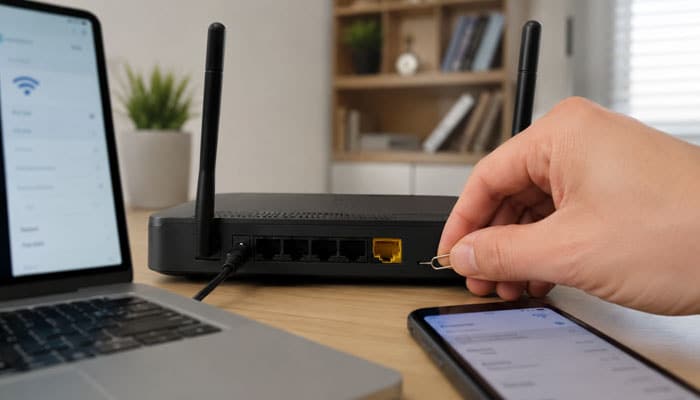
The phrase “reset a router password” may refer to several different actions:
- Viewing a Wi-Fi password saved on a connected device
- Sharing Wi-Fi access through a QR code
- Changing the Wi-Fi password through the router settings
- Changing the administrator password while signed in
- Recovering a forgotten administrator password
- Resetting a manufacturer or ISP account password
- Restoring the router to factory settings
Use the least disruptive method that solves the problem.
Which Router Password Recovery Method Should You Use?
Understanding how to reset a router password does not always mean pressing the physical Reset button.
| Your situation | Best first action | Factory reset needed? |
|---|---|---|
| You forgot the Wi-Fi password, but a device is connected | View the saved password on that device | No |
| You know the administrator password | Sign in and change the Wi-Fi password | No |
| You forgot the administrator password | Use the manufacturer’s recovery feature | Maybe |
| You can access the official router app | View or change the password in the app | Usually no |
| You cannot connect wirelessly | Use an Ethernet connection | Usually no |
| The router login page will not open | Find the correct gateway address | No |
| Password-recovery methods do not work | Follow the model-specific factory-reset procedure | Usually yes |
| You suspect unauthorized administrator access | Reset, update and review the configuration | Often recommended |
| You are selling or giving away the router | Remove linked accounts and factory reset it | Yes |
Always try password recovery before performing a factory reset.
What to Do Before Resetting Your Router
Before learning how to reset a router password, complete these checks to avoid an unnecessary factory reset.
Check the Router Label
Look underneath or behind the router for:
- Default Wi-Fi name and password
- Setup URL or local IP address
- Recovery key or QR code
- Model, serial number and hardware version
The printed password works only if the original Wi-Fi credentials have not been changed.
Check Your Records
The password may be saved in:
- The router box or installation card
- An ISP email or mobile app
- A password manager
- Notes from the installer
Use the Official Router App
Many routers can be managed through apps such as TP-Link Tether, ASUS Router, NETGEAR Nighthawk, Google Home, eero or Xfinity.
Use only the official manufacturer or ISP app. Never enter administrator credentials into an unofficial application.
Ask the Network Owner
A family member, technician, landlord or IT administrator may have changed the password. Do not reset a workplace, school or managed router without permission.
Try an Ethernet Cable
Connect a computer to a numbered LAN port. A wired connection may let you access the router settings without knowing the Wi-Fi password, although the administrator login may still be required.
How to Find a Saved Wi-Fi Password Without Resetting the Router
Before deciding how to reset a router password, check whether the Wi-Fi password is already saved on a connected device. This is usually faster and avoids deleting router settings.
On iPhone or iPad
- Open Settings > Wi-Fi.
- Tap the information icon beside the network.
- Select Password.
- Authenticate with Face ID, Touch ID or your passcode.
- View or copy the password.
Saved networks may also appear in the Passwords app.
On Mac
- Open the Passwords app.
- Select Wi-Fi.
- Choose the network.
- Authenticate and reveal the password.
Compatible Apple devices can also share Wi-Fi access with nearby Apple devices.
On Windows
- Open Settings > Network & Internet.
- Select the connected Wi-Fi network.
- Find Wi-Fi network password.
- Select Show.
For older Windows versions, open Wireless Properties > Security and enable Show characters.
On Android
- Open Settings > Wi-Fi or Connections.
- Select the connected network.
- Tap Share or the QR-code icon.
- Authenticate with your PIN, fingerprint or face.
- Scan the QR code with another device.
Some Android phones also display the password below the QR code. Sharing the code does not change the password; it only connects another device using the existing credentials.
How to Access Your Router’s Settings
If a saved password cannot be recovered, the next step in learning how to reset a router password is opening the router’s management interface.
Step 1: Connect to the Router
Use one of these methods:
- Current Wi-Fi connection
- Ethernet cable
- Official router app
An Ethernet connection is useful because changing the Wi-Fi password may disconnect your device immediately.
Step 2: Find the Router Address
Common local addresses include:
192.168.0.1192.168.1.110.0.0.1
The correct address may appear on the router label, in the manual, inside the official app or under your device’s Default Gateway setting.
Enter the address directly into the browser bar rather than a search engine.
Common Router Login Methods
| Router or service | Common access method |
|---|---|
| TP-Link | tplinkwifi.net or Tether app |
| TP-Link Deco | Deco app |
| NETGEAR Nighthawk | routerlogin.net or Nighthawk app |
| NETGEAR Orbi | Orbi app or Orbi login page |
| ASUS | asusrouter.com or ASUS Router app |
| Linksys | Linksys app or myrouter.local |
| D-Link | dlinkrouter.local |
| Google Nest Wifi | Google Home app |
| eero | eero app |
| Xfinity Gateway | Xfinity app or supported Admin Tool |
Login options vary by router model, firmware version and internet provider.
How to Reset a Router Password From a Phone
You can often complete how to reset a router password from an Android phone, iPhone or tablet.
Use the Official Router App
- Connect your phone to the router’s network.
- Open the manufacturer’s official app.
- Sign in to the router or linked account.
- Open Wi-Fi, Network or Wireless Settings.
- Enter a new Wi-Fi password.
- Save the change and reconnect your devices.
Cloud-managed routers may require internet access or account verification.
Use a Mobile Browser
- Connect your phone to the router’s Wi-Fi.
- Open Chrome, Safari or another browser.
- Enter the router’s local address.
- Sign in with the administrator credentials.
- Open the wireless settings.
- Change and save the password.
Internet access is not always required, but the phone must remain connected to the router.
If the Reset Does Not Work
- Confirm that you are connected to the correct network.
- Turn off mobile data temporarily.
- Disable any VPN or proxy.
- Enter the gateway address directly.
- Update the official router app.
- Restart the phone or reboot the router.
- Try a computer connected by Ethernet.
How to Change the Wi-Fi Password Without a Factory Reset
When you know the administrator login, you can follow these steps instead of performing a full reset:
- Connect to the router.
- Open the official app or management page.
- Sign in as the administrator.
- Open Wi-Fi, Wireless Security or Network Settings.
- Enter a new Wi-Fi password.
- Select WPA3 Personal or WPA2 Personal.
- Save the changes.
- Reconnect wireless devices.
This is usually the safest way to handle how to reset a router password without deleting your customized settings. Menu names may vary by model and firmware.
What Happens After Changing the Password?
Devices using the old Wi-Fi password will disconnect, including phones, computers, televisions, printers, cameras, smart-home devices and extenders.
Ethernet-connected devices normally remain online.
Should Every Wi-Fi Band Use the Same Password?
Using the same network name and password for 2.4 GHz, 5 GHz and 6 GHz bands makes connections easier. Separate names may help when setting up older devices that support only 2.4 GHz.
Mesh routers usually manage band selection automatically.
How to Change the Router Administrator Password
When you still know the current administrator password:
- Sign in to the router’s app or local interface.
- Open Administration, System, Management or Account Settings.
- Find the administrator credential controls.
- Enter the current password.
- Create a new, unique administrator password.
- Save the change.
- Sign out.
- Sign in again to confirm that the new password works.
Do not use the same password for Wi-Fi access and router administration. Guests may need the Wi-Fi password, but they should not be able to change DNS, firewall or security settings.
How to Recover a Forgotten Router Administrator Password
When deciding how to reset a router password, use the manufacturer’s official recovery option before performing a factory reset.
TP-Link
On supported models:
- Open
tplinkwifi.net. - Select Forgot Password?
- Verify your identity through email or security questions.
- Create a new administrator password.
A factory reset may be required if recovery was not configured earlier.
NETGEAR
Supported NETGEAR routers may use the serial number and security questions to recover administrator access. If the official recovery process fails, restore the router to factory settings.
Linksys
Some Linksys routers include a recovery key on the label:
- Open the Linksys app or management page.
- Select Reset Password.
- Enter the recovery key.
- Create a new administrator password.
This may preserve the existing router configuration.
ASUS and D-Link
Many ASUS and D-Link routers require a factory reset when the administrator password is forgotten and no recovery feature is available.
ISP Gateways
For rented or provider-managed equipment, use the ISP’s official app or support service first. These gateways may rely on account verification instead of a local administrator password.
Always check the instructions for your exact router model before resetting it.
How to Reset or Recover a Router Password by Brand
The correct method for how to reset a router password varies by brand. Try the official app or recovery feature before performing a factory reset.
TP-Link
To view or change the Wi-Fi password:
- Connect to the router.
- Open the Tether app,
tplinkwifi.netor the local gateway. - Sign in with the administrator credentials.
- Open Wireless, Basic > Wireless or the equivalent menu.
- View or replace the wireless password.
- Save the change.
To recover the administrator password:
Use the Forgot Password? option when email or security-question recovery was configured in advance.
Is a factory reset required?
Usually only when the administrator password is unavailable and no recovery option was previously enabled.
NETGEAR Nighthawk or Orbi
To view or change the Wi-Fi password:
- Open the Nighthawk or Orbi app, or use the supported local login address.
- Sign in with the administrator credentials.
- Open the wireless settings.
- Enter a new Wi-Fi password.
- Apply the change.
To recover the administrator password:
Use NETGEAR’s official recovery workflow. Supported routers may ask for the serial number and answers to configured security questions.
Is a factory reset required?
Yes, when password recovery is unsupported, disabled or unsuccessful.
ASUS
To view or change the Wi-Fi password:
- Open the ASUS Router app or router WebGUI.
- Sign in.
- Open the wireless settings.
- View or change the Wi-Fi password.
- Apply the changes.
To recover the administrator password:
ASUS commonly directs users to restore the router to factory settings when the configured administrator username or password is forgotten.
Is a factory reset required?
Often, although the exact recovery options depend on the model and firmware.
Linksys
To view or change the Wi-Fi password:
- Open the Linksys app or local interface.
- Sign in.
- Open the Wi-Fi settings.
- Change the wireless password.
- Save the configuration.
To recover the administrator password:
Supported models may use a recovery key printed on the router or node label.
Is a factory reset required?
Not always. A supported recovery key may restore administrator access without deleting the complete network configuration.
D-Link
To view or change the Wi-Fi password:
- Connect to the D-Link network.
- Open the official app or management interface.
- Sign in.
- Open Wireless Settings.
- Replace the Wi-Fi password.
- Save the change.
To recover the administrator password:
Recovery features vary. Many D-Link routers do not provide a separate forgotten-password workflow.
Is a factory reset required?
Often, when the administrator password has been forgotten.
Google Nest Wifi or Google Wifi
To view or change the Wi-Fi password:
- Open the Google Home app.
- Select Wi-Fi.
- Open Network settings.
- Select the existing password.
- Enter a new password.
- Save the change.
Google Nest Wifi and Google Wifi passwords must contain between 8 and 63 alphanumeric characters and cannot contain spaces.
To recover administrator access:
Management is tied to the Google Home account rather than a traditional local administrator username and password. Recover access to the correct Google account when necessary.
Is a factory reset required?
Only when account recovery, ownership transfer or broader network recovery cannot solve the problem.
eero
To view or change the Wi-Fi password:
- Open the eero app.
- Select Settings.
- Open Wi-Fi name & password.
- Select the password field.
- Enter a new password.
- Save the change.
To recover administrator access:
eero uses account verification rather than a traditional local administrator password. Recover the phone number, email address or account-verification access associated with the network.
Is a factory reset required?
Usually only when the eero must be removed from an account, transferred or rebuilt as part of a new network.
Xfinity Gateway
To view or change the Wi-Fi password:
- Open the Xfinity app.
- Select WiFi.
- Open WiFi details.
- View or edit the network password.
- Save the change.
To recover administrator access:
Use the Xfinity account-recovery process or provider support. Local Admin Tool availability depends on the gateway and configuration.
Is a factory reset required?
Only after app-based, account-based and provider-supported recovery methods fail.
Back Up Router Settings Before a Factory Reset
Before following how to reset a router password with a factory reset, export a configuration backup when administrator access is still available.
A backup may preserve:
- Wi-Fi names and security settings
- ISP, DNS and VLAN details
- DHCP reservations
- Port-forwarding and firewall rules
- Guest networks, parental controls and VPN settings
How to Back Up the Router
- Sign in to the router.
- Open Administration, System Tools or Maintenance.
- Select Backup, Save Settings or Backup and Restore.
- Export the file to a trusted device.
- Record the router model, hardware version and firmware version.
Restore the file only to a compatible router model and firmware version.
Keep the Backup Secure
Router backups may contain sensitive network, ISP, DNS, VPN and administrator settings. Store the file securely and delete unnecessary copies.
Avoid Restoring a Compromised Backup
If the router may have been hacked, rebuilding the settings manually is safer. An old backup could restore unauthorized DNS servers, remote access, port-forwarding rules or weakened security settings.
Restart vs. Factory Reset
Restarting and resetting are not the same action.
| Action | What it does | Removes custom passwords? | Best use |
|---|---|---|---|
| Restart or reboot | Turns the router off and back on | No | Temporary connection or performance issue |
| Power cycle | Disconnects and restores electrical power | No | Frozen or unresponsive router |
| App restart | Reboots the network through software | No | Controlled troubleshooting |
| Factory reset | Restores the default configuration | Yes—defaults are restored | Forgotten administrator password or ownership transfer |
| Firmware update | Installs current router software | Usually no | Security and stability improvements |
Try a reboot before a factory reset when the problem involves slow internet, a frozen interface or a temporary connection failure.
How to Factory Reset a Router
A factory reset is the final step in how to reset a router password when recovery options fail. It restores default settings and may erase:
- Wi-Fi name and password
- Administrator credentials
- ISP, DNS and VLAN settings
- Port-forwarding and firewall rules
- Guest networks, parental controls and VPN settings
- DHCP reservations and mesh configuration
A reset usually changes the configuration without installing an older firmware version.
Before Resetting
Record or back up:
- ISP or PPPoE credentials
- Static IP, VLAN and DNS settings
- Port-forwarding and DHCP rules
- Guest, VPN and parental-control settings
- Mesh-node information
Without these details, the router may work locally but fail to reconnect to the internet.
General Reset Procedure
- Keep the router powered on unless the manual says otherwise.
- Locate the recessed Reset button.
- Check the instructions for the exact model.
- Hold the button for the documented period.
- Release it when the specified LED begins flashing.
- Wait for the router to restart.
- Connect using the default details on the label.
- Create new Wi-Fi and administrator passwords.
- Restore only trusted settings.
Typical Reset Times
| Brand | Example guidance |
|---|---|
| TP-Link | More than 10 seconds on many models |
| NETGEAR | About 7 seconds |
| eero | About 15 seconds for a hard reset |
| ASUS | Varies by model |
| Google Nest Wifi | App-based or model-specific |
| Xfinity | Gateway-specific |
Never rely on a universal holding time. Follow the official instructions for your exact router model.
How Mesh Router Password Resets Are Different
When learning how to reset a router password on a mesh system, identify whether you are resetting a secondary point or the main gateway.
Resetting a Mesh Point
Resetting one point may:
- Remove it from the network
- Require setup again
- Leave the main router and other points online
Resetting the Main Mesh Router
Resetting the gateway may:
- Take the entire network offline
- Delete network settings
- Disconnect all devices
- Remove secondary points
- Require a complete setup
Safer Reset Order
- Identify the main gateway.
- Try changing the password in the official app.
- Confirm access to the owner’s cloud account.
- Record the Wi-Fi name and ISP settings.
- Reset only the affected point when possible.
- Reset the gateway only as a last resort.
- Add mesh points again through the official app.
Do not reset every mesh device unless the manufacturer specifically recommends it.
How to Set Up a Router After a Factory Reset
After completing how to reset a router password, reconnect and secure the router using these steps.
Connect to the Default Network
Use the default Wi-Fi name and password printed on the router label. Some models use a temporary network, QR code or app-based setup connection.
Open the Official Setup Tool
Use the manufacturer’s official:
- Mobile app
- Local management address
- Setup page
- ISP application
Avoid third-party login pages and search advertisements.
Restore the Internet Connection
Most routers detect the connection automatically. Some require:
- PPPoE credentials
- VLAN or static IP details
- WAN settings
- Modem activation
- ISP account verification
Contact your provider if the router works locally but cannot access the internet.
Create Secure Passwords
Replace the default administrator password with one that is long, unique and different from the Wi-Fi password.
Configure the network with:
- A private Wi-Fi name
- A strong Wi-Fi password
- WPA3 Personal or WPA2 Personal
- A guest network when needed
Update and Reconnect
Install available firmware updates and enable automatic updates when supported.
Reconnect essential devices first, such as phones, computers, security equipment, smart-home hubs and printers. Adding devices gradually makes compatibility problems easier to identify.
What to Do When the Router Login Page Will Not Open
If the login page fails while following how to reset a router password, try these checks before factory resetting the device.
Confirm the Connection
Make sure your device is connected to the correct router—not mobile data, a guest network, public Wi-Fi or another mesh system.
Enter the Router Address Directly
Type the local IP address or official setup URL into the browser bar. Do not use search results, advertisements or unofficial login pages.
Find the Default Gateway
Check the device’s network details for Router, Gateway or Default Gateway. This usually shows the correct local login address.
Try Basic Troubleshooting
- Connect a computer to a LAN port with Ethernet.
- Temporarily disable a VPN or proxy.
- Use another browser or a private window.
- Restart the router without pressing the Reset button.
A normal reboot should not erase your passwords or customized settings.
What Does “Your Connection Is Not Private” Mean?
While learning how to reset a router password, your browser may show a privacy or certificate warning.
This does not always mean the router has been hacked. Many local router pages use self-signed certificates that browsers do not recognize as publicly trusted.
Before continuing, confirm that:
- You are connected to your own router.
- You entered the official local address.
- The address matches the router label or manual.
- The correct router brand appears.
- You did not open the page through an advertisement or unfamiliar website.
- You are not using public Wi-Fi.
Proceed only when you are certain the page belongs to your local router.
Problems After Changing the Wi-Fi Password
After following how to reset a router password, you may encounter connection problems. Try these fixes.
The New Password Is Rejected
Check for:
- Incorrect capitalization or extra spaces
- Confusion between
0andO - Confusion between
1,landI - Unsupported characters
- Connection to the wrong network
- A device still using the old password
Forget the saved network, then reconnect manually.
Some Devices Cannot Connect
Older devices may not support WPA3-only security. Use WPA2/WPA3 transition mode when available instead of switching to outdated WEP security.
Smart Devices Cannot Find the Network
Many smart-home devices support only 2.4 GHz Wi-Fi. Move the device closer, temporarily separate the 2.4 GHz band and follow the manufacturer’s pairing instructions.
The Router Has No Internet
After a factory reset, check the WAN cable, modem, ISP status, PPPoE credentials, VLAN settings and activation requirements.
The Old Password Still Works
The device may be connecting to another router, extender, guest network or unsynchronized mesh point. Confirm which access point it is using.
The Old Admin Password Keeps Appearing
Your browser or password manager may be autofilling the previous credential. Delete the saved login and enter the new password manually.
How to Reset a Router Password After Suspected Hacking
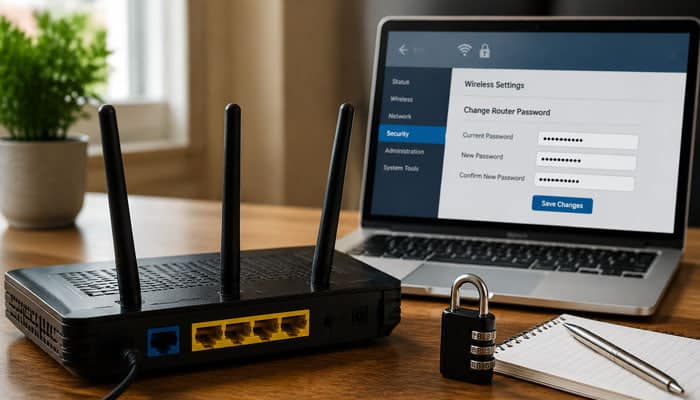
Changing only the Wi-Fi password may not be enough if someone accessed the router’s administrator settings.
Possible warning signs include:
- Unknown devices
- Changed DNS or port-forwarding rules
- Unexpected redirects
- Disabled updates
- Unfamiliar cloud accounts
- Changed network or administrator credentials
These issues may have other causes, so verify them carefully.
Router Recovery Checklist
- Disconnect unknown devices.
- Use a trusted phone or computer.
- Factory reset the router if administrator access was compromised.
- Install the latest official firmware.
- Create separate Wi-Fi and administrator passwords.
- Change linked ISP or manufacturer account passwords.
- Enable multifactor authentication when available.
- Review DNS, remote management, WPS, UPnP and port-forwarding settings.
- Enable WPA3 Personal or WPA2 Personal.
- Update connected devices and reconnect them gradually.
Do not reuse any password that may have been exposed.
How to Create a Secure Router Password
Use different passwords for Wi-Fi, router administration, your ISP account and the manufacturer’s cloud account.
Secure Password Tips
- Use a long, unique passphrase.
- Avoid names, birthdays, addresses and router-brand names.
- Never reuse email, banking or social-media passwords.
- Store credentials in a trusted password manager.
- Enable multifactor authentication when available.
- Do not share the administrator password with guests.
Use the longest password your router supports, preferably at least 15 characters. Avoid predictable changes such as adding 123 or replacing letters with common symbols.
Security Settings to Review After Resetting the Password
After completing how to reset a router password, review these settings to keep the network secure.
Use Strong Wi-Fi Encryption
Choose:
- WPA3 Personal when supported
- WPA2 Personal when WPA3 is unavailable
- WPA2/WPA3 transition mode for older devices
Avoid open networks, WEP and the original WPA standard.
Disable Unneeded Features
Turn off remote management, WPS and UPnP unless you actively need them and understand the security risks.
Enable Basic Protection
- Keep the router firewall enabled.
- Create a separate guest network for visitors and less-trusted devices.
- Review the connected-device list and investigate unknown entries.
- Install firmware updates and enable automatic updates when available.
Replace routers that no longer receive security fixes.
When Should You Change a Router Password?
Change the appropriate password when:
- Default credentials remain active
- Someone unauthorized may know it
- An unfamiliar device appears
- A tenant, roommate or employee leaves
- A technician received administrator access
- The password was shared publicly
- The router was purchased second-hand
- The router was factory reset
- A security alert indicates compromise
- The current password is weak
- The password is reused elsewhere
You do not need to replace a strong, unique and uncompromised password constantly with predictable variations.
When Should You Replace the Router?
Replace the router instead of resetting it when:
- It no longer receives security updates.
- It supports only WEP or old WPA security.
- It frequently crashes or cannot handle your internet speed.
- The management page or Reset button is unreliable.
- The manufacturer or ISP has ended support.
Before replacing it, confirm whether the device is a standalone router, modem-router gateway, mesh gateway or ISP-owned unit. Some equipment also handles modem, phone or fiber connections, so replacing only the router may not solve the problem.
How to Prepare a Router for Sale or Disposal
Before selling, donating or recycling a router:
- Back up settings you still need.
- Remove the router from manufacturer accounts.
- Remove it from ISP and smart-home applications.
- Cancel or transfer related subscriptions.
- Perform a factory reset.
- Confirm that the default setup screen appears.
- Remove personally added labels or notes.
- Include the correct power adapter.
- Recycle unsupported equipment through an approved electronics program.
Common Router Password Reset Mistakes
- Confusing the Wi-Fi password with the administrator password
- Pressing the Reset button before checking connected devices
- Using the wrong reset-button holding time
- Following the outdated “30-30-30” reset method without model-specific instructions
- Resetting the modem or mesh point instead of the main router
- Forgetting to save ISP, PPPoE, VLAN or static IP details
- Reusing the same password for Wi-Fi, router administration and online accounts
- Leaving default administrator credentials active
- Restoring an unsafe configuration backup
- Ignoring firmware updates after resetting
- Entering login details on an unofficial router website
- Resetting a workplace, rental or managed router without permission
Final Router Password Reset Checklist
Before finishing, confirm that you have:
- Identified the correct password type
- Checked the router label and saved credentials
- Tried the official app or recovery option
- Backed up important settings
- Recorded ISP connection details
- Created separate Wi-Fi and administrator passwords
- Enabled WPA3 or WPA2 security
- Updated the router firmware
- Reviewed remote access, WPS, UPnP and connected devices
- Stored the new passwords securely
Frequently Asked Questions
1. Can I Learn How to Reset a Router Password Without Losing Settings?
Yes. If you still know the administrator login, change the Wi-Fi password through the official app or management page without performing a factory reset.
2. What Happens If I Press the Router Reset Button?
A factory reset usually deletes the Wi-Fi name, passwords and customized network settings. A short press may only restart the router or activate WPS, depending on the model.
3. Can I Reset the Router Password Using an Ethernet Cable?
Yes. Connect a computer to a LAN port, open the router’s local management address and sign in with the administrator credentials.
4. Why Is My New Router Password Not Working?
The device may have saved the old password, connected to the wrong network or entered incorrect capitalization. Forget the network and reconnect manually.
5. Can I Use the Same Password for Wi-Fi and Router Administration?
You can, but it is not recommended. Use separate passwords so someone with Wi-Fi access cannot also change the router’s security settings.
6. Will Resetting the Router Fix a Slow Internet Connection?
Not always. Restart the router first and check for ISP outages, poor signal, overloaded devices or outdated firmware before performing a factory reset.
7. How Do I Reset a Router Password on a Mesh Network?
Use the official mesh app first. Resetting the main gateway can delete the entire network, while resetting one secondary point usually affects only that device.
8. How Often Should I Change My Router Password?
Change it when it is weak, exposed, shared with someone who no longer needs access or linked to suspicious activity. Strong, unique passwords do not need frequent routine changes.
Conclusion
Understanding how to reset a router password begins with identifying whether you have lost the Wi-Fi password, router administrator password or cloud-account credentials.
A Wi-Fi password can often be recovered from an already connected phone or computer. When administrator access remains available, you can change the wireless password without deleting the router configuration. Some manufacturers also provide recovery through email, security questions, serial-number verification, account authentication or a device-specific recovery key.
Use a factory reset only after safer recovery methods fail. Record ISP information and back up trusted settings before resetting. After regaining access, create separate Wi-Fi and administrator passwords, install firmware updates, enable WPA3 Personal or WPA2 Personal and review connected devices.
Following this recovery order can restore network access while minimizing unnecessary configuration loss, device disconnections and security risks.