

The Evolution of Accounts Payable
For decades, the accounts payable department was viewed as a necessary burden. It was a back office function characterized by stacks of paper, manual data entry, and the constant pursuit of missing approvals. This traditional model was inherently reactive, focusing solely on paying bills before late fees accrued. In this environment, the staff spent the majority of their time on low value tasks, leaving little room for analysis or strategic planning.
The digital transformation of the last decade has fundamentally altered this landscape. Organizations are no longer content with simply digitizing paper; they are seeking ways to remove human intervention from the process entirely.
This shift represents a move away from the cost center mentality toward a model where the finance team provides critical insights that drive business growth. By automating the mundane, companies can finally leverage their financial talent for high level decision making.
Defining Touchless Invoice Processing
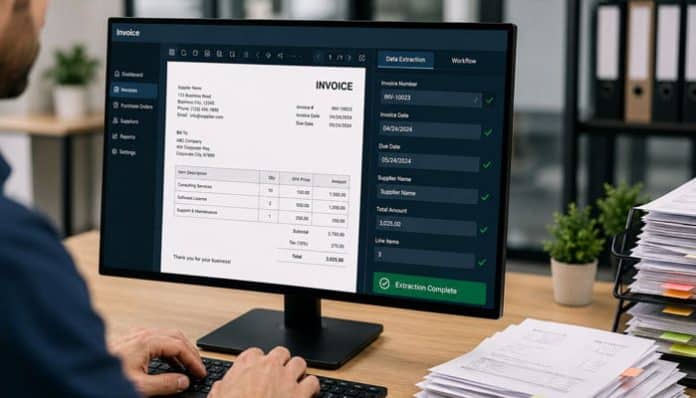
Touchless invoice processing refers to a workflow where an invoice is received, validated, coded, and approved for payment without any manual intervention from a human operator. This is the gold standard of modern finance.
In a truly touchless environment, the system recognizes the incoming document regardless of its format, extracts the relevant data with high precision, matches it against purchase orders or contracts, and routes it through the appropriate ledger codes automatically.
Achieving this level of automation requires a sophisticated blend of technologies. It is not merely about optical character recognition. It involves intelligent systems that can understand context and learn from historical data. When a solution like Yooz is implemented, the goal is to reach a state where the vast majority of invoices flow through the system silently.
Humans only step in when an exception occurs, such as a price mismatch or a missing line item, allowing the team to manage by exception rather than managing every single transaction.
The Mechanics of Automation and Artificial Intelligence
The engine behind touchless processing is a combination of Artificial Intelligence and Machine Learning. These technologies allow the software to do more than just read text; they allow it to interpret intent. For example, the system can distinguish between a freight charge and a sales tax without being explicitly told where those fields are located on every unique vendor invoice.
1. Data Capture: Modern systems use advanced recognition engines to pull data from emails, portals, and paper scans with nearly perfect accuracy.
2. Intelligent Mapping: The software learns the relationship between specific vendors and your general ledger codes, reducing the need for manual coding over time.
3. Automated Matching: True touchless processing involves three way matching, where the invoice is automatically compared to the purchase order and the receiving report.
4. Dynamic Workflows: Approval routing is handled by pre defined business rules, ensuring that the right people see the right documents at the right time without manual forwarding.
By utilizing Yooz to handle these complex mechanical tasks, organizations eliminate the risk of human error and significantly accelerate the payment cycle. This technological foundation is what enables the transition from a clerical function to a strategic one.
Moving Beyond Efficiency: The Strategic Shift
When a finance department achieves touchless invoice processing, the primary benefit is often cited as speed. While speed is important, the true value lies in the shift of human capital. When accounts payable professionals are freed from the shackles of data entry, they can transition into roles as financial analysts and vendor relationship managers.
This shift allows the department to focus on strategic initiatives such as spend analysis and cash flow optimization. Instead of asking where an invoice is, the team can ask why a certain department is over budget or how they can negotiate better terms with a high volume supplier. This elevates the entire department within the corporate hierarchy.
The accounts payable team becomes a source of intelligence that the Chief Financial Officer can rely on for accurate, up to the minute financial data.
Financial Benefits and Bottom Line Impact
The financial implications of touchless processing are profound and measurable. Research suggests that the cost to process a single invoice manually can range from fifteen to twenty five dollars when accounting for labor, overhead, and errors. In a touchless environment, that cost can drop to less than two dollars. For a company processing thousands of invoices a month, the annual savings are substantial.
1. Early Payment Discounts: Many vendors offer discounts for payments made within ten days. Manual processes are often too slow to capture these, but touchless systems can process invoices in hours.
2. Elimination of Duplicate Payments: Automated systems flag duplicates instantly, preventing a common source of capital leakage that often goes unnoticed in manual systems.
3. Reduced Audit Costs: With every transaction digitally tracked and timestamped, internal and external audits become significantly faster and less expensive.
4. Optimized Working Capital: Real time visibility into liabilities allows treasury teams to manage cash positions with much greater precision.
Integrating a platform like Yooz into the financial ecosystem ensures that these savings are captured consistently. The return on investment for such technology is typically realized within the first year of operation, making it one of the most justifiable capital expenditures for a modern finance leader.
Overcoming Common Implementation Hurdles
Despite the clear advantages, some organizations hesitate to adopt touchless processing due to perceived complexities. Common concerns include the difficulty of integrating with existing Enterprise Resource Planning systems and the fear that vendors will not cooperate with new digital requirements. However, modern cloud based solutions are designed to be plug and play, requiring minimal IT involvement.
Success in implementation depends on clear communication and change management. It is vital to involve the accounts payable staff early in the process, demonstrating that the technology is a tool to enhance their roles rather than replace them. Furthermore, choosing a user friendly interface is essential for adoption.
When teams see how easily Yooz integrates with their daily workflow, resistance typically fades. Training should focus on how to handle exceptions and how to use the newly available data for reporting, rather than the mechanics of the software itself.
The Role of Real Time Data in Corporate Strategy

In the traditional model, financial reporting was always looking in the rearview mirror. Reports were generated weeks after the month ended, providing a historical view that was often too late to influence current operations. Touchless processing changes this dynamic by providing real time data. As soon as an invoice enters the system, it is visible in the financial reports, even before it is fully approved.
This level of transparency is a game changer for corporate strategy. It allows for more accurate forecasting and more agile budgeting. If a project is trending over budget, the leadership team knows immediately and can take corrective action.
This visibility also extends to vendor performance. Organizations can track which suppliers are consistently late, which ones have the most billing errors, and which ones are the most reliable partners. This data driven approach to procurement is only possible when the underlying invoice process is automated and transparent.
Future Proofing the Finance Department
The business world is becoming increasingly complex, with global supply chains and evolving regulatory requirements. A manual accounts payable process is a liability in this environment. It is slow, prone to fraud, and lacks the scalability needed for growth. Adopting touchless invoice processing is not just about improving current operations; it is about future proofing the organization.
1. Scalability: As a company grows, its invoice volume increases. A touchless system can handle a ten percent or five hundred percent increase in volume without requiring additional headcount.
2. Fraud Prevention: Automated systems apply consistent rules to every transaction, making it much harder for fraudulent invoices to slip through the cracks.
3. Remote Work Readiness: Cloud based automation allows finance teams to operate from anywhere, ensuring business continuity regardless of external circumstances.
4. Regulatory Compliance: Automated systems maintain a perfect audit trail, ensuring that the company remains compliant with evolving tax laws and financial regulations.
By leveraging Yooz for touchless invoice processing, a company transforms its accounts payable function into a strategic asset. This evolution marks the end of the era where finance was seen as a cost center and begins a new chapter where the department serves as a hub of innovation and insight.
The transition to a touchless model is no longer a luxury for the few; it is a necessity for any organization that wishes to remain competitive in an increasingly digital economy.
Maximizing Value Through Intelligent Spend Management
The ultimate goal of this transformation is to achieve a state of intelligent spend management. This goes beyond just paying bills; it involves a holistic view of how every dollar leaves the organization. When the friction of processing is removed, the focus shifts to the quality of the spend.
Finance leaders can identify consolidated buying opportunities, eliminate rogue spending, and ensure that all purchases align with the strategic goals of the company. This level of control and insight is the hallmark of a modern, high performing finance organization that views every transaction as an opportunity to add value.