
Last updated: July 2, 2026
Artificial intelligence is changing how businesses analyze customer behavior, create content and personalize campaigns. With Einstein AI for Marketing, companies can move beyond manual segmentation, fixed sending schedules and generic messages. Predictive models, generative AI and intelligent agents help marketers make faster, data-driven decisions.
Einstein AI for Marketing is Salesforce’s collection of artificial intelligence capabilities for marketing. It can help businesses predict engagement, identify valuable audiences, generate campaign content, personalize customer experiences, optimize message timing and automate selected campaign tasks.
However, Einstein AI for Marketing is not one standalone application. Its capabilities are distributed across Salesforce products such as Marketing Cloud Engagement, Marketing Cloud Next, Agentforce Marketing, Marketing Cloud Account Engagement, Salesforce Personalization, Marketing Intelligence and Data 360.
This guide explains how Einstein AI for Marketing works, its most important features, practical uses, benefits, pricing, implementation requirements, limitations and major 2026 updates.
Quick Answer: What Is Einstein AI for Marketing?
Einstein AI for Marketing is Salesforce’s AI technology for improving marketing decisions and customer experiences. It combines predictive machine learning, generative AI, real-time personalization and agentic automation.
Depending on the Salesforce products and editions used, it can help marketers:
- Predict email and mobile-message engagement
- Determine suitable message-delivery times
- Identify overmessaged or undermessaged customers
- Build audience segments using natural-language instructions
- Generate campaign briefs, emails and landing-page content
- Personalize products, offers and content
- Detect unusual campaign-performance changes
- Prioritize B2B prospects
- Optimize paid-media activity
- Create multichannel customer journeys
- Support two-way email conversations
- Automate selected marketing workflows
Salesforce’s next-generation marketing platform is called Marketing Cloud Next and is also described as Agentforce Marketing. It adds AI agents, unified data and cross-channel orchestration to Salesforce’s established marketing capabilities.
Einstein AI for Marketing at a Glance
| Category | What Einstein can do | Example |
|---|---|---|
| Predictive AI | Predict likely customer behavior | Estimate whether a subscriber will click |
| Generative AI | Create or rewrite content | Draft an email or landing page |
| Agentic AI | Complete coordinated marketing tasks | Build a campaign brief, segment and journey |
| Decisioning AI | Select a suitable action or experience | Route a customer to a retention journey |
| Personalization | Adapt content in real time | Recommend a relevant product |
| Analytics | Detect trends and anomalies | Alert marketers to falling engagement |
| Paid-media optimization | Analyze and improve advertising | Identify an underperforming campaign |
| Conversational marketing | Respond to customer replies | Answer a product question by email |
Key Takeaways
- Einstein AI for Marketing includes predictive, generative and agentic AI.
- It is a group of capabilities across several Salesforce products, not one separate tool.
- Established Einstein features optimize engagement, sending time, frequency and content.
- Marketing Cloud Next adds natural-language segmentation, campaign creation and journey decisioning.
- Agentforce Marketing can coordinate multistep marketing activities within defined business rules.
- Data 360 supplies unified customer information that can improve AI grounding and personalization.
- Marketing Intelligence adds paid-media analysis and AI-assisted campaign optimization.
- Human review is still necessary for content, consent, compliance, audiences and budgets.
- Pricing can include subscriptions, messaging, Data 360 usage, implementation and Agentforce consumption.
- Businesses should evaluate Einstein through incremental conversions, profit, retention and operational savings.
What Is Einstein AI for Marketing?
Einstein is the name Salesforce uses for artificial intelligence embedded across its customer relationship management ecosystem.
In marketing, Einstein applies machine learning, generative AI and automated decisioning to customer data, campaign activity and content workflows.
Traditional marketing automation follows predetermined instructions. For example, a subscriber who downloads an ebook may automatically enter a three-email nurture sequence.
Einstein adds intelligence to that process. It can analyze the subscriber’s engagement history, estimate whether the person is likely to respond, recommend an appropriate delivery time or select more relevant content.
Agentforce can go further by helping complete coordinated tasks. A marketing agent may create a campaign brief, develop an audience, generate messages and prepare a customer journey based on instructions from a marketer.
The marketer defines the objective, business rules and boundaries. Einstein and Agentforce assist with analysis and execution.
Is Einstein AI for Marketing the Same as Einstein GPT?
No. Einstein GPT was Salesforce’s earlier branding for generative AI capabilities within its CRM products.
Salesforce states that Einstein GPT evolved into its broader Agentforce platform. Current Salesforce marketing terminology centers on Einstein AI, Agentforce, Marketing Cloud Next and Agentforce Marketing.
Older articles may still use terms such as:
- Einstein GPT for Marketing
- Einstein Copilot
- Marketing GPT
- Salesforce Data Cloud
- Pardot
- Interaction Studio
These names can refer to earlier versions or branding of products that now appear under updated Salesforce terminology.
Salesforce Marketing AI Terminology Explained
Understanding Salesforce’s current product names makes it easier to evaluate Einstein AI for Marketing features and avoid outdated terminology.
| Current term | Meaning |
|---|---|
| Einstein AI | Salesforce’s predictive and generative AI technology |
| Agentforce | Platform for creating and operating AI agents |
| Agentforce Marketing | Salesforce’s agentic marketing capabilities |
| Marketing Cloud Next | Next-generation Salesforce marketing platform |
| Marketing Cloud Engagement | Email, mobile messaging and Journey Builder platform |
| Data 360 | Unified customer data platform, formerly Data Cloud |
| Marketing Cloud Account Engagement | B2B automation platform, formerly Pardot |
| Salesforce Personalization | Real-time recommendations and personalization |
| Marketing Intelligence | Marketing analytics and paid-media optimization |
| Einstein Trust Layer | AI security, privacy and governance framework |
Data Cloud Is Now Data 360
Salesforce renamed Data Cloud to Data 360 on October 14, 2025. The platform continues to unify structured and unstructured information for customer profiles, segmentation, personalization, analytics and AI workflows.
Marketing Cloud Next and Agentforce Marketing
Marketing Cloud Next is Salesforce’s next-generation marketing platform built on its core CRM. Also positioned as Agentforce Marketing, it expands Einstein AI for Marketing through AI-assisted campaigns, audience creation, personalization and journey automation.
Eligible existing customers can access selected capabilities through “+” editions while continuing to use their current journeys, data and content.
How Does Einstein AI for Marketing Work?

Most Einstein AI for Marketing workflows follow five main stages, from collecting customer data to activating AI-powered recommendations.
1. Customer Data Is Collected
Salesforce can collect or connect information from:
- Email and mobile engagement
- Websites and ecommerce platforms
- Purchases and conversions
- CRM, lead and account records
- Customer preferences and loyalty programs
- Service interactions
- Advertising campaigns
Available data depends on the company’s Salesforce products, integrations, tracking settings and customer permissions.
2. Data Is Unified and Prepared
Data 360 connects information from CRM systems, websites, mobile apps, support platforms and data warehouses to create unified customer profiles.
Duplicate records, missing identifiers, outdated preferences and incomplete consent information can reduce AI accuracy. Clean, reliable data is therefore essential for Einstein AI for Marketing.
3. AI Models Analyze Patterns
Einstein analyzes historical behavior to predict whether a customer may:
- Open or click a message
- Convert or respond to an offer
- Unsubscribe or become inactive
- Show purchase intent
- Engage at a particular time
These predictions indicate probability rather than guaranteed behavior.
4. Einstein Produces an Output
Depending on the feature, Einstein may generate:
- Engagement scores
- Recommended sending times
- Audience segments
- Campaign briefs
- Subject-line drafts
- Personalized offers
- Journey or paid-media recommendations
- Performance alerts
5. A Marketer Reviews or Activates the Result
Recommendations can be added to Salesforce journeys and automated workflows. However, marketers should review audience eligibility, consent, brand accuracy, pricing, legal claims, campaign budgets and sensitive data before activating any Einstein AI for Marketing output.
Main Einstein AI for Marketing Features
The following table summarizes the main capabilities of Einstein AI for Marketing and how marketers can use them.
| Feature | Main function | Typical use |
|---|---|---|
| Einstein Engagement Scoring | Predicts engagement probability | Building engagement-based audiences |
| Send Time Optimization | Predicts suitable sending times | Scheduling email and push messages |
| Engagement Frequency | Measures message saturation | Reducing fatigue and unsubscribes |
| Messaging Insights | Detects unusual performance | Finding unexpected campaign changes |
| Copy Insights | Analyzes marketing language | Improving subject lines |
| Generative AI | Creates campaign content | Drafting emails and landing pages |
| Content Selection | Chooses approved assets | Personalizing email content |
| Content Tagging | Labels image assets | Organizing content libraries |
| Salesforce Personalization | Makes real-time recommendations | Showing relevant products or offers |
| Behavior Scoring | Identifies B2B buying signals | Prioritizing prospects |
| Campaign Insights | Explains campaign patterns | Finding high-performing audiences |
| Einstein Segment Creation | Builds audiences from prompts | Reducing technical segmentation work |
| Campaign Creation Agent | Creates campaign components | Accelerating campaign production |
| Journey Decisioning | Selects customer paths | Choosing the next suitable journey |
| Paid Media Optimization | Monitors advertising | Improving budgets and performance |
| Conversational Email | Enables two-way email | Answering customer replies |
1. Einstein Engagement Scoring
Within Einstein AI for Marketing, Engagement Scoring predicts how individual subscribers may respond to email or mobile messages.
It can identify:
- Highly engaged customers
- Moderately engaged subscribers
- Customers with declining activity
- Contacts likely to click
- Subscribers at risk of disengaging
- Customers suitable for re-engagement
Marketing Cloud Engagement needs sufficient historical data before activation, including at least 1,000 engagement events during the previous 90 days.
Einstein can predict:
- Email opens
- Link clicks
- Subscriber retention
- Website conversion
- Overall engagement
Scores update as new information becomes available.
How Marketers Can Use Engagement Scores
| Audience | Possible action |
|---|---|
| Highly engaged | Offer early product access |
| Moderately engaged | Send educational or comparison content |
| Declining engagement | Start a re-engagement sequence |
| Low engagement | Reduce promotional frequency |
| High unsubscribe risk | Suppress nonessential messages |
Scores should not become permanent labels. Customer behavior changes, so campaigns should use current scores and recent activity.
2. Einstein Send Time Optimization
Send Time Optimization helps Einstein AI for Marketing predict when each contact is most likely to engage with an email or push notification.
Instead of sending every message at a fixed time, Einstein can hold delivery until the contact’s predicted window.
Marketing Cloud Engagement uses machine learning and approximately 90 days of email or push-engagement data to choose a suitable time within the following 24 hours. When individual data is limited, Salesforce may use a generalized model.
Potential uses include:
- Welcome messages
- Product launches
- Newsletters
- Event reminders
- Promotional campaigns
- Loyalty messages
- Mobile-app notifications
- Re-engagement campaigns
This feature is helpful across time zones and different engagement habits, but it improves probability rather than guaranteeing engagement.
3. Einstein Engagement Frequency
Engagement Frequency allows Einstein AI for Marketing to estimate whether customers receive too few, enough or too many messages.
Typical classifications include:
- Undersaturated
- On target
- Saturated
Marketing Cloud Engagement bases these metrics on the previous 28 days.
Marketers can use the results to:
- Reduce messages for saturated customers
- Increase communication with undersaturated audiences
- Maintain schedules for on-target subscribers
- Create suppression rules
- Coordinate campaigns across departments
- Improve contact-governance policies
This feature is especially valuable when several teams communicate with the same customer base.
4. Einstein Messaging Insights
Messaging Insights enables Einstein AI for Marketing to detect campaign results that differ significantly from expected patterns.
An insight may reveal that:
- A campaign is performing unusually well
- Click activity has fallen
- Unsubscribes have increased
- A journey has lost effectiveness
- A new audience is responding differently
- A technical or deliverability issue may exist
The feature reduces manual dashboard monitoring. However, marketers must still determine whether the cause is content, audience selection, timing, deliverability, seasonality or another factor.
5. Einstein Copy Insights and Generative Content
Copy Insights strengthens Einstein AI for Marketing by analyzing subject-line language and identifying patterns associated with engagement.
Salesforce generative AI can also help marketers:
- Generate subject-line variations
- Draft email body copy
- Rewrite content in another tone
- Shorten long paragraphs
- Create calls to action
- Develop SMS copy
- Produce campaign variations
- Draft landing-page content
- Generate testing ideas
Every output should be reviewed for:
- Factual accuracy
- Product details
- Pricing
- Brand consistency
- Legal claims
- Offer conditions
- Grammar
- Accessibility
- Cultural sensitivity
- Inclusive language
AI-generated content works best as a first draft rather than an automatically published final version.
6. Einstein Content Selection
Content Selection helps Einstein AI for Marketing choose approved assets using customer information and performance signals.
A travel company could prepare images representing:
- Beach holidays
- Mountain destinations
- City breaks
- Family travel
- Luxury resorts
- Budget accommodation
Einstein may then select a relevant asset for each recipient instead of requiring a separate campaign for every audience group.
Successful personalization still requires:
- High-quality approved assets
- Accurate content attributes
- Appropriate fallback content
- Brand governance
- Performance measurement
7. Einstein Content Tagging
Content Tagging supports Einstein AI for Marketing by analyzing image assets and applying searchable labels.
It can help teams:
- Find images faster
- Organize large asset libraries
- Identify visual themes
- Prepare content for personalization
- Compare asset characteristics
- Improve content-management workflows
Marketers should review automated tags because image models may produce incomplete, broad or incorrect labels.
8. Salesforce Personalization
Salesforce Personalization extends Einstein AI for Marketing with real-time experiences based on customer behavior, profile information and business rules.
It can recommend:
- Products
- Articles
- Promotions
- Offers
- Website experiences
- Mobile-app content
- Email content
- Next-best actions
Personalization Example
For a returning outdoor-retail customer, Salesforce Personalization could consider:
- Previous purchases
- Recently viewed products
- Loyalty status
- Weather-related interests
- Available inventory
- Campaign eligibility
The website could then show hiking equipment instead of a generic promotion.
Personalization should remain relevant rather than intrusive. Businesses need rules for consent, sensitive attributes, message frequency and customer exclusions.
9. Einstein Behavior Scoring for B2B Marketing
Behavior Scoring brings Einstein AI for Marketing into B2B marketing by examining prospect activity and signals connected with buying interest.
Teams can use the scores to:
- Prioritize prospects for sales outreach
- Identify accounts showing renewed interest
- Create nurture journeys for early-stage buyers
- Avoid sending unqualified leads to sales
- Trigger alerts when engagement rises
- Compare behavioral interest with customer fit
A high score suggests interest but does not prove budget, authority or immediate purchase intent.
Combine Einstein scores with:
- Account fit
- Firmographic information
- Sales qualification
- Product usage
- Opportunity data
- Human judgment
10. Einstein Campaign Insights
Campaign Insights helps Einstein AI for Marketing identify unusual or influential campaign-performance factors.
It may show:
- Which personas are responding
- Which content attracts engagement
- Whether one region is outperforming another
- Which activity differs from normal patterns
- Which audience characteristics relate to results
Evaluate these insights alongside attribution data, conversions, qualified pipeline and sales outcomes.
11. Natural-Language Audience Segmentation
Natural-language segmentation allows Einstein AI for Marketing to create audiences from plain-language instructions.
For example:
Create an audience of customers who purchased running shoes during the past six months but have not purchased sportswear.
Einstein converts the request into proposed segment criteria based on available customer attributes.
AI-assisted segment creation is available for eligible Enterprise and Unlimited implementations using Marketing Cloud Next Growth or Advanced. Salesforce excludes demographic attributes and attributes with fewer than 10 population results to reduce bias and statistical outliers.
Before publishing a segment, verify:
- Selected attributes
- Date ranges
- Identity resolution
- Customer consent
- Exclusion rules
- Audience size
- Refresh frequency
- Regional restrictions
- Suppression conditions
This feature reduces technical work but does not replace strategic review.
12. Agentforce Campaign Creation
The Campaign Creation Agent expands Einstein AI for Marketing by turning conversational instructions into coordinated campaign materials.
A marketer can provide:
- Campaign objective
- Target audience
- Product
- Offer
- Campaign period
- Preferred channels
- Brand tone
- Call to action
- Exclusion conditions
The agent may create:
- Campaign briefs
- Audience segments
- Emails
- SMS messages
- Landing-page content
- Campaign structures
- Multichannel journeys
- Campaign summaries
Agentforce Campaign Creation is included in Marketing Cloud Next Growth and Advanced packages.
Before launch, confirm:
- Audience accuracy
- Consent
- Claims
- Links
- Offer conditions
- Brand language
- Journey logic
- Tracking
- Success metrics
13. Journey Decisioning
Journey Decisioning enables Einstein AI for Marketing to recommend the next suitable customer journey or path.
The agent may consider:
- Customer behavior
- Engagement history
- Purchase activity
- Loyalty status
- Service context
- Campaign eligibility
- Available offers
Possible decisions include:
- Choosing a retention journey
- Selecting a product offer
- Moving an engaged prospect toward sales
- Suppressing an inappropriate promotion
- Routing a customer to service
- Generating tailored journey content
Journey Decisioning currently requires eligible Enterprise or Unlimited editions with Marketing Cloud Next Growth or Advanced and Marketing Cloud Engagement+.
Organizations should establish guardrails for:
- Message frequency
- Product eligibility
- Sensitive customer attributes
- Budget
- Consent
- Human escalation
- Regulated communications
14. Agentforce Paid Media Optimization
Paid Media Optimization extends Einstein AI for Marketing beyond owned channels such as email and mobile messaging.
Marketing Intelligence uses Salesforce data, analytics and agents to improve advertising performance.
Potential uses include:
- Identifying campaigns that spend without enough conversions
- Highlighting weak audience segments
- Comparing advertising with defined objectives
- Recommending budget adjustments
- Detecting declining performance
- Creating campaign summaries
- Prioritizing campaigns requiring attention
- Supporting cross-channel analysis
Paid-media automation should include:
- Budget limits
- Approval thresholds
- Platform-specific rules
- Performance minimums
- Audit records
- Human override options
Segment Intelligence
Segment Intelligence helps teams evaluate audiences through:
- Conversion rate
- Revenue
- Return on ad spend
- Acquisition cost
- Retention
- Customer lifetime value
- Channel performance
- Campaign-objective performance
These insights can direct investment toward higher-value audiences.
15. Conversational Email
Conversational Email gives Einstein AI for Marketing a two-way email capability instead of limiting campaigns to one-way messages.
When a customer replies, Salesforce can:
- Trigger a Salesforce Flow
- Route the request to Agentforce
- Transfer the conversation to a person
- Update Salesforce data
- Continue within the same email thread
- Influence a future customer journey
Implementation requires Marketing Cloud Next, Agentforce and Service Cloud.
Conversational Email Use Cases
- Event registration
- Abandoned-cart questions
- Appointment scheduling
- Product enquiries
- Order tracking
- Return requests
- Lead qualification
- Loyalty redemption
- Subscription re-engagement
- Customer-service escalation
Conversational Email is available with eligible Enterprise and Unlimited Editions using Marketing Cloud Next Advanced.
Businesses need rules for:
- Response accuracy
- AI disclosure
- Unsubscribe requests
- Service hours
- Sensitive information
- Human escalation
- Conversation monitoring
Salesforce can recognize reply-based unsubscribe requests and remove customers from active conversational flows.
16. Using Unstructured Data to Ground Marketing AI
Unstructured data can make Einstein AI for Marketing more useful by grounding campaign generation and customer responses in approved business information.
Data 360 can work with sources such as:
- Product documentation
- Frequently asked questions
- Brand guidelines
- Internal knowledge files
- Blogs
- Support articles
- Google Drive
- Microsoft SharePoint
- Zendesk
- Policy documents
An agent could use:
- An approved product guide to draft launch content
- Brand guidelines to match the correct tone
- A knowledge base to answer questions
- A current policy document to avoid outdated claims
- Product FAQs to create educational messages
Before connecting documents, confirm that:
- The information is current
- The content is approved
- Permissions are appropriate
- Confidential information is excluded
- Outdated files are archived
- Conflicting documents are resolved
- Pricing and legal claims are verified
Grounding reduces unsupported generation, but it does not guarantee accuracy. Human review remains essential for every AI-supported workflow.
What Changed in Einstein AI for Marketing in 2026?
Salesforce’s Summer ’26 updates expand Einstein AI for Marketing beyond conventional email automation through richer messaging, multilingual content, live customer data and stronger personalization.
RCS Messaging
Marketing Cloud Next now supports Rich Communication Services for eligible implementations. This gives Einstein AI for Marketing more engaging mobile-messaging options, including:
- Branded sender identities
- Images and rich media
- Interactive cards
- Suggested actions
- More visual mobile experiences
Availability depends on location, carrier support, sender verification and Salesforce configuration.
Multilingual Content Variants
Summer ’26 improves multilingual campaign management for:
- Languages
- Countries
- Regional audiences
- Brands
- Business units
AI-generated translations should still be reviewed by fluent speakers or localization professionals to protect regional meaning, legal accuracy and brand tone.
Live Salesforce Data for Personalization
Marketing Cloud Next can use current Salesforce data to make Einstein AI for Marketing more responsive to:
- Recent purchases
- Open service cases
- Loyalty-status changes
- Sales opportunities
- Renewal dates
- Preference updates
This can prevent disconnected experiences, such as sending a promotion to a customer with an unresolved complaint.
Business-Unit Enhancements
Summer ’26 expands business-unit administration and content sharing. Eligible Advanced Edition organizations can create up to 150 business units, deactivate obsolete units and share selected assets through a common library.
This helps multinational and multibrand businesses manage:
- Data access
- Content ownership
- Sending identities
- Campaign permissions
- Regional operations
- Shared brand assets
Improved Content and Personalization Tools
The Summer ’26 release also adds:
- Custom web fonts
- Multilingual content variants
- Live Salesforce data
- Improved audience-building tools
- Agent templates
- RCS configuration
- Additional personalization capabilities
Salesforce describes Marketing Cloud Next as Agentforce Marketing in these release notes, showing how Einstein AI for Marketing is moving toward a more connected agentic platform.
The main 2026 change is not simply more AI-generated copy. Einstein AI for Marketing now connects data, predictions, content, messaging, customer conversations and autonomous agents within one coordinated marketing environment.
Benefits of Einstein AI for Marketing
Einstein AI for Marketing helps businesses personalize customer experiences, improve campaign efficiency and make better use of Salesforce data.
More Relevant Personalization
Einstein can use behavioral, transactional and engagement data to respond to actions such as:
- Viewing a product
- Abandoning a cart
- Clicking a topic
- Completing a purchase
- Becoming less active
- Opening a service case
- Reaching a loyalty milestone
Faster Audience Creation
Natural-language segmentation reduces dependence on complex queries, helping marketers build audiences more quickly.
Improved Campaign Productivity
With Einstein AI for Marketing, teams can accelerate the creation of:
- Campaign briefs
- First drafts
- Subject lines
- SMS messages
- Landing pages
- Audience definitions
- Journey structures
- Performance summaries
The time saved can support strategy, testing and customer research.
Better Message Timing
Send Time Optimization schedules communications according to individual engagement patterns instead of one fixed delivery time.
Reduced Customer Fatigue
Engagement Frequency helps identify customers who may be receiving too many messages.
Faster Problem Detection
Messaging Insights alerts marketers to unusual campaign activity earlier.
Stronger Sales and Marketing Alignment
Behavior scoring helps sales teams identify prospects showing meaningful engagement.
Better Use of Salesforce Data
Because Einstein AI for Marketing operates within Salesforce, decisions can use information from sales, service, commerce and loyalty workflows.
More Consistent Customer Journeys
Live data and cross-cloud orchestration help reduce conflicting communications between teams.
Continuous Optimization
Predictive models update as customer behavior changes. Einstein AI for Marketing can use refreshed data to improve timing, frequency and audience segmentation.
Practical Uses of Einstein AI for Marketing by Industry
Einstein AI for Marketing can support personalization, automation and customer engagement across many industries.
Ecommerce
Ecommerce businesses can use Einstein AI for Marketing to:
- Recommend related products
- Personalize homepages
- Optimize abandoned-cart messages
- Create product-launch campaigns
- Identify high-engagement customers
- Reduce excessive communication
- Develop retention journeys
- Personalize offers
Retail
Retailers can apply Einstein to:
- Loyalty campaigns
- Seasonal promotions
- Replenishment reminders
- Store-related offers
- Cross-channel messaging
- Product recommendations
- Win-back programs
- Content experimentation
Financial Services
Financial organizations can use Einstein AI for Marketing to:
- Personalize educational content
- Segment customers by product interest
- Optimize communication timing
- Develop onboarding journeys
- Detect falling engagement
- Recommend relevant service information
Financial claims, rates, eligibility statements and regulated communications require compliance review.
Healthcare
Healthcare organizations may use Salesforce AI for approved:
- Educational communications
- Appointment reminders
- Scheduling workflows
- Patient-engagement campaigns
- Service navigation
Sensitive health information requires strict consent, access and regulatory controls. AI-generated content should not replace qualified medical advice.
Travel and Hospitality
Travel companies can personalize:
- Destination suggestions
- Property recommendations
- Upgrade offers
- Booking reminders
- Pre-arrival messages
- Loyalty communications
- Post-trip campaigns
SaaS Companies
Software businesses can use Einstein AI for Marketing to:
- Segment trial users
- Identify buying signals
- Personalize onboarding
- Detect declining engagement
- Recommend educational content
- Trigger upgrade campaigns
- Route qualified prospects to sales
B2B Companies
B2B teams can use Einstein for:
- Lead prioritization
- Account-based marketing
- Buying-group identification
- Persona-specific campaigns
- Nurture programs
- Campaign insights
- Sales handoffs
Media and Publishing
Publishers can use Einstein AI for Marketing to personalize:
- Article recommendations
- Newsletter topics
- Subscription offers
- Renewal journeys
- Sending times
- Re-engagement campaigns
Example Einstein AI for Marketing Workflow
Consider an online sportswear company launching a new running-shoe collection. This Einstein AI for Marketing workflow connects customer data, campaign creation, personalization and performance measurement.
Step 1: Define the Objective
The company wants to increase purchases from existing customers without offering unnecessary discounts.
Step 2: Build the Audience
The marketer asks Einstein to identify customers who:
- Purchased running products in the past 12 months
- Viewed running shoes in the past 30 days
- Have not purchased the new collection
- Have valid marketing consent
- Do not have an unresolved service complaint
Step 3: Analyze Engagement
Einstein AI for Marketing uses Engagement Scoring to divide the audience into high-, medium- and low-engagement groups.
Step 4: Create Campaign Materials
Agentforce helps create:
- A campaign brief
- Email subject lines
- Email copy
- SMS content
- A landing page
- A customer journey
Step 5: Personalize the Campaign
Einstein AI for Marketing then combines Content Selection and Salesforce Personalization to choose approved imagery and recommend relevant products or accessories.
Step 6: Optimize Delivery
Send Time Optimization identifies suitable delivery times, while Engagement Frequency prevents saturated customers from receiving unnecessary promotions.
Step 7: Monitor Performance
Messaging Insights alerts the marketing team to unusual campaign-performance changes.
Step 8: Measure Incremental Results
The company compares the AI-assisted campaign with a control group using:
- Conversion rate
- Revenue per recipient
- Unsubscribe rate
- Average order value
- Incremental profit
- Customer retention
- Production time
This example shows how Einstein AI for Marketing can connect data, predictions, content and automation while preserving human approval.
How to Implement Einstein AI for Marketing
A successful Einstein AI for Marketing implementation requires clear goals, reliable data, appropriate Salesforce products and human oversight.
1. Define a Measurable Business Problem
Do not begin with, “We need AI.” Start with a specific challenge such as:
- Low campaign engagement
- Slow campaign production
- Poor lead prioritization
- Excessive email frequency
- Weak recommendations
- Fragmented customer data
- High unsubscribe rates
- Limited personalization
2. Match the Problem to the Correct Product
| Business need | Relevant Salesforce capability |
|---|---|
| Email and push optimization | Marketing Cloud Engagement Einstein |
| Agent-assisted campaign creation | Marketing Cloud Next |
| B2B prospect scoring | Marketing Cloud Account Engagement |
| Real-time recommendations | Salesforce Personalization |
| Unified customer information | Data 360 |
| Paid-media analytics | Marketing Intelligence |
| Multistep AI agents | Agentforce |
3. Confirm Technical Prerequisites
Purchasing a subscription does not automatically activate every Einstein AI for Marketing capability.
Requirements may include:
- Salesforce Enterprise or Unlimited Edition
- Marketing Cloud Next Growth or Advanced
- Marketing Cloud Engagement+
- Salesforce Foundations
- Data 360
- Identity-resolution rules
- Marketing Cloud and Agentforce permissions
- Journey Builder and data extensions
- Salesforce Flow
- Service Cloud
- Enabled generative AI settings
Marketing Cloud Next is available with eligible Enterprise and Unlimited editions using Growth or Advanced. Create a prerequisite worksheet before implementation.
4. Audit Data Quality
Review:
- Duplicate records
- Missing customer identifiers
- Inconsistent fields
- Outdated information
- Consent status
- Tracking reliability
- Identity resolution
- Unsubscribe processing
- Data retention
- Data ownership
AI can scale inaccurate data as easily as useful insights.
5. Confirm Data Volume
Predictive features require sufficient activity:
- Engagement Scoring needs historical events.
- Send Time Optimization needs engagement history.
- Engagement Frequency needs varied sending patterns.
- Personalization needs reliable behavioral data.
- B2B scoring needs prospect activity.
A small or new database may not immediately produce detailed predictions.
6. Establish Privacy and Consent Rules
Document:
- Which data can be used
- Why it is processed
- Which channels have consent
- Which attributes are sensitive
- How customers opt out
- How long data is retained
- Who can access predictions
- Which decisions require human review
7. Configure Brand Standards
Create guidance covering:
- Voice and tone
- Product terminology
- Approved claims
- Prohibited language
- Legal disclaimers
- Accessibility
- Inclusive wording
- Regional spelling
- Promotional conditions
These standards help Einstein AI for Marketing produce more accurate and consistent campaign content.
8. Begin With a Controlled Pilot
Test Einstein AI for Marketing on one campaign with:
- A clear objective
- Reliable baseline data
- A defined audience
- Limited compliance risk
- Measurable conversion activity
- A control group
Avoid activating every Einstein feature at the same time.
9. Create Human Approval Points
Require approval before:
- Publishing generated content
- Activating an audience
- Launching a journey
- Changing offer eligibility
- Increasing message frequency
- Using sensitive attributes
- Adjusting major advertising budgets
- Publishing regulated communications
10. Measure Incremental Performance
Compare:
- Optimized timing with fixed timing
- AI-created audiences with existing segments
- Personalized content with generic content
- AI-generated drafts with the normal workflow
- Frequency optimization with the existing calendar
- Agent-assisted campaigns with conventional campaigns
11. Expand After Verification
Scale Einstein AI for Marketing only after confirming:
- Data quality
- Brand accuracy
- Compliance
- Model usefulness
- Operational savings
- Customer impact
- Financial value
Metrics for Measuring Einstein AI Performance
| Capability | Recommended metrics |
|---|---|
| Engagement Scoring | Conversion lift by score group |
| Send Time Optimization | Click and conversion lift |
| Engagement Frequency | Unsubscribes, complaints and retention |
| Messaging Insights | Detection and resolution time |
| Generative content | Production time and approval rate |
| Content Selection | Click-through and conversion rate |
| Personalization | Recommendation revenue and conversion lift |
| B2B Behavior Scoring | Qualified opportunities and pipeline |
| Campaign Creation | Time to launch and revision count |
| Segment Creation | Creation time and audience accuracy |
| Journey Decisioning | Conversion and retention by journey |
| Paid Media Optimization | ROAS, CPA and incremental profit |
| Conversational Email | Reply, resolution and escalation rates |
Do not use email open rates as the only success measure. Email privacy protections and automated image loading can affect the reliability of opens.
Clicks, conversions, revenue, qualified pipeline, retention and incremental profit generally provide stronger evidence of value.
How to Calculate the ROI of Einstein AI for Marketing
A basic return-on-investment formula is:
ROI (%) = [(Financial benefit − Total cost) ÷ Total cost] × 100
Total Costs May Include
- Salesforce subscriptions
- Agentforce usage
- Flex Credits
- Data 360 consumption
- Messaging
- Consulting
- Integration
- Training
- Staff time
- Content review
- Ongoing administration
Financial Benefits May Include
- Incremental campaign profit
- Additional qualified pipeline
- Reduced production costs
- Lower acquisition costs
- Improved retention
- Reduced manual analysis
- Higher employee productivity
Example Calculation
Suppose a company spends $120,000 during its first year on licensing, implementation, training and usage.
It measures:
- $130,000 in incremental campaign profit
- $45,000 in production-time savings
- $25,000 in retention-related value
The total estimated benefit is $200,000.
ROI = [($200,000 − $120,000) ÷ $120,000] × 100
Estimated ROI = 66.7%
This is an illustrative example, not an expected Salesforce result.
To avoid overstating ROI:
- Use control groups
- Separate revenue from profit
- Exclude sales that would have occurred anyway
- Include staff and consulting costs
- Measure results over an appropriate period
- Document assumptions
Best Practices for Einstein AI for Marketing
Einstein AI for Marketing works best when businesses combine automation with responsible data use, human oversight and clear performance goals.
Keep Humans Accountable
AI can recommend, generate and act, but a qualified person should remain responsible for campaign decisions and results.
Use First-Party Data Carefully
When using Einstein AI for Marketing, collect and process customer data only with appropriate permission and a clear business purpose.
Avoid Intrusive Personalization
Personalization should feel useful rather than unsettling. Do not use information customers would not reasonably expect to influence a campaign.
Maintain Control Groups
Control groups help teams measure whether Einstein AI for Marketing caused an improvement or whether results came from seasonality or other campaign differences.
Optimize for Outcomes
More content does not automatically produce better marketing. Einstein AI for Marketing should support measurable outcomes such as:
- Qualified leads
- Conversions
- Profit
- Retention
- Customer value
- Production efficiency
- Customer satisfaction
Protect Deliverability
Einstein does not replace:
- Customer consent
- Email authentication
- Suppression management
- Bounce handling
- Complaint monitoring
- List hygiene
- Relevant content
Review Model Performance
Customer behavior changes. Compare AI predictions with actual outcomes and update campaign rules when performance declines.
Document AI Use
Teams using Einstein AI for Marketing should maintain records of:
- Enabled features
- Data sources
- Approval responsibilities
- Generated content
- Agent actions
- Campaign changes
- Performance tests
- Compliance reviews
Limitations, Risks and Common Mistakes of Einstein AI for Marketing
Einstein AI for Marketing can improve campaign efficiency, but its value depends on data quality, product availability, governance and careful implementation.
It Does Not Create a Complete Strategy
Einstein AI for Marketing can analyze data, generate drafts, recommend actions and automate approved workflows. However, it does not independently define brand positioning, customer value or long-term marketing priorities.
It also does not automatically:
- Repair inaccurate or fragmented data
- Obtain valid customer consent
- Guarantee conversions or profitability
- Approve legal, medical or financial claims
- Resolve conflicting business rules
- Understand every regional or cultural context
- Replace deliverability management
- Eliminate experimentation
- Remove human accountability
Define the business objective before choosing an Einstein capability.
Feature Availability Varies
Not every Einstein AI for Marketing feature is included in every Salesforce edition.
Some capabilities require:
- Higher editions
- “+” packages
- Data 360
- Agentforce
- Marketing Cloud Engagement+
- Additional permissions
- Consumption credits
- Regional availability
Do not assume that a feature shown in a Salesforce demonstration is included in your contract. Confirm editions, permissions, usage allowances and dependencies first.
Implementation Can Be Complex
A large implementation may require:
- Salesforce administrators
- Marketing Cloud specialists
- CRM architects
- Data engineers
- Privacy professionals
- Legal reviewers
- Analysts
- Content strategists
Purchasing Einstein AI for Marketing does not automatically create a functioning system. Data preparation, identity resolution, integrations, access controls, testing and training still require substantial work.
Results Depend on Data Quality and Volume
Predictive models become less reliable when records are duplicated, tracking is incomplete or consent data is inaccurate.
A small or new dataset may also lack enough history to produce individualized predictions. Activating Einstein AI for Marketing before correcting data problems can spread errors across segments, recommendations and journeys.
Generated Content Requires Human Review
Generative AI may produce incorrect product information, unsupported claims, unsuitable wording or outdated offers.
Review:
- Product specifications
- Prices
- Dates
- Links
- Legal claims
- Offer conditions
- Brand language
- Accessibility
- Regional suitability
Treat every Einstein AI for Marketing output as a draft until it has been approved.
Predictions Are Probabilities, Not Facts
An engagement score does not prove that a customer will click, purchase or unsubscribe.
Do not use one score as a permanent customer label. Compare predictions with actual outcomes and combine Einstein AI for Marketing insights with recent activity, eligibility rules and human judgment.
Historical Patterns Can Reinforce Bias
Models trained on historical behavior may repeat existing patterns.
Monitor:
- Unequal audience exclusions
- Sensitive-attribute usage
- Distorted targeting
- Different outcomes across customer groups
- Unexplained eligibility changes
- Segments that repeatedly exclude certain audiences
Natural-language segmentation is easier to use, but teams must still review who is included and excluded.
Privacy and Compliance Remain the Business’s Responsibility
Salesforce security controls do not automatically make every campaign lawful.
Organizations must confirm:
- Permission to use customer data
- Valid channel consent
- Exclusion of inappropriate sensitive attributes
- Customer opt-out rights
- Approval of generated claims
- Specialist review of regulated communications
A technically possible Einstein AI for Marketing audience is not always lawful or appropriate.
Avoid Automating Too Much Too Quickly
Activating several agents, predictive models and journeys at once increases risk.
Begin with one controlled use case, establish a baseline, use a comparison group and verify results before expanding Einstein AI for Marketing automation.
Major budget changes, sensitive communications and high-impact eligibility decisions should require approval thresholds and human override options.
Weak Measurement Can Overstate Value
Open rates, impressions and AI activity counts do not prove financial impact.
Measure:
- Incremental conversions
- Incremental profit
- Qualified pipeline
- Retention
- Customer lifetime value
- Cost per acquisition
- Production time saved
- Resolution time
- Customer satisfaction
Use control groups to avoid attributing seasonal or unrelated changes to Einstein.
Costs Can Exceed the Subscription Price
The total cost of Einstein AI for Marketing may include:
- Product editions
- Email, SMS, WhatsApp or RCS messaging
- Data 360 processing
- Agentforce consumption
- Storage
- Consulting
- Integration
- Training
- Support
- Governance
- Ongoing administration
Calculate the complete operating cost rather than evaluating only the advertised subscription price.
Cross-Team Coordination Is Essential
Marketing messages can conflict with sales conversations, service cases or customer preferences when departments follow different rules.
For example, a customer with an unresolved complaint should not receive an aggressive promotion merely because the person has a high engagement score.
Shared data and Einstein AI for Marketing do not replace shared operational policies.
Vendor Dependency Can Increase
Organizations that build extensive data, content and journey processes inside Salesforce may face higher migration costs later.
Document integrations, data definitions, business rules and custom workflows so the company understands where dependencies exist.
Einstein Trust Layer and Data Protection
The Einstein Trust Layer helps protect data used by generative AI, Agentforce and selected Einstein AI for Marketing workflows.
It primarily applies to Salesforce generative AI and Agentforce capabilities, not automatically to every predictive Einstein feature.
Salesforce describes controls that can include:
- Secure data retrieval
- Permission-aware grounding
- Data masking
- Zero-data-retention arrangements
- Toxicity detection
- Audit information
- Role-based access
Organizations using Einstein AI for Marketing should confirm which controls apply to each feature and implementation.
Salesforce notes that some pattern-based and field-based LLM masking capabilities may be disabled for agents. However, zero-data-retention arrangements can still apply to information sent to external model providers.
Under Salesforce’s zero-data-retention policy, external model providers should not retain submitted information or use it to train third-party models.
The Trust Layer can reduce risks associated with Einstein AI for Marketing, but it does not replace responsible configuration and governance.
Businesses must still:
- Configure permissions correctly
- Restrict sensitive data
- Obtain valid customer consent
- Review generated content
- Monitor agent actions
- Maintain escalation procedures
Before activating Einstein AI for Marketing, teams should document data access, masking rules, approval responsibilities and monitoring requirements.
Strong governance ensures that Einstein AI for Marketing supports useful automation without weakening privacy, security or accountability.
Einstein AI for Marketing Maturity Model
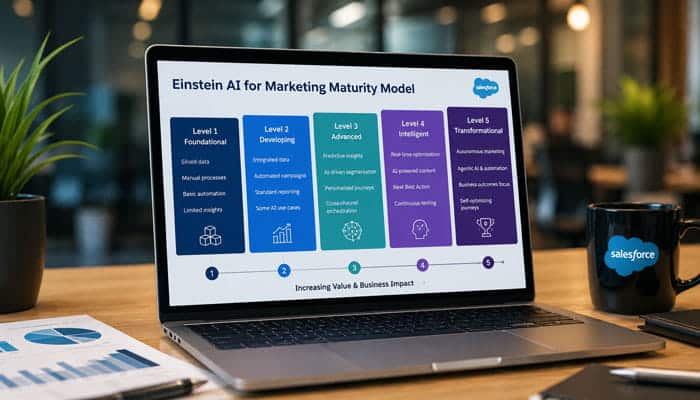
Organizations should introduce Einstein AI for Marketing gradually, moving to the next level only after confirming reliable data, governance and performance measurement.
| Level | Main objective | Suitable capabilities |
|---|---|---|
| Level 1: Foundation | Clean data and tracking | CRM hygiene, consent and Data 360 planning |
| Level 2: Prediction | Improve campaign decisions | Engagement scoring, timing and frequency |
| Level 3: Content Assistance | Accelerate controlled production | Copy Insights and generative drafts |
| Level 4: Personalization | Adapt customer experiences | Recommendations and Content Selection |
| Level 5: Agentic Execution | Coordinate multistep tasks | Campaign Creation and Journey Decisioning |
| Level 6: Optimization | Improve cross-channel value | Segment Intelligence and paid-media AI |
Level 1: Build the Foundation
Establish reliable customer identifiers, consent records, ownership rules and campaign tracking.
Level 2: Introduce Predictive Features
Begin with lower-risk tools such as engagement scoring and send-time recommendations.
Level 3: Use Content Assistance
Allow AI to create drafts and variations while retaining editorial approval.
Level 4: Expand Personalization
Use behavioral and transactional data to personalize content, products and offers.
Level 5: Introduce Controlled Agents
Allow agents to complete multistep tasks within clear limits and approval rules.
Level 6: Optimize Across Channels
Use performance data to improve audiences, journeys, advertising and customer value.
Businesses should expand their use of Einstein AI for Marketing only after proving that existing data, governance and measurement processes are reliable.
Einstein AI vs Traditional Marketing Automation
| Area | Traditional automation | Einstein AI for Marketing |
|---|---|---|
| Audience creation | Manually defined rules | AI-assisted segmentation |
| Message timing | Fixed schedules | Predicted individual timing |
| Frequency | Calendar-based | Behavior-based recommendations |
| Content | Written manually | AI-assisted generation |
| Lead scoring | Manually assigned points | Machine-learning behavior analysis |
| Personalization | Static rules | Predictive and real-time decisioning |
| Monitoring | Manual dashboards | Automated anomaly detection |
| Campaign setup | Multiple manual steps | Agent-assisted creation |
| Journey logic | Predetermined branches | AI-supported journey decisions |
| Human oversight | Required | Still required |
Einstein does not make traditional automation obsolete. It adds prediction, generation and decisioning to automated workflows.
Einstein AI vs Standalone Generative AI Tools
| Capability | Standalone generative AI | Einstein AI for Marketing |
|---|---|---|
| General content generation | Strong | Built into marketing workflows |
| CRM context | Requires integration | Connected to Salesforce data |
| Engagement scoring | Usually unavailable | Available in eligible products |
| Send-time optimization | Usually unavailable | Available in Marketing Cloud |
| Journey integration | Requires custom work | Built into Salesforce workflows |
| Real-time personalization | Requires other systems | Available through Salesforce products |
| Campaign execution | Usually limited | Supported through Marketing Cloud |
| Governance | Depends on provider | Uses Salesforce trust controls |
| Flexibility outside Salesforce | Usually higher | Strongest within Salesforce |
A standalone AI writing tool may be sufficient for occasional content creation. Einstein becomes more valuable when AI needs to interact directly with CRM data, audiences, campaigns and customer journeys.
Einstein AI for Marketing Pricing in 2026
There is no single universal price for Einstein AI for Marketing. Costs depend on the product, edition, usage, region, contract terms and implementation needs.
Salesforce Starting Prices
| Product | Starting US list price |
|---|---|
| Marketing Cloud Next Growth Edition | $1,500 per organization per month |
| Marketing Cloud Next Advanced Edition | $3,250 per organization per month |
| Salesforce Personalization | $8,000 per organization per month |
| Marketing Intelligence | $10,000 per organization per month |
| Marketing Cloud Engagement Pro+ | $2,000 per organization per month |
| Marketing Cloud Engagement Corporate+ | $5,500 per organization per month |
| Marketing Cloud Engagement Enterprise+ | $30,000 per organization per month |
| Marketing Cloud Intelligence+ | $11,000 per organization per month |
| Marketing Cloud Personalization+ | $15,000 per organization per month |
These are starting US list prices published by Salesforce as of July 2, 2026. Prices are generally billed annually and may differ by region, edition, usage and contract.
Published prices may not include:
- Email, SMS or WhatsApp messaging
- RCS usage
- Data 360 processing
- Agentforce consumption
- Storage
- Integration
- Implementation
- Training
- Support plans
- Regional contract differences
Agentforce Usage and Flex Credits
The subscription price may not represent the complete cost of Einstein AI for Marketing.
Agentic workflows may consume usage-based entitlements when an agent:
- Calls a language model
- Retrieves data
- Creates content
- Performs an action
- Selects a journey
- Executes a multistep task
- Processes Data 360 information
- Conducts a conversation
Journey Decisioning documentation advises customers to review usage allowances and available credits before deployment.
Questions to Ask Before Buying
| Cost area | Question |
|---|---|
| Subscription | Which edition supports the required feature? |
| Agentforce | Which actions consume credits? |
| Data 360 | How much ingestion and processing is expected? |
| Messaging | Are channel costs charged separately? |
| Storage | Will unified profiles increase storage needs? |
| Integration | Are MuleSoft or other connectors required? |
| Implementation | Is a Salesforce partner needed? |
| Support | Which Success Plan is included? |
| Training | How many users need training? |
Before purchasing Einstein AI for Marketing, calculate the complete operating cost rather than relying only on the advertised subscription price.
Evaluate Einstein AI for Marketing by cost per successful business outcome, such as incremental profit, qualified pipeline, retention or production time saved—not cost per AI action.
Frequently Asked Questions
1. How long does Einstein AI for Marketing implementation take?
Einstein AI for Marketing implementation may take a few weeks for a pilot or several months for a complex multichannel setup.
2. What is the best first use case for Einstein AI for Marketing?
A good starting point is Send Time Optimization, engagement scoring or AI-assisted email drafting because these use cases are measurable and relatively low risk.
3. Can Einstein AI for Marketing work with existing Marketing Cloud journeys?
Yes. Eligible businesses can add Marketing Cloud Next and Agentforce capabilities while continuing to use existing journeys, data and content.
4. Can Einstein AI for Marketing use third-party data?
Yes. Data 360 can connect customer information from websites, ecommerce platforms, advertising tools and data warehouses.
5. What skills are needed to manage Einstein AI for Marketing?
Teams may need marketing strategists, Salesforce administrators, data specialists, content reviewers and privacy professionals.
6. How often should Einstein AI for Marketing predictions be reviewed?
Review predictions monthly or quarterly and compare them with actual campaign results. High-volume campaigns may require more frequent checks.
7. Can Einstein AI for Marketing support multilingual campaigns?
Yes. Marketing Cloud Next supports multilingual content variants, but translations should still be reviewed by qualified speakers.
8. How can businesses control Einstein AI for Marketing costs?
Limit unnecessary Agentforce actions, monitor Flex Credits, set usage alerts and measure cost per conversion or qualified lead.
Final Thoughts
Einstein AI for Marketing has evolved from a collection of predictive optimization features into a broader marketing intelligence and agentic automation ecosystem.
Its established capabilities can help marketers understand engagement, improve message timing, manage frequency, personalize content and prioritize B2B prospects. Marketing Cloud Next and Agentforce extend those functions into natural-language segmentation, campaign creation, journey decisioning, paid-media optimization and two-way customer conversations.
The platform’s effectiveness depends on more than artificial intelligence. Businesses need accurate data, clear customer consent, appropriate permissions, measurable objectives and human oversight.
Organizations with mature Salesforce environments, recurring campaign activity and substantial customer data may gain meaningful efficiency and personalization benefits. Companies with fragmented data, weak governance or limited marketing volume should improve those foundations before making a major investment in Einstein AI for Marketing.