

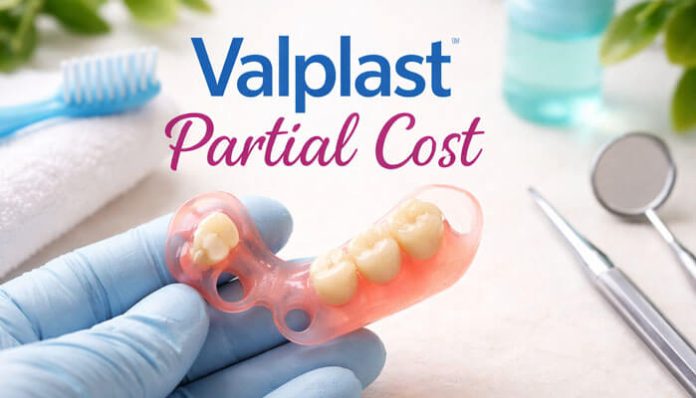

If you are comparing tooth replacement options, one of the first questions you will ask is simple: how much does a Valplast partial cost in 2026? The clearest answer is that prices vary a lot depending on whether you are looking at a mail-order product, a lab-only listing, or a dentist-supervised treatment plan. Current consumer cost references place partial flexible nylon dentures at an average of about $1,761, with a reported range of roughly $1,360 to $3,451.
At the same time, direct product-style listings can be far lower, including $89 for a lower Valplast partial on one lab-style listing and from $295 for a custom flexible Valplast partial on a direct-to-consumer site. Aspen Dental’s current published range for its Flexilytes partial denture is $1,319 to $1,819.
A low online price may reflect the appliance alone, while a higher office quote may include the exam, diagnostic work, records, impressions, fittings, bite checks, and follow-up adjustments. To readers, both may look like “Valplast partial cost,” but they are not the same purchase.
Valplast itself is marketed as a lightweight, flexible, metal-free removable partial denture with a more aesthetic appearance than many traditional removable partials. The brand’s official patient page highlights comfort, flexibility, and a virtually invisible look, and says Valplast is typically more affordable than fixed restorations while costing only somewhat more than conventional dentures with visible metal clasps.
Important Note Before You Compare Prices
A Valplast partial should be chosen after a proper dental evaluation, not by price alone. The ADA’s denture-care guidance stresses that dentures need correct care, fit, and professional oversight, while MouthHealthy’s replacement guidance makes clear that the right option depends on the patient’s mouth, function, and treatment goals.
In practical terms, this means the cheapest quote is not always the best value. A poorly fitting removable partial can create comfort, chewing, hygiene, and maintenance problems that raise long-term Valplast partial cost. That is one reason the ADA also strongly discourages direct-to-consumer dental laboratory services because of the potential for patient harm.
What Is a Valplast Partial?
A Valplast partial is a removable partial denture made from thermoplastic nylon rather than traditional rigid acrylic or metal. The official Valplast materials describe it as metal-free, flexible, lightweight, and highly aesthetic. Valplast also promotes the material as one that moves more naturally and helps avoid the look of visible metal clasps in many cases.
Patients usually consider Valplast when they want a removable solution that looks less obvious than a conventional clasped metal partial. It can be especially attractive when the missing teeth are in visible areas and the patient wants something more discreet. But removable partial dentures are highly case-specific, and some patients will do better with a cast metal framework, a bridge, or implants depending on support, bite forces, and long-term goals.
Valplast Partial Cost in 2026
The biggest source of confusion online is that “Valplast partial cost” can mean at least three different things:
- The cost of the appliance only,
- The cost of a mail-order custom product, or
- The cost of complete dentist-supervised treatment.
That is why one source may show under $100 while another shows well over $1,300. A routine dental exam with cleaning and X-rays has a national average of $203, so even before denture fabrication begins, diagnostic care alone can add meaningful cost in a supervised case.
Estimated 2026 Valplast Partial Cost Range
| Provider type | Estimated cost |
|---|---|
| Basic lab-style online listing | $89 to $295+ |
| Direct-to-consumer custom flexible partial | $295 to $555+ |
| Dentist-office flexible partial estimate | about $700 to $1,500+ |
| Aspen Dental Flexilytes partial denture | $1,319 to $1,819 |
| Flexible nylon partial national average | $1,761 |
| Flexible nylon partial national range | $1,360 to $3,451 |
These numbers should be treated as pricing signals, not universal quotes. The low end usually reflects product-only or limited-service models, while the high end is more likely to reflect full clinical treatment and more complex design.
Why Valplast Partial Cost Varies So Much
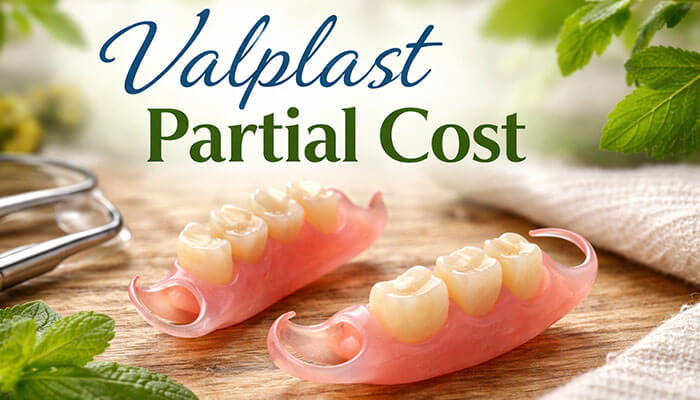
The cost of a Valplast partial is usually the sum of the appliance itself plus the professional work needed to diagnose, design, fit, and maintain it.
1. Number of teeth being replaced
A partial replacing one or two teeth is usually simpler than one replacing a larger span. Direct-to-consumer listings visibly scale pricing upward with added teeth, which reflects the extra design and fabrication work involved.
2. Upper vs lower arch
Upper and lower arches can differ in retention, coverage, support, and chewing forces. Even if some online sellers do not emphasize that difference, a clinician may price or recommend differently depending on the arch and the patient’s bite.
3. Material and design complexity
Flexible nylon partials, resin-based partials, and metal partials do not cost the same. CareCredit’s national estimates put partial flexible nylon dentures at $1,761, partial resin-based dentures at $1,738, and partial metal dentures at $2,229, showing that material category alone can influence pricing.
4. Pre-treatment dental work
Your total Valplast partial cost may also include consultation, X-rays, scans, impressions, extractions, bite registration, and fitting appointments. That is one reason product-only pricing and office-based pricing are so different.
5. Provider type and geographic location
A general dentist, prosthodontist, cosmetic practice, and mail-order seller will not price the same way. National Valplast partial cost ranges for dentures are broad, which strongly suggests major variation by provider type and location. Aspen Dental also explicitly says its published range may not reflect the actual price a patient encounters because of individual factors and location-specific pricing.
6. Insurance and financing
Coverage varies by plan. Waiting periods, annual maximums, in-network rules, and replacement limitations can all affect the final out-of-pocket cost. MouthHealthy also points patients toward dental schools, FQHCs, and Marketplace plans as affordability options.
Who Is a Good Candidate for a Valplast Partial?
A Valplast partial is often a good fit for someone who is missing a few teeth, wants a metal-free and more aesthetic removable option, and has enough healthy supporting teeth and gum support to retain the appliance. That aligns with how Valplast markets the product and with the general removable-partial framework in ADA consumer education.
It is not ideal for every patient. Some cases need more rigid support, especially when bite forces are higher or support conditions are less favorable. In those situations, a cast metal partial, bridge, or implant-based option may provide better long-term function. That is an inference based on the purpose of bridges, implants, and the clinical need for individualized removable-partial design rather than a universal rule for every case.
A Valplast partial may be a good fit if you:
- Want a metal-free removable partial
- Care strongly about appearance
- Have mild to moderate tooth loss
- Want a lightweight appliance
- Dislike visible metal clasps
- Prefer a removable option that may Valplast partial cost less than fixed restorations
It may be less suitable if you:
- Need maximum rigid support for heavy chewing
- Have unstable support teeth or poor gum support
- Want a fixed, non-removable replacement
- May be a stronger candidate for a bridge or implant
Valplast vs Other Tooth Replacement Options
A high-quality cost article should help the reader compare options, not just stare at one number.
Valplast vs other partial denture types
| Partial type | Average / range signal | Best known for | Main drawback |
|---|---|---|---|
| Acrylic / resin-based partial | $1,738 average; $1,333 to $3,283 | Lower cost category, simpler option | Bulkier, less aesthetic in many cases |
| Flexible nylon / Valplast-type | $1,761 average; $1,360 to $3,451 | Comfort, flexibility, metal-free look | Less rigid than metal |
| Metal partial | $2,229 average; $1,728 to $4,203 | Durability and support | Visible metal in some designs, higher average cost |
These numbers matter because they show Valplast-style flexible partials are not always the cheapest option, but they also are not automatically the most expensive removable option either.
Valplast vs bridge vs implant
| Option | Typical cost level | Best for | Main drawback |
|---|---|---|---|
| Valplast partial | Lower to mid-range | Removable, aesthetic, non-surgical option | Removable and less rigid |
| Dental bridge | Mid-range | Fixed replacement across a short gap | Relies on surrounding teeth for support |
| Dental implant | Highest upfront cost | Fixed replacement closest to a natural tooth | Surgery, healing, higher price |
MouthHealthy says bridges replace missing teeth by attaching to surrounding teeth for support, while implants are a popular long-term way to replace missing teeth and are designed to blend in with natural teeth. That makes Valplast especially relevant for people who want a non-surgical and more budget-friendly starting option.
Pros and Cons of Valplast Partials
A scannable decision section helps both readers and search performance.
Pros
- Flexible and lightweight
- Metal-free in design
- More natural appearance than many visible-clasp options
- Often positioned as more affordable than fixed restorations
- Attractive to patients who want a removable, discreet solution
Cons
- Not ideal for every bite pattern
- May not provide the rigidity of a metal framework
- Can Valplast partial cost more than very basic online or acrylic-style options
- Long-term value depends heavily on fit, maintenance, and correct case selection
These tradeoffs are consistent with Valplast’s own positioning, broader denture-cost comparisons, and ADA guidance that emphasizes fit, maintenance, and individualized care.
Is Valplast Worth the Cost?
For many patients, Valplast is worth it when the goal is to replace a few missing teeth with a lightweight, aesthetic, metal-free removable option without moving immediately to a bridge or implant. Valplast’s official messaging strongly emphasizes comfort and appearance, and that is often the main value proposition readers are paying for.
For other patients, “worth it” may point in a different direction. Someone who prioritizes a fixed solution may favor a bridge or implant. Someone who needs more rigid support may favor a different removable design. That is why the most honest answer is that Valplast can be worth the money in the right case, but it is not automatically the best value in every case.
Why Are Online Valplast Prices So Cheap?
This is one of the most important trust sections in the article.
A low online Valplast price often reflects lab-only or product-only pricing, not complete diagnosis and treatment. In many low-cost offers, you may not be paying for:
- A dental exam
- Evaluation of gum health and support teeth
- X-rays
- Bite analysis
- Clinical impressions or digital scans
- Chairside adjustments
- Follow-up care if the fit is off
That is why a $295 mail-order product is not comparable to a $1,319 to $1,819 office-based partial from a national dental provider. They are different service bundles. The ADA’s policy discouraging direct-to-consumer dental laboratory services strengthens this point further.
Why Valplast Partial Cost Changes by State or City
Two readers can search the same keyword and get very different answers because local pricing changes everything. Practice overhead, lab fees, urban vs rural Valplast partial cost, specialist fees, and local insurance participation all affect quotes. Aspen Dental explicitly notes that its partial denture pricing is an approximation and that location-specific pricing can differ.
This is one reason broad national ranges are useful as a benchmark but still imperfect for a real treatment quote. A local exam is usually the only way to get a case-specific price.
Hidden Costs to Watch Before You Choose
A Valplast partial may not be the whole bill. Additional costs may include:
- Consultation
- X-rays
- Extractions
- Impressions or scans
- Relines or adjustments
- Repairs
- Replacement teeth
- Cleaning products
- Future replacement if the fit changes
The ADA’s denture-care materials also note that ill-fitting dentures may need to be relined or replaced and that denture adhesives are not a fix for poor fit.
Valplast Maintenance Cost Over Time
One reason thin articles fail is that they talk only about purchase price. Real ownership cost also includes maintenance. Denture cleansers, storage products, follow-up adjustments, repairs, and eventual replacement can all affect long-term value. ADA-backed guidance says dentures should be kept in water or denture-cleanser solution when not worn, should never be placed in hot or boiling water because they can warp, and should be cleaned with appropriate nonabrasive care.
That means the long-term question is not only “How much does Valplast partial cost today?” but also “How much care and maintenance will it need over time?”
What to Expect When You First Start Wearing a Valplast Partial
Most new removable-partial wearers go through an adaptation period. At first, the appliance may feel unfamiliar, speech may need slight adjustment, and sore spots may require follow-up attention. MouthHealthy notes that partial dentures can help restore chewing and speech, which supports including this expectation-setting section for readers comparing convenience as well as cost.
This is another reason office-based treatment can justify a higher fee than a product-only purchase: follow-up care can make the difference between an appliance that technically exists and one that is actually wearable.
How the Valplast Partial Process Works
Many buyers want to know what they are paying for. The process usually includes:
- Exam and treatment planning
- X-rays or scans
- Impressions or digital records
- Lab fabrication
- Fitting and bite adjustments
- Follow-up care
That workflow helps explain why supervised treatment costs more than a product-only order. You are paying not only for the appliance but for the diagnostic and fitting process around it.
How to Clean and Store a Valplast Partial Safely
According to ADA denture-care guidance, dentures should be cleaned daily, rinsed after soaking and brushing, and stored in water or denture-cleanser solution when not being worn. Denture cleansers should not be used while the denture is in the mouth, and dentures should not be placed in hot or boiling water because they can warp.
A practical care routine usually means removing the partial, cleaning it gently as directed, soaking it appropriately, and getting it checked if it becomes uncomfortable or damaged. ADA-linked evidence-based guidance also recommends ongoing professional review of fit and function.
Can a Valplast Partial Be Repaired or Relined?
Removable partial dentures may need repair, adjustment, or replacement over time as mouths change and materials wear. ADA guidance notes that ill-fitting dentures may need to be relined or replaced rather than “managed” with adhesives alone. That does not answer every Valplast-specific lab question, but it does support the main buyer takeaway: a flexible partial is usually not a one-time cost forever.
How Long Does a Valplast Partial Last?
There is no universal lifespan because durability depends on hygiene, fit, bite forces, support teeth, and maintenance habits. Evidence-based denture-care guidelines recommend at least annual professional checks for fit and function, which underscores that long-term success depends on ongoing care rather than just the original purchase.
Questions to Ask Your Dental Insurance Provider
Before you commit, ask:
- Are flexible partial dentures covered?
- What percentage is covered?
- Is there a waiting period?
- Is pre-authorization required?
- Are replacement limits applied?
- Is there an annual maximum?
- Are only in-network providers covered?
- Are flexible partials handled differently than acrylic or metal partials?
For older adults, Medicare’s official guidance is especially important. Original Medicare generally does not cover dentures or most routine dental services, though some Medicare Advantage plans may include dental benefits. Medigap also generally does not cover dental care.
How to Save Money on Valplast Partial Cost
The smartest way to save money is to compare complete quotes, not just sticker prices. Ask what the price includes: records, impressions, fittings, adjustments, and follow-up care. A higher quote may still be the better value if it prevents refitting, remakes, or poor function.
It can also help to use dental insurance strategically, ask about office membership plans or financing, and compare dental schools or lower-cost clinics if budget is tight. MouthHealthy explicitly recommends dental schools and FQHCs as possible affordability routes.
Final Verdict: What Should You Expect to Pay?
For most readers searching Valplast partial cost, the most realistic current expectation is:
- Basic online or lab-style pricing: about $89 to $295+
- Direct-to-consumer custom flexible partials: about $295 to $555+
- Dentist-office flexible partial estimates: often around $700 to $1,500+
- Aspen Dental partial range: $1,319 to $1,819
- Broader flexible nylon partial range: $1,360 to $3,451
- Flexible nylon partial national average: $1,761
So the best article should never promise one universal number. The right price depends on whether the reader wants the lowest upfront cost, a more natural appearance, a metal-free removable option, or the best long-term function for their mouth. That is also the position most consistent with current ADA, Medicare, Valplast, and consumer denture-cost guidance.
Valplast Partial Cost FAQs
1. How much does a Valplast partial cost in 2026?
Current consumer references place flexible nylon partial dentures at an average of about $1,761, with a broader range of roughly $1,360 to $3,451, while much lower online listings also exist for product-only or limited-service offers.
2. Why is one Valplast partial quote much cheaper than another?
Because some prices cover only the appliance, while others include exam, X-rays, impressions, fittings, bite checks, and follow-up care. They are often not like-for-like comparisons.
3. Is Valplast better than acrylic partial dentures?
Not always. Valplast-style flexible partials are often chosen for comfort, flexibility, and appearance, while resin-based options may appeal more on price. The better option depends on the case.
4. Can a Valplast partial be repaired?
Some removable partials can be adjusted or remade, but repair practicality depends on the appliance and provider. The bigger point is that ill-fitting dentures may need professional adjustment, relining, or replacement over time.
5. How many teeth can a Valplast partial replace?
That depends on design, support, and oral condition. The number is case-specific rather than fixed. Direct-to-consumer listings show variants from 1 to 12 teeth, which illustrates how variable these designs can be.
6. Can you eat normally with a Valplast partial?
Many patients adapt well, but chewing comfort depends on fit, bite balance, and follow-up adjustment. That is one reason professional oversight matters.
7. Does Medicare cover Valplast partial dentures?
In most cases, Original Medicare does not cover dentures or most routine dental services. Some Medicare Advantage plans may include dental benefits, but coverage varies by plan.
