



Last updated: October 2026
Tirzepatide is a prescription medication used for chronic weight management in eligible adults. However, understanding the correct dose can be confusing, especially when injection instructions refer to syringe units rather than milligrams. If you are researching tirzepatide dosing for weight loss in units, the most important distinction is that milligrams (mg) measure the amount of medication, while syringe units indicate liquid volume on certain syringes.
There is no universal conversion between tirzepatide milligrams and syringe units. The correct measurement depends on the medication concentration, prescribed dose, and syringe or delivery device being used. A conversion that applies to one formulation may be incorrect for another.
This guide explains the approved dosing schedule, the difference between milligrams and syringe units, how to interpret medication labels, what to know about compounded formulations, and important safety precautions.
What Is Tirzepatide?
Tirzepatide is a prescription medication that activates two hormone receptors: glucose-dependent insulinotropic polypeptide (GIP) and glucagon-like peptide-1 (GLP-1). These hormones help regulate blood sugar, appetite, and food intake.
In the United States, tirzepatide is marketed under two brand names for different approved uses:
- Zepbound: Approved for chronic weight management in eligible adults alongside a reduced-calorie diet and increased physical activity. It is also approved to treat moderate-to-severe obstructive sleep apnea in adults with obesity.
- Mounjaro: Approved to improve blood sugar control in people with type 2 diabetes, alongside diet and exercise.
Although both products contain tirzepatide, their approved indications and prescribing instructions should be followed separately. Product availability and approved uses may also differ by country.
Tirzepatide can help reduce appetite, increase feelings of fullness, and decrease food intake. It also slows stomach emptying, particularly during the initial stages of treatment.
Tirzepatide Dosing for Weight Loss in Units: The Essential Facts
The standard U.S. Zepbound dosing schedule is expressed in milligrams per injection, not universal syringe units.
The recommended starting dose is 2.5 mg injected under the skin once weekly for four weeks. The dose then increases to 5 mg once weekly. Further increases may be made in 2.5 mg increments after at least four weeks on the current dose, depending on treatment response and tolerability.
The number of syringe units required cannot be determined from the prescribed milligram dose alone. You must also identify the formulation, concentration, and measuring device.
Before using an injectable product, confirm:
- The prescribed dose in milligrams.
- The concentration stated on the medication label.
- The prescribed volume, if the product requires volume measurement.
- The exact syringe or delivery device specified for the product.
- The pharmacy’s instructions for preparing and administering the injection.
Never assume that a particular syringe marking always represents 2.5 mg, 5 mg, or another tirzepatide dose.
Tirzepatide Weight Loss Dosage Chart
The following table summarizes the standard U.S. Zepbound dose-escalation schedule for chronic weight management.
| Treatment stage | Weekly dose | Purpose |
|---|---|---|
| Weeks 1–4 | 2.5 mg | Treatment initiation |
| After the first four weeks | 5 mg | First maintenance-dose option |
| Further escalation, if prescribed | 7.5 mg | Intermediate escalation step |
| Further escalation, if prescribed | 10 mg | Maintenance-dose option |
| Further escalation, if prescribed | 12.5 mg | Intermediate escalation step |
| Further escalation, if prescribed | 15 mg | Highest recommended dose |
Dose increases should occur only after at least four weeks on the current dose.
For weight reduction and long-term maintenance, the recommended maintenance doses are 5 mg, 10 mg, or 15 mg once weekly. The 7.5 mg and 12.5 mg doses are escalation steps rather than listed maintenance doses for weight reduction. The maximum recommended dose is 15 mg once weekly.
Not everyone needs the highest dose. The appropriate maintenance dose depends on treatment response and tolerability, as assessed by the prescribing clinician.
Important: This is a milligram-based treatment schedule, not a syringe-units conversion chart.
What Do Units Mean on a Tirzepatide Syringe?
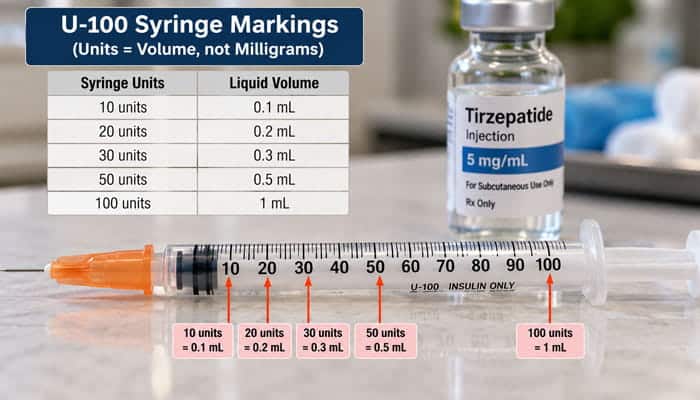
Syringe units are markings used to measure liquid volume on certain syringes. They do not directly measure the mass of tirzepatide in milligrams.
A U-100 insulin syringe is calibrated so that 100 units represent 1 mL of liquid.
| U-100 syringe marking | Liquid volume |
|---|---|
| 10 units | 0.1 mL |
| 20 units | 0.2 mL |
| 30 units | 0.3 mL |
| 50 units | 0.5 mL |
| 100 units | 1 mL |
These values are volume conversions only. They do not establish how much tirzepatide is present in the measured liquid.
The medication concentration determines how many milligrams are contained in a given volume. Other syringe types may use different scales, so you should not assume that every syringe follows the same measurement system.
Some approved tirzepatide products use prefilled pens or specific vial instructions. Follow the directions for your exact product instead of assuming that every formulation should be measured using an insulin syringe.
Safety reminder: Never use the table above to calculate a tirzepatide dose. Confirm the correct measurement with your dispensing pharmacist.
Milligrams vs. Units: What Is the Difference?
Understanding the difference between milligrams, milliliters, and syringe units is essential when reading an injectable medication label.
| Measurement | What it means | Example |
|---|---|---|
| Milligram (mg) | Mass of the active medication | A prescribed dose of 5 mg |
| Milliliter (mL) | Volume of liquid | A volume of 0.5 mL |
| Syringe unit | A volume marking on a particular syringe | 20 units on a U-100 syringe equals 0.2 mL |
The medication’s concentration connects mass and volume. For example, a concentration expressed in mg/mL tells you how much medication is contained in each milliliter.
This explains why two online units charts can give different answers for the same milligram dose. They may assume different concentrations or measuring devices.
A chart can be mathematically correct for one formulation and still be unsuitable for your medication. Always verify the actual product and its instructions.
Why Two Tirzepatide Units Charts Can Disagree
One important question for readers searching this keyword is why different websites list different syringe-unit values for the same dose.
The reason is usually that the charts assume different medication concentrations, syringe scales, or product presentations.
For example, a single-dose Zepbound presentation may contain 2.5 mg in 0.5 mL, while certain multidose vials and KwikPen presentations use different concentrations and dose volumes. Always check the instructions for the exact product prescribed rather than relying on a generic syringe-units chart.
Before interpreting any chart, check the following details:
- Concentration: How much medication is contained in each milliliter?
- Product presentation: Is the medication a single-dose pen, single-dose vial, multidose vial, or another device?
- Syringe scale: Is the specified syringe calibrated as U-100 or something else?
- Prescribed dose: What dose did the clinician actually prescribe?
- Administration instructions: Does the product require a specific volume or device?
If a chart does not clearly state these assumptions, do not rely on it to measure an injection.
Pen vs. Vial: Which Instructions Apply?
Not every tirzepatide product should be measured in syringe units. The correct administration method depends on the exact product and its supplied instructions.
Prefilled pens
A prefilled pen is designed to deliver a specified dose according to its instructions. Do not transfer its dose to an insulin-syringe conversion chart or attempt to extract medication from the device unless the official product instructions explicitly direct you to do so.
Single-dose vials
Some approved single-dose vials require a suitable syringe to measure the prescribed volume. The official instructions identify the appropriate presentation and administration method.
Use the syringe and technique specified for your exact product. If you are unfamiliar with the device, ask your pharmacist or healthcare professional to demonstrate its use.
Multidose vials and pens
Multidose presentations may have different concentrations and administration instructions from single-dose products. Use the instructions supplied with the exact product, not a conversion chart intended for a different vial or device.
Compounded tirzepatide
Compounded formulations may differ in concentration and packaging. Their instructions should be confirmed with the prescribing clinician and dispensing pharmacy.
Compounded tirzepatide is not an FDA-approved version of Zepbound. Its use, availability, and lawful dispensing depend on applicable requirements. Do not assume that a compounded product has the same concentration, quality, or instructions as an FDA-approved medication.
The prescribing information emphasizes training patients on the particular product presentation they receive and providing new instructions when that presentation changes.
How to Interpret a Tirzepatide Label Safely
Before using a vial, read the entire pharmacy label rather than relying on the total amount of medication in the package.
Look for the following information:
- Prescribed dose: The amount intended for one injection, expressed in milligrams.
- Concentration: The amount of medication per milliliter, if listed.
- Dose volume: The exact liquid volume required for the prescribed dose, when applicable.
- Administration device: The pen or syringe specified for the product.
- Pharmacy instructions: Product-specific directions for measurement, preparation, storage, and use.
If the label lists only a total amount, or if the concentration and instructions are unclear, do not estimate the dose. Ask the dispensing pharmacist to confirm the correct measurement.
A Pre-Injection Verification Checklist
Before each injection, confirm that the following details match your prescription and product instructions.
- The product name and strength match the prescription.
- The medication concentration has been confirmed.
- The prescribed dose is clear.
- The correct pen or syringe is available.
- The administration instructions match the exact product presentation.
- The medication has been stored according to its instructions.
- The solution has no unexpected appearance, and the packaging shows no signs of damage.
If any item is uncertain, pause and contact the dispensing pharmacist or prescribing clinician before injecting.
What to Do When Your Vial or Concentration Changes
Never assume that instructions from a previous vial apply to a new one. A change in concentration, formulation, package size, or delivery device can change the amount of liquid required for a prescribed dose.
Before using a replacement product:
- Check the new label and confirm the concentration.
- Ask the dispensing pharmacist to verify the prescribed dose and exact measurement.
- Confirm which syringe or delivery device should be used.
- Request a demonstration if the instructions or device are unfamiliar.
- Do not use an old conversion chart or previous measurement without confirmation.
If the new instructions appear inconsistent with your prescription, do not inject until the pharmacy or prescriber clarifies them.
Why Compounded Tirzepatide Requires Extra Care
Compounded tirzepatide is not an FDA-approved version of a commercially manufactured product. Compounded formulations may differ in concentration and packaging, and their instructions can vary between pharmacies.
The FDA has reported dosing errors involving compounded GLP-1 medicines, including tirzepatide. Errors have involved patients measuring or administering incorrect doses, and some reported events required medical attention.
As of May 31, 2026, the FDA had received more than 730 adverse-event reports associated with compounded tirzepatide. These reports do not establish that the medication caused every event, and adverse events involving compounded products may be underreported.
If you have a compounded formulation:
- Verify the prescribed dose with your clinician.
- Ask the dispensing pharmacy to confirm the exact measurement for that formulation.
- Request a demonstration if you are unfamiliar with the syringe.
- Do not reuse conversion instructions from a previous vial if the concentration or product has changed.
- Contact the pharmacy before injecting if any instruction appears inconsistent.
Compounded medications do not undergo the same FDA premarket review for safety, effectiveness, and quality as approved drugs. Obtain prescription medication from a legitimate, appropriately licensed source, and ask your clinician whether an FDA-approved product is suitable for you.
How Is Tirzepatide Dosing Adjusted Over Time?
Tirzepatide treatment typically begins at a low dose and increases gradually when appropriate. This approach helps the body adjust to the medication and may reduce gastrointestinal side effects.
Starting dose: 2.5 mg once weekly
For adults beginning Zepbound, the recommended starting dose is 2.5 mg injected under the skin once weekly for four weeks. This dose initiates treatment and is not a recommended maintenance dose for weight reduction.
First increase: 5 mg once weekly
After four weeks, the recommended schedule increases to 5 mg once weekly. This is one of the approved maintenance options for chronic weight management.
Further increases: 7.5 mg, 10 mg, 12.5 mg, and 15 mg
If additional treatment is needed and the medication is well tolerated, a clinician may increase the dose in 2.5 mg increments after at least four weeks on the current dose.
Do not increase your dose simply because weight loss has slowed. Your clinician should consider treatment response, tolerability, and individual health needs before recommending an increase.
Who Is Eligible for Tirzepatide for Weight Loss?
In the United States, Zepbound is approved for chronic weight management in adults with obesity, or adults with overweight who have at least one weight-related medical condition, alongside a reduced-calorie diet and increased physical activity. It is also approved for certain adults with obesity and moderate-to-severe obstructive sleep apnea.
Eligibility depends on medical history, current medications, potential risks, and the expected benefits of treatment. A healthcare professional can determine whether tirzepatide is suitable and establish an appropriate monitoring plan.
Approval criteria differ by country, so readers outside the United States should follow local prescribing information and medical guidance.
How Much Weight Can You Lose With Tirzepatide?
Weight loss varies according to dose, treatment duration, individual health factors, adherence, and lifestyle.
In a major 72-week clinical trial involving adults with obesity or overweight without diabetes, participants receiving the highest studied tirzepatide dose lost an average of approximately 20.9% of their starting body weight. Average weight reduction varied by dose, and participants also received lifestyle counseling.
These results are clinical-trial averages, not predictions for every individual.
Weight loss depends on several factors, including:
- The prescribed maintenance dose and how well it is tolerated.
- Treatment duration and consistency.
- Dietary habits and physical activity.
- Other medical conditions and medications.
- Individual differences in appetite, metabolism, and treatment response.
Tirzepatide is intended for long-term management when appropriate, rather than rapid weight loss through unsupervised dose escalation.
How to Use Tirzepatide Safely
The correct administration method depends on the specific product prescribed. Follow the instructions supplied with your pen or vial, and ask your healthcare professional to demonstrate the technique if you are unsure.
General precautions include:
- Administer the medication once weekly as prescribed.
- Use only the prescribed dose and appropriate delivery device.
- Rotate injection sites as directed.
- Never share pens or needles with another person.
- Use a new, sterile needle and syringe for each injection when the product requires a syringe.
- Inspect the solution and follow the product’s storage instructions.
- Tell your healthcare professional about all prescription medications, supplements, and other injectable weight-loss treatments you use.
For FDA-approved Zepbound, injection sites include the abdomen or thigh, or the back of the upper arm when another person administers the injection. Follow the official instructions for your specific product.
What Happens If You Miss a Tirzepatide Dose?
For Zepbound, the prescribing information provides the following guidance:
- If you miss a dose, administer it as soon as possible within four days (96 hours) of the scheduled time.
- If more than four days have passed, skip the missed dose and take the next dose on your regular weekly schedule.
- Do not take an extra dose to compensate for a missed injection.
- If you are uncertain about your schedule, contact your prescriber or pharmacist.
The day of weekly administration may be changed when necessary, provided at least 72 hours separate the two doses. Confirm the instructions for your own product.
Common Side Effects of Tirzepatide
Tirzepatide can cause side effects, particularly when treatment begins or the dose increases. Commonly reported effects include:
- Nausea
- Diarrhea
- Constipation
- Vomiting
- Abdominal discomfort or pain
- Indigestion
- Bloating or belching
- Fatigue
- Injection-site reactions
- Heartburn or acid reflux
- Hair loss
Some people experience mild symptoms that improve over time, while others have symptoms that interfere with eating, drinking, or daily activities.
To help manage mild gastrointestinal symptoms, consider eating smaller meals, avoiding foods that worsen nausea, staying hydrated, and eating slowly. Contact your healthcare professional if symptoms persist or become difficult to manage. Do not change your dose without medical guidance.
Serious Side Effects That Need Medical Attention
Seek prompt medical attention for symptoms such as:
- Severe or persistent abdominal pain: This may indicate pancreatitis, particularly if pain spreads to the back.
- Persistent vomiting or diarrhea: These can cause dehydration and kidney problems.
- Upper abdominal pain with fever or jaundice: This may indicate gallbladder disease.
- Swelling of the face or throat, or difficulty breathing: These may be signs of a serious allergic reaction and require emergency care.
- Symptoms of severe low blood sugar: This is particularly important for people taking insulin or sulfonylurea medications.
Tirzepatide also carries a boxed warning concerning thyroid C-cell tumors observed in rats. Its relevance to humans is unknown. Zepbound should not be used by people with a personal or family history of medullary thyroid carcinoma or by people with multiple endocrine neoplasia syndrome type 2 (MEN 2).
Who Should Discuss Tirzepatide Risks With a Doctor?
Before starting treatment, discuss your medical history and current medications with your prescriber, particularly if you:
- Have a history of pancreatitis or gallbladder disease.
- Have severe stomach-emptying problems, such as severe gastroparesis.
- Take insulin or medication that can cause low blood sugar.
- Have diabetic retinopathy.
- Are pregnant, planning a pregnancy, or breastfeeding.
- Take oral hormonal contraceptives.
- Are scheduled for surgery or a procedure involving general anesthesia or deep sedation.
Have had a serious allergic reaction to tirzepatide or any of the product’s ingredients: Zepbound is contraindicated in this situation. Tell your healthcare professional about any previous serious allergic reaction before treatment.
Zepbound may reduce the effectiveness of oral hormonal contraceptives after treatment begins and after each dose escalation. Its prescribing information advises using a non-oral contraceptive method or adding a barrier method for four weeks after starting treatment and for four weeks after each dose increase. Discuss the appropriate option with your healthcare professional.
Tirzepatide During Pregnancy
Weight-loss treatment with tirzepatide is not appropriate during pregnancy. If you become pregnant while using Zepbound, contact your healthcare professional promptly to discuss discontinuation and appropriate care.
People planning a pregnancy should discuss treatment timing and contraception with their clinician before starting or continuing medication.
Tirzepatide Before Surgery or Sedation
Tirzepatide slows stomach emptying, which may increase the risk of stomach contents entering the lungs during general anesthesia or deep sedation. Tell your surgeon, anesthesiologist, and other healthcare professionals that you take tirzepatide before any planned procedure.
Do not independently stop or change the medication. Your care team should provide individualized instructions based on the procedure and your medical circumstances.
What Should You Do If You Accidentally Inject Too Much Tirzepatide?

If you believe you have injected the wrong dose, taken an extra dose, or used the wrong syringe measurement, contact a healthcare professional or poison-control service promptly for individualized advice. Do not take another dose until you have received appropriate guidance.
Seek urgent medical attention for severe or persistent vomiting, significant abdominal pain, fainting, confusion, or symptoms of low blood sugar. Severe symptoms or difficulty breathing require emergency assistance.
When contacting a healthcare professional, have the medication packaging available and explain the prescribed dose, concentration, amount injected if known, and time of administration. Do not try to correct a dosing mistake by skipping, adding, or adjusting future doses on your own.
Common Mistakes to Avoid When Measuring Tirzepatide
- Confusing milligrams with syringe units.
- Using the same conversion for different vial concentrations.
- Increasing the dose faster than prescribed.
- Assuming the highest dose is always best.
- Following an outdated syringe conversion chart.
- Using unverified compounded products.
- Ignoring the medication’s storage instructions.
- Not telling your clinician about other medications you take.
Tirzepatide Dosing For Weight Loss In Units FAQs
1. How many units of tirzepatide should I take for weight loss?
There is no single number of syringe units that applies to every tirzepatide product. The correct volume depends on the prescribed dose, medication concentration, and syringe scale. Ask your prescriber or pharmacist to confirm the exact measurement for your formulation.
2. Is tirzepatide dosed in milligrams or units?
Approved tirzepatide dosing schedules are expressed in milligrams. Units may be used to measure liquid volume on certain syringes, but they do not directly represent the amount of medication.
3. What is the starting dose of tirzepatide for weight loss?
The recommended starting dose of Zepbound in the United States is 2.5 mg injected once weekly for four weeks. The next scheduled dose is 5 mg once weekly, subject to the prescribing instructions. The 2.5 mg dose is for treatment initiation, not maintenance.
4. Can I increase my tirzepatide dose every week?
No. The standard Zepbound escalation schedule allows increases in 2.5 mg increments only after at least four weeks on the current dose. Your prescriber should determine whether an increase is appropriate.
5. Is 15 mg the best tirzepatide dose for weight loss?
Not necessarily. The approved maintenance options for weight reduction are 5 mg, 10 mg, and 15 mg once weekly. The most appropriate dose depends on treatment response and tolerability.
6. Can I use an insulin syringe for tirzepatide?
Some vial-based products have specific syringe instructions, but not every product is intended to be measured in the same way. Use only the syringe and technique specified for your medication, and obtain professional instruction before administering an unfamiliar formulation.
7. Why do different tirzepatide units charts show different numbers?
Charts may assume different medication concentrations or syringe scales. The same milligram dose can correspond to different liquid volumes, so a chart intended for one formulation may be unsuitable for another. Always confirm the product-specific instructions.
8. What should I do if I am unsure about my syringe units?
Do not inject until the measurement is confirmed. Contact the dispensing pharmacy or prescribing clinician, and provide the exact product name, concentration, prescribed dose, and syringe type.
9. Is compounded tirzepatide the same as Zepbound?
No. Compounded formulations are not FDA-approved versions of Zepbound and may differ in concentration, formulation, and packaging. They require product-specific instructions, and the FDA has warned about dosing errors involving compounded GLP-1 medicines.
10. Can I take tirzepatide with another weight-loss injection?
Do not combine tirzepatide with another tirzepatide-containing product or a GLP-1 receptor agonist unless specifically directed within appropriate medical care. The Zepbound prescribing information does not recommend these combinations.
11. Does tirzepatide guarantee weight loss?
No. Individual results vary. Tirzepatide is intended to be used alongside a reduced-calorie diet and increased physical activity, with ongoing medical supervision.
12. What happens if I miss a weekly tirzepatide injection?
For Zepbound, a missed dose may be taken within 96 hours of the scheduled time. If more than 96 hours have passed, skip that dose and resume the regular schedule. Do not take an extra dose to compensate. Confirm the instructions for your prescribed product.
13. How long does it take for tirzepatide to work?
Some people notice appetite changes early in treatment, but the timing and extent of weight loss vary. Clinical weight-management results are assessed over months, not just the first few injections. Your clinician can evaluate your progress and determine whether adjustments are appropriate.
14. Can I stop tirzepatide once I reach my target weight?
Do not stop or change treatment without discussing it with your healthcare professional. Weight management often requires long-term planning, and your clinician can help assess ongoing treatment, potential weight regain, and alternative strategies.
15. Is tirzepatide available as an oral medication?
The FDA-approved U.S. products discussed in this article are injectable medications. Do not assume that an online product advertised as oral tirzepatide is an approved equivalent. Check the product’s regulatory status with a qualified healthcare professional.
Final Thoughts
Understanding tirzepatide dosing for weight loss in units starts with recognizing that milligrams and syringe units measure different things. The approved Zepbound dosing schedule uses milligrams, while syringe markings represent liquid volume and depend on the device and formulation.
For safe treatment, follow the prescribed dose-escalation schedule, verify the concentration and measurement instructions, and consult your healthcare professional before changing a dose. Avoid generic units charts that do not match your exact product.
Tirzepatide can be an effective treatment option for eligible adults, but safe use depends on correct administration, realistic expectations, awareness of side effects, and ongoing medical supervision. When in doubt, ask your prescriber or dispensing pharmacist to confirm the exact dose and measurement before injecting.
