



It is 9:40 on a Thursday morning and the front desk of a six-chair salon is doing four jobs at once. A colour client is under foils and wants to rebook. The phone has rung four times in ten minutes. The receptionist is holding a paper diary open with one hand and a card reader in the other, and somewhere in those ten minutes a regular who wanted Saturday at two gave up and booked down the road.
Nothing in that scene is a staffing problem. It is a systems problem. The salon is running its calendar, its till, its client history and its marketing as four separate things, and the only integration layer is a person who is already busy.
The salons growing fastest stopped asking a human to be the integration layer.
The front desk is three jobs wearing one apron
Pull the front desk apart and you find three distinct functions bolted together.
The first is allocation — who gets which chair, which room, which hour. The second is money — taking payment, applying a promo code, splitting a tip, logging a retail sale against the right stylist’s commission. The third is memory — what formula this client had in July, which shampoo she bought, whether she cancelled late last time.
Each one fails differently under pressure. Allocation fails as double-bookings. Money fails as a queue at the till. Memory fails worst of all, because it fails quietly: nobody tells you that you forgot their toner, they simply stop coming.
Automation earns its keep where it removes a decision, not where it adds a dashboard.
Double-bookings are a resource problem
Most booking conflicts are not two clients in one slot. They are two appointments that each need the same thing at the same moment — the one colour bar, the one backwash, the one stylist cleared to do balayage.
A calendar that only models stylists cannot see that collision. A resource-aware one can, because it treats the room, the equipment and the person as separate constraints and refuses the combination that cannot physically happen. The same logic drives the features that sit around it: a waitlist that knows what has actually come free, recurring appointments for the six-week colour client, express booking for the regular who wants her usual.
Bookings arrive while the salon is dark
A meaningful share of appointment requests land outside opening hours — evening, Sunday, the gap between a client’s meetings. A receptionist cannot answer those. A booking page can, and it can take the deposit and sync the slot to the stylist’s own calendar before anyone unlocks the door.
The difference between a booking widget and a management platform is what happens after the click. In a bolted-on widget, the appointment is a notification somebody has to re-enter. In an integrated system it lands on the calendar as a resourced appointment, attaches itself to the existing client record, triggers the reminder sequence and arrives at the till as the right price. Industry-specific platforms are built around that single record: STX Software, for instance, has been building point of sale and calendar booking for salons since 1981 and keeps online booking, resource scheduling, checkout and SMS on top of the same client card.
Checkout is a retention moment
Checkout is the only point in the visit where every client is standing still and paying attention. Most salons waste it.
The mechanics matter more than they sound. A till configured with the ten services and products you actually sell removes most of the searching. Instant tipping removes the awkward arithmetic. Loyalty points applied automatically remove the conversation where a client has to ask whether she has earned anything — and the one where you discover she was never enrolled.
Rebooking belongs here too: asking about six weeks’ time while the card is still in the reader converts better than an email sent three weeks later.
Texting clients is a regulated channel
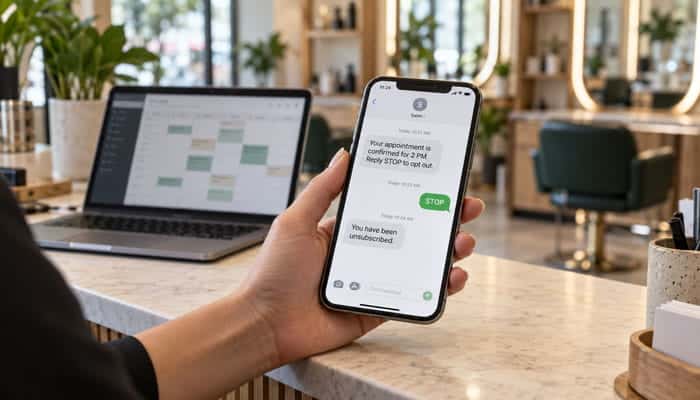
Automated SMS is the highest-response channel most salons have, and the one they set up most carelessly. Two things are worth knowing before you build anything on it.
First, it is not instant to switch on. Capacity, which runs the Textel business-messaging service used by several salon platforms, states that standard 10DLC registration takes a few weeks and short codes can take longer — so a texting programme is something you start before the season you need it, not during.
Second, consent is an operational obligation, not a checkbox. Opt-outs have to be honoured across every number you send from, which is an argument for a platform that logs and applies them automatically rather than a shared inbox and someone’s memory. And SMS is not a secure channel — anything touching payment details or health information belongs in a form, not a thread.
The client record is the asset
Appointments are revenue this month. The client record is the business.
A salon with complete records — formulas, service notes, preferences, purchase history — survives a stylist leaving. A salon where that knowledge lives in three people’s heads does not; it loses a slice of its book every time someone hands in notice. Which is why staff access controls on client records are a commercial feature before they are an IT one.
Buy the smallest system that closes the loop
The failure mode here is rarely under-investing. It is buying an enterprise platform for a three-chair salon and using a tenth of it. The discipline that works is the same one that applies to any operational software purchase: write down the three workflows that currently cost you money, and refuse to pay for anything that does not touch them. Startup Editor’s own walk-through of evaluating booking platforms covers a different trade, but the method transfers.
Start with the one that is leaking now. For most salons that is after-hours booking, because the loss is invisible and continuous — nobody tells you about the appointment they did not make. Fix that, then the till, then the follow-up. Somewhere around the second one the front desk stops being the bottleneck and starts being a desk.
