
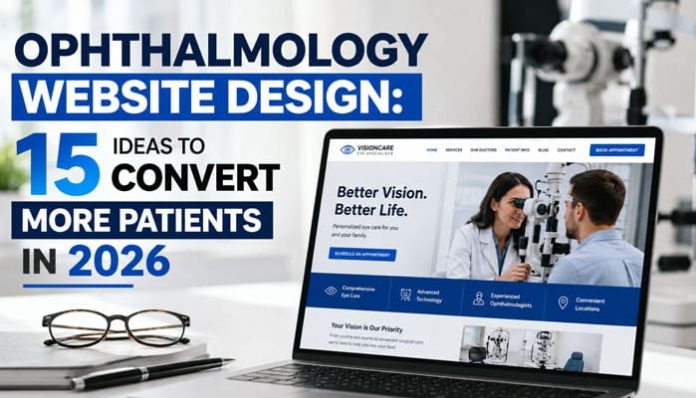

Ophthalmology website design is no longer just about creating an attractive homepage for an eye clinic. A modern ophthalmology website has to help prospective patients understand their condition, evaluate an ophthalmologist, compare treatment options, locate the right office and take the next step without unnecessary confusion.
That challenge is particularly important in eye care. Someone researching cataract surgery has very different needs from a younger adult considering LASIK, a parent searching for pediatric ophthalmology or a patient concerned about glaucoma, retinal disease or macular degeneration.
An effective website therefore needs to perform several jobs at the same time. It must educate patients, establish medical credibility, remain usable for people with visual limitations, perform well on mobile devices, support local search visibility and make appointment pathways simple.
This guide explains 15 ophthalmology website design ideas for 2026 and goes beyond visual design to cover accessibility, medical content, patient conversion, cybersecurity, HIPAA considerations, local SEO, AI search, EHR integrations, website migration and long-term maintenance.
Quick Answer
The best ophthalmology website design combines medical trust, accessibility, SEO and a simple path to booking.
A strong site should include:
- Clear appointment CTAs
- Doctor and procedure pages
- Mobile-friendly, accessible design
- Fast loading and Core Web Vitals
- Location, insurance and financing details
- Secure scheduling and patient-portal integrations
- Local SEO and privacy-conscious analytics
The goal of effective ophthalmology website design is simple: help patients quickly understand the practice, trust the doctors and take the next step toward care.
Key Takeaways
- Prioritize accessibility, mobile usability and fast loading.
- Make appointments, calls and directions easy to find.
- Create dedicated pages for doctors, treatments, conditions and locations.
- Use medically reviewed, expert-led content.
- Protect privacy, cybersecurity and patient data.
- Preserve SEO rankings during website redesigns.
- Optimize content for Google Search, AI Overviews and AI Mode.
- Track appointments and patient actions, not just pageviews.
Why Ophthalmology Website Design Is Different
Ophthalmology website design must do more than present services. Patients may arrive with a known treatment in mind, such as LASIK, or with only a symptom such as blurry vision or flashes and floaters.
A strong site should therefore support both condition-based and treatment-based journeys, guiding visitors from symptoms or diagnoses to the right procedure, specialist and appointment option.
Common searches include:
- Cataract surgeon near me
- LASIK consultation
- Glaucoma specialist
- Dry eye treatment
- Retina specialist
- Emergency eye care
The website structure should make each path clear, simple and trustworthy.
What Should an Ophthalmology Website Accomplish?
Before choosing colors, images or layouts, every ophthalmology website design project should define what the website needs to achieve.
| Website Goal | What the Patient Needs |
|---|---|
| Build trust | Doctor credentials and transparent information |
| Explain services | Clear conditions, treatments and next steps |
| Generate appointments | Simple booking and contact options |
| Support patients | Forms, portal, directions and office details |
| Improve local SEO | Accurate location and business information |
| Educate visitors | Reliable eye-health content |
| Reduce uncertainty | Insurance, financing and recovery details |
| Improve accessibility | Readable and screen-reader-friendly design |
| Protect information | Strong privacy and security controls |
| Demonstrate expertise | Medical reviewers, authors and trusted sources |
Conversions can include more than online bookings, such as phone calls, appointment requests, directions clicks, consultation inquiries and portal visits.
How Much Does Ophthalmology Website Design Cost in 2026?
There is no fixed price for ophthalmology website design. Costs depend on the size of the practice, number of locations and doctors, required integrations, content needs and level of customization.
| Cost Factor | Why It Matters |
|---|---|
| Locations | Each office may need a dedicated page |
| Physicians | Doctors may need individual profiles |
| Procedures | Major services require detailed content |
| Custom design | Requires more design and development work |
| Scheduling/EHR | Adds integration complexity |
| Accessibility | Requires proper testing and implementation |
| SEO migration | Protects existing rankings and URLs |
| Medical content | May require expert writing and review |
| Security | Includes updates, monitoring and testing |
| Maintenance | Hosting and ongoing support may cost extra |
What Should the Quote Include?
For an ophthalmology website design proposal, check whether the quote covers:
- UX and mobile design
- Accessibility
- Medical content
- Technical SEO
- Redirects and schema
- Scheduling integrations
- Security and hosting
- Analytics and Search Console
- Post-launch support
Also confirm who owns the domain, website, content, analytics accounts and other digital assets before signing a contract.
15 Ophthalmology Website Design Ideas That Can Convert More Patients

1. Make the First Screen Clear
In effective ophthalmology website design, visitors should immediately understand:
- What the practice does
- Who it helps
- What they should do next
Instead of a vague slogan, use a specific headline such as:
Advanced Cataract, Glaucoma and LASIK Care in Austin
Then provide clear CTAs such as Request an Appointment, Call the Practice or Find a Location.
| Element | Example |
|---|---|
| H1 | Advanced Eye Care in Phoenix |
| Supporting copy | Cataract, glaucoma, retina and comprehensive ophthalmology |
| Primary CTA | Request an Appointment |
| Trust element | Board-certified ophthalmologists |
Keep the hero simple and give visitors one obvious path forward.
2. Design for People Who May Have Difficulty Seeing
Accessibility is especially important in ophthalmology website design because some visitors may already have visual limitations.
A 2025 study, “Accessibility of Canadian ophthalmology department webpages for the visually impaired,” found accessibility errors on all 15 university ophthalmology homepages examined.
Prioritize:
- Readable text
- Strong color contrast
- Clear headings
- Keyboard navigation
- Visible focus states
- Proper form labels
- Meaningful alt text
- Large buttons
- Responsive layouts
WCAG 2.2 Level AA generally requires 4.5:1 contrast for normal text and 3:1 for qualifying large text, while text should remain usable when resized up to 200%.
Don’t Rely Only on Accessibility Widgets
An accessibility overlay cannot replace properly structured HTML, keyboard testing, labels and accessible navigation.
3. Make Appointment Booking Easy
Appointment options should be visible on:
- Main navigation
- Homepage
- Mobile header
- Doctor profiles
- Procedure pages
- Location pages
Good ophthalmology website design uses consistent CTAs such as Request an Appointment or Schedule a Consultation. Keep forms short and collect only necessary information.
Connect Existing Practice Systems
Useful integrations may include:
- Online scheduling
- Patient portals
- Electronic forms
- EHR systems
- Practice-management software
- Secure communication
- Online payments
The goal is to reduce unnecessary steps without compromising patient privacy or security.
4. Create Dedicated Procedure Pages
A strong ophthalmology website design should not place every treatment on one generic services page.
Important procedures such as cataract surgery, LASIK, PRK, glaucoma treatment, retina care and dry eye treatment deserve individual pages.
| Section | Purpose |
|---|---|
| Overview | Explain the procedure |
| Candidates | Explain who may qualify |
| Benefits | Discuss potential advantages |
| Risks | Keep information balanced |
| Recovery | Answer patient concerns |
| Alternatives | Explain other options |
| Surgeon | Build credibility |
| CTA | Encourage consultation |
Avoid overly promotional medical content. Procedure pages should explain benefits, limitations, risks and alternatives clearly.
5. Build Condition Pages Too
A patient-focused ophthalmology website design recognizes that not every visitor knows which procedure they need.
Useful pages may cover:
- Cataracts
- Glaucoma
- Macular degeneration
- Dry eye
- Diabetic eye disease
- Retinal detachment
- Floaters and flashes
- Keratoconus
Connect these pages logically:
Cataracts → Cataract Surgery → Lens Options → Cataract Surgeon → Consultation
Create an Urgent Eye-Care Path
Some symptoms require more than a routine appointment form.
Pages covering urgent conditions should clearly explain what patients should do next.
6. Turn Doctor Bios Into Trust Pages
A trust-focused ophthalmology website design should create a dedicated page for every ophthalmologist.
Include relevant details such as:
- Credentials
- Specialty
- Education
- Residency and fellowship
- Board certification
- Hospital affiliations
- Languages
- Procedures performed
- Locations
- Appointment CTA
For medical content, consider displaying:
Written by: [Author]
Medically reviewed by: [Ophthalmologist, credentials]
Last medically reviewed: [Date]
This makes expertise easier for both patients and search engines to understand.
7. Use Authentic Practice Photography
Authentic ophthalmology website design should replace generic stock photos with real images of:
- Ophthalmologists
- Clinical staff
- Exam rooms
- Diagnostic equipment
- Reception areas
- Practice locations
Optimize images with compression, correct sizing, responsive formats and useful alt text.
8. Design for Mobile First
Mobile-first ophthalmology website design should be more than a smaller desktop page.
Prioritize:
- Large tap targets
- Simple navigation
- Click-to-call
- Easy appointments
- Readable text
- Short forms
- Fast images
Test whether users can call, book, read treatment information and find directions without zooming or struggling with navigation.
9. Improve Speed and Core Web Vitals
Even attractive ophthalmology website design can underperform when large videos, excessive scripts and oversized images slow the site.
| Core Web Vital | Good Target |
|---|---|
| Largest Contentful Paint | ≤ 2.5 seconds |
| Interaction to Next Paint | < 200 ms |
| Cumulative Layout Shift | < 0.1 |
Improve performance by:
- Compressing images
- Reducing unnecessary JavaScript
- Using caching
- Optimizing fonts
- Limiting third-party scripts
- Improving hosting
Test doctor, treatment, location and appointment pages not only the homepage.
10. Create Dedicated Location Pages
For multi-location ophthalmology website design, every genuine office should have its own useful page containing:
- Address
- Phone number
- Hours
- Map
- Parking details
- Doctors
- Available services
- Appointment options
Keep information consistent across the website, Google Business Profile and medical directories.
Consider Multilingual Pages
If the practice serves multilingual communities, consider professionally reviewed translations of important pages.
For multilingual SEO, Google recommends using separate URLs for different language versions and using hreflang where appropriate.
Medical translations should receive human review because inaccurate terminology can change clinical meaning.
11. Use Reviews Strategically
Conversion-focused ophthalmology website design can place genuine patient reviews near important decision points such as:
- Homepage
- Doctor profiles
- Cataract pages
- LASIK pages
- Location pages
Combine reviews with stronger trust signals including verified credentials, affiliations, real photographs and transparent treatment information.
Avoid unsupported claims such as “The #1 Eye Surgeon in America.”
12. Explain Insurance, Pricing and Financing
Patient-centered ophthalmology website design can reduce uncertainty by clearly explaining:
- Accepted insurance
- Referral requirements
- Self-pay policies
- Financing options
- Payment methods
- Billing contacts
If LASIK or another elective procedure has advertised pricing, clearly explain what the price includes and any eligibility requirements.
13. Treat Privacy, HIPAA and Security Seriously
Secure ophthalmology website design treats healthcare privacy as more than simply adding a privacy notice.
An ophthalmology website may use analytics, cookies, pixels, forms, patient portals and appointment platforms.
Review:
- What information is collected
- Which vendors receive it
- Whether PHI may be involved
- Whether a Business Associate Agreement is required
- How information is stored and accessed
Don’t Forget Cybersecurity
Key safeguards include:
- HTTPS/TLS
- Administrator MFA
- Software updates
- Vulnerability management
- Secure backups
- Access controls
- Logging
- Incident-response planning
14. Build SEO Into the Website From Day One
SEO-friendly ophthalmology website design should use a logical site structure such as:
Home → Conditions → Treatments → Doctors → Locations → Patient Resources → Eye Health Library
Use descriptive titles such as:
Cataract Surgery in Tampa | Vision Center
instead of:
Services | Vision Center
Use descriptive internal links and relevant structured data such as:
LocalBusinessOrganizationBreadcrumbArticleProfilePage
Google’s structured data documentation explains how markup can help Google understand page content, although it does not guarantee rankings or enhanced search results.
Protect SEO During a Redesign
Before changing an existing website:
- Identify important URLs
- Preserve valuable content
- Map changed URLs
- Implement permanent redirects
- Update internal links
- Check canonical tags
- Update XML sitemaps
- Monitor Search Console
Google’s site migration guidance recommends mapping old URLs to relevant replacements and generally keeping redirects for at least one year.
Avoid redirecting every deleted page to the homepage.
15. Measure Patient Actions, Not Just Pageviews
A beautiful website is useful only if patients can complete meaningful actions.
Track conversions such as:
- Appointment requests
- Completed bookings
- Phone calls
- Click-to-call actions
- Directions
- Portal visits
- Consultation forms
| Metric | What It Shows |
|---|---|
| Appointment conversion rate | Whether visits generate inquiries |
| Form completion rate | Whether forms create friction |
| Phone conversions | Calling behavior |
| Procedure conversions | Which treatments generate action |
| Location conversions | Which offices attract patients |
| Search impressions | Organic visibility |
| Core Web Vitals | Technical experience |
Measure the actions that matter to the practice while ensuring healthcare analytics and tracking technologies receive appropriate privacy review.
The Ideal Ophthalmology Homepage Structure
In effective ophthalmology website design, the homepage should act like a navigation hub rather than attempting to explain every procedure in detail.
1. Header
Include:
- Logo
- Conditions
- Treatments
- Doctors
- Locations
- Patient Resources
- Phone
- Appointment CTA
2. Hero
Communicate:
- Primary specialty
- Major services
- Geographic area
- Main CTA
3. Major Services
Highlight key areas such as:
- Cataract surgery
- LASIK
- Glaucoma
- Retina
- Cornea
- Dry eye
4. Meet the Ophthalmologists
Show authentic physician photography with concise credential summaries.
5. Why Choose the Practice?
Use specific and supportable differentiators.
6. Conditions Treated
Help patients searching by diagnosis or symptom.
7. Patient Education
Surface useful medically reviewed resources.
8. Reviews
Use authentic patient feedback appropriately.
9. Locations
Show where care is actually available.
10. Final CTA
End with a clear next step:
Request an Appointment
Ophthalmology Website Navigation Example
Keep navigation simple and understandable.
| Main Menu | Suggested Subpages |
|---|---|
| Conditions | Cataracts, Glaucoma, Retina, Dry Eye |
| Treatments | Cataract Surgery, LASIK, PRK, Glaucoma Treatment |
| Doctors | Individual ophthalmologist profiles |
| Locations | Individual clinic pages |
| Patient Resources | Insurance, Forms, Financing, Portal |
| About | Practice, Technology, Careers |
| Contact | Phone, Directions, Appointment |
Avoid making important pages accessible only through complicated mega-menus.
Design Elements That Work Well for Eye-Care Websites
Good ophthalmology website design should make information easier to consume.
Useful visual approaches include:
- Generous whitespace
- High-contrast typography
- Large body text
- Restrained color palettes
- Real clinical photography
- Consistent buttons
- Clean section headings
- Simple iconography
- Limited animation
- Clear cards
- Large mobile tap targets
Decorative design should never make essential healthcare information harder to find.
SEO Content Strategy for an Ophthalmology Website
A sustainable SEO strategy for ophthalmology website design extends well beyond the homepage.
Build topical clusters.
Cataract Content Cluster
Main treatment page: Cataract Surgery
Supporting pages can include:
- What Are Cataracts?
- Early Signs of Cataracts
- When Is Cataract Surgery Needed?
- Cataract Surgery Recovery
- Types of Intraocular Lenses
- Cataract Surgery FAQs
Glaucoma Content Cluster
Main treatment page: Glaucoma Treatment
Supporting content:
- What Is Glaucoma?
- Open-Angle Glaucoma
- Angle-Closure Glaucoma
- Glaucoma Testing
- Eye Pressure
- Glaucoma Treatment Options
LASIK Content Cluster
Main treatment page: LASIK
Supporting content:
- LASIK Candidacy
- LASIK Recovery
- LASIK vs. PRK
- LASIK Consultation
- LASIK Cost
- LASIK FAQs
Retina Content Cluster
Main page: Retina Care
Supporting content:
- Retinal Detachment
- Diabetic Retinopathy
- Macular Degeneration
- Flashes and Floaters
- Retinal Imaging
The objective is not to publish as many pages as possible.
Google warns against producing large amounts of search-engine-first content and instead recommends creating helpful, reliable, people-first material that demonstrates real value and expertise.
Designing Ophthalmology Websites for AI Search in 2026
Google Search includes generative experiences such as AI Overviews and AI Mode, making AI-search visibility a relevant part of a 2026 SEO strategy.
However, practices do not need to create a special “AI SEO” schema.
Google’s current AI features and website guidance states that the same foundational SEO best practices continue to apply to AI Overviews and AI Mode.
Pages need to be technically accessible, eligible for indexing and snippets, and useful to people. Google also says there are no additional technical requirements or special schema.org structured data required specifically for these AI features.
Focus on Original Ophthalmology Expertise
Instead of producing another generic page explaining cataracts in almost the same language as hundreds of other sites, add information the practice is uniquely positioned to provide.
Examples include:
- Ophthalmologist explanations
- Original physician videos
- Treatment-selection considerations
- Practice-specific technology
- Frequently asked patient questions
- Original photography
- Specialist attribution
- Local information
- Recovery guidance based on the practice’s actual protocols
- Original diagrams
- First-hand physician insights
In May 2026, Google published additional guidance for generative AI search emphasizing valuable, unique and non-commodity content while reiterating that foundational SEO remains relevant.
AI Search Still Requires Technical SEO
Continue to focus on:
- Crawlable pages
- Indexable content
- Strong internal linking
- Textual information
- High-quality supporting media
- Accurate structured data
- Helpful page experience
- Current Business Profile data
Google says pages used as supporting links in AI Overviews or AI Mode still need to be indexed and eligible to appear in Google Search.
How to Make Ophthalmology Content More Trustworthy
Trustworthy ophthalmology website design requires more editorial discipline for healthcare content than ordinary marketing content.
Important medical pages should consider displaying:
- Writer name
- Medical reviewer
- Reviewer qualifications
- Original publication date
- Latest substantive review date
- Primary references
- Editorial policy
- Corrections process
Ophthalmology Website Maintenance After Launch
An ophthalmology website should be treated as an ongoing clinical-information and marketing asset rather than a project that ends when the new design goes live.
Create a maintenance schedule.
| Task | Suggested Review |
|---|---|
| Physician credentials | Whenever something changes |
| Office hours | Immediately after changes |
| Insurance information | Regularly |
| Medical pages | Periodic clinical review |
| Broken links | Regularly |
| CMS and plugins | Ongoing |
| Security vulnerabilities | Ongoing |
| Core Web Vitals | Regularly |
| Search Console issues | Regularly |
| Accessibility | After major updates and periodically |
| Tracking technologies | Whenever tools change |
| Location information | Immediately after changes |
| Schema markup | After major page changes |
| Appointment flows | Regular functional testing |
| Forms | Regular functional testing |
Because health-related content can significantly affect people’s decisions, maintaining accurate information, transparent sourcing and visible expertise is especially important for ophthalmology websites.
How to Choose an Ophthalmology Website Design Company

A visually attractive portfolio is not enough.
An agency or developer working on an ophthalmology website should understand healthcare information, accessibility, conversion design, privacy, security and SEO migration.
Ask prospective providers:
| Question | What You Want to Learn |
|---|---|
| Have you built ophthalmology websites? | Industry experience |
| Who writes medical content? | Content expertise |
| How is medical content reviewed? | Editorial standards |
| How do you approach accessibility? | Accessibility process |
| How do you handle healthcare privacy? | Data governance |
| How do you approach cybersecurity? | Technical security |
| Can you preserve existing URLs and rankings? | Migration competence |
| Can you integrate our scheduling system? | Technical compatibility |
| Can you work with our EHR or portal? | Integration expertise |
| Who owns the website? | Ownership rights |
| Who controls Search Console? | Data control |
| Who controls Analytics? | Data control |
| What happens if we change agencies? | Portability |
| How is the website maintained? | Long-term support |
| How will results be measured? | Accountability |
Be cautious when a provider promises guaranteed Google rankings.
Ophthalmology Website Design Mistakes to Avoid
- Using tiny or hard-to-read text
- Choosing low-contrast colors
- Writing vague homepage headlines
- Hiding phone numbers or appointment buttons
- Putting every service on one page
- Using weak or incomplete doctor bios
- Relying too heavily on generic stock photos
- Adding excessive animations
- Using autoplay video or audio
- Creating long, complicated forms
- Making unsupported medical claims
- Publishing medical content without qualified authors or reviewers
- Relying only on accessibility overlays
- Installing tracking tools without privacy review
- Redesigning the site without proper redirects
- Ignoring ongoing website security and updates
- Creating content only for search engines instead of patients
What Makes an Ophthalmology Website Convert?
Conversion usually does not come from one button color or design trick.
It happens when the website answers the patient’s questions in a logical order:
Do they treat my problem?
↓
Which ophthalmologist would I see?
↓
Can I trust this doctor?
↓
What will evaluation or treatment involve?
↓
Where is the practice?
↓
Do they accept my insurance or explain payment?
↓
How can I schedule?
A strong website systematically removes uncertainty at every stage.
That is the real conversion strategy behind effective ophthalmology website design.
Ophthalmology Website Design Trends for 2026
Accessibility-First Development
WCAG 2.2 remains W3C’s current Web Content Accessibility Guidelines recommendation, and its relevance is particularly clear for eye-care audiences.
Physician-Led Authority
Show the professionals behind medical information instead of publishing anonymous health content.
Procedure-Specific Patient Journeys
Cataract, LASIK, glaucoma and retina patients should not all be pushed through one generic funnel.
Simplified Mobile Experiences
Clear navigation and direct contact pathways matter more than decorative complexity.
Privacy-Aware Analytics
Tracking technologies require careful evaluation on healthcare websites.
Stronger Cybersecurity
Healthcare websites and internet-facing applications require continued protection from known vulnerabilities and authentication weaknesses.
AI Search Visibility
AI Overviews and AI Mode make original expert content increasingly important, while Google’s current guidance says foundational SEO remains the basis for visibility.
Original Multimedia
Original physician videos, diagrams, images and expert explanations can add value that generic medical summaries cannot.
Better Local Integration
Location pages, Business Profiles and booking links can shorten the path between local discovery and patient action.
Multilingual Patient Journeys
Practices serving multilingual populations can improve usability with professionally reviewed translated content and technically correct language architecture.
Final Thoughts
Successful ophthalmology website design in 2026 is about more than attractive visuals. The best websites make eye-care decisions easier by helping patients understand their condition, evaluate specialists and take the next step with confidence.
Accessibility, privacy, cybersecurity, mobile performance and medically trustworthy content should all be built into the website from the start.
As Search, local results, AI Overviews and AI Mode evolve, ophthalmology practices also have an opportunity to stand out with real physician expertise, useful patient information, strong SEO and simple appointment journeys.
A well-designed ophthalmology website can become a powerful tool for patient education, search visibility and appointment generation.
Frequently Asked Questions
1. What makes ophthalmology website design different from a regular medical website?
Ophthalmology website design should consider patients with visual limitations. Readable text, strong contrast, simple navigation and clear appointment options are especially important.
2. What pages should an ophthalmology website include?
Include dedicated pages for doctors, conditions, treatments, locations, insurance, patient resources and appointment booking. Major services like LASIK and cataract surgery should have separate pages.
3. How can ophthalmology website design improve patient conversions?
Effective ophthalmology website design makes it easier to understand services, evaluate doctors and book care. Clear CTAs, short forms and mobile-friendly navigation can increase conversions.
4. Why is accessibility important for an ophthalmology website?
Some visitors may have reduced vision or contrast sensitivity. Use readable typography, strong contrast, keyboard-friendly navigation, alt text and accessible forms.
5. Should ophthalmology practices create separate location pages?
Yes. Each clinic should have a page with its address, phone number, hours, doctors, services and appointment options to support patients and local SEO.
6. How important is website speed for ophthalmology practices?
Website speed is important for both usability and conversions. Optimize images, reduce unnecessary scripts and monitor Core Web Vitals across important pages.
7. Does ophthalmology website design need to consider HIPAA and cybersecurity?
Yes. Practices should review forms, analytics, scheduling tools, PHI risks, vendor access, MFA, software updates, backups and other security controls.
8. How can ophthalmology websites rank better in Google and AI search?
Strong ophthalmology website design should combine technical SEO, clear site structure, expert medical content, internal links and original physician insights for traditional and AI-powered search.