


Many businesses determine the value of a used CNC machine by consulting a depreciation schedule. But the number they find listed is essentially meaningless in the context of an actual sale. Depreciation is an accounting device, not a measure of what people are willing to pay for used equipment. And treating it as such is a big mistake that many small manufacturers make at a time when every dime counts.
Book value and market value are different animals
Book value depreciation is an accounting entry, drawn up for income tax purposes (in the US, that’s regulated by the IRS) and, in some situations, financial reporting. There’s nothing wrong with making the most of your books to minimize your tax bill. Just realize that trading in iron is not the time to appreciate your accountant’s skills. You’re looking for a number that helps you come home with the deal you need in order to get the new equipment you want, not a number that helps your accountant reduce this year’s tax burden.
Spindle hours and condition tell the real story
How many hours are on that thing? (Or machine hours, depending on the control.) It’s the first thing any dealer or buyer asks for. It’s the closest proxy to mileage on a car, and it sets the tone for the entire conversation before anyone even looks at the machine in person.
But not all hours are the same, and alone they don’t tell the full story. Two machines with identical hour counts can be worth very different amounts depending on how they were used. A buyer or appraiser will look at:
- Way wear and backlash, which indicate how much positioning accuracy has degraded
- Spindle runout, a direct signal of bearing health
- Coolant system condition and general housekeeping, which hints at how the machine was maintained overall
Report these honestly before you ask for a quote. Dealers inspect the machine anyway, and a lowball offer shows up fast once they find something you didn’t mention. Being upfront just gets you to a real number faster.
Brand and control generation move the price more than age does
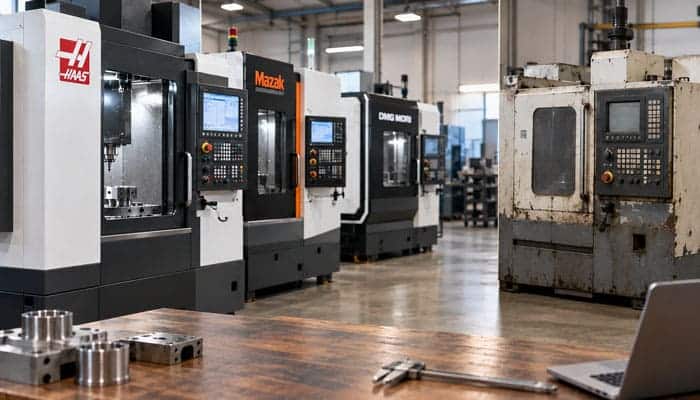
The age of the machinery is less relevant than many vendors think. It’s really more about brand and control vintage. A well-cared-for Haas, Mazak, or DMG MORI with a current-generation Fanuc, Siemens, or Heidenhain control will frequently fetch two to three times the amount of an analogous-aged off-brand machine, since the name-brand machines have a resale safety net in the form of the dealer network, readily available parts, and buyers who are already comfortable with the product.
On the flip side, no-name and orphan machines tend to do worse in used machinery markets, and some struggle to find buyers at any price because discontinued and unsupported models can have little resale market – no one wants to buy a problem. These are machines for which the parts problem is no longer an if but a when. They’re simply not going to be able to obtain their 70 cents on the dollar no matter how prettily they present their paperwork.
Check comparable listings before you accept an offer
Prior to engaging in any trade-in discussion, determine what similar units are actually trading for. Dealer listings and auction pricing aggregators (e.g. BidSpotter, Machinery Values) provide actual sales data on comparable models, hours, and specs. This will give you an open-market range rather than a shot in the dark, and a good amount of leverage to have going into the trade-in negotiation.
If the trade-in offer is well under that range, an independent equipment appraisal will answer the question. It is also a good piece of paperwork to have if you need to prove value for financing or insurance later on.
Structure the trade-in as your financing move, not a side sale
This is where the strategic part is important. For small manufacturers who want to tackle larger contracts, they’re likely to bump into a capacity wall first – needing another machine, or a newer one, to handle the volume or tolerances of the new work order. That will require a big capital outlay at precisely the time when you’re most likely to be cash-poor because the bigger contract hasn’t given you any cash cushion yet.
If that’s the scenario you find yourself in, factoring in a trade-in can maximize the value of your existing asset towards expanding your capacity. Specialized used equipment dealers like Premier Equipment will apply your old machine’s value as a trade-in credit against the total purchase, effectively letting your existing equipment help finance your expansion. Plus, the old sales adage is true. If you buy a machine specifically for a new contract and suddenly lose that contract, you’ve got an underutilized machine and a big new monthly payment that’s squeezing you even harder. It can be a catch-22 worth avoiding if a trade-in can help.
Given that roughly 98% of U.S. manufacturers qualify as small manufacturers with fewer than 500 employees, this isn’t a niche problem. It’s the normal financial reality most shops are working within, where one equipment decision really can make or break whether you can safely bid on the next job.
Bring the tooling into the conversation
Include tooling, workholding, and any automation you’re selling as part of the machine package. Be upfront from the start with what’s included when offering up the machine, anticipate what add-on items the dealer might request, and have solid justifications for any overages beyond the initial ballpark price range. Most sellers offer up plenty of extras and don’t disclose in advance exactly how much including them jacks up their price compared to a bare-machine transaction. That’s a fast way to lose trust and the dealer’s best offer on your most profitable used equipment. Don’t forget to include coolant, manuals and documentation, and any auxiliary equipment needed to operate the machine.