


Influencer marketing has become one of the most effective ways for brands to build trust, reach targeted audiences, and generate measurable business results across social media. In 2026, brands that understand how to create a social media influencer strategy are no longer treating creator collaborations as random sponsored posts. They are building structured programs with clear goals, audience targeting, creator fit, content planning, disclosure compliance, and ROI tracking.
If you want to understand how to create a social media influencer strategy, the goal is to build a repeatable plan that connects your business objectives with the right creators, the right content, and the right measurement framework. That is what turns influencer marketing into a sustainable growth channel.
In 2026, influencer programs are also more measurable and operational than before. Instagram supports partnership ads and content-level permissions, while FTC disclosure guidance remains a core compliance requirement for brand-creator collaborations.
What Is a Social Media Influencer Strategy?
A social media influencer strategy is a documented plan for how your brand will work with creators to achieve specific marketing goals such as awareness, engagement, traffic, user-generated content, leads, or sales. A strong strategy defines your target audience, platforms, creator criteria, campaign type, budget, content expectations, disclosure requirements, and KPIs.
In simple terms, how to create a social media influencer strategy means building a roadmap for creator partnerships that is intentional, scalable, and measurable.
Why Influencer Marketing Matters in 2026
Influencer marketing still matters because consumers often trust creators more than standard brand advertising when discovering products and opinions online. It now supports more than awareness alone. Brands use influencer campaigns for product education, affiliate sales, community building, creator-made content, and performance marketing.
The channel is also becoming more operationally mature. Instagram officially documents partnership ads with creator permissions, and TikTok positions creator collaboration tools within TikTok One as formal campaign infrastructure for brands. That means creator marketing is becoming easier to scale and measure through platform-native systems.
The Core Elements of a Strong Influencer Strategy
A strong influencer strategy usually includes:
- clear business goals
- a defined target audience
- the right platform mix
- the right creator tiers
- a suitable campaign model
- a realistic budget
- a campaign brief
- contracts and usage rights
- FTC-compliant disclosures
- reporting and ROI analysis
Defining Your Goals and Target Audience
Before contacting any creator, define the result you want. Your objective may be brand awareness, engagement, traffic, lead generation, sales, app installs, affiliate revenue, or reusable content creation. The right influencer strategy depends on that goal. A campaign built for awareness should be structured differently from one built for direct sales.
Target audience clarity is equally important. You should know who you want to reach by age, location, interests, pain points, content habits, and buying behavior.
Choosing the Right Social Media Platforms
Instagram remains strong for visual storytelling, beauty, fashion, wellness, lifestyle content, Reels, Stories, and partnership ads. It is one of the most important platforms to consider when learning how to create a social media influencer strategy for visual-first brands.
TikTok
TikTok is ideal for discovery, short-form storytelling, trends, product demos, and fast creative testing. It is especially useful when brands want broad top-of-funnel visibility through native-feeling video content. Platform collaboration systems have made discovery and campaign management more structured in recent years.
YouTube
YouTube is useful for product reviews, tutorials, explainers, and deeper trust-building content. It is often a better fit when customers need more context before buying. Longer-form creator content can support product education and higher-consideration purchases.
LinkedIn can be valuable for B2B influencer strategy, executive branding, SaaS thought leadership, recruitment marketing, and expert-led educational content. If your audience is made up of professionals, decision-makers, or buyers in specialized industries, LinkedIn creators may be more relevant than lifestyle influencers.
Pinterest is useful for visual search, evergreen discovery, shopping inspiration, home, beauty, fashion, weddings, and seasonal planning. Brands in visually searchable categories may benefit from pairing Pinterest creator content with Instagram and TikTok.
Multi-Platform Strategy
In many cases, the best answer to how to create a social media influencer strategy is not choosing one platform only. TikTok may drive discovery, Instagram may strengthen social proof and paid amplification, and YouTube may support product education.
Understanding Influencer Tiers
A practical creator tier structure often looks like this:
- Nano influencers: under 10,000 followers
- Micro influencers: 10,000 to 100,000
- Mid-tier influencers: 100,000 to 500,000
- Macro influencers: 500,000 to 1 million
- Mega influencers: over 1 million
Current pricing and strategy coverage continues to segment creators by tier and highlights that smaller creators can often be more cost-effective depending on campaign goals.
Creator Tier Comparison
| Creator Type | Best For | Main Advantage | Main Limitation |
|---|---|---|---|
| Nano | local campaigns, niche trust, UGC | authentic audience connection | limited scale |
| Micro | affiliate campaigns, product launches, community fit | strong relevance and better cost efficiency | moderate reach |
| Mid-tier | broader awareness with some niche fit | balance of reach and relatability | higher cost |
| Macro | large brand campaigns | visibility and scale | weaker niche targeting |
| Mega | mass awareness and celebrity-style reach | huge exposure | expensive and often lower efficiency for niche conversions |
This comparison helps readers understand that the best creator is not always the biggest one.
Finding and Evaluating the Right Influencers
Creators should be evaluated on more than follower count. Look at:
- audience relevance
- engagement quality
- content consistency
- brand fit
- tone and values
- past partnerships
- disclosure habits
- audience sentiment
A smaller creator with real trust and audience fit is often more valuable than a bigger creator with weak alignment. That is especially true for affiliate, niche, and product-education campaigns.
How to Detect Fake Influence and Low-Quality Audiences
This is one of the most important missing pieces in many influencer guides.
When vetting creators, look for warning signs such as:
- sudden follower spikes with no matching content breakout
- very low-quality comments like repeated emojis or generic phrases
- audience-country mismatch compared with your target market
- giveaway-heavy engagement that does not reflect real purchase intent
- weak Story views compared with follower count
- inconsistent posting or erratic engagement patterns
A creator does not need massive numbers to be effective. What matters more is whether the audience is real, relevant, and likely to respond to the campaign.
How to Reach Out to Influencers
Outreach is one of the most practical parts of how to create a social media influencer strategy, yet many articles skip it.
Your first message should be short, professional, and personalized. Include:
- who you are
- why you selected that creator
- the product or campaign
- the proposed collaboration type
- whether the partnership is paid, gifted, affiliate-based, or hybrid
- the expected deliverables
- next-step contact details
Personalized outreach usually performs better than generic mass messaging because it shows that your brand understands the creator’s audience and content style. Current strategy guidance also points toward collaborative relationships rather than purely transactional ones.
Sample Influencer Outreach Message
Hi [Creator Name],
I’m [Your Name] from [Brand]. We’ve been following your content and especially liked your posts about [topic]. We’re launching [product/campaign] and think your audience could be a strong fit. We’d love to discuss a paid collaboration that could include [deliverables]. If you’re interested, I can share the campaign brief, timeline, and budget details.
Running Small Test Campaigns Before Scaling
A smart influencer strategy often starts with testing. Instead of committing large budget upfront, run a smaller pilot with a limited creator group. Test:
- message angle
- content format
- creator fit
- click-through rate
- conversion quality
- communication reliability
This is one of the most practical ways to reduce risk and improve campaign efficiency over time.
Choosing the Right Campaign Type
Product Seeding
Brands send products to selected creators to generate awareness, early feedback, and organic-style content. This works best when the product naturally fits the creator’s audience.
Sponsored Content Campaigns
These are direct paid collaborations for Reels, TikToks, Stories, videos, or campaign packages. They are common for launches, promotions, and seasonal pushes.
Affiliate Campaigns
These use trackable links, promo codes, or commission structures tied to leads or sales. ROI-focused guidance reinforces the importance of measurable outcomes like revenue and conversion value.
Ambassador Programs
These involve long-term relationships with creators over a series of campaigns. They are often stronger for trust, message consistency, and brand recall than one-off promotions.
UGC-Focused Campaigns
These are designed mainly to create reusable content assets for paid ads, email, product pages, and landing pages.
Planning Content and Campaign Messaging
Once creators are selected, build a campaign brief that gives structure without over-scripting the content. The strongest creator campaigns balance brand clarity with creator authenticity. Current influencer strategy guidance repeatedly emphasizes this balance because content usually performs worse when it feels forced.
Your brief should include:
- campaign objective
- target audience
- product details
- key message
- deliverables
- deadlines
- CTA
- disclosure requirements
- approved claims
- restricted claims
- review process
- tracking links or codes
- usage expectations
Simple Campaign Brief Checklist
Goal:
Platform:
Creator name:
Deliverables:
Deadline:
Core message:
CTA:
Hashtags/links:
Disclosure instruction:
Usage rights:
Approval workflow:
KPI target:
Influencer Marketing Budget, Pricing, and Compensation Models
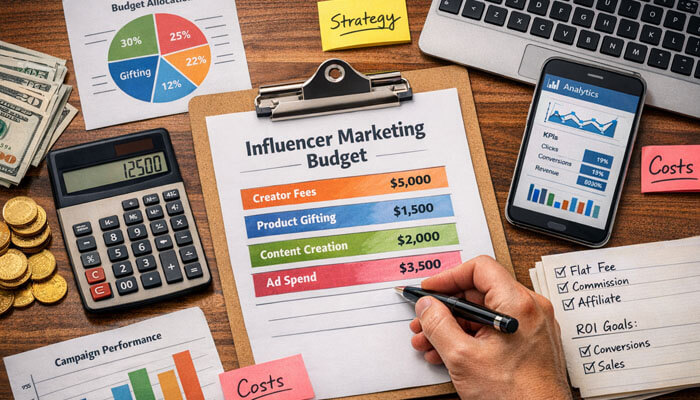
A strong article on how to create a social media influencer strategy should always explain budget planning. Costs can include creator fees, gifting, shipping, revisions, usage rights, affiliate commissions, paid amplification, software, and reporting time.
Common compensation models include:
- flat fee per deliverable
- campaign package fee
- affiliate commission
- monthly retainer
- performance bonus
- hybrid model
- product gifting for select seeding campaigns
Product gifting alone may work for some seeding programs, but commercial creator work often requires direct payment.
Contracts, Deliverables, and Usage Rights
Every professional influencer campaign should define terms in writing. Your agreement should cover:
- deliverables
- timelines
- revisions
- payment terms
- disclosure requirements
- exclusivity
- cancellation terms
- approval rights
- usage rights
What Usage Rights Should Cover
To avoid confusion later, define whether your brand has permission for:
- organic reposting on brand channels
- paid ad usage
- website and landing page usage
- email marketing usage
- raw file delivery
- editing/cropping permissions
- duration of use, such as 30 days, 90 days, or 12 months
- platform limitations, if any
Usage rights matter because brands often want to reuse creator content in paid ads, email, landing pages, or product pages. That permission should be agreed upfront.
FTC Disclosure and Compliance Guidelines
Any serious influencer strategy must include disclosure compliance. The FTC says endorsements must be truthful, not misleading, and that influencers must clearly disclose material connections to brands.
A material connection can include:
- payment
- free products
- discounts
- gifts
- travel
- employment
- family or personal relationships
The FTC guidance makes clear that disclosures should be easy to notice and understand. Good examples include:
- Ad
- Sponsored
- Paid partnership with [Brand]
Platform Collaboration Tools You Should Know
Modern influencer marketing increasingly depends on platform-native collaboration tools.
Instagram explains that partnership ads let advertisers run ads with creators, brands, and other businesses, and that content-level permission settings can be used to authorize boosting individual posts, Stories, or Reels.
TikTok’s official creator-collaboration infrastructure has also made creator discovery and campaign management more standardized for brands. That makes campaign execution more scalable and easier to manage across multiple creators.
These tools make influencer campaigns more permission-based, scalable, and measurable.
Brand Safety and Crisis Prevention
Brand safety is another topic that should be inside a complete strategy guide. Before signing a creator, review:
- past content tone
- controversial posts
- comment quality
- disclosure habits
- overall alignment with your brand values
It also helps to define a simple escalation process:
- who reviews risky content
- when a post should be paused
- when a contract should be terminated
- who handles creator communication
- who responds publicly if needed
Measuring Influencer Campaign Success
Success should always be tied to the original campaign goal. Sprout Social’s recent ROI and metrics guides emphasize measuring influencer impact through business outcomes, not just vanity metrics.
Awareness Metrics
- reach
- impressions
- views
- follower growth
Engagement Metrics
- likes
- comments
- saves
- shares
- replies
Traffic Metrics
- clicks
- CTR
- landing-page sessions
Conversion Metrics
- leads
- sign-ups
- sales
- promo code usage
- affiliate revenue
- CPA
- ROAS
Content Value Metrics
- number of reusable assets
- cost per asset
- creator-content ad performance
Simple Influencer ROI Formula
ROI = (Revenue from campaign – Total campaign cost) / Total campaign cost × 100
For non-sales-first campaigns, you can also track:
- cost per click
- cost per lead
- cost per acquisition
- cost per creator asset
- assisted conversions
Reporting Cadence: Weekly vs Final Reporting
A strong influencer strategy should not wait until the campaign is over to review performance.
Weekly Optimization Reporting
Use weekly reporting to check:
- creator posting status
- link performance
- CTR trends
- audience feedback
- paid amplification results
- underperforming creative angles
Final Campaign Reporting
Use end-of-campaign reporting to review:
- total reach
- total traffic
- leads or sales
- CPA or ROAS
- top creators by efficiency
- top-performing content themes
- reusable asset value
- lessons for the next campaign
This reporting cadence helps brands optimize live campaigns and make smarter future investments.
Tools to Manage Influencer Campaigns
As influencer programs grow, teams usually need more than spreadsheets alone. A practical stack may include:
- creator discovery tools
- influencer CRM or outreach tracking
- UTM links
- promo codes
- affiliate tracking tools
- landing-page analytics
- native platform tools like Instagram partnership ads
- reporting dashboards
The best tool stack depends on whether your primary goal is awareness, UGC production, affiliate sales, or paid-media performance.
Common Influencer Strategy Mistakes to Avoid
Many campaigns underperform because the strategy is weak, not because influencer marketing itself does not work.
Common mistakes include:
- choosing creators by follower count only
- skipping audience-fit checks
- using vague briefs
- failing to define usage rights
- not requiring clear disclosures
- tracking likes but not revenue or leads
- scaling too early without testing
- treating creator content like traditional ads
- ignoring brand safety risks
- failing to build long-term creator relationships
Real-World Mini Example
A skincare brand launching a new serum may choose:
- goal: product trial and sales
- platforms: TikTok and Instagram
- creator mix: 20 micro influencers and 10 nano influencers
- campaign type: product seeding plus paid sponsored content
- tracking: promo codes, landing page links, creator-level reporting
- success metrics: CTR, add-to-cart rate, sales, cost per acquisition, reusable video assets
This example reflects how current strategy guidance encourages brands to connect creator type, campaign type, and measurable outcomes instead of running generic influencer activity.
30-Day Influencer Strategy Action Plan
Week 1
- define your campaign goal
- identify your target audience
- choose your primary platform
- decide your budget range
Week 2
- build a shortlist of creators
- review audience fit and engagement quality
- check for brand safety concerns
- prepare outreach templates
Week 3
- send outreach
- negotiate deliverables and pricing
- finalize contracts
- create your campaign brief and tracking setup
Week 4
- launch your test campaign
- monitor creator posting
- review early clicks, engagement, and conversions
- document results before deciding whether to scale
This action plan makes how to create a social media influencer strategy more practical for beginners and teams building a repeatable system.
Final Execution Checklist
Influencer Strategy Checklist
- Define one clear campaign goal
- Identify your target audience
- Choose the right platform
- Select the right creator tier
- Vet creators for fit and trust
- Check for fake audience signals
- Choose campaign type
- Set budget and compensation model
- Send personalized outreach
- Create campaign brief
- Define contract and usage rights
- Require proper disclosures
- Track KPIs and ROI
- Review results before scaling
Final Thoughts
If you want to master how to create a social media influencer strategy, focus on structure, not randomness. The strongest influencer programs in 2026 are built around clear goals, audience fit, creator relevance, platform-native content, permissions, compliance, and reporting. That direction is consistently reflected in current strategy, pricing, ROI, and platform guidance.
In 2026, brands are most likely to win when they treat creator partnerships as a repeatable system. They test before scaling, secure usage rights, use official platform tools, track business outcomes, and build longer-term creator relationships.
How to Create a Social Media Influencer Strategy FAQs
1. How long does it take to create a social media influencer strategy that delivers results?
It can take a few weeks to a few months, depending on your goals, budget, creator selection, and campaign planning. Testing small campaigns first usually helps brands get better results before scaling.
2. Can small businesses learn how to create a social media influencer strategy without a big budget?
Yes, small businesses can build an effective influencer strategy with a limited budget by using nano and micro influencers. Product seeding, affiliate partnerships, and small test campaigns can deliver cost-effective results.
3. How do seasonal campaigns affect how to create a social media influencer strategy?
Seasonal campaigns require earlier planning because timing, buyer intent, and content themes matter more during holidays and launches. Brands should prepare outreach, approvals, and content schedules in advance for better performance.
4. What role does user-generated content play in how to create a social media influencer strategy?
User-generated content helps brands create authentic assets for ads, emails, product pages, and social proof. In many campaigns, the reusable content becomes as valuable as the direct post performance.
5. Why is competitor research important when learning how to create a social media influencer strategy?
Competitor research helps brands understand which creators, platforms, and campaign formats are already working in their niche. It also reveals gaps and opportunities to build a more original and effective influencer strategy.
