


If you are wondering How Long Does Meth Stay in Your System for Urine Sample, the most accurate answer is that methamphetamine can commonly be detected in urine for several days, but there is no universal detection window that applies to every person or every test.
ARUP Consult lists an estimated urine detection window of approximately 1–4 days for methamphetamine. Mayo Clinic Laboratories notes that amphetamine-type stimulants detected above its laboratory limit of quantification can generally indicate exposure within roughly 2–3 days, while another Mayo urine-confirmation resource describes a typical detection interval of approximately 3–5 days after the last ingestion.
Those ranges are estimates rather than guaranteed deadlines.
When people ask How Long Does Meth Stay in Your System for Urine Sample, several factors have to be considered, including:
- Frequency of exposure
- Amount involved
- Individual metabolism
- Kidney function
- Urine characteristics
- Testing sensitivity
- Laboratory cutoff
- Type of screening or confirmation test
Controlled human research has also shown that lowering a laboratory testing cutoff can extend the period during which methamphetamine remains detectable.
That is why the most scientifically responsible answer to How Long Does Meth Stay in Your System for Urine Sample is a detection range rather than a precise number of hours.
Quick Answer: How Long Does Meth Stay in Your System for Urine Sample?
For many urine-testing situations, methamphetamine may remain detectable for approximately 1–4 days, although some laboratory references describe periods extending to roughly 3–5 days depending on the analytical method and circumstances.
If your main question is How Long Does Meth Stay in Your System for Urine Sample, this table provides a useful overview:
| Testing reference or situation | General urine detection information |
|---|---|
| ARUP Consult | About 1–4 days |
| Mayo drug-testing reference | Approximately 2–3 days at stated laboratory sensitivity |
| Mayo urine confirmation guidance | Typically about 3–5 days after last ingestion |
| Repeated exposure | Detection may last longer |
| Lower analytical cutoff | Smaller amounts may remain detectable longer |
| Exact individual result | Cannot be predicted reliably |
The important word is approximately.
Methamphetamine does not suddenly disappear from urine after a predetermined number of hours. Its concentration declines gradually until it falls below the detection or reporting threshold used by a specific test.
What Is Methamphetamine?
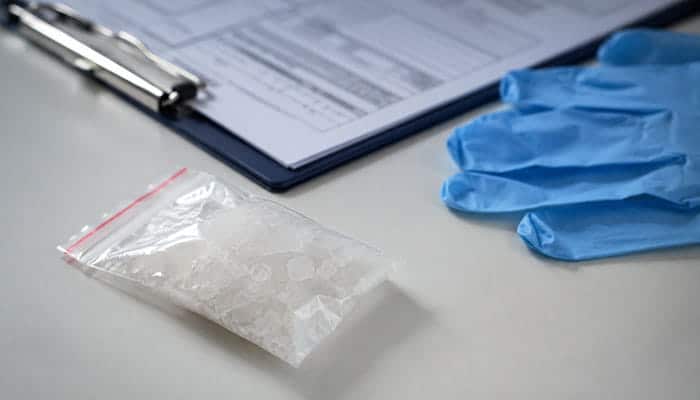
Methamphetamine is a powerful central nervous system stimulant.
It can increase:
- Alertness
- Wakefulness
- Energy
- Heart rate
- Blood pressure
- Body temperature
- Physical activity
Methamphetamine also carries serious health risks, including dependence, cardiovascular complications, severe agitation, psychosis, overheating, seizures, and overdose.
Although the word meth is often associated with illicit methamphetamine, methamphetamine-related laboratory testing can also involve limited pharmaceutical uses and chemically related medications or compounds.
Understanding that distinction helps answer How Long Does Meth Stay in Your System for Urine Sample because laboratories may need to determine exactly which substance produced a result.
Meth vs. Amphetamine: What Is the Difference?
Methamphetamine and amphetamine are closely related stimulants, but they are not identical. Methamphetamine is partially metabolized into amphetamine. The relationship can be summarized as:
Methamphetamine → Amphetamine
That means a urine sample after methamphetamine exposure may contain:
- Methamphetamine
- Amphetamine
- Both compounds
Amphetamine itself, however, does not metabolize into methamphetamine.
This distinction matters when laboratories interpret confirmatory results.
It is also one reason that answering How Long Does Meth Stay in Your System for Urine Sample requires more than looking only for the word “amphetamine” on a screening test.
How Long Does Meth Stay in Your System for Urine Sample?
The best general estimate is several days, with approximately 1–4 days commonly cited in clinical reference material.
Some laboratories describe slightly different ranges.
Mayo Clinic Laboratories states that amphetamine-type stimulant concentrations above its stated limit of quantification can generally indicate exposure during approximately the previous 2–3 days.
Another Mayo urine-confirmation resource describes a typical amphetamine-type stimulant detection interval of approximately 3–5 days after last ingestion.
The reason these estimates differ is that urine tests are not all identical.
Different laboratories can use different:
- Detection limits
- Reporting thresholds
- Analytical methods
- Confirmation technologies
- Testing objectives
- Cutoff concentrations
Therefore, anyone asking How Long Does Meth Stay in Your System for Urine Sample should avoid assuming methamphetamine always becomes undetectable at exactly 48, 72, or 96 hours.
Meth Urine Detection Timeline at a Glance
A broad timeline can help readers understand How Long Does Meth Stay in Your System for Urine Sample, but it should not be used as an individualized prediction.
| Time after exposure | General interpretation |
|---|---|
| First several hours | Methamphetamine can begin appearing in urine |
| About 1–3 days | Common detection period for many urine tests |
| Around 3–4 days | Methamphetamine may still be detectable in some cases |
| Around 3–5 days | Possible depending on laboratory method and circumstances |
| Beyond common range | May occur in some repeated-exposure or sensitive-testing situations |
Controlled research has shown that methamphetamine and amphetamine can begin appearing in urine within hours following administration.
However, urinary concentrations vary significantly between individuals.
That is why the question How Long Does Meth Stay in Your System for Urine Sample cannot be answered with one guaranteed number.
Why Meth Can Be Detected After Its Effects Wear Off
One of the most common misunderstandings surrounding How Long Does Meth Stay in Your System for Urine Sample is the assumption that the drug becomes undetectable once its noticeable effects end.
That is not how toxicology works.
After methamphetamine enters the body:
- It circulates in the bloodstream.
- The liver metabolizes part of it.
- Some methamphetamine becomes amphetamine.
- The kidneys filter methamphetamine and metabolites.
- These compounds are gradually excreted in urine.
A person can therefore feel normal while methamphetamine or its metabolites remain measurable. The duration of stimulant effects and the urine detection window are two different concepts.
Methamphetamine Half-Life vs. Urine Detection Window
Half-life is another concept frequently misunderstood by people asking How Long Does Meth Stay in Your System for Urine Sample.
Methamphetamine Half-Life
A half-life is the approximate time required for the amount of a substance in the body to decline by half.
Human pharmacokinetic research has reported average methamphetamine elimination half-lives around 10 hours in certain controlled studies, while clinical laboratory references can provide broader ranges.
However, a drug does not disappear after one half-life.
If a simplified example begins with 100 units:
- After one half-life → 50 units remain
- After two half-lives → 25 units remain
- After three half-lives → 12.5 units remain
- After four half-lives → 6.25 units remain
Detection Window
The detection window describes how long a test can identify a substance above its analytical or reporting threshold.
Therefore:
Half-life ≠ urine detection time
This distinction is fundamental when explaining How Long Does Meth Stay in Your System for Urine Sample.
What Does a Meth Urine Test Detect?
Depending on the test, urine analysis may identify:
- Methamphetamine
- Amphetamine
- Amphetamine-class substances
- Related stimulant compounds
Initial immunoassays often test a broader drug class. Confirmatory laboratory testing can identify individual compounds separately.
For example, laboratory amphetamine confirmation panels may analyze:
- Methamphetamine
- Amphetamine
- Phentermine
- MDMA
- MDA
- Ephedrine
- Pseudoephedrine
The exact substances included depend on the laboratory and testing panel.
When evaluating How Long Does Meth Stay in Your System for Urine Sample, it is therefore important to know what the specific test actually measures.
Initial Screening vs. Confirmatory Testing
A major factor in understanding How Long Does Meth Stay in Your System for Urine Sample is whether the result comes from an initial screen or a confirmatory laboratory test.
Initial Screening
Initial urine drug tests commonly use immunoassay technology.
They are designed to identify possible drug-class positives quickly.
Advantages include:
- Fast results
- Lower cost
- High-volume testing
- Easy point-of-care use
However, some chemically related compounds can produce cross-reactivity.
A screening positive may therefore be described as:
- Presumptive positive
- Preliminary positive
- Screening positive
Confirmatory Testing
Confirmatory testing uses more specific analytical techniques.
These can include:
- GC-MS
- LC-MS
- LC-MS/MS
| Test stage | Main purpose | Key characteristic |
|---|---|---|
| Initial immunoassay | Identify possible drug-class result | Fast but less specific |
| Laboratory confirmation | Identify specific compounds | Greater analytical specificity |
| Medical review | Evaluate legitimate explanations | Adds clinical context |
A confirmed result provides considerably more information than an initial screening result.
Home Meth Urine Test vs. Laboratory Urine Test
Not every methamphetamine urine test works the same way.
This distinction is important for anyone researching How Long Does Meth Stay in Your System for Urine Sample.
At-home tests are generally screening tools. They are designed to indicate whether an amphetamine-class substance may be present above the manufacturer’s cutoff. They usually cannot determine precisely which compound caused the result. Laboratory testing can provide far more specific information.
Mayo Clinic Laboratories, for example, uses LC-MS/MS for certain urine amphetamine-confirmation testing.
| Test type | What it generally provides | Main limitation |
|---|---|---|
| Home urine test | Preliminary positive or negative | Usually less specific |
| Point-of-care immunoassay | Rapid drug-class screen | Cross-reactivity may occur |
| Laboratory confirmation | Identifies specific analytes | Requires laboratory testing |
| LC-MS/MS | Highly specific measurement | Interpretation still requires context |
A positive home test should therefore not automatically be interpreted as final proof of illicit methamphetamine exposure.
How Reliable Are Home Meth Urine Tests?
Home urine drug tests can be useful screening tools when used properly.
However, factors affecting their reliability include:
- Manufacturer cutoff
- Product quality
- Storage conditions
- Expiration date
- Timing of result interpretation
- Urine concentration
- Cross-reactivity
- Drug concentration near the cutoff
A home test should therefore not be considered equivalent to a specific laboratory confirmation.
If the question How Long Does Meth Stay in Your System for Urine Sample relates to an important medical, workplace, treatment, or legal matter, professional laboratory testing provides much more useful information.
Federal Workplace Methamphetamine Urine Test Cutoffs
An important part of How Long Does Meth Stay in Your System for Urine Sample is understanding test cutoffs.
Current DOT-regulated urine testing uses:
| Analyte | Initial cutoff | Confirmatory cutoff |
|---|---|---|
| Amphetamine/Methamphetamine group | 500 ng/mL | — |
| Amphetamine | — | 250 ng/mL |
| Methamphetamine | — | 250 ng/mL |
These federal thresholds apply to regulated workplace testing and should not be assumed to apply to every clinical, private, or home urine test.
Do All Meth Urine Tests Use the Same Cutoff?
No.
Different testing programs can use different analytical thresholds. Federal workplace cutoffs should not automatically be applied to:
- Hospital or clinical testing
- Addiction-treatment programs
- Private employers
- Home drug tests
- Specialized forensic or laboratory testing
For example, one Mayo Clinic Laboratories LC-MS/MS urine confirmation assay lists a methamphetamine cutoff of 25 ng/mL.
| Testing context | Methamphetamine threshold |
|---|---|
| Federal/DOT urine confirmation | 250 ng/mL |
| Mayo LC-MS/MS confirmation assay | 25 ng/mL |
These tests serve different purposes, but the comparison shows why How Long Does Meth Stay in Your System for Urine Sample can vary depending on the laboratory method.
Why Testing Cutoffs Affect the Detection Window
Methamphetamine concentration gradually declines over time.
A test with a higher cutoff may stop reporting a positive result sooner than a more sensitive test that can detect smaller concentrations.
For example:
500 → 300 → 200 → 100 → 50 → 25 ng/mL
Controlled research has shown that lower testing thresholds can extend detection time.
That is why laboratory sensitivity can influence How Long Does Meth Stay in Your System for Urine Sample.
What Factors Affect How Long Meth Is Detectable in Urine?
Several factors can affect the detection window:
1. Frequency and Amount of Exposure
Repeated or higher exposure can produce greater drug concentrations and may extend detection.
2. Individual Metabolism
Detection can vary with:
- Genetics
- Age
- Liver function
- Kidney function
- Medications
- Individual physiology
3. Urinary Elimination
Methamphetamine and its metabolites are partly eliminated through urine, so renal clearance and urine characteristics can affect concentration.
4. Laboratory Cutoff
Lower thresholds can detect smaller amounts for longer.
5. Testing Method
Immunoassays and LC-MS/MS tests differ in sensitivity and specificity.
6. Repeated vs. Isolated Exposure
Repeated exposure may produce a longer or different concentration pattern than a single exposure.
Together, these factors explain why How Long Does Meth Stay in Your System for Urine Sample cannot be predicted with one exact number.
Can Meth Stay Detectable in Urine for Five Days?
Yes, it can in some circumstances.
Mayo Clinic Laboratories describes a typical amphetamine-type stimulant detection interval of approximately 3–5 days after last ingestion in one testing context.
Another Mayo reference describes an approximate interval of two to three days at its stated laboratory sensitivity.
Neither estimate should be treated as a universal rule.
If you are asking How Long Does Meth Stay in Your System for Urine Sample because five days have passed, the scientifically accurate answer is that detection may still be possible depending on the test and individual circumstances.
Can Meth Be Detected in Urine for a Week?
Longer detection can occur under some circumstances.
However, seven days should not be presented as the typical urine detection window for every person.
Repeated exposure and sensitive analytical methods can sometimes extend detection.
The safest conclusion when researching How Long Does Meth Stay in Your System for Urine Sample is that approximately 1–4 days is a commonly cited general range, while longer detection may occur in some situations.
Does Repeated Meth Exposure Extend the Detection Window?
Potentially, yes.
Repeated exposure can contribute to accumulation because new methamphetamine enters the body before previous amounts have completely cleared.
Controlled pharmacokinetic studies have documented accumulation and prolonged urinary detection following repeated administration.
This is another reason How Long Does Meth Stay in Your System for Urine Sample cannot be calculated accurately using only the time since the most recent exposure.
Can a Urine Test Tell Exactly When Meth Was Used?
Usually not.
A urine test can indicate that methamphetamine or a related analyte met the laboratory’s criteria.
It generally cannot tell the exact hour exposure occurred.
Urinary concentrations depend on:
- Time since exposure
- Individual metabolism
- Kidney clearance
- Urine concentration
- Frequency of exposure
- Laboratory cutoff
- Specimen collection timing
Therefore, a result normally cannot establish that methamphetamine was used at an exact time such as 24, 36, or 48 hours earlier.
That limitation is important when interpreting How Long Does Meth Stay in Your System for Urine Sample.
Can a Meth Urine Test Tell How Much Was Used?
Not reliably.
A quantitative laboratory report may provide the concentration measured in urine, often in ng/mL.
That number does not directly reveal the exact amount originally taken.
Urine concentration is affected by:
- Urine volume
- Metabolism
- Renal clearance
- Collection timing
- Exposure pattern
- Individual physiology
Two people with similar exposure may therefore have different urine concentrations.
The question How Long Does Meth Stay in Your System for Urine Sample should not be confused with estimating an exact dose from a urine result.
Methamphetamine vs. Amphetamine on the Lab Report
Methamphetamine is partly metabolized into amphetamine.
Therefore, both compounds may commonly appear in a laboratory confirmation report.
However, the absence of a large amphetamine concentration does not automatically invalidate a confirmed methamphetamine finding.
Does Methamphetamine Always Need Amphetamine to Be Present?
No.
This is especially important because some older online testing information is outdated.
Effective February 1, 2024, federal and DOT-regulated urine laboratories were no longer required to quantify at least 100 ng/mL of amphetamine before reporting a specimen positive for methamphetamine.
Readers researching How Long Does Meth Stay in Your System for Urine Sample should therefore be cautious when relying on older drug-testing articles.
Can Prescription or OTC Products Affect Methamphetamine Testing?
Yes.
Certain prescription medicines, metabolites, or chemically related products can complicate screening or laboratory interpretation.
Examples can include:
- Selegiline
- Benzphetamine
- Some prescription amphetamines
- Certain sympathomimetic compounds
Some over-the-counter substances may also cross-react with broad immunoassay screens. This does not mean they necessarily produce a confirmed methamphetamine result. Specific laboratory confirmation is therefore important.
D-Methamphetamine vs. L-Methamphetamine
| Feature | D-Methamphetamine | L-Methamphetamine |
|---|---|---|
| Form | D-isomer of methamphetamine | L-isomer of methamphetamine |
| Pharmacological effect | Produces stronger central nervous system stimulant effects | Generally has much weaker central nervous system stimulant effects |
| Possible sources | Illicit methamphetamine and certain prescription sources | Some medications or products containing levmetamfetamine |
| Standard confirmation test | May be reported simply as methamphetamine | May also be reported simply as methamphetamine |
| Can routine testing distinguish it? | Not always | Not always |
| Specialized testing | Enantiomer or isomer testing can identify the d-form | Enantiomer or isomer testing can identify the l-form |
| Why the distinction matters | May help evaluate the source and interpretation of a positive result | May help identify a legitimate medication or product-related explanation |
A standard urine confirmation test may show that methamphetamine is present without automatically identifying whether it is the d- or l-isomer. When the source of a result is unclear, specialized isomer or enantiomer testing may provide more specific information.
What Can Cause a False-Positive Amphetamine Screen?
Initial immunoassays can sometimes react with compounds structurally similar to amphetamines.
Possible explanations for a preliminary positive can include:
- Medication cross-reactivity
- Related stimulant compounds
- Drug metabolites
- Assay characteristics
- Testing error
A presumptive positive does not necessarily mean a specific laboratory confirmation will identify methamphetamine.
This distinction is crucial for readers asking How Long Does Meth Stay in Your System for Urine Sample after receiving only a rapid screening result.
Does Drinking Water Make Meth Leave the Body Faster?
Drinking large amounts of water does not create a reliable methamphetamine elimination timetable. Fluid intake can change urine concentration, but it does not make drug metabolism predictable. Federal workplace programs also use specimen-validity testing.
Measurements may include:
- Creatinine
- Specific gravity
- Other validity indicators
Excessive water consumption can also cause serious medical complications.
For this reason, the answer to How Long Does Meth Stay in Your System for Urine Sample should be based on toxicology and testing science—not hydration tricks.
What Does Dilute, Invalid, Substituted or Adulterated Urine Mean?
When researching How Long Does Meth Stay in Your System for Urine Sample, readers may also encounter specimen-validity terms.
| Result | General meaning |
|---|---|
| Dilute | Urine is less concentrated than expected |
| Invalid | Laboratory validity requirements were not satisfied |
| Substituted | Specimen characteristics meet substitution criteria |
| Adulterated | Abnormal characteristics meet program criteria |
A dilute result does not automatically prove intentional manipulation. These classifications relate to the specimen itself and should not all be interpreted as a positive methamphetamine result.
Do Detox Drinks or Home Remedies Guarantee a Negative Test?
No.
No scientifically validated drink, supplement, home remedy, or commercial detox product can guarantee a negative urine result.
Results depend on factors such as:
- Methamphetamine concentration
- Metabolism
- Renal elimination
- Exposure pattern
- Laboratory cutoff
- Testing method
Readers asking How Long Does Meth Stay in Your System for Urine Sample should rely on evidence-based detection ranges rather than detox claims.
How to Read a Meth Urine Test Result
Understanding test terminology helps interpret How Long Does Meth Stay in Your System for Urine Sample.
| Result | General meaning |
|---|---|
| Negative | Drug did not meet positive-reporting criteria |
| Presumptive positive | Initial screen exceeded its threshold |
| Confirmed positive | Specific testing identified the analyte |
| Negative-dilute | Negative result with a dilute specimen |
| Invalid | Validity requirements were not satisfied |
| Substituted | Specimen meets substitution criteria |
| Adulterated | Specimen meets adulteration criteria |
A preliminary screening positive is not the same as an LC-MS/MS-confirmed result.
What Does a Negative Meth Urine Test Mean?
A negative result generally means methamphetamine or the relevant analyte did not meet the test’s positive-reporting criteria.
Possible reasons include:
- No exposure occurred
- Exposure occurred outside the detection window
- Concentration fell below the cutoff
- The relevant compound was not included in the test
- Specimen timing affected detectability
A negative result does not necessarily prove methamphetamine was never present.
What Does a Positive Meth Urine Test Mean?
A confirmed positive generally means methamphetamine met the laboratory or testing program’s reporting criteria.
Interpretation may still depend on:
- Medication history
- Confirmation method
- Methamphetamine and amphetamine concentrations
- Isomer testing
- Testing rules
- Medical Review Officer evaluation
A confirmed laboratory result provides more specific information than a rapid home test.
What Happens After a Federal Workplace Methamphetamine Test Is Positive?
For federal workplace testing, the process may include:
- Initial testing
- Confirmatory testing
- Laboratory reporting
- Medical Review Officer review
- Review of legitimate medical explanations
- Final verified reporting
A Medical Review Officer is a licensed physician who evaluates drug-test results and relevant medical information.
What Is a Split Specimen?
Certain federally regulated urine tests divide the sample into:
- Bottle A — Primary specimen
- Bottle B — Split specimen
Bottle A is tested, while Bottle B remains sealed for possible retesting.
Can an Employee Request Split-Specimen Testing?
Under DOT-regulated testing, an employee generally has 72 hours after notification of a verified positive result to request split-specimen testing at another HHS-certified laboratory.
This process applies to regulated workplace testing and is not typical of routine clinical urine testing.
Federal Workplace Tests vs. Clinical Meth Urine Tests
Anyone researching How Long Does Meth Stay in Your System for Urine Sample should distinguish federal workplace testing from clinical testing.
| Federal workplace testing | Clinical testing |
|---|---|
| Governed by standardized rules | Primarily used for clinical interpretation |
| Uses defined regulatory cutoffs | Laboratory-specific thresholds may apply |
| Chain of custody may be required | Often not required |
| MRO review is important | Clinician may interpret results |
| Split specimens may be used | Usually not part of routine testing |
Applying federal workplace rules to every hospital or clinical test can lead to misleading conclusions.
What Is Chain of Custody?
Chain of custody documents who controls a specimen throughout:
- Collection
- Transportation
- Storage
- Laboratory testing
- Final handling
Its purpose is to protect specimen integrity. Chain-of-custody procedures are especially important for:
- Workplace testing
- Court proceedings
- Forensic testing
- Regulatory programs
Routine medical urine testing does not always use the same procedures.
Why Online Meth Detection Calculators Can Be Misleading
Some online calculators claim to answer How Long Does Meth Stay in Your System for Urine Sample by asking for:
- Weight
- Age
- Number of exposures
- Frequency
- Time since last exposure
They may then provide an exact prediction such as:
“Your urine will be negative in 72 hours.”
That level of precision is not scientifically justified.
The calculator usually does not know:
- Actual drug concentration
- Kidney clearance
- Test cutoff
- Laboratory method
- Metabolite concentrations
- Urinary characteristics
- Individual pharmacokinetics
General ranges are therefore more scientifically defensible than exact countdowns.
Urine vs. Blood, Oral Fluid and Hair Testing
Although this article focuses on How Long Does Meth Stay in Your System for Urine Sample, methamphetamine can also be tested using other specimens.
| Specimen | General characteristic |
|---|---|
| Urine | Commonly used and can remain positive after acute effects end |
| Blood | Often useful for more recent exposure and clinical evaluation |
| Oral fluid | Generally reflects a relatively recent exposure window |
| Hair | Can provide a substantially longer retrospective window |
These specimen types are not interchangeable.
A negative blood result does not automatically predict a negative urine test. Likewise, hair testing operates on a much longer timeline than urine testing.
Why Is Urine Commonly Used for Meth Testing?

Urine testing has several advantages:
- Collection is relatively simple.
- Methamphetamine and metabolites are excreted in urine.
- Detection can continue after noticeable effects end.
- Laboratories have established analytical methods.
- Federal workplace procedures are standardized.
- Screening and confirmation options are widely available.
These practical advantages are why How Long Does Meth Stay in Your System for Urine Sample is such a common drug-testing question.
Can a Positive Urine Test Prove Impairment?
Usually not by itself. A urine result primarily demonstrates that a drug or metabolite met the applicable laboratory criteria.
It does not necessarily prove:
- Current intoxication
- Degree of impairment
- Exact time of exposure
- Exact dose
- Behavioral effects when the sample was collected
Those questions may require additional medical, forensic, or observational evidence.
Why a Positive Urine Concentration Is Not a Dose Calculator
A higher concentration does not automatically reveal an exact larger dose.
Urinary concentrations are affected by:
- Individual metabolism
- Kidney clearance
- Urine volume
- Specimen timing
- Repeated exposure
- Individual physiology
Controlled studies have shown substantial variation even when researchers know the administered amount.
For that reason, How Long Does Meth Stay in Your System for Urine Sample cannot be calculated accurately from urine concentration alone.
When Should a Laboratory Result Be Professionally Reviewed?
Professional review is especially helpful when:
- A result is unexpected
- Prescription medications may affect interpretation
- Screening and confirmation results differ
- Employment or legal consequences are involved
- The specimen is dilute or invalid
- Methamphetamine and amphetamine findings are unclear
Appropriate professionals include physicians, toxicologists, laboratory specialists, and Medical Review Officers.
For an individual result, professional interpretation is more reliable than relying only on general guidance about How Long Does Meth Stay in Your System for Urine Sample.
When Methamphetamine Exposure Is a Medical Emergency
Questions about How Long Does Meth Stay in Your System for Urine Sample are less important when severe symptoms occur.
Seek urgent medical care for symptoms such as:
- Chest pain
- Severe breathing difficulty
- Seizure
- Loss of consciousness
- Severe confusion or agitation
- Very high body temperature
- Stroke-like symptoms
- Dangerous heartbeat changes
In these situations, immediate medical care should take priority over drug-test timing.
Final Thoughts
So, How Long Does Meth Stay in Your System for Urine Sample? In general, methamphetamine may be detectable in urine for about 1–4 days, while some laboratory references extend the range to approximately 3–5 days.
The exact timeframe varies with metabolism, kidney function, exposure pattern, urine characteristics, test sensitivity, and laboratory cutoff. Repeated exposure may also extend detection.
Testing method matters too. Home immunoassays, federal workplace tests, and LC-MS/MS laboratory confirmation can use different thresholds, so results are not directly interchangeable.
For this reason, How Long Does Meth Stay in Your System for Urine Sample should be viewed as a range, not a fixed countdown. Detection windows are estimates, not guarantees, and important medical, workplace, or legal results should be interpreted using the actual laboratory method and professional review.
Frequently Asked Questions
1. How Long Does Meth Stay in Your System for Urine Sample?
Methamphetamine is commonly detectable in urine for about 1–4 days, though some tests may detect it for 3–5 days. The exact window varies by person and test.
2. Can methamphetamine show up in urine after five days?
Yes. Detection can sometimes last beyond five days, especially with repeated exposure or more sensitive testing.
3. Does one-time meth exposure stay in urine as long as repeated exposure?
Usually not. Repeated exposure may extend detection because methamphetamine can accumulate in the body.
4. Does a home urine test detect meth for the same amount of time as a laboratory test?
Not always. Home tests are usually less specific, while laboratory methods such as LC-MS/MS may detect lower concentrations.
5. Why can meth still appear in urine after the effects have worn off?
The noticeable effects can end before methamphetamine and its metabolites are fully eliminated from the body.
6. Can kidney function affect How Long Does Meth Stay in Your System for Urine Sample?
Yes. Because methamphetamine is partly eliminated through the kidneys, renal function can influence detection time.
7. Does a lower drug-test cutoff make meth detectable for longer?
Potentially. Lower cutoffs can detect smaller concentrations, which may extend the measurable detection window.
8. Can a negative urine test prove that methamphetamine was never used?
No. A negative result only means the drug did not meet that test’s positive-reporting threshold at the time of collection.