


Last updated: October 2026
Buying gift cards in bulk can help businesses stretch employee-recognition budgets, reward customers, motivate sales teams, and simplify corporate gifting. But buying hundreds or thousands of dollars in gift cards at face value can become a significant expense.
A bulk gift cards discount can reduce that cost.
Corporate gift-card programs may offer percentage discounts, volume pricing, reduced shipping costs, digital fulfillment, centralized ordering, or other business benefits. However, there is no universal discount rate. Current programs vary by brand, order size, payment method, delivery format, and buyer eligibility.
For example, Panera currently advertises a 10% discount on qualifying bulk gift-card orders of $500 or more for approved bulk-account holders, while Darden advertises a 10% discount on orders of $1,000 or more.
This guide explains how bulk gift-card discounts work, how to compare offers, how to calculate the actual savings, where discounts come from, and what businesses should know about taxes, security, fulfillment, and recipient management.
What Is a Bulk Gift Card Discount?
A bulk gift card discount is a reduction in the amount a buyer pays when purchasing multiple gift cards or a large total value of gift cards through a corporate, business, wholesale, or bulk-order program.
For example, a business that needs $10,000 in gift-card value might pay less than $10,000 if the issuer provides a qualifying bulk discount.
A 10% discount on $10,000 would produce:
$10,000 × 10% = $1,000 savings
The buyer would pay:
$10,000 − $1,000 = $9,000
However, the advertised percentage is only part of the calculation.
Shipping, processing charges, payment fees, fulfillment costs, and other expenses can reduce the actual savings. The best comparison therefore uses the effective discount, not simply the headline rate.
How Bulk Gift Card Discounts Work
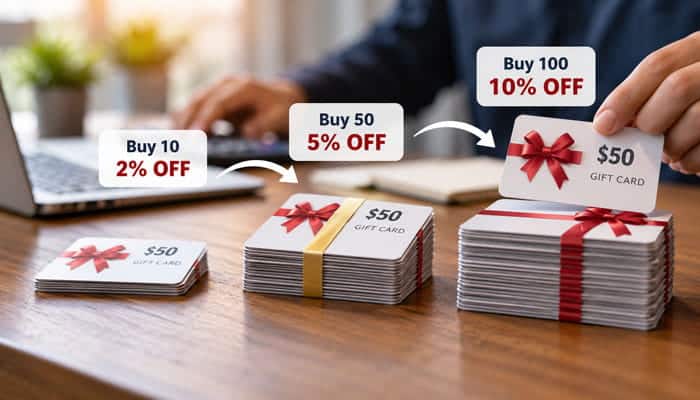
Bulk gift card discounts reduce the amount you pay while keeping the cards’ full face value. Pricing may follow a published discount or a tiered structure based on your order size.
Published Percentage Discount
Some issuers offer a fixed percentage discount when an order meets a minimum purchase requirement.
For example, Panera advertises 10% off bulk gift card orders of $500 or more for bulk-account holders. A qualifying order with a $500 face value would therefore cost $450 before any applicable fees.
Tiered Volume Pricing
With tiered pricing, larger orders may qualify for higher discounts. The table below shows a hypothetical example, not actual rates from a specific provider.
| Total Gift Card Face Value | Illustrative Discount |
|---|---|
| $500–$999 | 5% |
| $1,000–$4,999 | 8% |
| $5,000–$9,999 | 10% |
| $10,000 or more | Negotiated rate |
Actual bulk gift card discounts depend on the issuer and program terms. Confirm the qualifying order value, available rate, and any delivery or processing fees before purchasing.
Negotiated Corporate Pricing
Large organizations may contact the issuer’s corporate sales team for customized pricing.
A provider may consider order size, purchase frequency, payment method, fulfillment requirements, and the expected duration of the business relationship.
Payment-Based Discounts
Some programs may make discounts or pricing concessions dependent on how the order is paid.
This means the payment method can sometimes be part of the overall purchasing strategy.
Do not choose a payment method solely because it produces a discount. Also consider processing fees, fraud controls, cash-flow requirements, accounting procedures, and any available rewards.
Platform or Reseller Pricing
Some specialized gift-card platforms and resellers may offer certain brands below face value.
These offers can sometimes produce attractive savings, but buyers should evaluate authorization, supply, fees, redemption restrictions, refund policies, and fraud protections before purchasing.
Unusually large discounts should be treated as provider-specific offers rather than as an industry-wide standard.
How Much Is a Typical Bulk Gift Card Discount?
There is no standard bulk gift card discount. Rates vary by brand, order value, and program eligibility. Some established corporate programs advertise 10% off qualifying orders, as shown below.
| Provider | Qualifying Purchase | Published Discount |
|---|---|---|
| Panera Bread | Orders of $500 or more through a bulk gift card account | 10% |
| Darden Restaurants | Orders of $1,000 or more through its corporate gift card program | 10% |
Both discounts are advertised by the providers, but they are examples rather than an industry average or a guaranteed rate for every buyer.
At a 10% discount, gift cards with a total face value of $1,000 would cost $900 before any applicable fees, saving $100.
Other providers may offer different rates. Compare the final cost, including processing and delivery fees, and confirm eligibility and current terms before placing an order.
Bulk Gift Card Discount Savings Calculator
The easiest way to compare offers is to calculate how much the organization actually spends.
Use:
Effective savings = Face value − Total amount paid
Then:
Effective discount % = Effective savings ÷ Face value × 100
For example:
- Face value: $20,000
- Advertised discount: 10%
- Discount: $2,000
- Amount after discount: $18,000
- Fees and shipping: $300
- Final amount paid: $18,300
Actual savings:
$20,000 − $18,300 = $1,700
Effective discount:
$1,700 ÷ $20,000 × 100 = 8.5%
Although the advertised discount was 10%, the organization actually saved 8.5%.
This is one of the most important calculations to make before choosing a provider.
How to Calculate the ROI of a Bulk Gift Card Program
A bulk gift-card program should be evaluated using both direct savings and operational costs.
Use:
Net program savings = Face value − Final purchase cost − Incremental program costs
For example:
- Gift-card value: $25,000
- Discount: 10% = $2,500
- Fees: $250
- Shipping: $100
- Incremental administration: $300
Final purchase cost:
$25,000 − $2,500 = $22,500
Net program savings:
$25,000 − $22,500 − $250 − $100 − $300 = $1,850
This gives the business a more realistic view of the value created by the program.
A large discount may look attractive, but if it requires substantial manual work, expensive fulfillment, or complicated reconciliation, the effective financial benefit may be smaller than expected.
Example: 200 Employees Receiving $100 Each
A company purchasing a $100 gift card for each of its 200 employees needs $20,000 in total gift card value.
Here is how three hypothetical bulk gift card offers compare after fees:
| Option | Advertised Discount | Additional Fees | Final Cost | Effective Savings |
|---|---|---|---|---|
| A | 5% | $0 | $19,000 | 5% |
| B | 10% | $300 | $18,300 | 8.5% |
| C | 12% | $700 | $18,300 | 8.5% |
Final cost = Total gift card value − Discount + Additional fees
Options B and C both save the company $1,700, bringing the final cost to $18,300. Although Option C advertises a larger discount, its higher fees cancel out the extra savings.
When comparing bulk gift card discounts, calculate the total cost after fees to see which offer delivers the greatest savings.
10 Ways to Get a Better Bulk Gift Card Discount
1. Start With the Official Corporate Program
If you need one brand in large quantities, check the issuer’s official corporate gift-card program first.
Direct programs make it easier to verify:
- Eligibility
- Pricing
- Discount terms
- Delivery
- Activation
- Replacement procedures
- Customer support
For example, Darden’s corporate program currently advertises a 10% discount on qualifying orders of $1,000 or more.
2. Compare Minimum Order Requirements
A discount may only become available once your purchase reaches a certain threshold.
Panera currently advertises 10% off bulk orders of $500 or more for approved bulk-account holders. Darden advertises 10% off orders of $1,000 or more.
Do not increase your order solely to reach a discount if you do not need the additional gift cards.
3. Ask About Larger-Order Pricing
If you are purchasing $10,000, $25,000, $50,000, or more, ask whether the provider offers customized volume pricing.
Questions to ask include:
- Is there a higher discount above a certain amount?
- Is there a recurring-customer rate?
- Can shipping be waived?
- Is there a dedicated account manager?
- Can the provider customize denominations?
- Is there a better rate for ACH or wire payment?
- Can recurring orders receive preferential pricing?
4. Compare Payment Methods
Payment method can affect total cost.
Before choosing a payment method, consider:
- Fraud controls
- Cash-flow requirements
- Credit-card rewards
- Processing fees
- Accounting requirements
- Payment security
A lower purchase price may not be beneficial if the payment method creates significant fees or administrative complexity.
5. Compare Digital and Physical Cards
Digital cards may reduce shipping and manual distribution.
Physical cards can be better for:
- Conferences
- Holiday events
- In-person recognition
- Employee celebrations
- Traditional corporate gifting
Darden, for example, offers both traditional and eGift cards through its corporate program.
6. Consider Multi-Brand Platforms
If you do not want every recipient to receive the same brand, a multi-brand reward platform may be more practical.
These platforms can provide:
- Multiple retailers
- Recipient choice
- Digital delivery
- Automated fulfillment
- Reporting
- HR or CRM integrations
- API access
The tradeoff is that a platform may have different fees or pricing from a direct issuer program.
7. Negotiate for Large Recurring Orders
A business that purchases gift cards every month or quarter may have more negotiating leverage than a one-time buyer.
Consider negotiating:
- Volume discount
- Annual pricing
- Shipping
- Custom branding
- Dedicated support
- Reporting
- Fulfillment
- Service levels
8. Look for Seasonal Promotions
Some brands run promotional offers around:
- Holidays
- Employee Appreciation events
- Black Friday
- Year-end gifting
- New customer campaigns
- Special corporate promotions
Never assume that a promotional discount can be combined with corporate pricing. Check the current terms before placing the order.
9. Choose a Useful Brand
A 15% discount is worthless if recipients cannot conveniently use the card.
Consider:
- Store locations
- Online redemption
- Geographic coverage
- Product selection
- Recipient preferences
- Expiration rules
- Fees
10. Buy Only What You Can Distribute
Large discounts can tempt buyers into purchasing more than they actually need.
Unused cards create:
- Security risks
- Accounting issues
- Storage requirements
- Potential expiration concerns
- Administrative work
A smaller order with a slightly lower discount can sometimes be financially smarter.
Where Can You Buy Gift Cards in Bulk?
Directly From Retailers
This is often the simplest option for a single-brand purchase.
Best for: businesses that need a large quantity of the same brand and want a direct relationship with the issuer.
Many major brands have corporate or bulk programs, although discounts and eligibility requirements vary.
Corporate Reward Platforms
These platforms can be useful for organizations distributing rewards across multiple brands.
They may provide:
- Recipient choice
- Bulk uploads
- Digital delivery
- Reporting
- Automated rewards
- Integrations
Best for: organizations that need multiple brands, automation, or recipient choice.
Gift Card Resellers
Resellers may offer cards below face value.
Best for: price-sensitive buyers who can independently verify the provider and receive adequate protections.
Before purchasing, verify:
- Business legitimacy
- Authorization
- Card source
- Balance guarantee
- Refund policy
- Replacement policy
- Delivery security
- Customer support
Banks and Financial Institutions
Some financial institutions offer corporate incentive or reward services.
Best for: organizations that already have a business relationship with the institution and want to consolidate purchasing or payment services.
Availability and pricing vary.
Official Gift Card Program vs. Reseller vs. Reward Platform
Businesses can purchase bulk gift cards directly from a brand, through a reseller, or through a reward platform. Each option offers a different balance of pricing, selection, and delivery features.
| Feature | Official Brand Program | Gift Card Reseller | Multi-Brand Reward Platform |
|---|---|---|---|
| Main advantage | Direct purchase from the brand | Potential savings across brands | Centralized reward distribution |
| Brand selection | One brand or restaurant group | Varies by available inventory | Multiple participating brands |
| Pricing | Published or negotiated rates | Depends on inventory and demand | Depends on provider and plan |
| Recipient choice | Usually limited | Depends on the service | Often available |
| Digital delivery | Depends on the program | Depends on the seller | Commonly offered |
| Automation and integrations | Program-specific | Provider-specific | May include APIs and business integrations |
| Best suited to | Rewards from a specific brand | Buyers comparing prices across brands | Programs needing choice and automation |
| What to check | Minimum orders and eligibility | Card source and balance protection | Fees and redemption terms |
Which Should You Choose?
- Choose an official brand program when recipients want a particular brand and your order meets its bulk-purchase requirements.
- Consider a reputable reseller when comparing bulk gift card discounts across brands. Verify the seller, card source, and refund or replacement policy.
- Choose a reward platform when you need recipient choice, scheduled delivery, or integration with your existing business systems.
Compare providers using the same total gift card value, including all fees and the features your program needs.
Bulk Gift Cards vs. Cash Bonuses
Businesses sometimes need to decide whether a reward should be a gift card or cash.
| Factor | Gift Cards | Cash Bonuses |
|---|---|---|
| Recipient flexibility | Depends on brand | Very high |
| Employee tax treatment | Generally taxable | Generally taxable |
| Brand restrictions | Yes | No |
| Corporate discount potential | Possible | Usually not |
| Administration | Can be automated | Often integrated with payroll |
| Recipient experience | Specific reward | Maximum flexibility |
| Best use | Recognition, campaigns, incentives | Compensation and unrestricted rewards |
Gift cards can be attractive when a business can obtain a meaningful discount or wants to run a branded rewards program.
Cash may be simpler when maximum recipient flexibility and payroll integration are the priorities.
For employee rewards, businesses should evaluate the tax and payroll consequences before deciding between the two.
Bulk Gift Cards vs. Merchandise Rewards
Gift cards offer spending flexibility, while merchandise provides a physical reward. The right choice depends on recipient preferences, delivery requirements, and your budget.
| Factor | Gift Cards | Merchandise |
|---|---|---|
| Recipient choice | Choice within the card’s accepted stores or brands | Limited to selected items or a reward catalog |
| Storage | No physical storage for digital cards | May require inventory space |
| Fulfillment | Digital delivery can be quick | Requires sourcing, packing, and delivery |
| Shipping | Not needed for digital cards | Usually required |
| Returns | Often nonreturnable; check purchase terms | Returns or exchanges depend on the supplier |
| Custom branding | Messages and designs may be customizable | Products and packaging may support branding |
| Best for | Flexible spending and easy distribution | Tangible recognition and commemorative gifts |
Bulk gift cards suit programs where recipients value choosing their own purchases. Check that the available brands match their interests and locations.
Merchandise rewards suit occasions where a physical item carries meaning, such as a service anniversary or achievement award. Include packaging, shipping, and potential returns when comparing costs.
What Makes a Bulk Gift Card Program Good?
The cheapest card is not necessarily the best program.
A strong corporate program should provide a reasonable combination of:
- Competitive pricing
- Transparent fees
- Reliable fulfillment
- Secure delivery
- Useful brands
- Recipient flexibility
- Good customer support
- Reporting
- Clear terms
- Appropriate fraud controls
For larger programs, technology can become particularly important.
A platform that saves your team significant manual work every month may be more valuable than one offering a slightly larger discount.
The Hidden Cost of Bulk Gift Cards
The face value is only one part of the total cost.
Consider:
Purchase Cost
The amount actually paid for the cards.
Shipping
Physical cards may require shipping.
Processing
Some providers charge transaction or fulfillment fees.
Administrative Labor
Employees may spend hours:
- Preparing recipient lists
- Uploading data
- Reconciling orders
- Tracking delivery
- Replacing lost cards
Tax and Payroll Administration
Employee rewards can require payroll processing and tax reporting. These consequences should be evaluated separately from the purchase price.
Security
Large stored-value purchases require controls to prevent unauthorized use.
Unused Inventory
Cards purchased but never distributed represent money tied up in unused value.
A useful purchasing calculation is:
Total program cost = Purchase cost + fees + shipping + fulfillment + incremental administrative costs + other applicable program costs
This is a better measure of value than the discount percentage alone.
Bulk Gift Cards for Employee Rewards
Employee rewards are one of the most common uses for bulk gift cards.
Businesses may use them for:
- Performance recognition
- Sales achievements
- Work anniversaries
- Birthdays
- Holiday programs
- Employee-of-the-month awards
- Referral programs
- Team achievements
- Wellness incentives
For a distributed workforce, digital delivery can make the process significantly easier.
However, U.S. employers should understand that gift cards are generally not treated as small non-cash de minimis gifts for federal payroll purposes.
The IRS’s 2026 Publication 15-B states that cash and cash-equivalent fringe benefits, including gift cards and gift certificates, are never excludable as de minimis benefits. The IRS also says the achievement-award exclusion generally does not apply to cash, cash equivalents, gift cards, gift coupons, or gift certificates.
If a gift card is taxable, the employer generally needs to include the applicable amount in wages and apply the relevant withholding and reporting rules.
Important: Businesses should consult a tax professional for their particular employee-reward program.
Bulk Gift Cards for Customer Rewards
Businesses can also use gift cards for:
- Referral programs
- Loyalty campaigns
- Customer surveys
- New-customer incentives
- Product promotions
- Service-recovery payments
- Customer appreciation
The accounting and tax treatment can differ depending on the purpose and recipient.
A business should document:
- Recipient
- Date
- Amount
- Business purpose
- Campaign
- Order number
Business Gifts vs. Employee Rewards: Do Not Mix the Tax Rules
This is an important distinction that many bulk-gift-card articles overlook.
Employee rewards are generally analyzed under employee compensation and fringe-benefit rules.
Gifts to customers or other business contacts may fall under business-gift deduction rules.
For U.S. federal tax purposes, the IRS currently states that businesses generally cannot deduct more than $25 per person per tax year for business gifts, subject to applicable rules and exceptions. Certain incidental costs, such as packing and shipping, may be excluded from the $25 calculation when they do not add substantial value.
Do not apply the $25 business-gift deduction limit to employee gift cards. Employee rewards are governed by different compensation and fringe-benefit rules.
Businesses should keep records showing the business purpose, recipient information where required, amount, and date of the gift.
Bulk Gift Cards for Sales Incentives
Bulk gift cards give sales teams a clear reward for reaching defined targets. A simple tiered structure helps employees see what they can earn.
| Sales Achievement | Example Gift Card Value |
|---|---|
| 100% of target | $50 |
| 110% of target | $100 |
| 125% of target | $150 |
| 150% of target | $250 |
These amounts are illustrative, not recommended compensation levels. In this example, each employee receives the reward for the highest tier achieved, rather than adding rewards together.
Before launching the program, define:
- Eligibility: Which employees or teams can participate.
- Sales period: When qualifying sales must occur.
- Qualifying transactions: Which completed sales count toward the target.
- Returns and cancellations: How reversed transactions affect eligibility.
- Payout date: When gift cards will be distributed.
- Approval process: Who verifies results and authorizes rewards.
- Tax treatment: How payroll will handle applicable reporting and withholding.
Set these rules in advance so employees understand how performance is measured and when rewards are earned.
Bulk Gift Cards for Events and Conferences
Events often have different procurement requirements.
Physical cards may work well for:
- Conference attendees
- Trade-show giveaways
- Holiday parties
- Employee events
- Customer appreciation events
Digital cards may be more efficient for:
- Virtual events
- Remote teams
- Online promotions
- Large distributed audiences
For event orders, build in enough time for account approval, payment verification, fulfillment, shipping, and distribution.
Digital vs. Physical Bulk Gift Cards
Digital bulk gift cards simplify online distribution, while physical cards offer something tangible to present at events or celebrations.
| Factor | Digital Gift Cards | Physical Gift Cards |
|---|---|---|
| Delivery | Sent electronically, subject to processing | Shipped or handed out in person |
| Shipping costs | No physical shipping charges | Shipping charges may apply |
| Storage | No physical storage needed | Secure storage needed before distribution |
| Remote employees | Convenient for online distribution | Requires mailing or collection |
| In-person events | Delivered through a link or message | Easy to present during the event |
| Recipient details | Usually an email address or phone number | Mailing address needed if shipped individually |
| Presentation | Customizable digital message or design | Card, envelope, or branded packaging |
| Security risks | Compromised accounts or exposed redemption codes | Loss, theft, or card tampering |
Choose digital bulk gift cards for recipients who prefer electronic delivery. Choose physical gift cards when an in-person presentation matters or recipients have limited access to digital services.
For either format, confirm delivery timing, applicable fees, and the provider’s replacement policy before ordering.
How to Secure a Large Gift Card Order
Large gift-card purchases should be treated like other valuable financial assets.
Limit Purchasing Authority
Only authorized employees should be able to place bulk orders.
Use Dual Approval
For high-value orders, consider a two-person approval process.
One employee prepares the order while a second authorized employee independently verifies:
- Vendor
- Order amount
- Recipient list
- Denominations
- Payment instructions
- Delivery details
This reduces the risk of unauthorized or fraudulent orders.
Use Purchase and Approval Controls
For larger purchases, consider requiring:
- Purchase order
- Manager approval
- Finance approval
- Vendor verification
Use Delayed Activation When Available
Some programs offer delayed activation as a security measure.
Keep Records
Maintain:
- Invoice
- Order number
- Card values
- Recipient list
- Delivery records
- Distribution date
Secure Unused Cards
Physical cards should be stored securely.
Digital card numbers and PINs should be treated as sensitive financial information.
Gift Card Scams: A Critical Warning for Businesses
Gift cards are commonly used in scams because criminals can obtain the value after receiving the card number and PIN.
A particularly dangerous business scam involves someone impersonating:
- A CEO
- Manager
- Finance executive
- Vendor
- Customer
- Government official
The scammer may claim that gift cards are urgently needed for a client, employee event, or business emergency.
The FTC warns that scammers may impersonate bosses and ask employees to purchase gift cards and send the card numbers or PINs. The FTC recommends verifying the request through a known phone number or email address rather than responding to the original message.
Business Rule
Never release gift-card numbers or PINs based solely on an email or message requesting urgent payment.
Use a known phone number, internal messaging system, or in-person confirmation rather than replying to the original request.
Also keep copies of gift cards and receipts when appropriate. The FTC notes that these records can help when reporting problems to the issuer.
What If Gift Cards Are Lost or Stolen?
Before purchasing in bulk, find out:
- Whether cards can be replaced
- Whether proof of purchase is required
- Whether unused cards can be canceled
- Whether digital cards can be resent
- Whether balances can be frozen
- How quickly compromised cards must be reported
For large corporate programs, establish a documented incident-response procedure before cards are distributed.
If a physical card is lost, the ability to recover the balance may depend on the issuer’s terms and whether the card can be identified and verified.
Gift Card Expiration, Inactivity Fees, and Restrictions
U.S. federal rules provide important protections for covered gift cards.
The Consumer Financial Protection Bureau explains that gift-card funds generally must remain valid for at least five years under federal law, subject to applicable rules. Federal rules also restrict inactivity fees and generally require at least one year of inactivity before a dormancy or inactivity fee can be imposed, along with other conditions.
However, businesses should still read the individual cardholder agreement.
Check for:
- Expiration of underlying funds
- Inactivity fees
- Replacement fees
- Foreign transaction fees
- Cash-out rules
- Geographic restrictions
- State-specific requirements
The physical card’s expiration date and the expiration of the underlying funds are not necessarily the same issue. Review the provider’s current terms.
Protect Recipient Data in Bulk Gift Card Programs
Bulk digital-gift-card programs may require organizations to upload recipient information.
Depending on the program, this could include:
- Name
- Email address
- Phone number
- Gift-card value
- Delivery date
- Employee or customer identifier
Only provide information necessary for fulfillment.
Before uploading a large employee or customer list, check:
- Privacy policy
- Data retention
- Security controls
- Authorized users
- Data deletion procedures
- Whether information is shared with third parties
For enterprise programs, procurement, IT, privacy, or security teams may need to review the provider.
International Bulk Gift Card Purchases
International orders require additional research.
A gift card that works in the United States may not work in another country even when the brand operates internationally.
Before buying internationally, verify:
- Country of issue
- Currency
- Redemption locations
- Online redemption
- Cross-border restrictions
- Local taxes
- Local consumer laws
- Delivery availability
- Currency-conversion rules
For multinational organizations, country-specific cards or multi-brand reward platforms may be more practical.
India and Other Regional Markets
The bulk gift-card market is not limited to the United States.
In India, corporate platforms commonly focus on:
- Employee rewards
- Festive gifting
- Channel incentives
- Client gifting
- Multi-brand vouchers
- GST-ready invoicing
For example, Orbit by SaverPe currently markets bulk e-gift cards from 290+ brands for employee rewards, partner incentives, client gifting, and festive programs. Its current catalog lists 292 brands and describes multi-brand orders and GST-ready invoicing.
Orbit also states that Indian employee gift-card tax treatment can involve an exemption of up to ₹5,000 per employee per financial year under the Income-tax Rules, with amounts above that generally treated as taxable. Businesses should confirm the current treatment with an Indian tax professional.
This is an important reminder that bulk gift-card taxation and redemption rules are jurisdiction-specific.
A U.S.-focused tax rule should never automatically be applied to an Indian, UK, UAE, Canadian, or other international program.
How to Choose the Best Bulk Gift Card Program

Score each provider against these categories:
| Factor | Questions to Ask |
|---|---|
| Discount | What is the actual discount? |
| Minimum order | How much must we purchase? |
| Fees | Are there processing or fulfillment charges? |
| Shipping | Is shipping free or discounted? |
| Payment | Which payment methods qualify? |
| Delivery | Physical, digital, or both? |
| Recipient choice | Can recipients choose brands? |
| Security | Are activation and fraud controls available? |
| Reporting | Are invoices and order records available? |
| Integration | Is API or HR/CRM integration available? |
| Support | Is corporate support available? |
| Redemption | Where can recipients use the card? |
| International | Does it work in required countries? |
| Tax | How is the reward treated? |
| Data | How is recipient information protected? |
For large programs, this scorecard is often more useful than simply ranking providers by discount percentage.
Questions to Ask Before Signing a Corporate Gift Card Agreement
Before committing to a large or recurring program, ask:
- Can the discount change during the contract term?
- Is there a minimum annual spend?
- Are unused balances refundable?
- What happens if a card is delivered to the wrong recipient?
- What happens after a security incident?
- Who is responsible for fraudulent redemptions?
- Is there a service-level agreement?
- How long is recipient data retained?
- Can the company export transaction records?
- Are there termination fees?
- Can pricing be renegotiated when volume increases?
- Are discounts applied before or after other fees?
- Can digital delivery be scheduled?
- What happens if a brand leaves the platform?
- What is the replacement process for lost or compromised cards?
- Can the provider supply detailed invoices and reconciliation reports?
These questions are especially important for businesses making recurring or high-value purchases.
Bulk Gift Card Procurement Checklist
Before ordering, confirm these six essentials:
- Pricing: Total face value, discount, minimum order, and payment terms.
- Fees: Processing, shipping, digital delivery, and replacement charges.
- Delivery: Card format, delivery date, and recipient information required.
- Security: Purchase approval, activation process, secure storage, and fraud reporting.
- Tax and records: Business purpose, applicable tax treatment, and purchase documentation.
- Recipient use: Suitable brands, redemption options, and geographic restrictions.
When Should You Not Buy Gift Cards in Bulk?
Bulk purchasing is not always the best option.
Avoid buying large quantities simply because a discount is advertised.
It may not make sense when:
You Do Not Know Your Final Recipient Count
Buying excess cards can create unused inventory.
The Discount Is Too Small
A 2% discount may not justify the administrative work for a small organization.
Fees Eliminate the Savings
Always calculate the final delivered cost.
Recipients Have Different Preferences
A multi-brand platform or recipient-choice system may be better.
Cards Have Restrictive Redemption Rules
A cheap card that employees cannot conveniently use is poor value.
The Organization Cannot Securely Manage the Cards
Stored-value products require appropriate controls.
Tax Treatment Is Unclear
Get professional advice before launching a recurring employee incentive.
Bulk Gift Cards Discount FAQs
1. What Is a Bulk Gift Card Discount?
A bulk gift card discount reduces the purchase price of qualifying gift card orders while preserving their full face value.
2. What Is the Minimum Order for a Bulk Gift Card Discount?
Minimums vary by provider. Some programs base eligibility on the total order value, while others require a minimum number of cards.
3. Can I Negotiate a Bulk Gift Card Discount?
Some providers offer negotiated rates for large or recurring orders. Ask about volume pricing, payment discounts, and reduced delivery fees.
4. Can Employees Choose Their Own Gift Card Brand?
Some multi-brand reward platforms let employees select from a catalog. Single-brand programs limit redemption to that brand or its participating businesses.
5. Can Businesses Send Bulk Gift Cards Directly to Employees?
Yes, depending on the provider. Delivery options may include email, text message, or individual mailing of physical cards.
6. Can Bulk Gift Card Discounts Be Combined With Promotions?
Only when the provider’s terms allow it. Confirm whether corporate discounts can be combined with promotional codes or seasonal offers.
7. How Do I Calculate the Effective Bulk Gift Card Discount?
Subtract the total cost, including fees, from the cards’ face value. Divide that saving by the face value and multiply by 100.
Effective discount = (Face value − Total cost) ÷ Face value × 100
8. Can Bulk Gift Cards Be Used Internationally?
Some can, but country and currency restrictions may apply. Confirm that each card works in the recipient’s location before ordering.
Final Thoughts on Bulk Gift Card Discounts
A bulk gift card discount can help businesses stretch their rewards budget while giving recipients something useful. Compare the final cost after fees, confirm delivery times, and choose brands employees or customers will actually use.
Before placing an order, verify the provider, protect card details and recipient information, and review the tax treatment for your intended use. The best bulk gift card discount delivers meaningful savings alongside reliable delivery and straightforward redemption.