


Flatbed freight is different from dry van shipping. There is no box to close, no walls to rely on, and no room for error regarding weight distribution when the truck is about to hit the road. In case you are in charge of business logistics concerning oversized, heavy, or irregularly shaped freight, the margin for error on a flatbed load is probably smaller than you think. This hits home for most shippers when something goes awry.
This overview details the three most critical phases: planning the route and the load, securing and loading the freight properly, and managing safety precautions to ensure that the driver, shipper, and general public are not at risk.
What Makes Flatbed Freight Different
Flatbed trailers are used when cargo cannot be transported in a van or cannot be rolled into the trailer through the back. Items such as steel coils, lumber, pipe, construction equipment, oversized machinery, and agricultural equipment must be loaded from above or from the side using a crane or a forklift. For these types of freight, a flatbed trailer is the best solution.
The planning for a flatbed load is very different from the planning for a dry van load. With a dry van load, once the cargo is strapped or boxed inside the sealed trailer, the load is essentially contained. With a flatbed trailer, the load is completely exposed to the elements the entire trip. Wind, rain, road debris, and gravity are all acting on the load. The shape of the cargo, its height, and its center of gravity are variables that impact legal compliance and the physical stability of the load, rather than just how effectively the cargo is packed into a trailer.
For this reason, flatbed freight needs more upfront planning than any other mode of truck transportation. You are not just booking a truck. You are solving a physics and compliance problem before the load ever moves.
Planning The Route Before You Plan The Load
Before the driver is even assigned, you need to plan the route they’re going to take. Flatbed cargo often exceeds standard height or width limits. Which means bridge clearances, weight-restricted roads, and low overpasses all need to get checked against the actual dimensions of what’s being hauled. And that’s before you start worrying about navigation the driver can’t handle or turns they can’t make.
A few planning steps that get skipped too often:
- Confirm bridge and overpass clearances along the entire route, not just the highway segments.
- Check for weight-restricted roads or seasonal load limits, which are common in rural areas during spring thaw.
- Identify any turns, roundabouts, or narrow access points that could be a problem for oversized loads.
- Pull permits early. Over-dimension and oversize permits are route-specific, and processing time varies by jurisdiction. Some take days, not hours.
- Determine whether pilot cars or escort vehicles are required. Many jurisdictions mandate escorts once a load crosses certain width or length thresholds, and that adds cost and scheduling complexity you need to account for in advance.
Weather is its own planning category. Flatbed operations lose more time to storms and high wind than almost any other trucking mode, because tarped loads act like sails and unsecured cargo becomes genuinely dangerous in high crosswinds. Building weather contingency into your timeline isn’t optional if you want predictable delivery windows.
Weight Distribution: The Discipline That Keeps Trucks Legal and Stable
Getting cargo onto the trailer is only half the job. Where the cargo is positioned is just as important as its weight. Federal weight regulations determine how weight must be distributed across the axles based on their spacing. This is regulated by the bridge formula, which is not based on the total vehicle weight.
A load might be under the legal maximum gross weight, but it can still violate the axle weight limits if it’s too far forward or too far back on the trailer. This is a common mistake that can be easily avoided. Overloaded axles due to this mistake can lead to tire and brake failures, as well as handling issues occurring when you’re on the road, which is the worst-case scenario.
Loaders must have the precise weight and information about the cargo’s center of gravity before they place it on the trailer. This is not a time for guesswork. Shippers and carriers must establish open communication because if the shipper hasn’t provided accurate weight and dimension data, the loading team will simply be guessing, which is not a risk you want to take with a 40,000-pound piece of equipment.
FMCSA Securement Rules, In Plain Terms
Cargo securement is not optional. According to 49 CFR Part 393, the federal cargo securement standard, tie-downs, chains, and binders must all meet certain working-load limits determined by the weight and length of the cargo being transported.
Most refer to it as the deceleration standard: Securement devices need to hold against 0.8 g of forward deceleration, 0.5 g of lateral acceleration, and 0.5 g of rearward deceleration (FMCSA). In practical terms, this means the straps and chains on a load must be strong enough to prevent the cargo from moving during a hard brake or a sharp turn, not just under normal driving conditions.
A few basic operational rules this leads to:
- Loads over 5,000 pounds in weight require at least a minimum number of tie-downs based on length. More tie-downs are required as the length of the load increases.
- Tensioning devices must be used to regularly check and re-tighten straps and chains, not just to install them and never check them.
- Where a strap or chain would otherwise be over a sharp edge (cable reels, machine corners, banded steel), a professional edge protector must be placed. Fail to do this and your strap is liable to snap a few miles in, a common cause of load shift.
- Dunnage and blocking materials (wood, foam) are used to prevent lateral movement of the load and must be used regardless of whether the load is secured.
Tarping: When It’s Required and When It’s Just Smart
While not always a legal requirement, tarping is generally a customer expectation for outdoor flatbed loads. For most carriers and shippers, the potential consequences of a damaged, untarped load are motivation enough. Steel that rusts from rain exposure, lumber that warps, or machinery with exposed electronics that gets wet – all of these can suffer damage that results in a claim, not just a complaint from the customer. Most carriers look at the cost of a claim against their liability policy or their own damage reserves, and quickly realize that tarping would have been very inexpensive insurance.
Three broad categories of tarps are used in flatbed work covering most use cases nicely are mesh, vinyl, and canvas. Mesh tarps are lightweight and self-explanatory; they are used mostly in applications where you need a tarp only to prevent blowing off (like scrap or debris where no water protection is needed). Vinyl tarps are the workhorse of the waterproof category and are used in virtually all applications where some level of water resistance is needed (finished goods being the most prevalent use). Canvas tarps are the heaviest of the three. They are also the most durable. Canvas is used when length of service is the main consideration or for heavier hauls where the cost of several vinyl tarps is prohibitive.
Agricultural Harvest Hauling: A Case Study In Surge Demand
Harvest season is where flatbed logistics gets tested hardest. Agricultural freight is seasonal and weather-driven, which means demand spikes hard and fast within a narrow window. The drivers who operate in your area will be in high demand as harvests come in, and the best ones are the early birds who secured their routes and prepped their trailers well in advance. If you’re not one of those routes, you’re not going to get one of those drivers.
This is exactly the situation where generalist carriers fall short. Hauling a combine or a grain handling unit requires flatbed equipment sized and rigged for that specific cargo, plus tarps and straps rated for the weight and shape involved. During harvest, capacity gets tight fast, and shippers who wait until the last minute to book often find themselves without options. Partnering with a carrier that offers dedicated flatbed trailer hauling services for agricultural freight means you’re not scrambling for equipment and drivers when the harvest window opens and every day of delay costs money in the field.
Loading and Unloading Without Creating A Safety Incident
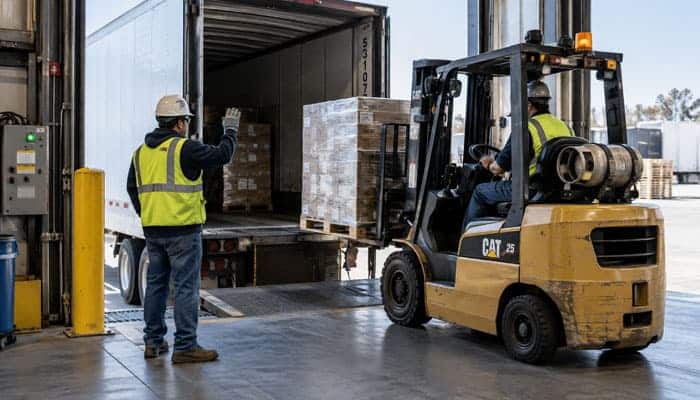
Flatbeds are usually loaded at ground level, using either a forklift or crane. This has some distinctly different safety and staging concerns than backing a dry van up to a loading dock. You want your materials and equipment to be positioned properly so that the loading crew isn’t constantly adjusting the position of heavy cargo once it’s already been lifted on the bed of the trailer.
Forklift drivers need both line of sight and a lift angle that won’t overstress the materials being lifted or the forklift equipment. Often, this isn’t possible with some types of very heavy or oversized loads, and the forklift will be forced to lift from the rear. OSHA also has specific guidelines for this situation because the forklift is lifting above a height that a person would normally be able to jump down from safely.
When it comes to working at trailer height and the recommendations for workers who may need to be several feet off the ground to perform duties of varying complexity, including tarping loads, inspecting loads, or securing a load:
- Guardrails and fall arrest systems are preferred over fall restraint.
- Apply fall protection measures to either prevent workers from falling or to arrest the potential fall.
- Alternatively, provide a forklift cage the worker can be safely secured in while working above ground level.
The Shipper’s Job: Communicate Before The Truck Shows Up
Many on-site delays and safety problems can be linked to a simple oversight: the shipper didn’t inform the carrier of the actual cargo. Dimensions, weight, center of gravity, and any special requirements for securing, loading, or unloading the freight must be known before the truck gets there, not first realized by the driver when he’s handed a load that won’t fit on his trailer.
The responsibility for making this happen falls mainly on the shipper’s shoulders. Carriers can map out the route and arrive with the right securement devices if they are given the proper details. A bill of lading that correctly documents the count, condition, and description of the freight also safeguards everyone in case of any disagreement over what was loaded on the trailer and in what condition it was in when loaded.
The Driver’s Final Checkpoint
Everything upstream – planning, weight distribution, securement, tarping – funnels down to one person who has final responsibility before the truck leaves: the driver. Pre-trip inspection covers tires, brakes, and securement integrity, and it’s not a box-checking exercise. It’s the last chance to catch a problem before it becomes an incident on the highway.
Drivers are also required to re-check tie-downs during transit. Cargo settles, straps stretch, and vibration loosens hardware that seemed tight at the dock. Federal rules require re-inspection within the first 50 miles of a trip and periodically afterward, because load shift often happens early, not at mile 400.
If something has shifted or a securement device has failed, that needs to get documented before the driver signs off on the bill of lading. Signing without noting a problem transfers liability in ways that can get complicated later, especially if damage shows up at delivery.
A Carrier-Vetting Checklist For Shippers
Before you trust a carrier with your flatbed freight, ask yourself the following questions:
- What’s their safety record like? You can usually check public safety ratings and inspection histories; do so.
- How old is their equipment, and are they a stickler for maintenance on a documented schedule? Respectable maintenance can make an old trailer perform like new, but neglect can also make a new trailer perform like a clapped-out beater.
- Do their insurance limits make sense for what you’re shipping (and do they actually have it)? A carrier with minimum liability coverage hauling a load worth 10 times the value of their combined equipment and insurance likely isn’t going to help you collect after an accident.
- Do they have the equipment specialized to your type of freight? There’s no one-size-fits-all flatbed configuration that’s good for machinery moving, tarping and securing loads of raw plastics, and oversized rigs running general freight or foodstuffs.
- Can they tell you exactly what sort of tie-downs they’ll use and where they’ll put them before they arrive? How about how they’ll deal with your tarps, whether your load needs to roll and how they handle and apply that, and what the load stands and end protections will look like?
None of these questions are exotic. They’re just the ones that get skipped when a shipment is booked in a hurry, and they’re almost always the same questions that come up after an incident when someone’s trying to figure out what went wrong.
Flatbed freight rewards preparation and punishes shortcuts. The carriers and shippers who treat planning, securement, and communication as a single connected process – not three separate boxes to check – are the ones who move heavy, awkward, high-value freight without drama. Everyone else finds out the hard way why the rules exist.