



It is 8:15 on a Saturday morning and the dock is already busy. A family is waiting for a self-drive pontoon booked online, a fishing charter is supposed to leave at nine but one deckhand has called out sick, and another customer wants to extend a jet ski rental by an hour. Meanwhile, staff are checking deposits, waivers, fuel logs, and crew messages across three different apps. For operators who recognise that situation, this guide to boat rental and charter software compares the main options available.
Our top pick is EquipDash for operators running bareboat rentals and captained charters side by side because hourly hire and scheduled departures share one calendar. Published pricing starts at $29/month, with a 2% direct-booking fee that drops on higher plans and falls to 0% on OTA bookings. Security deposits, vessel condition reports, maintenance logs, crew scheduling, and waivers are also included. For mixed rental fleets with boats alongside jet skis or other gear, BookingCentral is the strongest alternative. For dry-stack marinas and dispatch-heavy boat clubs, SpeedyDock is the go-to.
We looked at independent marinas, bareboat rental shops, fishing and sightseeing charters, and watersports docks across the US. Each platform was judged on pricing transparency, calendar flexibility, fleet tools, crew and waiver features, and how easy it is to try. Below is our ranked list of the five best options for 2026, along with the type of operator each one fits.
Our selection criteria
The platform with the most features is not necessarily the right choice. Operators need software that matches the way they actually run trips. Here is how we compared each option and why it ranked where it did.
Pricing transparency
We looked for real prices and fees that could be reviewed without booking a demo. Platforms that publish monthly rates and booking fees clearly make it easier to budget before speaking to sales. Hidden quote-only pricing or unclear commission language scored lower because operators cannot estimate their likely cost in advance.
Calendar flexibility
Calendar flexibility is particularly important for hybrid operators. Some tools handle hourly self-drive rentals well but struggle with fixed departure times, while others are designed mainly around scheduled tours. We gave extra credit to systems that support both models without forcing operators to juggle two separate calendars or repeatedly enter the same vessel information.
Fleet and vessel management
Beyond the booking grid, we checked for per-vessel records, condition reports, maintenance logs, and current availability. Whether an operator runs five boats or fifty, staff need to know which hull is ready, which one is undergoing service, and who had it last. These records are especially useful when bookings, maintenance, and customer handovers are managed by different members of the team.
Crew scheduling and digital waivers
For broader workforce context, see Statista’s 2023 US fishing boat charter employee count. We looked for built-in rostering, captain assignment, and waivers that can be collected before arrival rather than treated as paid extras. The aim is to reduce staffing confusion at the dock while giving operators less paperwork to collect and chase.
Ease of onboarding and trial access
Operators should be able to test the software during a real week of bookings. We prioritised self-serve signup, a free trial with no card required, and a setup process that does not depend on a lengthy implementation project. A useful trial should allow staff to configure at least one vessel, take a sample booking, and assess the customer experience before committing.
The 5 best boat rental and charter software platforms for 2026
No single platform wins every category in boat rental and charter software. The right choice depends on whether the business mainly handles hourly rentals, scheduled departures, or a combination of the two. The five options below are best fits for different workflows, with our No. 1 pick ranked as the strongest all-rounder for businesses that combine rentals and charters.
| Provider | Best for | Key strength |
| EquipDash | Operators running bareboat rentals and captained charters side by side | Unified calendar for hourly hire and scheduled departures with low fees |
| BookingCentral | Mixed rental fleets with boats, jet skis and other equipment | Fleet management, waivers and dynamic pricing in one system |
| SpeedyDock | Dry-stack marinas, boat clubs and dispatch-heavy docks | Automated dispatching and real-time fleet tracking |
| WaveRez | Watersport and tour-boat operators needing niche scheduling | Web-based inventory scheduling built for watersport tours |
| CaptainPanel | Fishing charters, scuba and watersports wanting coaching plus software | Booking tools bundled with training and growth support |
#1. EquipDash – Best for operators running bareboat rentals and captained charters side by side
Unified booking for hybrid rental and charter operations in one calendar.
EquipDash earns the top spot because it addresses the split that many docks manage every day. EquipDash lets operators sell hourly bareboat hire and fixed-time captained departures from the same availability grid, helping staff manage vessels used across both types of booking. It provides online booking for direct sales, OTA channel support, and a dockside point of sale for walk-ups, fuel, add-ons, and extensions.
For day-to-day work, the included tools are a major part of the appeal. Security deposit holds and releases, per-vessel condition reports, maintenance and servicing logs, captain and crew rostering, and digital waivers are part of the platform rather than separate add-ons that need to be connected. Staff can check a boat out, record its condition, assign crew, and send a waiver link through the same system. Published pricing starts at $29/month as of 2026, with a 2% direct-booking fee that drops to 1.5% and 1% on higher plans and 0% on OTA bookings, plus a 21-day free trial with no card and no mandatory demo.
Strengths
- Unifies hourly rentals and scheduled charter departures on one shared calendar
- Lowest published direct-booking fee in this comparison at 2%, with reductions on higher plans and 0% on OTA bookings
- Deposits, condition reports, maintenance logs, crew scheduling, and waivers are included rather than sold as extras
- Transparent starting price and self-serve 21-day trial with no card required
- Dockside point of sale and online booking support both advance reservations and walk-up traffic
Trade-offs
- Operators should check whether the available accounting and marketing connections match their existing software
- Public reviews and community documentation are more limited than those of some established general booking tools
- Best suited to rental and charter hybrids, while pure high-volume tour operators may prefer a specialist departure tool
- No proprietary marketplace for distribution, so operators will rely on external OTAs for that channel
Best for: operators running self-drive boats and captained trips from the same dock who want one calendar, one checkout, and one crew list.
#2. BookingCentral – Best for mixed rental fleets with boats, jet skis and other equipment
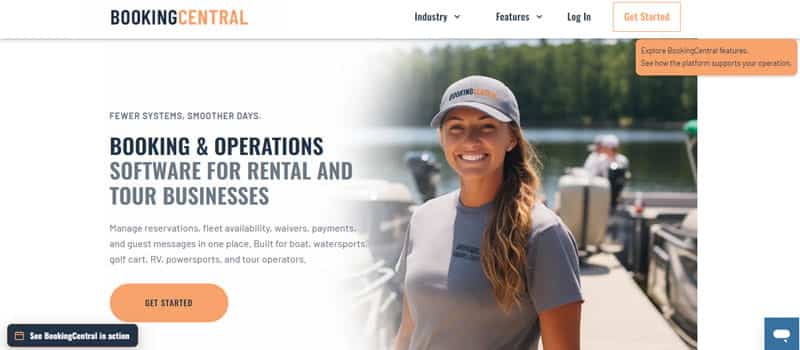
All-in-one booking for diversified rental docks.
BookingCentral is built for operators whose inventory extends beyond boats. A dock that rents pontoons in the morning, jet skis at noon, and golf carts or RVs through another part of the business can manage those reservations in one booking flow. The platform combines online reservations with fleet management tools, digital waiver collection, dynamic pricing, and payment processing, reducing the need to piece together separate apps.
In practice, that breadth can help smaller teams manage several types of inventory. Operators can set different durations, buffers, and prices by equipment type, apply weekend pricing, and keep waivers associated with each reservation. The company is based in Santa Rosa Beach, Florida and focuses on rental operations. As of October 2026, BookingCentral publishes monthly pricing at $0, $39 and $59 per month, alongside a contact-sales plan. Charter-specific scheduling for captained departures is less prominent than its rental tools.
Strengths
- Handles mixed inventories such as boats, jet skis, golf carts, and RVs, as well as tours, in a single platform
- Combines fleet management, waivers, dynamic pricing, and payments in one system
- Built around US rental workflows rather than adapted solely from general appointment software
- Supports operators that need different booking rules across several equipment categories
Trade-offs
- Some pricing is public, while one plan still requires contacting sales, so operators should confirm which tier fits their expected usage
- Prospective customers should confirm support arrangements and response times for peak-season use
- Less specialised for captained charter scheduling than platforms focused on hybrid operations
- Limited independent reviews make it harder to assess fit without a demonstration or trial process
Best for: operators for whom boats are one of several rental lines and who want fleet tools, waivers, and pricing rules in one place.
#3. SpeedyDock – Best for dry-stack marinas, boat clubs and dispatch-heavy docks
Dispatch automation for marinas that move boats throughout the day.
SpeedyDock is designed around forklifts, launch queues, and member requests. It offers online booking for boat rentals, boat clubs, and dry-stack operations, alongside digital payments, automated dispatching, real-time fleet management, and customer request handling. When a member requests a launch, the system can provide status updates by email and text, reducing the amount of time dock staff spend handling routine phone calls.
That focus is reflected in its daily workflow. Dispatchers can see what needs to enter the water, which boats are out, and which are overdue, while owners can receive updates without requiring individual manual messages. It is a marina-focused tool with roots in Auburn, Alabama and operations in Florida, and its dry-stack logic distinguishes it from more general rental software. As of October 2026, SpeedyDock publishes dry-stack pricing from $200 per month, with final pricing varying by business needs, while captained charter or tour-departure features are not its main strength.
Strengths
- Built specifically for dry-stack marinas and boat clubs, an uncommon specialisation among booking platforms
- Automated dispatching reduces manual coordination during busy launch windows
- Real-time fleet tracking and automated owner notifications can reduce repetitive staff tasks
- Marina-focused workflows reflect the way dry-stack docks sequence and monitor launches
Trade-offs
- Operators should confirm whether the available support model suits larger or multi-location marinas
- Pricing can vary because products are customised to the needs of each business, despite the published $200-per-month starting point
- Less suited to captained charters or businesses organised around fixed tour departures
- Its narrow marine focus may provide fewer connections to some general business tools
Best for: dry-stack storage facilities, boat clubs, and high-volume rental docks where dispatch is the main operational bottleneck.
#4. WaveRez – Best for watersport and tour-boat operators needing niche scheduling
Web-based reservations for tour and activity style inventory.
WaveRez is designed for watersport and tour-boat businesses rather than broad equipment rental. Its web-based reservation system combines online booking with inventory management suited to timed activities, capacity limits, and repeat departures. Nothing needs to be installed locally, which can simplify access for seasonal staff working from shared terminals or tablets.
The main advantage is its niche fit. Instead of adapting a generic calendar to parasail slots, snorkel trips, or sightseeing cruises, operators work with a system built around scheduled water activities. The company operates from Destin, Florida and has experience in this market. Pricing is not published, bareboat hourly workflows and dry-stack features are not the emphasis, and public case studies are limited, so operators should use a live walkthrough to test the platform against their actual schedule.
Strengths
- Focused on the watersport and tour-boat niche rather than being a repurposed general rental tool
- Web-based system with no local installation, which can simplify seasonal onboarding
- Designed around the reservation needs of scheduled water activities
- Inventory scheduling supports capacity-based trips and repeat departures
Trade-offs
- No public pricing, so comparing costs with other providers takes additional effort
- Operators with complex requirements should confirm available support and customisation before committing
- Less suited to bareboat hourly rentals or dry-stack marina operations
- Limited public case studies or reviews make long-term results harder to evaluate independently
Best for: operators selling mainly guided water activities who need scheduling organised around departures and capacity.
#5. CaptainPanel – Best for water-based operators wanting software plus coaching support
Booking management bundled with hands-on business help.
CaptainPanel pairs booking software for water-based businesses with in-person training and growth strategy. It serves boat rentals, fishing charters, scuba lessons, and watersports, with customer support tools, payment processing, and accounting helpers presented as a complete suite. For independent captains who also manage marketing, pricing, and hiring, that combination may be as useful as the booking calendar.
Its pitch centres on guided support. Operators can receive help setting up bookable products, refining checkout, and considering repeat business rather than being left to configure the system entirely on their own. That approach suits owner-operators who want an involved provider while they grow. Pricing is not published, verified details about some features are limited, and businesses looking only for lean self-serve software may not need the coaching layer.
Strengths
- Covers varied water businesses, including fishing charters, scuba, rentals, and watersports
- Bundles coaching, training, and growth strategy with its booking tools
- Includes payments and accounting helpers alongside reservation management
- Focused specifically on marine and water-based operators
Trade-offs
- No published pricing to benchmark against the other options in this list
- Operators should confirm support coverage and platform capacity for their particular business size
- The coaching bundle may not suit teams that want software with a fully self-serve setup
- Limited independently verified detail is available on advanced fleet or dispatch features
Best for: operators who want booking software together with coaching on pricing, marketing, and business growth.
Frequently asked questions about boat rental software
1. What is the best app for boat rental businesses to manage bookings and payments?
The best app depends on the operator’s booking mix. Businesses running bareboat rentals and captained trips together should look for a unified calendar, deposit holds, condition reports, and waivers in one system. Mixed fleets with boats and jet skis may benefit more from fleet tools and flexible pricing, while dry-stack facilities should prioritise dispatch and owner notifications. A sensible approach is to shortlist two options and test them with a representative week of bookings before committing.
2. Can one platform handle both bareboat rentals and captained charter departures?
Yes, although many platforms lean towards either hourly rentals or fixed departures. A suitable system should explicitly support both booking types on one calendar, with buffers, crew assignment, and per-vessel availability to help prevent scheduling conflicts around the same boat. Operators should ask for a live demonstration using their own schedule rather than relying on a generic tour of the software.
3. How do security deposit holds work in boat rental software?
Operators set a hold amount for each vessel or trip type, collect card details at booking or check-in, and place a pre-authorisation rather than taking a full charge. After the vessel is returned, staff compare the condition report and checklist before releasing or adjusting the hold to account for applicable fuel, damage, or late fees. State rules vary, so operators should review resources such as the Oregon State Marine Board boat rental business guidance alongside their own policies and waiver language.
4. Is there a Vrbo or Airbnb equivalent for boats and how is it different from charter software?
Peer-to-peer boat marketplaces allow individual owners to list boats for rent in a model similar to vacation rental sites. Dedicated charter software serves a different purpose by managing the operator’s calendar, direct website bookings, deposits, waivers, crew schedules, maintenance logs, and point of sale. Many businesses use marketplaces for discovery while relying on their own booking system to manage policies, direct customers, and repeat guests.
5. How much does boat rental and charter software typically cost per month?
Pricing varies by provider, fleet, feature set, and booking model. Some purpose-built options use a base subscription plus a booking fee, while others provide quote-based pricing or adjust costs according to the selected plan. Operators should ask what counts as a billable booking, whether OTA bookings carry a different fee, and whether waivers, texting, additional users, or other required tools cost extra.
6. Do boat rental software platforms charge a commission on every booking?
Many platforms charge booking fees, but the structure varies. Some apply a percentage to direct website bookings and use a different rate or no platform fee on OTA bookings, in addition to standard card processing. Others combine higher subscriptions with lower percentages. The useful comparison is the effective cost based on the business’s average ticket and booking volume, with all published pricing confirmed for 2026 before signing.
7. Which features matter most for dry-stack marinas and boat clubs?
Launch requests, dispatch queues, real-time boat status, and automated owner updates by text or email should be priorities. Members need a clear way to request a splash, while staff need to sequence launches without repeated phone calls and keep customers informed about delays. Payment collection and rental add-ons can be helpful, but clear dispatch information is the feature most directly tied to a busy dry-stack workflow.
8. How long does it take to get started with a new booking system?
For a small fleet, setup can often move quickly when the required information is ready. Operators should prepare vessel lists, photos, pricing, durations, buffers, waiver text, deposit rules, and crew roles before signup. During a no-card trial, staff can build one vessel from start to finish, take a test booking, capture a waiver, and run a mock checkout. If the complete flow is straightforward for both staff and guests, the remaining fleet can then be added.
How to pick your best fit without overbuying
Choose EquipDash for a business that runs bareboat hire and captained charters and needs one calendar, low direct-booking fees, and included tools for deposits, maintenance, crew, and waivers. BookingCentral is a better fit when revenue spans boats, jet skis, and other rental gear. SpeedyDock suits dry-stack facilities and boat clubs where launch dispatch shapes the working day, while WaveRez is aimed at timed watersport tours. CaptainPanel is the option for operators who value hands-on coaching alongside the software.
For most hybrid docks reading this guide to boat rental and charter software, the starting point is straightforward. Look first for the platform that reduces duplicate work between rental and charter bookings, then consider specialist tools only where a clear gap remains. Testing the preferred option against a live weekend schedule during the 21-day no-card trial will show whether check-in, deposit handling, and departures become easier to manage.
