
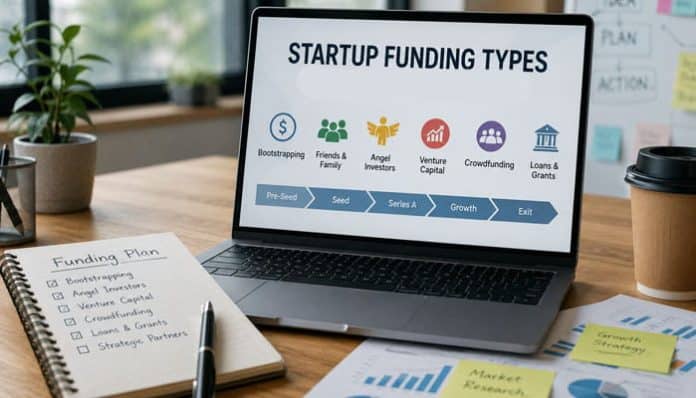

Startup funding types include bootstrapping, customer financing, grants, angel investment, crowdfunding, venture capital, business loans and specialized growth financing. Each option provides money differently and creates distinct financial, legal and operational obligations.
The best source of startup funding is not necessarily the one offering the largest check or highest valuation. It is the option that gives the business enough capital to reach its next meaningful milestone without creating excessive dilution, repayment pressure, legal complexity or loss of control.
A profitable agency may be able to expand through customer revenue and a working-capital line. A biotechnology company, by comparison, may need research grants, strategic partnerships and several equity rounds before commercializing its product.
Understanding the different startup funding types helps founders choose suitable investors, compare the true cost of capital, preserve ownership, avoid unsuitable debt and create a financing strategy that matches the company’s stage and business model.
Quick Answer
The 12 main startup funding types are bootstrapping, friends-and-family funding, customer financing, reward crowdfunding, grants, accelerators, angel investors, SAFEs and convertible notes, equity crowdfunding, venture capital, business loans, and specialized growth financing.
Early-stage startups often use founder capital, grants, customer payments, accelerators, or angel investment. More established startups may use venture capital, bank loans, revenue-based financing, venture debt, or growth equity.
The best option depends on the startup’s stage, capital needs, repayment ability, growth potential, and willingness to give up ownership or control.
Key Takeaways
- Funding types suit different startup stages.
- Bootstrapping preserves ownership but may slow growth.
- Equity funding causes dilution.
- Debt requires interest and repayment.
- SAFEs and notes create future dilution.
- Grants and prepayments carry obligations.
- Funding stages are not funding instruments.
- Compare full terms, not just valuation.
- Raise enough to reach the next milestone.
- Startups may combine several funding sources.
What Are Startup Funding Types?
Startup funding types are the sources and financial structures used to pay for product development, employees, equipment, research, inventory, marketing, regulatory approval, customer acquisition and expansion.
Funding can affect how a company is owned, governed and operated. Founders should therefore distinguish between money that comes from the business, money invested for ownership, money that must be repaid and money provided for specific non-equity purposes.
Startup capital can be organized into five broad categories.
Self-Funding and Internally Generated Capital
Self-funding and internally generated capital include founder contributions, founder loans, personal resources and cash generated through the company’s early operations.
Examples include:
- Personal savings
- Employment income
- Consulting revenue
- Founder loans
- Personal equipment
- Customer revenue
- Profits reinvested into the company
Founder contributions place financial risk on the founders. Customer revenue and reinvested profits, by contrast, are generated through business activity.
These sources preserve ownership and control but may not provide enough money for capital-intensive development.
Equity Financing
Equity financing occurs when investors provide money in exchange for shares or another ownership interest.
Examples include:
- Angel investment
- Common-stock financing
- Preferred-stock financing
- Venture capital
- Equity crowdfunding
- Growth equity
Equity financing does not normally require monthly repayment. However, it reduces the ownership percentage of existing shareholders and may give investors voting, board, information or approval rights.
SAFEs are often discussed alongside equity financing because they can convert into shares later. However, the investor usually does not receive stock immediately.
Convertible or Hybrid Financing
Convertible or hybrid financing begins in one form and may later become equity.
Examples include:
- SAFEs
- Convertible notes
- Debt with warrants
- Other debt instruments with equity-conversion features
A standard SAFE is generally not structured as conventional debt. A convertible note, however, begins as debt and may accrue interest before converting into equity during a future financing.
These instruments can simplify an early fundraising round, but founders must model their conversion carefully.
Debt Financing
Debt financing occurs when the company borrows money and agrees to repay principal, interest and applicable fees.
Examples include:
- Bank loans
- Lines of credit
- SBA-backed loans
- Equipment financing
- Venture debt
- Revenue-based financing
- Invoice financing
- Purchase-order financing
Debt usually preserves founder ownership, but the company must make payments even when revenue is below expectations. Some loans also require collateral, personal guarantees, financial covenants or security interests.
Non-Dilutive Funding
Non-dilutive funding provides capital without requiring the founders to sell ownership.
Examples include:
- Grants
- Research awards
- Customer deposits
- Product pre-orders
- Paid pilot programs
- Competitions
- Tax incentives
- Strategic commercial contracts
In this guide, non-dilutive funding primarily refers to grants, awards and commercial funding that do not require equity. Debt is discussed separately because it creates repayment obligations, even though it normally preserves ownership.
Non-dilutive does not mean obligation-free. Customer prepayments create delivery commitments, while grants may include spending restrictions, milestones, reporting requirements and audits.
Startup Funding Stage vs. Source vs. Instrument
Founders sometimes use terms such as seed funding, angel investment, SAFE and venture capital interchangeably. However, these terms describe different parts of a financing transaction.
| Financing concept | What it describes | Examples |
|---|---|---|
| Funding stage | When capital is raised and which milestone it supports | Pre-seed, seed, Series A, Series B |
| Funding source | Who provides the money | Founder, customer, angel, bank, venture fund |
| Funding instrument | The legal or financial structure | Common stock, preferred stock, SAFE, note, loan |
| Offering pathway | The securities-law route used | Rule 506(b), Rule 506(c), Regulation Crowdfunding |
| Use of funds | What the company intends to accomplish | Prototype, hiring, inventory, expansion |
For example, a startup could complete a seed-stage round funded by several angel investors using post-money SAFEs.
- Seed describes the stage.
- Angel investors describe the source.
- SAFEs describe the instrument.
Another company might raise a Series A round from a venture capital fund by selling preferred stock through a private securities offering.
The stage name does not determine the legal pathway. Under the SEC offering pathways, a company offering stock, SAFEs, convertible notes or other securities must generally register the offering or rely on an available exemption.
Startup Funding Types by Stage Explained
Startup stages describe a company’s maturity, risk, financing needs, and next milestones. The most suitable startup funding types change as the business moves from an idea to a growing or publicly traded company.
| Startup stage | Main objective | Typical funding needs | Common funding types |
|---|---|---|---|
| Idea stage | Validate the problem and customer | Research and prototype development | Bootstrapping, grants, friends and family |
| Pre-seed | Build and test an initial product | Product development and early hires | Pre-sales, accelerators, angels and SAFEs |
| Seed | Establish product-market fit | Product improvement and customer acquisition | Angels, seed funds, SAFEs, notes and crowdfunding |
| Series A | Scale a repeatable business model | Sales, infrastructure and senior hires | Venture capital, strategic investment and venture debt |
| Series B | Expand proven operations | New markets, products and larger teams | Venture capital, growth equity and debt |
| Series C and later | Support major expansion or an exit | Acquisitions and international growth | Growth equity, private credit and strategic capital |
| Public stage | Access public capital | Expansion, acquisitions and liquidity | Registered public offerings |
Idea Stage
At the idea stage, founders have identified a potential customer problem but may have little evidence that people will pay for the solution.
Important milestones include:
- Conducting customer interviews
- Defining the target market
- Testing technical feasibility
- Developing a prototype
- Forming the founding team
The most common startup funding types at this stage are bootstrapping, grants, and friends-and-family funding. Institutional investors rarely finance an undeveloped idea unless the founders have exceptional experience or proprietary technology.
Pre-Seed Stage
A pre-seed startup is usually building a minimum viable product and testing early customer demand.
Investors may evaluate:
- Founder expertise
- Market opportunity
- Product progress
- Pilot commitments
- Early user engagement
Because meaningful revenue may not exist yet, common startup funding types include founder capital, grants, accelerators, angel investment, pre-sales, and SAFEs.
Seed Stage
Seed financing helps a startup improve its product, acquire customers, and establish product-market fit.
Important milestones may include:
- Paying customers
- Recurring revenue
- Strong retention
- Repeatable customer acquisition
- Improving unit economics
The startup funding types used in a seed round may include SAFEs, convertible notes, equity crowdfunding, common stock, or preferred stock. The term “seed” describes the funding stage rather than a specific financial instrument.
Series A Stage
Series A capital generally supports a company that has demonstrated meaningful customer demand and is ready to scale.
Investors may expect:
- A large addressable market
- A repeatable growth channel
- Consistent customer demand
- Improving unit economics
- Reliable performance data
- A capable management team
A Series A is commonly structured as a priced preferred-stock round led by an institutional venture capital investor, although structures can vary.
Series B and Later Stages
Later-stage financing may support:
- Geographic expansion
- New product lines
- Acquisitions
- International hiring
- Manufacturing capacity
- Sales and marketing at scale
At these stages, common startup funding types include venture capital, growth equity, private credit, strategic investment, and venture debt.
As the company matures, investors typically expect stronger financial reporting, governance, security, compliance, and operational controls.
Startup Funding Types Comparison
| Funding type | Best stage | Dilution | Repayment | Main trade-off |
|---|---|---|---|---|
| Bootstrapping | Idea to early revenue | No | No | Full control, limited capital |
| Friends and family | Idea to pre-seed | Sometimes | Sometimes | Easy access, relationship risk |
| Customer financing | Idea to growth | No | Delivery required | Validates demand, creates obligations |
| Reward crowdfunding | Prototype to launch | No | No | Funding plus exposure, fulfillment risk |
| Grants | Research to commercialization | No | Usually no | Preserves ownership, highly competitive |
| Accelerators | Pre-seed to seed | Often | No | Mentorship and capital, equity cost |
| Angel investors | Pre-seed to seed | Yes | No | Expertise and funding, dilution |
| SAFEs and notes | Pre-seed to seed | Future dilution | Varies | Faster funding, conversion complexity |
| Equity crowdfunding | Seed to growth | Yes | No | Broad access, compliance burden |
| Venture capital | Seed to late stage | Yes | No | Large capital, high-growth pressure |
| Business loans | Revenue stage | No | Yes | Preserves equity, repayment risk |
| Growth financing | Growth stage | Sometimes | Usually yes | Extends runway, higher cost |
The 12 Main Startup Funding Types
These startup funding types differ in ownership impact, repayment requirements, availability, and suitability for each business stage.
1. Bootstrapping
Bootstrapping means building a company with founder resources and revenue generated by the business.
Common sources include:
- Personal savings
- Employment or consulting income
- Founder loans
- Personal credit
- Existing equipment
- Customer revenue
- Reinvested profits
Advantages
- Founders retain ownership.
- Decisions do not require investor approval.
- The company develops financial discipline.
- Founders can focus on customers instead of fundraising.
- Later investors may receive evidence of capital efficiency.
Disadvantages
- Growth may be slower.
- Founders carry personal financial risk.
- Limited capital may delay hiring or product development.
- The company may miss time-sensitive opportunities.
Bootstrapping is one of the startup funding types best suited to agencies, consulting firms, online businesses, professional services, and low-cost software products.
It is less suitable for biotechnology, advanced manufacturing, medical devices, and other businesses requiring substantial capital before earning revenue.
2. Friends-and-Family Funding
Friends-and-family funding comes from people who know and trust the founders.
It may be structured as:
- A personal or company loan
- Common or preferred stock
- A SAFE
- A convertible note
A personal gift is different from a company investment and may create separate legal or tax consequences.
Advantages
- Early access to capital
- Flexible negotiations
- Relationship-based trust
- Fewer institutional requirements
Risks
- Investors may underestimate the risk of total loss.
- Financial losses can damage relationships.
- Informal promises may create ownership disputes.
- Poor documentation can complicate future fundraising.
This is one of the most accessible startup funding types, but founders should document the amount, repayment or conversion terms, ownership rights, interest, voting rights, and possible loss.
Stock, SAFEs, and convertible notes may still be securities even when issued to relatives or close friends.
3. Customer Financing and Pre-Sales
Customer financing occurs when buyers provide money before the product or service is fully delivered.
Examples include:
- Product pre-orders
- Customer deposits
- Annual subscriptions paid in advance
- Paid pilot programs
- Implementation fees
- Custom-development contracts
Advantages
- No ownership dilution
- Direct demand validation
- Improved cash flow
- Stronger evidence for future investors
- Less dependence on fundraising
Risks
- The startup must deliver what it promised.
- Delays may cause refunds and reputational damage.
- Custom requests may distract from the main product.
- Production and support costs may be underestimated.
Customer financing is one of the few startup funding types that can provide capital while also proving that customers are willing to pay.
Example
A hardware startup needs $120,000 for production and receives 600 deposits of $200:
600 × $200 = $120,000
The money may still need to cover manufacturing, packaging, shipping, support, refunds, warranties, taxes, and replacement units.
4. Reward-Based Crowdfunding
Reward crowdfunding raises money from many supporters who receive a product, early access, recognition, membership, or another non-financial benefit.
Unlike equity crowdfunding, backers generally do not receive company shares.
Advantages
- Founders preserve ownership.
- The campaign can validate demand.
- It may generate publicity.
- Early supporters may become brand advocates.
- Pre-orders can help finance production.
Disadvantages
- Campaign marketing may be expensive.
- Platforms charge fees.
- The concept becomes visible to competitors.
- Manufacturing and shipping costs may be underestimated.
- Delays can create refund and fulfillment pressure.
Reward crowdfunding works especially well for consumer products, games, books, food products, hardware, creative projects, and community-supported launches.
5. Grants and Non-Dilutive Funding
Grants provide capital for approved projects without requiring founders to sell ownership.
Potential sources include:
- Federal and state programs
- Universities
- Foundations
- Corporate competitions
- Industry organizations
- Export initiatives
- Climate and energy programs
- Research institutions
Government grants generally support specific public objectives such as research, innovation, exporting, manufacturing, or workforce development. They are rarely unrestricted money for starting an ordinary business.
Advantages
- No equity dilution
- No traditional loan repayment
- External validation
- Support for high-risk research
- Greater credibility with investors
Disadvantages
- Applications can be time-consuming.
- Funding decisions may be slow.
- Spending may be restricted.
- Reporting and milestone requirements may apply.
- Some recipients face audits.
Grants are among the least dilutive startup funding types, but they still create compliance and reporting obligations.
SBIR and STTR Funding
The Small Business Innovation Research and Small Business Technology Transfer programs are known collectively as America’s Seed Fund.
Funding generally progresses through:
- Phase I: Proof of concept
- Phase II: Technology development
- Phase III: Commercialization using outside funding
These programs may suit biotechnology, medical research, defense, climate technology, advanced manufacturing, energy, agriculture, scientific software, and university spinouts.
6. Incubators and Accelerators
Incubators and accelerators help early companies develop through mentorship, education, resources, networking, and investor access.
Programs may provide:
- Initial investment
- Mentorship
- Technical support
- Customer introductions
- Investor meetings
- Founder communities
- Demo days
Incubator vs. Accelerator
| Factor | Incubator | Accelerator |
|---|---|---|
| Duration | Flexible | Usually fixed |
| Typical stage | Idea or early stage | Pre-seed or seed |
| Investment | Sometimes | Common |
| Equity required | Sometimes | Often |
| Structure | Flexible support | Intensive program |
Advantages
- Mentorship and education
- Fundraising preparation
- Investor introductions
- Peer support
- Possible investment capital
Disadvantages
- Some programs require equity.
- Quality varies widely.
- Participation may require relocation.
- Program work may distract from customers.
- Some programs receive future investment rights.
Among early-stage startup funding types, accelerators can provide both money and strategic support. Founders should compare investment terms, mentor quality, program results, time requirements, and intellectual-property provisions.
7. Angel Investors
Angel investors are individuals who invest their own money in private companies.
They may include:
- Former founders
- Industry executives
- Professional angel investors
- Technical specialists
- Members of angel groups
- Strategic customers
Angels commonly invest at the pre-seed or seed stage.
Advantages
- Angels may invest earlier than venture funds.
- Decisions can be faster.
- Experienced investors may advise founders.
- They may introduce customers, employees, and later investors.
Disadvantages
- Founders surrender ownership or future equity.
- Some investors may interfere excessively.
- Too many small investors can complicate the cap table.
- Investors may promise support but contribute little.
Angel investment is one of the equity-based startup funding types, so founders should evaluate both the financial terms and the investor’s reputation, experience, network, and working style.
Angels commonly assess:
- Founder quality
- Market opportunity
- Product differentiation
- Early traction
- Scalability
- Competitive advantage
- Use of funds
- Potential financial return
8. SAFEs and Convertible Notes
SAFEs and convertible notes allow startups to raise money before completing a priced equity round.
What Is a SAFE?
SAFE stands for Simple Agreement for Future Equity.
The investor provides money now and may receive shares after:
- A priced financing
- A company sale
- A dissolution
- Another defined conversion event
Common SAFE terms include:
- Valuation cap
- Discount
- Most-favored-nation rights
- Pro rata rights
- Liquidity-event treatment
What Is a Convertible Note?
A convertible note is debt that may convert into equity during a future financing.
Common terms include:
- Principal
- Interest
- Maturity date
- Valuation cap
- Conversion discount
- Qualified-financing threshold
SAFE vs. Convertible Note
| Feature | SAFE | Convertible note |
|---|---|---|
| Initially debt | Generally no | Yes |
| Interest | Usually no | Usually yes |
| Maturity date | Usually no | Usually yes |
| Future conversion | Yes | Yes |
| Documentation | Often simpler | More detailed |
SAFEs and notes are startup funding types that can postpone a full valuation negotiation, but they may create significant future dilution.
Founders should model how every instrument converts after a priced round, option-pool expansion, and additional investment.
9. Equity Crowdfunding
Equity crowdfunding allows a startup to raise money online from multiple investors in exchange for securities.
Possible instruments include:
- Common stock
- Preferred stock
- SAFEs
- Convertible notes
- Debt securities
Advantages
- Access to a broad investor population
- Customers can become shareholders
- Increased brand visibility
- Stronger community engagement
- Potential support alongside angel investment
Disadvantages
- Legal and accounting expenses
- Platform fees
- Public disclosures
- Reporting obligations
- Marketing costs
- A potentially complicated investor base
Equity crowdfunding is one of the regulated startup funding types because the company is offering securities rather than products or rewards.
Under Regulation Crowdfunding, an eligible U.S. company may raise up to $5 million during a rolling 12-month period through a registered broker-dealer or funding portal.
It may suit startups with an engaged customer base, a clear public story, understandable products, strong community support, and enough resources to manage compliance.
10. Venture Capital
Venture capital funds invest pooled money in companies with strong growth and return potential.
VC investments commonly involve preferred stock and may include:
- Board representation
- Liquidation preferences
- Protective provisions
- Pro rata rights
- Information rights
- Anti-dilution protection
- Founder vesting
- Approval rights
Common VC Stages
- Pre-seed
- Seed
- Series A
- Series B
- Series C
- Growth stage
Advantages
- Access to substantial capital
- Strategic and operational support
- Recruiting assistance
- Customer introductions
- Follow-on financing
- Increased credibility
Disadvantages
- Founder dilution
- Reduced control
- Board oversight
- Pressure for rapid growth
- Complex legal documentation
- Expectations of a substantial exit
Venture capital may be unsuitable for companies with limited markets, modest growth plans, low capital requirements, or founders who prioritize long-term control.
A profitable business can still be a poor venture investment when its potential outcome is too small for the fund’s return model.
11. Business Loans and SBA-Backed Financing
Business loans provide capital that must be repaid with interest and fees.
Possible sources include:
- Banks
- Credit unions
- Community-development lenders
- Online lenders
- Equipment lenders
- SBA-approved lenders
- Microloan intermediaries
Advantages
- Founders usually retain ownership.
- Payments may be predictable.
- Loans can fund equipment and inventory.
- Debt may cost less than equity when the business succeeds.
- Credit lines can support working capital.
Disadvantages
- Repayment continues even when revenue slows.
- Personal guarantees may be required.
- Collateral may be required.
- Interest and fees reduce cash flow.
- Pre-revenue companies may not qualify.
Business loans are startup funding types best suited to companies with predictable revenue, stable margins, strong credit, established customers, and a clear repayment source.
SBA 7(a) Loans
The SBA 7(a) program can support:
- Working capital
- Equipment
- Real estate
- Furniture and supplies
- Business acquisitions
- Eligible refinancing
The maximum individual 7(a) loan is $5 million.
Effective July 4, 2026, eligible borrowers may combine up to $5 million in 7(a) financing with up to $5 million in 504 financing, for a possible combined maximum of $10 million.
Approval is not automatic. Underwriting, eligibility, lender requirements, and permitted-use rules still apply.
SBA Microloans
SBA Microloans provide up to $50,000 through approved intermediary lenders.
Funds may support:
- Working capital
- Inventory
- Supplies
- Equipment
- Furniture and fixtures
12. Specialized Growth Financing
Established startups may qualify for financing based on revenue, invoices, assets, customer orders, or venture backing.
Venture Debt
Venture debt is primarily designed for venture-backed startups.
It may be used:
- After an equity round
- To extend runway
- To purchase equipment
- To finance working capital
- To reach a major milestone
- To delay another equity round
Terms may include interest, fees, covenants, security interests, warrants, minimum cash requirements, and prepayment provisions.
Venture debt can reduce immediate dilution but becomes risky when the company lacks a credible repayment or refinancing plan.
Revenue-Based Financing
Revenue-based financing links repayment to company revenue.
The company may pay a percentage of monthly revenue until an agreed repayment amount is reached.
It may suit businesses with:
- Predictable recurring revenue
- Strong margins
- Consistent customer payments
- Measurable acquisition returns
- Limited desire to sell equity
It is generally unsuitable for pre-revenue businesses or companies with highly volatile sales.
Invoice Financing
Invoice financing allows a business to borrow against eligible unpaid customer invoices.
Founders should compare:
- Advance rates
- Fees
- Recourse provisions
- Customer-notification rules
- Effective annual cost
Purchase-Order Financing
Purchase-order financing helps a company pay suppliers when it has a confirmed customer order but insufficient working capital.
Equipment Financing
Equipment financing funds machinery, computers, vehicles, production equipment, and other productive assets. The financed asset often secures the loan.
When comparing startup funding types, founders should consider ownership dilution, repayment pressure, legal obligations, funding speed, strategic value, and the milestone the capital must achieve.
What Is a Priced Equity Round?
A priced equity round is a financing in which a startup and its investors agree on the company’s valuation and share price before the investment closes.
Unlike SAFEs, priced equity rounds immediately establish:
- The class and price of shares
- The investor’s ownership percentage
- Pre-money and post-money valuations
- Voting and board rights
- Liquidation and conversion rights
Among the main startup funding types, priced rounds are commonly used for institutional seed, Series A, and later financings. Founders and employees usually hold common stock, while investors often receive preferred stock with additional economic or governance rights.
Simple Priced-Round Example
Assume:
- Pre-money valuation: $8 million
- New investment: $2 million
- Post-money valuation: $10 million
The investor receives:
$2 million ÷ $10 million = 20% ownership
Existing shareholders retain 80% before considering SAFEs, convertible notes, warrants, or option-pool expansion.
SAFE vs. Priced Equity Round
| Factor | SAFE | Priced equity round |
|---|---|---|
| Share price set immediately | Usually no | Yes |
| Investor receives stock immediately | Usually no | Yes |
| Typical security | Future equity right | Preferred stock |
| Documentation | Simpler | More extensive |
| Governance rights | Usually limited | Negotiated at closing |
| Common use | Early fundraising | Seed and later rounds |
Priced rounds generally cost more to complete than SAFEs, but they provide greater clarity about ownership, investor rights, and the company’s capitalization.
U.S. Securities-Law Pathways for Startup Funding
When a startup offers stock, SAFEs, convertible notes or other securities, the transaction must generally be registered with the SEC or qualify for an exemption.
The name of the round does not determine the exemption.
| Offering pathway | General federal limit | Public advertising | Important requirement |
|---|---|---|---|
| Rule 506(b) | No federal offering cap | Generally prohibited | Investor-participation restrictions apply |
| Rule 506(c) | No federal offering cap | Permitted | Purchasers must be accredited and reasonably verified |
| Rule 504 | $10 million in 12 months | Permitted only in limited circumstances | Federal and state requirements may apply |
| Regulation Crowdfunding | $5 million in a rolling 12-month period | Limited to the permitted process | Registered intermediary required |
| Regulation A Tier 1 | $20 million in 12 months | Permitted | SEC qualification and state requirements |
| Regulation A Tier 2 | $75 million in 12 months | Permitted | Audited financials and ongoing reports generally required |
| Registered public offering | No general federal offering limit | Permitted | Registration and public-company obligations |
The SEC currently lists a $10 million limit for Rule 504, $5 million for Regulation Crowdfunding, $20 million for Regulation A Tier 1 and $75 million for Regulation A Tier 2.
Rule 506(b)
Rule 506(b) generally prohibits general solicitation. It can permit sales to accredited investors and, subject to additional requirements, a limited number of sophisticated non-accredited investors.
Rule 506(c)
Rule 506(c) permits general solicitation, but purchasers must be accredited investors and the issuer must take reasonable steps to verify their accredited status.
Rule 504
Rule 504 allows an eligible company to raise up to $10 million during a 12-month period. State securities-law requirements may also apply.
Regulation Crowdfunding
Regulation Crowdfunding permits an eligible issuer to raise up to $5 million in a rolling 12-month period through an SEC-registered intermediary. The SEC calculates the limit on a rolling basis from the date of each closing.
Regulation A
Regulation A provides two tiers:
- Tier 1: Up to $20 million in 12 months
- Tier 2: Up to $75 million in 12 months
Tier 2 generally requires audited financial statements and ongoing reports.
Form D
Companies relying on Rule 506(b), Rule 506(c) or Rule 504 generally must file Form D within 15 days after the first sale.
Federal exemptions do not necessarily eliminate state notice filings, fees, antifraud requirements or other obligations. Founders should obtain qualified securities counsel before marketing or accepting an investment.
Equity vs. Debt vs. Non-Dilutive Funding
| Factor | Equity funding | Debt funding | Non-dilutive funding |
|---|---|---|---|
| Ownership surrendered | Yes | Usually no | No |
| Scheduled repayment | Usually no | Yes | Usually no |
| Primary cost | Dilution and investor rights | Interest, fees and repayment | Compliance or delivery obligations |
| Qualification basis | Growth and return potential | Credit and repayment ability | Program or customer requirements |
| Provider involvement | Often significant | Usually limited | Varies |
| Best use | High-growth expansion | Predictable return-producing uses | Research, validation and development |
| Examples | Angels, VC, equity crowdfunding | Loans and venture debt | Grants and customer prepayments |
When Equity May Be Better
Equity may be more suitable when:
- The startup is pre-revenue.
- Cash flow cannot support repayments.
- Significant capital is required before launch.
- The market opportunity is large.
- The company could scale rapidly.
- Investors can provide strategic support.
- The founders accept dilution and oversight.
When Debt May Be Better
Debt may be more suitable when:
- Revenue is predictable.
- The company can make payments under conservative assumptions.
- The use of funds has a measurable return.
- Founders want to preserve ownership.
- The company has assets, invoices or contracts.
- The business does not fit a venture-capital return model.
When Non-Dilutive Funding May Be Better
Non-dilutive funding may be preferable when:
- The startup qualifies for grants.
- Customers will pay before delivery.
- The research supports a government or institutional objective.
- A relatively small amount can unlock an important milestone.
- Founders want to validate demand before selling shares.
How Term Sheets Affect the Real Cost of Startup Funding
A term sheet outlines the main financial and control terms of an investment. When comparing startup funding types, founders should examine the complete offer—not only the valuation.
A higher valuation may still be unattractive if the investor receives stronger liquidation, board, or approval rights.
Important Term-Sheet Provisions
| Term | What founders should examine |
|---|---|
| Valuation | Company value before and after the investment |
| Security type | Preferred stock, common stock, SAFE, note, or debt |
| Liquidation preference | Amount investors receive before common shareholders |
| Board composition | Who controls or appoints board seats |
| Protective provisions | Decisions requiring investor approval |
| Pro rata rights | Right to invest in future rounds |
| Anti-dilution protection | Investor protection during lower-priced rounds |
| Option pool | Whether employee equity dilutes existing shareholders |
| Founder vesting | Whether founder shares remain subject to vesting |
| Information rights | Reports the company must provide |
Liquidation-Preference Example
Assume an investor contributes $2 million for 20% ownership and receives a 1x non-participating liquidation preference.
If the company sells for $8 million, the investor compares:
- Preference: $2 million
- Conversion value: 20% of $8 million, or $1.6 million
The investor would normally take the $2 million preference.
If the company sells for $20 million, the investor’s 20% conversion value would be $4 million, so conversion would usually provide the better return.
Option-Pool Effect
An investor may require the startup to expand its employee option pool before closing. When the pool is added to the pre-money capitalization, founders and existing shareholders usually absorb most of the dilution.
Founders should model:
- SAFE and note conversion
- Option-pool expansion
- New investor ownership
- Post-financing ownership
- Future dilution
The real cost of startup funding types depends on valuation, dilution, control rights, liquidation terms, and future financing effects. Founders should therefore compare the entire term sheet rather than choosing an offer based only on valuation.
How Is a Startup Valuation Determined?
A startup valuation estimates the company’s value during an investment transaction. Because early-stage companies may have limited revenue or profit, valuations often depend on traction, market size, comparable deals, investor demand, and future growth potential.
Valuation also affects the cost of equity-based startup funding types, including angel investment, SAFEs, and venture capital.
Comparable-Company Method
The startup is compared with similar companies based on factors such as:
- Revenue and growth
- Gross margin
- Customer retention
- Market size
- Funding stage
- Recent financing deals
Revenue-Multiple Method
A revenue-generating company may be valued by applying a negotiated multiple to annual revenue or annual recurring revenue.
Example:
- Annual recurring revenue: $1.5 million
- Valuation multiple: 6
Estimated value: $1.5 million × 6 = $9 million
The multiple may change based on growth, margins, retention, customer concentration, competition, and market conditions.
Venture Capital Method
An investor estimates a possible future exit value and works backward based on:
- Expected return
- Exit timing
- Future revenue
- Additional dilution
- Financing needs
- Business risk
Scorecard Method
Pre-revenue startups may be compared with similar companies using:
- Founder experience
- Market opportunity
- Product progress
- Customer evidence
- Competitive advantage
- Intellectual property
Milestone-Based Valuation
A startup’s value may increase after it:
- Launches a working product
- Gains paying customers
- Demonstrates retention
- Proves unit economics
- Obtains regulatory approval
- Protects intellectual property
When evaluating equity-based startup funding types, founders should remember that valuation is a negotiated financing figure. It is not cash available to the founders and does not guarantee the company can be sold for that amount.
Best Startup Funding Types by Business Model
| Business model | Suitable early funding | Possible later funding | Main concern |
|---|---|---|---|
| SaaS startup | Bootstrapping, angels, accelerators and SAFEs | VC, revenue financing and venture debt | Churn and acquisition efficiency |
| Consumer product | Pre-sales, crowdfunding and angels | Inventory financing and VC | Manufacturing and returns |
| Marketplace | Angels, seed funds and SAFEs | VC and strategic investment | Supply-and-demand liquidity |
| Agency | Bootstrapping and customer deposits | Line of credit or SBA loan | Founder dependence |
| Hardware startup | Grants, pre-orders and angels | VC and equipment debt | Production and working capital |
| Biotechnology | Grants, university support and angels | Life-science VC and partnerships | Regulation and long timelines |
| Climate technology | Grants, pilots and project partners | Specialized VC and infrastructure capital | Capital intensity |
| Local retail | Founder capital and friends and family | Bank or SBA financing | Location and repayment risk |
| E-commerce | Bootstrapping, pre-sales and angels | Inventory or revenue financing | Advertising costs and returns |
| Mobile application | Bootstrapping, accelerators and angels | Seed VC and strategic capital | Retention and monetization |
This table is a starting point rather than a fixed rule.
A profitable SaaS company may never need venture capital. A capital-intensive consumer-product company may require institutional equity before launching.
How to Choose the Right Startup Funding Type
Choosing between startup funding types requires more than comparing interest rates or valuations. Founders should evaluate the company’s stage, funding purpose, repayment ability, ownership impact, and long-term growth plan.
1. Define the Use of Funds
Avoid vague goals such as “growth.” Identify exactly what the money will finance, such as:
- Completing a prototype
- Hiring key employees
- Obtaining regulatory approval
- Producing inventory
- Acquiring customers
- Entering a new market
- Reaching break-even
A clear use-of-funds plan helps determine the right amount and financing structure.
2. Identify the Next Milestone
Capital should help the startup reduce risk or increase its value.
Important milestones may include:
- Product launch
- Paid pilot completion
- Regulatory clearance
- Paying customers
- Strong retention
- Repeatable sales
- Positive unit economics
The best startup funding types are those that provide enough runway to reach the next measurable milestone.
3. Evaluate Repayment Capacity
Before choosing debt, test whether the company can make payments under conservative assumptions.
Consider:
- Revenue and gross margin
- Operating expenses
- Existing liabilities
- Customer concentration
- Seasonality
- Cash reserves
- Churn and payment delays
Do not rely only on optimistic financial forecasts.
4. Model Ownership Dilution
Suppose an investor contributes $1 million at a $4 million pre-money valuation.
Post-money valuation: $4 million + $1 million = $5 million
Investor ownership: $1 million ÷ $5 million = 20%
Existing shareholders retain 80% before SAFEs, notes, warrants, or option-pool expansion are included.
5. Consider the Growth Model
Ask:
- Is the market large enough for venture capital?
- Is rapid growth necessary?
- Can the startup grow through revenue?
- Would slower, profitable growth produce a better outcome?
- Does the business need capital before earning revenue?
Venture capital may suit a scalable company pursuing a large market, while loans or bootstrapping may better serve a smaller profitable business.
6. Compare the Full Cost
For debt, examine:
- Interest and fees
- Total repayment
- Collateral
- Personal guarantees
- Prepayment penalties
For equity, examine:
- Ownership dilution
- Liquidation preferences
- Board and voting rights
- Anti-dilution provisions
- Founder vesting
- Option-pool treatment
Equity has no scheduled repayment, but it can become expensive if the company achieves a major exit.
7. Consider Speed and Complexity
Some startup funding types, such as founder capital and customer deposits, may be available quickly.
Venture capital and grants may require:
- Applications or investor outreach
- Multiple meetings
- Due diligence
- Term-sheet negotiations
- Legal documents
- Regulatory filings
Founders should begin preparing before cash becomes critically low.
8. Assess Strategic Value
A suitable investor may provide:
- Customer introductions
- Recruiting support
- Industry expertise
- Regulatory knowledge
- Follow-on funding
- Strategic partnerships
Founders should check investor references and speak with other portfolio companies before accepting an offer.
Startup Funding Selection Scorecard
Rate each option from 1 to 5.
| Selection factor | Weight | Score |
|---|---|---|
| Fit for the current stage | 20% | |
| Amount available | 15% | |
| Cost of capital | 15% | |
| Ownership impact | 15% | |
| Repayment risk | 10% | |
| Funding speed | 10% | |
| Strategic value | 10% | |
| Legal burden | 5% |
Multiply each score by its weighting and compare the totals.
The right choice among startup funding types should provide enough capital to reach the next milestone without creating excessive dilution, repayment pressure, or loss of control.
How Much Startup Funding Should You Raise?
The funding target should be connected to runway and a measurable milestone.
A basic formula is:
Funding required = projected net cash burn until milestone + one-time costs + contingency reserve
Funding Requirement Example
Assume:
- Monthly net cash burn: $80,000
- Required runway: 18 months
- One-time launch and equipment costs: $120,000
- Contingency reserve: 15%
Runway requirement:
$80,000 × 18 = $1,440,000
Add one-time costs:
$1,440,000 + $120,000 = $1,560,000
Add the contingency reserve:
$1,560,000 × 1.15 = $1,794,000
The initial planning target would be approximately $1.79 million.
The founders should then determine whether that amount is realistic for the company’s stage, valuation, investor market and financing structure.
Risks of Raising Too Little
Raising too little may:
- Force the company to fundraise again too soon.
- Weaken negotiating leverage.
- Prevent the startup from reaching its milestone.
- Distract founders from customers.
- Create an emergency financing situation.
Risks of Raising Too Much
Raising too much may:
- Cause unnecessary dilution.
- Encourage uncontrolled spending.
- Increase investor expectations.
- Create an unsustainable valuation.
- Reduce operating discipline.
- Increase the risk of a future down round.
The objective is to finance the next stage adequately, not simply maximize the amount raised.
How the Startup Fundraising Process Works
Selecting the funding type is only the first step. Founders must prepare the company, identify suitable capital providers, complete due diligence, negotiate terms and close the transaction.
Step 1: Establish Funding Readiness
Determine:
- How much capital is required
- Which milestone the capital will finance
- How long the money should last
- Which funding structure fits the company
- What evidence supports the business case
- What ownership, rights or guarantees the founders will accept
Before approaching investors, resolve major founder disputes, document existing securities and ensure intellectual property has been assigned to the company.
Step 2: Build a Target List
Filter potential investors or lenders by:
- Industry
- Startup stage
- Typical investment or loan size
- Lead or follow-on role
- Portfolio conflicts
- Financing structure
- Follow-on capacity
A focused list is generally more effective than sending the same message to hundreds of unsuitable capital providers.
Step 3: Prepare Fundraising Materials and the Data Room
Prepare:
- Pitch deck
- Executive summary
- Financial model
- Capitalization table
- Use-of-funds plan
- Product demonstration
- Customer evidence
- Organized data room
The pitch should explain:
- Customer problem
- Proposed solution
- Market opportunity
- Business model
- Financial position
- Funding request
- Planned use of capital
The data room may include:
Corporate and Legal Documents
- Formation documents
- Bylaws or operating agreement
- Board minutes
- Shareholder approvals
- Founder stock agreements
- Intellectual-property assignments
- SAFE and convertible-note records
- Material contracts
- Employment and contractor agreements
- Licenses and permits
- Litigation disclosures
Financial Documents
- Historical financial statements
- Financial projections
- Cash-flow forecast
- Burn-rate calculation
- Revenue assumptions
- Unit-economics analysis
- Debt schedule
- Bank statements
- Tax returns, when requested
Traction Evidence
- Revenue reports
- Customer contracts
- Sales pipeline
- Retention data
- Product-usage information
- Customer-acquisition cost
- Customer lifetime value
- Churn
- Pilot results
- Letters of intent
Step 4: Begin Outreach
Founders may use:
- Warm introductions
- Targeted direct outreach
- Accelerators
- Industry events
- Angel networks
- Crowdfunding platforms
- Professional advisers
- Existing customers and partners
Publicly advertising an investment can affect which securities exemption is available. Founders should obtain legal advice before publicly marketing a private financing.
Step 5: Hold Initial Meetings
Equity investors commonly evaluate:
- Founder experience and commitment
- Market size
- Product differentiation
- Customer demand
- Revenue growth
- Retention
- Unit economics
- Competitive advantage
- Scalability
- Exit potential
- Capital efficiency
- Legal and capitalization-table accuracy
Lenders focus more heavily on:
- Revenue history
- Cash flow
- Credit profile
- Existing liabilities
- Collateral
- Business age
- Customer concentration
- Repayment capacity
- Personal guarantees
- Use of funds
Investors focus primarily on potential upside. Lenders focus primarily on repayment probability.
Founders should also evaluate the capital provider’s reputation, working style, conflicts, decision-making process and capacity to support future financing.
Step 6: Complete Due Diligence

Due diligence may cover:
- Corporate records
- Financial statements
- Intellectual property
- Customer contracts
- Employment arrangements
- Tax records
- Regulatory compliance
- Capitalization table
- Existing securities
- Litigation
- Cybersecurity
- Data privacy
Incomplete records, undocumented promises or intellectual-property gaps can delay or prevent the financing.
Step 7: Negotiate the Term Sheet
Compare:
- Valuation
- Dilution
- Liquidation preference
- Board rights
- Protective provisions
- Option-pool treatment
- Pro rata rights
- Founder vesting
- Future financing consequences
The preferred offer should be evaluated as a complete package rather than by valuation alone.
Step 8: Complete Legal Documentation
Final documents may include:
- Stock-purchase agreement
- Investors’ rights agreement
- Voting agreement
- Amended certificate of incorporation
- Right of first refusal and co-sale agreement
- SAFE or convertible-note agreement
- Loan agreement
- Security agreement
- Board approvals
- Shareholder approvals
Step 9: Close and Manage Investor Relations
After closing:
- Update the capitalization table.
- Record the transaction accurately.
- Complete required filings.
- Track investor and lender rights.
- Monitor spending against the approved plan.
- Provide agreed reports.
- Hold required board meetings.
- Prepare for the next milestone.
When to Avoid Outside Funding and Common Mistakes
External funding is not automatically evidence of success. In some circumstances, raising capital can create more problems than it solves.
When a Startup May Not Be Ready
A company may not be ready to raise when:
- The founders cannot explain how the money will be used.
- The product or problem has not been validated.
- Founder or ownership disputes remain unresolved.
- Intellectual property has not been assigned to the company.
- Financial records are incomplete or unreliable.
- The cap table contains undocumented promises.
- The market is too limited for the targeted investor.
- Debt repayment depends on unrealistic projections.
- The money would cover losses without addressing their cause.
- The founders are unwilling to accept dilution or oversight.
- Customer revenue could finance the next important milestone.
Common Startup Funding Mistakes
- Raising money without a clear milestone
- Focusing only on the company valuation
- Ignoring dilution from SAFEs and convertible notes
- Taking debt without a realistic repayment plan
- Using informal agreements with friends and family
- Assuming grants have no restrictions
- Waiting too long to begin fundraising
- Using short-term financing for long-term development
- Accepting money from an unsuitable investor
- Failing to maintain an accurate capitalization table
- Raising more money than the startup actually needs
- Ignoring legal, tax, and reporting obligations
Questions to Ask Before Raising
- What measurable result will this capital produce?
- Could customer revenue finance part of the plan?
- What happens if the next round is delayed?
- Can the company repay debt under a conservative forecast?
- How much ownership remains after all securities convert?
- Does the investor’s return model fit the company?
- Would slower growth create a stronger business?
- Is the company prepared for due diligence?
- Are the founders aligned on the financing strategy?
- Is outside capital necessary at this stage?
Can a Startup Use Multiple Funding Types?
Yes. Many startups combine several funding sources to reduce dilution and fund different business needs.
Example Funding Path
A technology startup might use:
- $50,000 from founders
- $40,000 from customer pilots
- A $200,000 research grant
- Accelerator support
- $500,000 from angel investors
- A $2 million seed round
- Venture debt for additional runway
The company must still track dilution, debt repayments, grant restrictions, investor rights, conversion terms, and reporting obligations.
Using multiple startup funding types provides flexibility but also increases legal and financial complexity.
Startup Funding Scams and Red Flags
Founders seeking capital may encounter fraudulent lenders, fake grant providers, misleading brokers and identity-theft schemes. The FTC financing scam guidance warns that scammers may promise guaranteed financing and demand an advance fee before providing a loan that never arrives.
Watch for a financing provider that:
- Guarantees approval without examining the business
- Demands unusual advance fees before releasing funds
- Promises guaranteed government grants
- Requests payment through gift cards or cryptocurrency
- Refuses to provide complete written terms
- Hides the total repayment cost
- Pressures the founder to sign immediately
- Falsely claims government affiliation
- Requests banking information through an unsolicited message
- Encourages the founder to provide false information
- Avoids explaining liens or guarantees
- Requires payment in exchange for a guaranteed loan
How to Verify a Funding Provider
Before signing an agreement or transferring money:
- Verify the legal company name.
- Confirm applicable registrations or licenses.
- Research enforcement actions and complaints.
- Review the complete agreement.
- Calculate the total financing cost.
- Confirm whether a lien is required.
- Confirm whether a personal guarantee is required.
- Verify payment instructions directly.
- Consult an independent lawyer or adviser.
- Never provide false application information.
Startup Funding Types FAQs
1. Which Funding Option Is Best for a New Startup?
The best choice among startup funding types depends on the company’s stage, capital requirements, revenue potential, industry, and willingness to give up ownership.
2. Can a Startup Raise Money Without Selling Equity?
Yes. Non-dilutive startup funding types include bootstrapping, grants, customer prepayments, reward crowdfunding, and certain business loans.
3. When Should a Startup Use a SAFE?
A SAFE may suit an early company that wants to raise capital before completing a priced equity round. Among startup funding types, SAFEs are simpler but can create future dilution.
4. Can a Pre-Revenue Startup Get a Business Loan?
It is possible but difficult. Debt-based startup funding types usually require strong credit, collateral, a personal guarantee, or another credible repayment source.
5. How Does the Funding Stage Affect the Funding Choice?
Idea-stage companies often use founder capital or grants, while growth-stage businesses may use venture capital or debt. Suitable startup funding types change as the company matures.
6. Is Crowdfunding Suitable for Every Startup?
No. Crowdfunding works best for businesses with an understandable product and an engaged audience. These startup funding types also require marketing, compliance, and campaign management.
7. Can a Startup Combine Grants and Investor Funding?
Yes. A company may use grants for approved research and equity for hiring or expansion. Combining startup funding types can reduce dilution and spread financial risk.
8. What Should Founders Compare Before Accepting Funding?
Founders should compare dilution, repayment costs, investor rights, legal requirements, funding speed, and strategic value. The cheapest-looking startup funding types may not offer the best overall terms.
Conclusion
Choosing among startup funding types is one of the most important financial decisions a founder will make.
Every source of capital creates obligations:
- Equity creates dilution and investor rights.
- Convertible instruments create future dilution and possible conversion complexity.
- Debt creates interest and repayment pressure.
- Grants create compliance requirements.
- Customer financing creates delivery commitments.
- Bootstrapping places financial risk on the founders.
The right strategy should match the company’s stage, business model, growth potential, cash flow, capital requirements and long-term objectives.
Founders should identify the milestone they need to reach, calculate the required capital and compare the complete consequences of each option. The decision should account for dilution, repayment, investor rights, security interests, legal requirements and future financing effects—not only the amount offered.
A carefully structured combination of founder capital, customer revenue, non-dilutive programs, equity financing and responsibly selected debt can help a startup grow without surrendering unnecessary ownership or creating unmanageable financial pressure.