

You run a lean shop in the Sunshine State—maybe a beach-side café in Miami or a five-person tech startup in Tampa—and the talent war is heating up. Pay alone no longer seals the deal; a retirement plan does. Yet 4.3 million Floridians, roughly six in ten private-sector workers, still lack any workplace savings option.
SECURE 2.0 now foots most startup costs with richer tax credits, higher contribution limits, and bonuses for auto-enrollment and catch-ups. In short, Washington will help you launch a 401(k) that doubles as a recruiting magnet.
Ready? Let’s protect paychecks and futures at the same time.
How we built the scorecard
Choosing a 401(k) vendor is part math, part gut check. We leaned on the math first.
We gathered fee schedules, SEC Form 5500 filings, and third-party reviews for eight national providers. Then we ran every number through the same scenario: a 10-employee plan with $500 k in assets. That baseline let us compare dollars to dollars instead of marketing spin.
They further recommend repeating that benchmarking at least once a year—part of their ongoing plan-management checklist—so rising assets don’t quietly inflate percentage-based fees.
Price was not the only yardstick, though. We weighted five factors the way a Florida small-business owner typically does at budget time:
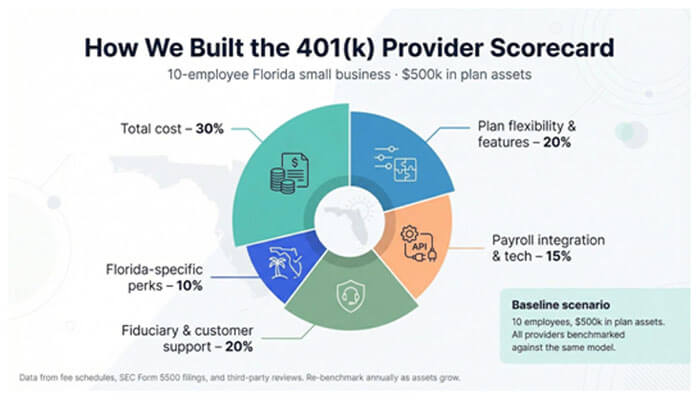
- Total cost (30 percent): startup fees, ongoing admin, and average fund expenses
- Plan flexibility & features (20 percent): Roth, Safe Harbor, auto-enroll, and 2026-ready catch-ups
- Payroll integration & tech (15 percent): true API sync versus manual file uploads
- Fiduciary and customer support (20 percent): who signs the 5500 and who answers the phone when the IRS letter lands
- Florida-specific perks (10 percent): bilingual materials, in-state reps, and disaster-recovery safeguards for hurricane season
Finally, we skimmed user reviews and J.D. Power digital-experience scores to sanity-check our spreadsheet. Providers that scored high across the board made the Top 5, while those that stumbled on any major category, such as hidden asset charges, no Roth option, or zero local support, stayed on the bench.
Now that you know the rules of the game, let’s meet the winners.
1. Guideline — the low-cost automation ace
Guideline thinks like a startup: strip out extras, automate, and return the savings to you.
Cost sits in the lightweight class. You pay no setup fee. Core pricing is eighty-nine dollars a month plus eight dollars per employee, plus an asset fee of one quarter percent. In our 10-person, five-hundred-thousand-dollar scenario, the annual bill lands near three thousand three hundred dollars, a figure most owners erase with SECURE 2.0 credits.
The standout feature arrives on payday. Guideline connects to more than forty payroll systems—Gusto, QuickBooks, Rippling, and others—so contributions move automatically. No file exports, no late-deposit letters from the Department of Labor.
Employees pick from a curated list of Vanguard and BlackRock index funds and age-based target-date portfolios. Guideline serves as the named 3(38) fiduciary for those choices, easing liability if markets stumble. Starting at age fifty, employees can turbo-charge their nest egg with tax-advantaged catch-up contributions that stack on top of regular deferrals. Guideline already supports those deposits alongside loans, Roth, and Safe Harbor.
What Guideline skips is hand-holding. Support runs through email or chat during business hours, and there is no Florida office. If you prefer a local rep with enrollment packets in hand, see Paychex or ADP. For owners who want set-and-forget pricing and dependable tech, Guideline leads the pack.
2. Human Interest: flat-fee flexibility with room to grow
If Guideline is the scrappy automation champ, Human Interest works like a multitool. The company swaps asset-based charges for one flat monthly bill, so your fees stay predictable even as assets grow.
The Essentials plan costs one hundred twenty dollars a month plus four dollars per employee. Move to Complete at one hundred fifty a month and six dollars per head, and Human Interest becomes your 3(16) plan administrator, filing Form 5500, managing loans, and sending every compliance notice that keeps owners up at night. In our ten-person scenario, Essentials totals about one thousand nine hundred twenty dollars a year, still under the new startup tax-credit ceiling.
Payroll pain disappears. Human Interest syncs with more than five hundred payroll systems, from ADP to niche providers, so contribution files post automatically and nondiscrimination tests run in the background.
The platform is cloud-native and delivers 99.9 percent uptime, a promise backed by a customer-experience guarantee. Reliability matters when a hurricane hits and staff need access. Spanish-language enrollment webinars and email support add another Florida-friendly layer, especially for hospitality teams with mixed workforces.
The trade-off is scale. Human Interest is younger than the legacy giants, so onsite reps are rare and phone support keeps West Coast hours. If you want a walk-in branch, consider Fidelity or Paychex. For owners seeking fuss-free fiduciary coverage, Roth and Safe Harbor built in, and a fee that never surprises, Human Interest delivers.
3. ADP: one dashboard for payroll, HR, and retirement
Sometimes the simplest path is staying with the payroll vendor you already trust. ADP turns that convenience into a clear edge.
Add ADP Retirement Services to ADP Payroll and deductions post in real time. Employees view their 401(k) balance in the same mobile app they use for pay stubs and timecards. No dual logins, no mismatched Social Security numbers, no year-end cleanup.
Costs sit above the fintech newcomers. A typical small-plan quote shows a few hundred dollars to set up, an asset fee of ten basis points (0.10 percent), and about fifty dollars per participant each year. In our ten-employee scenario, the annual total is roughly three thousand dollars. Higher, yes, but many owners recoup the difference in time saved and fewer outside vendors.
ADP’s scale brings perks. Regional reps travel across Florida to host onsite enrollment meetings in English and Spanish. The compliance engine runs nondiscrimination tests automatically, and higher-tier bundles include pooled-employer-plan access for ultra-small teams that want big-plan pricing. If a hurricane hits the Gulf Coast, mirrored data centers keep payroll and 401(k) records available.
The trade-off is bureaucracy. Support flows through large call centers, and fee sheets can read like a phone bill. Still, for companies already committed to ADP, or for HR teams that want one platform from onboarding through retirement, ADP remains a reliable choice.
4. Paychex: high-touch service for owners who want a human
Paychex earns loyal fans by pairing reliable tech with something rare in 2026: a dedicated representative who learns your business.
If you already run Paychex Flex for payroll, adding retirement is simple. Contribution data flows instantly, and employees use a single login to view pay history, benefits, and 401(k) balances.
Pricing is custom, but think ballpark: a modest setup waiver during promos followed by a monthly bundle of about one hundred dollars plus six dollars per participant. In our ten-person example, the annual total is roughly three thousand five hundred dollars. Not the lowest price, yet many owners view the difference as tuition for peace of mind.
That support shows up on enrollment day. Paychex reps crisscross Florida, hosting bilingual sessions at restaurants, clinics, and construction sites. They bring tablets, answer every question, and stay long after the last empanada disappears. For seasonal industries, reps help you toggle eligibility as staff hours rise and fall.
On the compliance front, Paychex can act as a 3(16) fiduciary, filing Form 5500 and tracking late loan payments so you do not have to. Disaster-recovery systems copy data to centers outside hurricane zones, and payroll plus 401(k) can run from any laptop with Wi-Fi.
Downsides? The web portal feels older than the slick fintech dashboards, and extras such as custom fund windows add cost. Still, if you want one phone number, a local guide, and payroll and retirement under one roof, Paychex deserves a look.
5. Fidelity Advantage 401(k): big-name trust, index-fund pricing
Some owners breathe easier when a household brand protects their retirement money. Fidelity offers that comfort without overcharging small plans.

Start with the dollars. Budget about five hundred dollars to set up and roughly one thousand two hundred in annual administration for a ten-employee plan. Fund expenses stay low: most Fidelity index funds charge below ten basis points, and the plan has no wrap fee or per-trade cost.
Scale appears in the feature set. Participants may begin with a single-click target-date fund, then branch into thousands of mutual funds or ETFs as confidence grows. The mobile app combines 401(k) balances with personal IRAs and brokerage accounts, giving staff a complete view of their finances.
Florida owners gain on-the-ground support. Investor Centers in Miami, Orlando, and Tampa run free education days and hurricane-season seminars on emergency withdrawals. Phone support is nearly 24/7, and Spanish-speaking reps stand by.
Administration leans self-service. Fidelity serves as a 3(21) investment fiduciary but will not file Form 5500 unless you engage an outside TPA. Payroll connections work through APIs and file feeds, yet setup can feel more manual than the fintechs. If you want a local guide, consider Paychex. If your priority is minimal fund costs under a well-known name, Fidelity is a strong fit.
Quick-glance comparison
Choosing a provider often comes down to a handful of decisive numbers. Scan the table below, then keep reading for the deeper rule changes and tax-credit tips we promised.
| Provider | Startup fee | Estimated first-year admin* | Payroll sync | Fiduciary level | Florida perks | Best for |
| Guideline | $0 | ≈ $3,300 | 40+ systems (Gusto, QuickBooks) | 3(38) investments | Cloud redundancy, partial Spanish UI | Cost-first tech-savvy firms |
| Human Interest | $0 | $1,920 (Essentials) | 500+ systems | 3(38); 3(16) in Complete tier | Spanish webinars, uptime SLA | Flat-fee seekers who want growth runway |
| ADP | ≈ $300 | ≈ $3,000 | Native ADP; API to others | Full-service available | In-state reps, onsite bilingual enrollments | Companies already on ADP payroll |
| Paychex | Promo $0–$500 | ≈ $3,500 | Direct with Paychex Flex | 3(16) included | Local reps, bilingual meetings | Owners who value hands-on help |
| Fidelity | $500 | ≈ $2,000 | API/file feeds | 3(21) guidance | Investor Centers, 24/7 Spanish phone line | Brand-conscious teams wanting broad funds |
*Figures assume ten employees and $500 k in plan assets. Actual quotes vary.
A clear pattern stands out. Fintechs trim costs, payroll giants trade on convenience and live support, and Fidelity holds the middle ground with low fund expenses, moderate admin, and a Wall Street name your employees already recognize.
Keep this cheat sheet nearby as we dive into 2026 rule changes that can erase most, or even all, of those first-year fees.
2026 rule changes: read the fine print, pocket the savings
Congress and the IRS rewrote the playbook, and 2026 is the first full season under the new rules. A short briefing today saves headaches and dollars later.
The headline number grew. Employees may defer up to $24,500 into a 401(k) this year, up from $23,500 in 2025. Workers aged fifty and older add an $8,000 standard catch-up. Those aged sixty to sixty-three qualify for a larger catch-up of $11,250, letting late starters stash more cash before retirement.
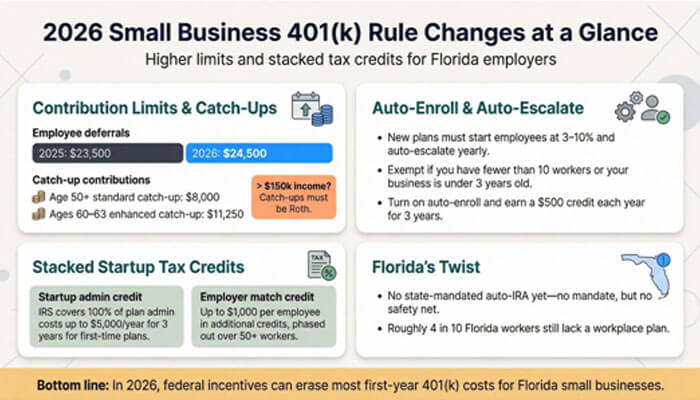
New plans must start employees at three to ten percent and auto-escalate each year unless you have fewer than ten workers or your business is under three years old. Even if you fall under the exemption, turning on auto-enroll earns a $500 credit each year for three years, so skipping it leaves money on the table.
The broader startup credit is richer as well. Launch a first-time plan and the IRS covers one hundred percent of admin costs up to $5,000 per year for three years, easily offsetting Guideline or Human Interest fees. Add a match and you unlock a second credit of up to $1,000 per employee, phased out gradually for businesses with more than fifty workers.
One technical twist: anyone earning more than $150,000 must place catch-up dollars in Roth format. All five providers on our list already support Roth payroll codes, but double-check your setup so high-comp owners do not face surprises on deadline day.
Florida still has no state-mandated auto-IRA. That means no extra paperwork, yet also no safety net. If you want to stand out in a labor market where four in ten workers lack a plan, a private 401(k) remains the quickest path.
Bottom line: with higher limits and stacked tax credits, Washington is effectively paying small businesses to offer retirement benefits. Take advantage while the incentives last.
How to pick your perfect fit
Numbers impress, but day-to-day reality decides whether a plan stays painless or becomes a paperwork hassle. Walk through the questions below with your accountant or HR lead, and you will zero in on the winner quickly.
First, trace the money. Ask each vendor for an “all-in” quote on your headcount and pay cycle. Look for three lines: platform fee, per-participant charge, and average fund cost. If any item feels fuzzy, press for clarity. Transparent providers answer in one email, not five.
Next, open your payroll dashboard and picture the nightly flow. Does the 401(k) pull data automatically, or will you export a file every pay run? Automation saves hours and avoids late-deposit penalties, especially in high-turnover fields like hospitality.
Now, protection. Confirm who signs as the 3(16) plan administrator and who takes 3(38) investment duty. Shifting those roles to the provider limits your liability. If the vendor declines, budget for an outside advisor or prepare for extra compliance chores in-house.
Service style matters too. If your team spans English and Spanish or works split shifts, check support hours and language options. A rep available at 7 p.m. in Miami beats a chatbot that signs off at five.
Finally, think five years ahead. Will the pricing model still look good when assets triple? Flat fees win as balances grow, while percentage fees sting later. Make sure the fund lineup and mobile experience feel modern enough for Gen-Z hires; migrating a plan later is doable, but never fun.
Work through these checkpoints and one provider will stand taller than the rest. That clarity keeps momentum high when it is time to sign the adoption agreement.
Frequently asked questions
Do I need a 401(k) if I have only five employees?
Yes. SECURE 2.0 credits can erase first-year fees, and even small teams compete for talent. Owners may shelter up to $24,500 of income each year, plus catch-ups. A SIMPLE IRA helps, but it caps savings at $17,000 in 2026, well below a 401(k).
Florida has no state mandate. Why hurry?
Lack of a mandate does not mean lack of pressure. More than half of Florida’s workforce has no plan, so offering one sets you apart now instead of scrambling later if lawmakers follow states like California and Illinois.
What does a 3(16) fiduciary give me?
Peace of mind. A 3(16) provider signs and files Form 5500, tracks loan defaults, and keeps the plan document current. If the Department of Labor audits, you direct them to the provider first. Without this service you own every deadline, along with the penalties for missing one.
Will fees still look good after my plan grows?
Run the math today. Flat-fee vendors such as Human Interest become cheaper on a percentage basis as assets rise. Asset-based fees from ADP or some advisors may start low but can outpace flat fees once balances pass $1 million. Forecast three to five years ahead so you do not need to switch mid-stride.
Can I include part-timers who work seasonally?
Yes—and soon it will be required. Starting in 2025, long-term part-timers who log at least 500 hours in two consecutive years must be eligible. Modern platforms track hours through payroll feeds, sparing you manual calculations each spring.
Still stumped? Book demo calls with your top two providers, walk them through your payroll process, and let real screenshots, not glossy brochures, seal the deal.
The bottom line
Retirement plans once seemed like a luxury for Fortune 500 budgets. In 2026 they are a strategic necessity, and, thanks to new federal credits, almost free to launch.
Our research surfaced five strong providers. Guideline and Human Interest trim costs through automation and flat pricing. ADP and Paychex fold retirement into the payroll and HR dashboards many Florida firms already use. Fidelity supplies brand recognition and low fund expenses in one package.
Your task is clear: choose the model that fits your workflow, claim the credits that wipe out your invoice, and show employees you are investing in their future. Along the way, you sharpen recruiting power, lower your taxable income, and help shrink the state’s $17 billion retirement gap.
Schedule demo calls, review fee sheets with your accountant, and set a go-live date. The sooner you act, the sooner your team starts building wealth, and the sooner you move ahead of competitors still waiting on the sidelines.
We will raise a cafecito to that.