


Social media traffic in 2026 is not about posting more just to stay visible. It is about creating content platforms are more likely to recommend, matching that content to real user intent, sending people to pages that actually help people, and measuring what happens after the click. If you want to know how to improve social media traffic?, the answer is simple: publish for discovery, optimize for search, make the next click obvious, and track every campaign properly. Your content should use the words people search for in important places like the title, heading, alt text, and link text, while keeping pages clear, useful, and easy to navigate.
A strong social traffic strategy does not stop at the post. It includes the platform, the creative, the click path, the landing page, and the follow-up measurement. When all of those parts work together, social traffic becomes more predictable, more scalable, and more valuable.
What Is Social Media Traffic?
Social media traffic refers to visits that come from social platforms to your website, blog, online store, landing page, lead form, or another owned destination. This traffic becomes much easier to measure when you use tagged URLs, because analytics tools can then show which source, medium, and campaign drove the visit.
In practice, social media traffic includes users who click from Instagram, Facebook, TikTok, Pinterest, LinkedIn, YouTube, X, or other platforms to content you own. These visitors may arrive through organic posts, paid ads, short-form videos, stories, profile links, creator collaborations, or community discussions.
Understanding how to improve social media traffic starts with understanding that not all traffic is equal. A thousand visits from the wrong audience can be less valuable than one hundred visits from people who actually need what you offer.
Who Needs to Improve Social Media Traffic?
This topic matters to more than influencers and media brands. Many types of businesses can benefit from stronger social traffic if the click leads to useful content or a clear conversion path.
This article is especially useful for:
- bloggers who want more readers on evergreen content
- ecommerce brands that want more product page visits
- SaaS companies trying to drive trial signups
- agencies building lead generation systems
- local businesses promoting service pages
- creators building newsletter or course traffic
- publishers and affiliate sites trying to grow qualified sessions
The best strategy depends on your business model, but the core principle stays the same. Better traffic comes from better alignment between platform content, audience intent, and destination page quality.
Why Social Media Traffic Is Harder to Win in 2026
Social platforms are more recommendation-driven than ever. Reach is shaped less by follower count and more by whether the platform predicts your content will be useful, relevant, or engaging to a specific user.
That is why brands now need a more complete traffic system. You need content that earns attention inside the platform, a page worth clicking through to, and clear measurement once people arrive. Strong content, clear page structure, useful images, and accessible pages all matter more now.
Another reason social media traffic is harder to win is competition. More brands are publishing more content, which means average content gets ignored. To stand out, you need clearer positioning, better hooks, stronger formatting, and a more helpful page after the click.
Top 15 Proven Strategies on How to Improve Social Media Traffic?
1. Start With One Traffic Goal and One Destination Page
The first step in how to improve social media traffic is choosing one primary goal for each campaign. Do not try to drive clicks, leads, sales, and awareness from the same post set without a clear priority.
Choose one destination page and one main action, such as:
- reading a guide
- booking a call
- starting a free trial
- downloading a resource
- viewing a product collection
This makes your campaign easier to measure and improves message clarity. When the audience sees one clear promise and one obvious next step, click quality usually improves.
Goal and Destination Page Examples
| Campaign Goal | Best Destination Page | Main CTA |
|---|---|---|
| Traffic growth | Blog post or guide | Read more |
| Lead generation | Landing page | Get the guide |
| Product discovery | Category page | Shop now |
| SaaS trials | Feature page | Start free trial |
| Local services | Service page | Book a call |
2. Build a Better Page Before You Push More Traffic to It
A common mistake is trying to increase traffic before improving the page people land on. If the page is thin, unclear, slow, or disconnected from the promise made in the post, your traffic will underperform even if reach is decent.
Your destination page should be:
- useful and specific
- clearly titled
- easy to scan
- internally linked
- visually clean
- mobile friendly
- closely matched to the social post that sent the visitor there
A better landing page often improves results faster than publishing more content. Before trying to drive more visits, ask whether your page actually deserves the click.
Landing Page Quality Checklist
| Element | Why It Matters |
|---|---|
| Clear title and H1 | Confirms users landed on the right page |
| Strong opening paragraph | Reduces bounce and reinforces relevance |
| Helpful subheadings | Improves readability |
| Internal links | Encourages deeper exploration |
| Clear CTA | Moves visitors to the next step |
| Fast mobile load | Prevents drop-off |
| Useful visuals | Improves understanding and trust |
3. Target Search Intent, Not Just Social Trends
One of the best ways to improve social media traffic is to create content around what people are already searching for. Instead of posting vague motivational content, create posts around questions, comparisons, mistakes, examples, tutorials, checklists, and problem-solving angles.
A post built around a real problem usually sends higher-quality traffic because the click comes from stronger intent, not just momentary curiosity.
For example, these are stronger than generic trend posts:
- how to improve social media traffic for ecommerce
- why social media traffic is high but conversions are low
- best CTAs for Instagram traffic
- how to track social media traffic in analytics
- social media traffic vs engagement
Search intent gives your content direction. It helps you choose better angles, better hooks, and better destination pages.
4. Match Your Content to Platform Ranking Behavior
If you want better traffic, you need better discovery. Social platforms rank content using signals about relevance, interest, and likely engagement.
That means your content should be built to earn the kinds of responses platforms value:
- attention
- saves
- shares
- repeat viewing
- comments
- topical clarity
- watch time or dwell signals
The practical lesson is not to chase the algorithm, but to make content that is useful enough to deserve stronger distribution. The better your content matches both the platform format and the user’s expectation, the more traffic potential it usually has.
5. Use Short-Form Video for Discovery and Pages for Depth
Short-form video is still one of the strongest discovery formats, but it works best when paired with a deeper destination. A short video can attract the click, but your site has to do the work of explanation, trust-building, and conversion.
This is where many brands fail. They create a strong video and then send people to a weak page. The result is decent reach, weak traffic quality, and low conversion value.
The better model is simple:
- use short-form video to earn attention
- use the landing page to answer the full question
- use internal links to move users deeper
- use a CTA that fits the viewer’s level of intent
6. Optimize Your Titles, Headings, and Link Text
Your page title, H1, social hook, CTA, and linked text should align around the same topic. This is not about stuffing keywords. It is about consistency, clarity, and making the page understandable for both users and search systems.
For example, if your post says “3 ways to improve social media traffic,” your landing page should not open with a vague headline about “digital success.” The topic match should be immediate and obvious.
Strong link text also matters. Avoid weak language like:
- click here
- read more
- learn more
Use descriptive phrases instead, such as:
- read the full social media traffic guide
- see the 30-day traffic plan
- compare organic vs paid social traffic
7. Make Save-Worthy and Share-Worthy Assets
Social traffic often grows after the first posting window when a piece keeps getting saved, shared, or revisited.
That is why practical assets tend to outperform generic posts. Checklists, templates, mini-guides, comparison posts, before-and-after content, and quick tutorials are easier to save and share, which gives them more chances to keep sending traffic over time.
Examples of strong save-worthy assets:
- content planning checklists
- social media audit templates
- CTA swipe files
- performance benchmark graphics
- post structure frameworks
- quick comparison charts
These formats work because they create utility. Utility drives saving. Saving often improves reach. Better reach can lead to more traffic.
8. Optimize Your Social Profiles for More Traffic
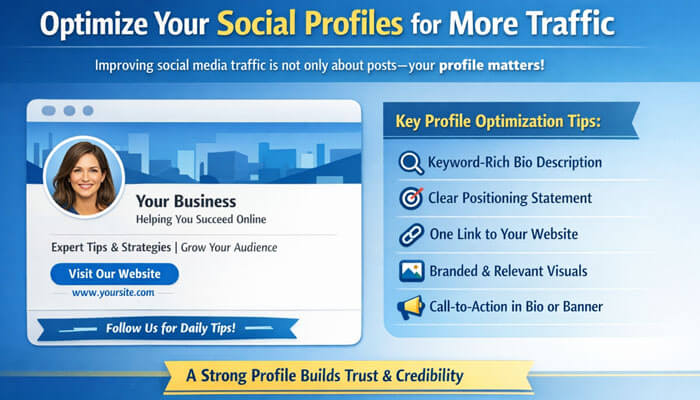
Improving social media traffic is not only about individual posts. Your profile or company page affects whether people trust the click.
A stronger profile setup usually includes:
- a keyword-aware description
- a clear positioning statement
- one visible destination link
- platform-native visuals
- branding that matches your published topics
- a CTA in the bio or banner area when possible
Profile optimization matters because many users do not click directly from the post. They visit the profile first, decide whether you are credible, and then choose whether to continue.
9. Repurpose by Platform Intent, Not by Copy-Paste
Copying the exact same post everywhere usually underperforms because different platforms surface content differently.
A better workflow is to start with one strong topic and adapt it. Turn a blog article into a Reel hook, a LinkedIn insight post, a Pinterest checklist graphic, a TikTok explainer, and a YouTube Short recap. The idea stays the same, but the packaging changes to fit the platform.
This improves performance because it respects platform intent. People browse LinkedIn differently than they browse TikTok. They save differently on Pinterest than they do on Instagram. Good repurposing understands that.
10. Use Platform-Specific Click Paths
Different platforms offer different ways to move people deeper into your ecosystem. The takeaway is simple: do not rely on one generic “link in bio” mindset for everything. Use the click paths each platform already supports well.
Examples include:
- Instagram story links and bio links
- TikTok profile links
- YouTube descriptions, pinned comments, and end screens
- Pinterest pin links
- LinkedIn company page buttons and post links
- Facebook page buttons and link-supporting posts
The easier the path feels, the more likely users are to take it. Friction kills clicks.
11. Add Stronger CTAs and Reduce Friction
Many social posts are interesting but not actionable. If users have to guess what to do next, many of them will not click. Your CTA should tell them exactly what they will get and why leaving the platform is worth it.
Weak CTAs:
- learn more
- check it out
- visit now
Stronger CTAs:
- read the full 30-day traffic plan
- see the checklist that improves social traffic
- get the full breakdown of social media traffic metrics
- compare organic vs paid social traffic here
Good CTAs reduce mental effort. Users should understand the benefit immediately.
12. Track Every Link With UTMs
You cannot improve what you do not measure. Tagged URLs let analytics tools separate campaigns and show which social assets are actually sending traffic.
Without a clean naming system for source, medium, campaign, and content variation, brands often confuse activity with performance.
A simple UTM naming structure might include:
- source: instagram
- medium: social
- campaign: spring_traffic_guide
- content: reel_hook_1
This makes campaign analysis far easier and helps you find which topic, hook, and format are actually driving results.
13. Promote What Already Works Organically
Paid promotion works best when it amplifies content that already has signs of audience fit.
That is a stronger strategy than boosting random recent posts. First identify the content that already has good saves, clicks, engaged sessions, or time-on-page signals, then add budget behind that winner.
This lowers creative risk and improves the chance that your paid spend supports a proven message instead of a weak assumption.
14. Cut Clickbait, Unoriginal Posts, and Thin Pages
If you want lasting traffic growth, remove weak destination pages, misleading headlines, copied posts, and empty listicles that do not solve the problem they promise to solve.
Low-quality hooks may produce short bursts of activity, but they usually weaken trust and traffic quality over time.
Users remember disappointment. If your social post overpromises and the page underdelivers, they are less likely to click again later.
15. Review Traffic and Search Data Every Week
Traffic growth is an optimization loop, not a one-time publishing sprint.
Every week, review:
- which topics drove sessions
- which posts had the best CTR
- which landing pages held attention
- which platform-format combinations converted
- which campaigns assisted deeper site engagement
Then publish more around those winners instead of constantly resetting your strategy.
Consistency in review is what turns scattered content into a system.
Organic vs Paid Social Traffic: When to Boost a Winner
Organic social is best for testing message-market fit. Paid social is best for scaling what already works.
A simple rule is this: use organic posts to discover which hook, topic, or content format produces the best click quality, then use paid amplification to extend the reach of that proven asset.
Organic vs Paid Social Traffic
| Channel | Best Use | Main Strength |
|---|---|---|
| Organic social | Test topics and formats | Lower cost learning |
| Paid social | Scale proven content | Faster reach expansion |
| Organic + paid | Full funnel strategy | Better efficiency |
How to Improve Social Media Traffic From Each Major Platform
Each platform supports traffic in a different way. The content format, discovery behavior, and click path are not the same, so the strategy should not be the same either.
Instagram and Facebook
Instagram and Facebook reward content that earns saves, shares, replies, and meaningful engagement. Reels can drive discovery, carousels can drive saves, and stories can support stronger click intent when used with a direct CTA.
To improve traffic from these platforms:
- use strong first-line hooks
- make carousels worth saving
- add clear bio and story click paths
- keep visual branding consistent
- match the post message closely to the landing page
TikTok
TikTok works well when content is built around fast answers, curiosity, practical insight, and search-driven topics. People often use TikTok to look for quick solutions, opinions, and examples.
To increase traffic from TikTok:
- use search-friendly spoken and on-screen phrases
- make the first 2 seconds clear and specific
- create follow-up posts around questions in comments
- direct viewers to a profile link or lead magnet
- keep the topic focused on one outcome
Pinterest behaves more like a visual discovery engine than a typical social feed. It often works best for evergreen, searchable, and highly visual topics.
Pinterest traffic improves when you:
- use keyword-rich pin titles
- write useful pin descriptions
- design clear vertical graphics
- create matching boards around the topic
- send the click to a strong, relevant page
LinkedIn traffic improves when your page is complete, active, and clearly positioned. It works especially well for B2B, services, recruiting, consulting, and thought leadership content.
Better LinkedIn traffic usually comes from:
- publishing useful insight posts
- turning blog ideas into opinion-led summaries
- using document posts and carousels
- keeping your company page complete
- placing links where they feel natural and relevant
YouTube
YouTube is strong for both discovery and deeper consumption. Shorts can bring in new viewers, while longer videos, playlists, descriptions, pinned comments, and end screens can move them deeper into your content ecosystem.
If you want more traffic from YouTube:
- align video topics with search demand
- give viewers a specific reason to click
- add clear links in descriptions and comments
- connect Shorts to longer content or guides
- use playlists to extend session depth
How to Repurpose One Topic Into 5 Traffic-Driving Posts
A practical workflow looks like this: publish one strong destination page first, then create one short video, one carousel or document post, one Pinterest asset, one LinkedIn angle, and one YouTube Short or follow-up post around that same topic.
For example, if your main article is about social media traffic, you can turn it into:
- three traffic mistakes for TikTok
- a saveable checklist for Pinterest
- a business insight for LinkedIn
- an Instagram Reel with one fast tactic
- a YouTube Short pointing viewers to the full guide
Repurposing Example Table
| Platform | Post Format | Traffic Angle |
|---|---|---|
| Reel or carousel | Quick tip with clear CTA | |
| TikTok | Short explainer | Search-driven answer |
| Vertical checklist graphic | Evergreen discovery | |
| Insight post or document | Professional takeaway | |
| YouTube | Short or long-form summary | Deeper learning path |
Social SEO Tips That Help Social Traffic Convert Better
Social traffic performs better when the destination page is also built for search clarity. A strong page should have one main topic, descriptive internal links, useful metadata, relevant images near the related text, and a structure that makes the next action obvious.
The goal is not to force rankings with tricks. The goal is to make the content easier for both readers and search systems to understand.
Useful on-page improvements include:
- one clear main keyword focus
- descriptive headings
- easy-to-scan paragraphs
- image alt text written naturally
- internal links to related pages
- visible trust elements
- a CTA that matches the page purpose
Posting Frequency and Timing Tests Matter
Posting rhythm matters. That does not mean every brand should blindly post more, but it does mean consistency and testing are important.
The best approach is to treat timing and frequency as test variables. Keep topic quality constant, vary publish times and cadence, then compare click-through rate, engaged sessions, and conversions instead of relying only on impressions or likes.
You may find that one high-quality post per day outperforms three lower-value posts. Or you may learn that certain audience segments respond better on specific days. Testing reveals what general advice cannot.
Best Metrics to Track for Social Media Traffic
Traffic volume alone is not enough. You also need to measure what happened after the click.
The most useful KPIs for social media traffic usually include:
- sessions
- engaged sessions
- engagement rate
- landing page performance
- source and medium
- campaign comparisons
- click-through rate on the originating platform
- conversions or key events on the site
- time spent on page
- bounce or exit patterns
- assisted conversions
KPI Table for Social Media Traffic
| Metric | What It Shows | Why It Matters |
|---|---|---|
| Sessions | Total visits from social | Measures traffic volume |
| Engaged sessions | Visits with meaningful activity | Measures traffic quality |
| CTR | Click rate from the platform | Measures post effectiveness |
| Conversion rate | Users who completed an action | Measures business value |
| Landing page engagement | Scroll, time, interaction | Shows page quality |
| Source/medium | Which platform drove traffic | Improves channel analysis |
| Campaign comparison | Performance by campaign | Helps prioritize winners |
Mobile Experience and Page Speed Still Matter
A large share of social traffic arrives on mobile devices, so the destination page must be fast and stable.
If your mobile page is slow, jumps around while loading, or makes the main content hard to access, strong social traffic can still underperform. Many users make a decision within seconds. A poor mobile experience wastes the opportunity you worked to create.
To improve mobile traffic performance:
- keep page layout simple
- reduce unnecessary scripts
- compress images properly
- make buttons easy to tap
- place important content high enough on the page
Technical Discoverability of the Destination Page
A useful page still needs to be discoverable. Your important traffic pages should be linked from other crawlable pages on your site, included in your sitemap, and not hidden behind weak navigation.
Social traffic and search visibility work better together when the page is easy for both people and search systems to reach.
This matters because strong social traffic can support wider content visibility, but only if the destination page is technically accessible, clearly structured, and connected to the rest of the site.
Optimize Images and Social Previews for More Clicks
Preview assets matter. High-quality, relevant images can increase the chances of getting clicks from social feeds and discovery surfaces.
Use:
- clear and relevant images
- strong preview text
- descriptive filenames
- natural alt text
- topic-matched thumbnails
- clean visual hierarchy
Your preview should match the page promise. If the image creates one expectation and the page delivers something else, click quality falls.
Accessibility and Trust Signals That Support Social Traffic
Accessibility and trust support stronger traffic performance over time.
Use clear alt text that describes the image naturally and supports accessibility. Avoid stuffing keywords into alt text. If you use AI-assisted visuals, edited media, or synthetic content, present them honestly and clearly.
Other helpful trust-supporting elements include:
- readable font sizes
- strong contrast
- clear heading structure
- visible author or business details
- easy contact information
- honest claims and transparent framing
These signals may seem small, but together they improve the visitor experience and support credibility.
Brand and Entity Trust Signals
If this article is being published on a business site, site-level trust signals are worth strengthening too.
A strong About page, visible contact details, consistent branding, clear company information, author transparency, and editorial standards can support the credibility of the site behind the article.
The stronger your overall entity signals, the more confidence users may have when deciding whether to click, stay, and explore.
A Practical 2026 Framework for How to Improve Social Media Traffic
A simple working system looks like this:
- Create one strong destination page.
- Build several social assets around one clear search intent.
- Adapt those assets for the platforms that matter most.
- Track every link.
- Review traffic and engagement quality.
- Update both the page and the next batch of posts based on the data.
Simple Traffic Framework Table
| Step | Action | Outcome |
|---|---|---|
| 1 | Publish a strong page | Better post-click experience |
| 2 | Build platform-specific assets | Better discovery potential |
| 3 | Use clear click paths | Higher CTR |
| 4 | Track all links | Better attribution |
| 5 | Review quality metrics | Better decision-making |
| 6 | Improve winners | Stronger long-term growth |
Social Media Traffic vs Social Media Engagement
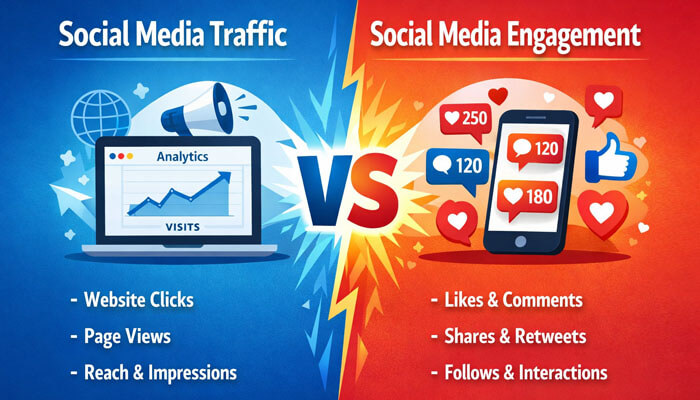
This is one of the most important distinctions in the whole article. Engagement and traffic are connected, but they are not the same.
A post can get likes, comments, saves, or shares and still send weak website traffic. Engagement tells you whether people reacted on-platform. Traffic tells you whether they clicked. Quality traffic tells you whether they stayed, explored, and converted.
The best strategy is to treat engagement as an early signal and traffic plus conversion behavior as the business outcome.
| Metric Type | Measures | Business Meaning |
|---|---|---|
| Engagement | Likes, comments, shares, saves | Audience reaction on-platform |
| Traffic | Clicks and sessions | Movement to owned channels |
| Quality traffic | Engaged sessions and conversions | Real business value |
Common Mistakes to Avoid
The biggest mistakes are:
- chasing vanity metrics only
- sending traffic to weak pages
- publishing the same content everywhere without adaptation
- skipping campaign tagging
- using vague anchor text
- ignoring mobile performance
- relying on clickbait previews that the page cannot satisfy
- boosting content before testing it organically
- using weak CTAs
- failing to review data weekly
Mistake vs Better Approach
| Mistake | Better Approach |
|---|---|
| Generic posts | Intent-based content |
| Weak landing page | Improved page before promotion |
| No UTM tracking | Clean campaign tagging |
| Copy-paste across platforms | Platform-specific adaptation |
| Boosting random posts | Promote proven organic winners |
| Chasing likes only | Measure traffic quality and conversions |
30-Day Action Plan to Improve Social Media Traffic
Week 1: Fix the destination page
Improve its title, headings, internal links, images, CTA, mobile speed, and metadata. Make sure the page is genuinely helpful and clearly aligned with the traffic goal.
Week 2: Publish platform-adapted content
Publish three to five posts around one clear search intent. Use different platform formats instead of reposting the same version everywhere. Tag every link.
Week 3: Review traffic quality
Check sessions, engaged sessions, engagement rate, CTR, landing page behavior, and conversions. Find the best-performing hook, platform, and page combination.
Week 4: Double down on winners
Update the page, boost the strongest organic asset, and create the next batch of content around the topics and formats that already showed traction.
Conclusion
How to improve social media traffic in 2026 comes down to four things: discoverability, clarity, usefulness, and measurement. You need content platforms can understand and recommend, topics people are actively searching for, pages that genuinely help the visitor, and tracking that tells you which campaigns are sending quality traffic.
The brands that win more social traffic are usually not the ones posting the most. They are the ones connecting platform behavior, user intent, landing page quality, and analytics into one clear system.
That is the foundation for social traffic that does not just look busy, but actually supports growth.
Frequently Asked Questions (FAQs)
1. How long does it take to improve social media traffic?
Improving social media traffic usually takes a few weeks to a few months, depending on your content quality, posting consistency, platform fit, and landing page strength. Brands often see faster results when they improve existing high-potential pages instead of creating everything from scratch.
2. Can small businesses improve social media traffic without posting every day?
Yes. Small businesses can improve social media traffic without daily posting if they focus on consistent quality, strong audience targeting, and clear calls to action. A few useful, well-optimized posts usually perform better than frequent low-value content.
3. Is it better to send social media traffic to blog posts or landing pages?
It depends on the goal. Blog posts work better for educational and top-of-funnel traffic, while landing pages work better for direct offers, lead generation, and conversions. The best choice is the page that matches the user’s intent most closely.
4. Why do some social posts get engagement but not traffic?
Some social posts perform well inside the platform because they are entertaining or easy to react to, but they do not give users a strong reason to click. Weak CTAs, unclear next steps, or a mismatch between the post and the destination page often reduce traffic.
5. Should I update old content or create new posts to improve social media traffic?
The best strategy is usually to do both. Update strong existing pages so they are more useful and conversion-friendly, then create new platform-specific posts that drive traffic back to those improved pages. This approach often produces better results than constantly starting over.
