

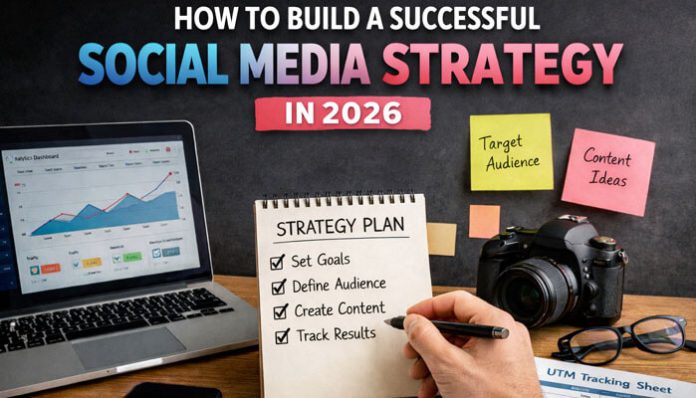

If you want to know how to build a successful social media strategy in 2026, the answer is not to post more and hope for the best. The brands, businesses, and creators getting results now are the ones that connect one clear goal to one clear audience, publish original platform-native content, and measure what actually drives business outcomes.
A successful social media strategy in 2026 is not a random posting schedule. It is a system for attracting the right people, earning attention with useful or memorable content, moving that attention toward a business goal, and improving over time with real data.
To build a successful social media strategy in 2026, start with one primary goal, define one audience deeply, choose the platforms that fit that audience, create original content around a few strong content pillars, and track the path from post to click to lead or sale. Then improve the system with competitor research, profile optimization, UTM tracking, a realistic content calendar, strong community management, mobile-friendly landing pages, and regular testing.
Why Social Media Strategy Matters More in 2026
Social media is more competitive than ever, and platform systems increasingly reward originality, relevance, retention, and consistency. Generic posting is weaker than it used to be, while useful, differentiated content has a better chance of reaching the right audience.
That is why a strong strategy starts with clarity, not volume. If you want to understand how to build a successful social media strategy, you need to know what growth means for your business, who you want to reach, what type of content they respond to, and how you will evaluate progress over time.
A strong strategy helps you do four things:
- attract the right audience
- create content with a clear purpose
- move attention toward action
- improve performance using real feedback and data
Step 1: Start With One Primary Goal
The first step in how to build a successful social media strategy is choosing one primary objective. That goal could be brand awareness, traffic, leads, booked calls, sales, or retention. One of the biggest mistakes brands make is trying to chase all of them at once.
Choose one main KPI and one supporting KPI.
- Awareness: reach and follower growth
- Traffic: clicks and sessions
- Leads: form fills and cost per lead
- Sales: conversions and revenue
- Retention: repeat engagement and returning audience activity
When the goal is specific, your strategy becomes easier to execute, prioritize, and improve.
Step 2: Define One Audience Deeply
A strategy usually fails when the audience is too broad. Instead of targeting everyone, focus on one core segment first. That could be startup founders, local service buyers, working parents, B2B marketers, or people actively comparing products or services.
Document these audience details before creating content:
- their biggest pain point
- the result they want
- what confuses them
- what objections stop them from taking action
- what content format they prefer
- what questions they ask before trusting a brand
This is where your content starts becoming relevant instead of generic.
Step 3: Analyze Competitors and Find Content Gaps
If you want your strategy to stand out, audience research alone is not enough. You also need to study the content already competing for your audience’s attention.
Review three to five competitors or creators in your niche. Look at what topics they repeat, what formats perform best, what proof they use, what offers they push, and what questions keep showing up in their comments. Then compare that with what your audience still seems to need.
A useful content-gap review should identify:
- topics competitors cover often
- topics they explain poorly
- objections they ignore
- formats they underuse
- chances for you to add fresher examples, stronger clarity, or more original insight
Strong strategy comes from finding the gap between what is already being posted and what your audience still wants. This is a core part of how to build a successful social media strategy.
Step 4: Choose Platforms With Intention
A successful strategy does not require you to be everywhere. It requires you to choose the platforms that fit your audience, your content strengths, and your business model. This is an important part of how to build a successful social media strategy because the right platform choice affects reach, consistency, and results.
A practical approach is simple:
- choose one primary platform
- choose one secondary platform for repurposing
- ignore the rest until the first two are working
That is usually far more effective than trying to maintain five weak channels.
Simple Platform Selection Guide
| Platform | Best For | Strong Content Types | Typical Goal |
|---|---|---|---|
| B2B, professional services, founders | text posts, carousels, thought leadership, case studies | leads, authority, networking | |
| visual brands, coaches, creators, local brands | reels, carousels, stories, before and after content | engagement, trust, discovery | |
| TikTok | fast reach, product discovery, creator-led brands | short videos, demos, reaction content, hooks | awareness, traffic, community |
| YouTube Shorts | searchable short education and tips | educational shorts, tutorials, quick breakdowns | reach, discovery, authority |
| community-based brands, local business, older demographics | reels, feed posts, groups, offers | traffic, engagement, local reach |
Pick the platform where your audience already pays attention and where your content style can be produced consistently.
Step 5: Optimize Your Profiles and Pages Before Publishing More Content
This is one of the most overlooked parts of a social media strategy. Great posts can underperform if the profile or page feels incomplete, unclear, or low-trust.
Before publishing heavily, optimize these elements:
- profile or brand image
- banner or cover image
- keyword-rich bio or description
- website or landing page link
- contact details
- featured or pinned content
- a clear call to action
This gives your content a stronger destination and improves credibility when people check your profile after seeing a post.
Step 6: Build Your Strategy Around Content Pillars
Once your goal and audience are clear, define three to five content pillars. These are the themes your content will return to consistently.
A strong mix often includes:
- Educational content that solves real problems
- Proof content such as testimonials, results, case studies, or before-and-after examples
- Authority content such as frameworks, expert takes, and original opinions
- Connection content that shows story, values, team, or behind-the-scenes context
- Conversion content that leads toward the next step
Your pillars should not be chosen only because they are trending. They should be chosen because they match your expertise and your audience’s needs. Done well, this becomes a core part of how to build a successful social media strategy and helps keep your content focused, useful, and consistent.
Step 7: Turn the Strategy Into a Content Calendar, Cadence, and Ownership System

A strategy becomes powerful only when it becomes repeatable. That means deciding how often you will post, what formats you will use, who creates the content, who approves it, and how you will repurpose it.
A simple weekly cadence could look like this:
- Monday: educational post
- Tuesday: short-form video
- Wednesday: authority or opinion post
- Thursday: proof-based post
- Friday: conversion-focused post
- Daily: replies, comments, and community engagement
You should also assign clear ownership:
- strategy owner
- writer or script creator
- designer or editor
- approver
- publisher
- performance reviewer
A content calendar reduces friction. Many strategies fail not from lack of ideas, but from lack of execution.
Step 8: Create Original Platform-Native Content
One of the biggest shifts in 2026 is that lazy reuse is less effective. Posting the exact same content everywhere is rarely the best move. This is a major part of how to build a successful social media strategy because each platform rewards content that feels native, useful, and original.
In practice, this means:
- do not repost the exact same message everywhere
- change the hook, format, and structure for the platform
- add your own interpretation or experience
- use screenshots, examples, steps, or proof
- avoid looking like a copy of someone else’s content
Originality is not just a branding advantage. It is also a distribution advantage.
Step 9: Use Platform-Specific Content Examples
Readers understand strategy better when they see how one core message changes across platforms.
A single topic might look like this:
- LinkedIn: a text-led post with one sharp insight and a practical takeaway
- TikTok: a quick hook, a short demonstration, and a simple call to action
- YouTube Shorts: a concise educational or searchable tip
- Instagram: a carousel or reel focused on teaching, showing proof, or demonstrating transformation
- Facebook: original creator-led content that feels native to Feed or Reels
This kind of adaptation helps your content feel natural instead of copied.
Step 10: Build a Full-Funnel Content Plan and Clear Conversion Path
A strong social media strategy should guide people through stages, not just chase visibility.
Your content should do four jobs:
- attract attention
- build trust
- create intent
- prompt action
Educational clips and strong hooks attract attention. Proof content and comparisons build trust. Offers, lead magnets, demos, and case studies increase buying intent. Clear calls to action move people to the next step.
Just as important, define what happens after the click or reply:
- post to landing page
- reel to lead magnet
- carousel to email signup
- LinkedIn post to consultation page
- DM to booking link or offer page
Without a clear post-click path, even good content can become top-of-funnel noise.
Step 11: Set Up UTM Tracking So You Can Measure What Actually Works
This is one of the most practical parts of the strategy. If you do not tag your links properly, it becomes much harder to see which platform, format, and message actually drives results.
A simple naming structure could look like this:
- utm_source=instagram
- utm_medium=social
- utm_campaign=social_strategy_2026
- utm_content=carousel_1
Keep naming consistent. Differences in spelling or capitalization can split your reporting and make analysis harder.
Step 12: Optimize the Mobile Experience After the Click
This is a major area many strategies ignore. Social traffic is often mobile-first, so your landing pages need to work smoothly on a phone.
Your landing pages should be:
- easy to read on mobile
- fast enough to load without frustration
- clear in the first screen view
- simple to navigate
- supported by short forms and obvious calls to action
If your post performs well but the destination page feels weak, the strategy breaks after the click. Paying attention to this final step is essential in how to build a successful social media strategy, because strong content still needs a smooth path to conversion.
Step 13: Decide When to Use Organic Only and When to Add Paid Support
A successful social media strategy in 2026 does not always need paid ads at the start, but it helps to know when paid support makes sense.
Stay mostly organic when:
- you are still learning what content resonates
- your messaging is not proven yet
- your landing page or offer is still being improved
- you want to test topics, hooks, and proof first
Add paid support when:
- one post or format is already performing well organically
- you have a strong lead magnet, offer, or sales page
- your audience targeting is clear
- you want to accelerate reach or retarget engaged users
A smart approach is to use organic content to find winning messages, then use paid support to scale what already shows signs of working.
Step 14: Measure the Right Things Every Week
If you track the wrong metrics, you will either stop too early or keep scaling the wrong content.
Track these categories weekly:
- Reach metrics: impressions, reach, profile visits, views
- Engagement metrics: watch time, saves, shares, comments, average view duration
- Audience metrics: follower growth, returning viewers, community quality
- Business metrics: clicks, leads, bookings, conversion rate, revenue
This keeps the strategy tied to outcomes instead of vanity metrics alone.
Step 15: Turn Reporting Into Decisions
Data matters only when it changes what you do next. This is a critical part of how to build a successful social media strategy because results only improve when reporting leads to better decisions.
Use reporting like this:
- high reach and high conversions: scale the format or angle
- high reach and low clicks: improve the call to action or offer
- strong clicks but weak conversion: fix the landing page or sales flow
- low reach but strong conversion quality: test more hooks before discarding the topic
- repeated weak performance: reduce that format and focus on better performers
That decision-making loop is how a strategy becomes more efficient over time.
Step 16: Build a Community Management Loop
A successful strategy is not only publishing. It is also conversation.
Your weekly system should include:
- replying to comments
- answering direct messages
- engaging with relevant creators or industry conversations
- noting recurring questions
- turning audience feedback into future posts
Step 17: Use AI Carefully and Add Human Experience
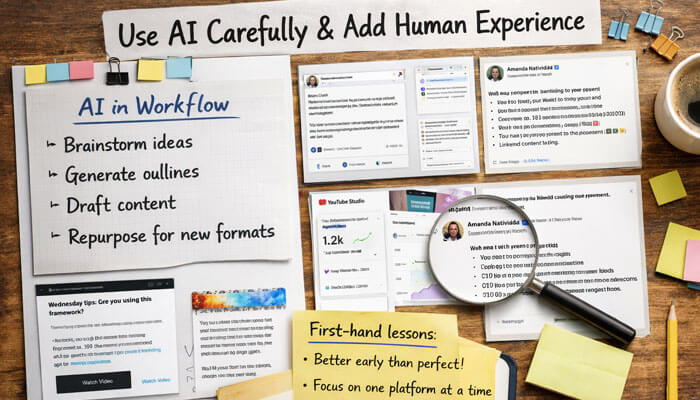
AI can help with brainstorming, outlines, repurposing, and drafts. But it should not be the final layer.
If you use AI in your workflow:
- add real examples
- include current platform context
- use screenshots where possible
- bring in first-hand lessons
- add clearer judgment and original frameworks
That is what helps your content stand out from generic material.
Step 18: Add Real Proof and First-Hand Detail
One of the best ways to make your content stronger is to show proof, not just advice. This is a valuable part of how to build a successful social media strategy because real evidence helps your content feel more trustworthy, specific, and useful.
Good proof elements include:
- mini case studies
- screenshots
- campaign examples
- a short what worked for us section
- lessons from a test that failed and what changed after
These additions make your strategy less generic and more credible.
Example Strategy in Action
A small B2B consultant chooses LinkedIn as the primary platform and Instagram as the secondary platform. In the first month, they publish one educational post, one authority post, one client-proof post, and one short video each week, all linked to a simple lead magnet with UTM tracking. By the end of 30 days, they can see which post format drove the most profile visits, email signups, and consultation clicks, then double down on the best-performing angle in month two.
Step 19: Use the Right Tools to Support Your Workflow
You do not need a complicated stack, but a few tools can make your strategy easier to manage.
Helpful tool categories include:
- content planning tools for scheduling and approvals
- analytics tools for tracking reach, engagement, clicks, and conversions
- UTM builders for link tagging consistency
- social listening tools for audience questions, mentions, and sentiment
- design and video tools for platform-native creative production
A Simple 30 Day Social Media Strategy Example
Here is a practical 30-day rollout plan to make the strategy easier to apply.
Week 1
Define one goal, choose one audience segment, review three to five competitors, and optimize your profile or page.
Week 2
Choose three to five content pillars, build a simple calendar, prepare your main landing page or lead magnet, and set up UTM tracking.
Week 3
Publish consistently on your primary platform, test different hooks and calls to action, and reply to comments and DMs every day.
Week 4
Review reach, engagement, clicks, and conversions. Keep the formats that perform, improve weak conversion points, and build next month’s plan around what the data showed.
This kind of monthly loop turns a content plan into a growth system.
Common Mistakes to Avoid
Many businesses still weaken their strategy by making the same mistakes:
- posting without a defined goal
- targeting too many audiences
- copying trends without adding value
- publishing incomplete profiles
- reusing the same content on every platform
- skipping UTM tracking
- sending traffic to weak mobile pages
- ignoring comments and DMs
- focusing only on likes instead of business results
- quitting before enough testing has happened
Most strong strategies look simple from the outside. Behind the scenes, they are focused, measured, and improved consistently.
Final Thoughts
If you are serious about learning how to build a successful social media strategy, stop thinking in terms of hacks and start thinking in terms of systems. Begin with one clear goal, one clear audience, one or two platforms, and a few content pillars that match your expertise. Then strengthen the strategy with competitor analysis, profile optimization, original platform-native content, UTM tracking, mobile-friendly destination pages, community management, and ongoing testing.
That is what gives a social media strategy a much stronger chance of producing real growth in 2026: more clarity, more originality, more consistency, and better decision-making.
Frequently Asked Questions (FAQs)
1. How often should I post on social media in 2026?
The best posting frequency is the one you can maintain consistently without reducing quality. For many brands, three to five strong posts per week on a primary platform is more effective than posting every day without a clear strategy.
2. What is the best social media platform for business growth?
There is no single best platform for every business. The right platform depends on where your audience spends time, what content you can create well, and whether your goal is awareness, leads, or sales.
3. How long does a social media strategy take to work?
A social media strategy usually needs consistent testing over several weeks before patterns become clear. Some brands see early traction within 30 days, but stronger business results often come after repeated testing, optimization, and better content-market fit.
4. What metrics matter most in a social media strategy?
The most important metrics depend on your goal. Reach and engagement help measure attention, but clicks, leads, conversions, bookings, and revenue matter more when you want to evaluate business impact.
5. Why do many social media strategies fail?
Most social media strategies fail because they lack focus and measurement. Common reasons include unclear goals, weak audience definition, inconsistent publishing, poor conversion paths, and relying on vanity metrics instead of real outcomes.
