
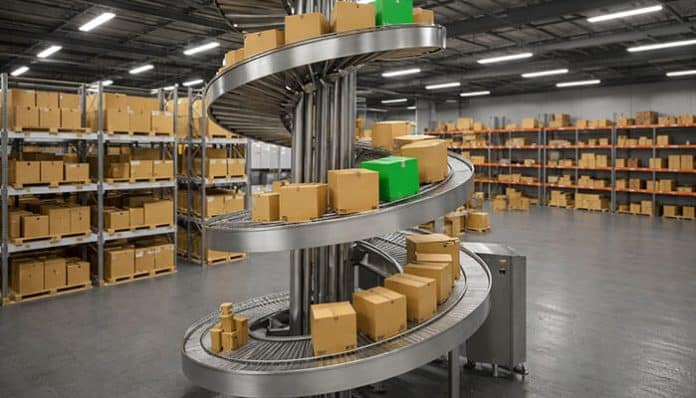

When you’re trying to move products between different floor levels in a warehouse or manufacturing facility, choosing the right vertical transportation system can make a huge difference in your operation’s efficiency and bottom line. How do spiral conveyors compare to vertical lifts or elevators for material handling?
Spiral conveyors offer continuous flow and gentler handling at slower speeds, while vertical lifts move materials faster in batches with more abrupt starts and stops. Spiral conveyors typically require more floor space but need less maintenance.
The choice between these systems isn’t always straightforward, though, because the “best” option depends heavily on your specific products, throughput requirements, available space, and budget—factors that can completely flip which system makes the most sense for your operation.
Understanding Spiral Conveyors
Spiral conveyors use a helical design to move materials up or down in a continuous, flowing motion. Think of them as a corkscrew-shaped belt or roller system that wraps around a central column. Products stay on the conveyor surface the entire time, moving at a steady pace without stopping.
These systems excel at handling delicate items, lighter loads, and situations where you need a constant stream of products moving between levels. Spiral Conveyors are engineered with specific incline angles typically ranging from 15 to 30 degrees to balance product stability against vertical rise efficiency, use friction-based or chain-driven mechanisms depending on load requirements and product characteristics, and incorporate safety features like side guards and emergency stops throughout the helical path to prevent product falloff or jamming—making them particularly well-suited for food processing, packaging, and distribution centers where bottles, cartons, or packages need gentle handling while maintaining high throughput rates.
The footprint is their defining characteristic—they go up instead of out, but still need enough diameter space to accommodate the spiral path.
Understanding Vertical Lifts And Elevators
Vertical lifts and elevators operate on a completely different principle. They use platforms or cages that move straight up and down, carrying batches of products from one level to another. The products stop, get loaded, travel vertically, stop again, and get unloaded.
This batch-style operation means they can handle heavier loads and bulkier items more effectively than spiral conveyors. Pallet lifts, for example, can move entire pallets weighing thousands of pounds between floors—something a spiral conveyor simply can’t do.
The vertical nature means they take up minimal floor space, just the footprint of the platform itself plus clearance area for loading and unloading.
Speed And Throughput Comparison
Spiral conveyors typically move at speeds ranging from 30 to 100 feet per minute, providing continuous throughput without interruption. This means products keep flowing without waiting for a lift cycle to complete.
Vertical lifts can move much faster during their actual travel time—some systems reach speeds of 100+ feet per minute vertically. However, the overall throughput gets reduced by loading time, unloading time, and the time spent waiting for the platform to return.
For high-volume operations with smaller items, the continuous flow of spiral conveyors often wins out. For operations moving larger batches less frequently, vertical lifts can be more efficient.
Handling Capabilities And Product Suitability
Spiral conveyors work best with unit loads under about 75 pounds, though some heavy-duty models can handle more. They’re ideal for boxes, cartons, totes, bottles, and packaged goods. The gentle, constant motion means fragile items experience minimal jarring or sudden movements.
Vertical lifts shine when dealing with pallets, heavy totes, drums, or oversized items. They can handle loads from a few hundred pounds up to 10,000+ pounds depending on the model. The trade-off is that products experience more sudden starts and stops, which can be problematic for unstable loads or very fragile items.
If your operation handles a wide variety of product types and sizes, vertical lifts offer more versatility. If you’re moving a consistent stream of similar-sized packages, spiral conveyors provide better optimization.
Space Requirements And Facility Integration
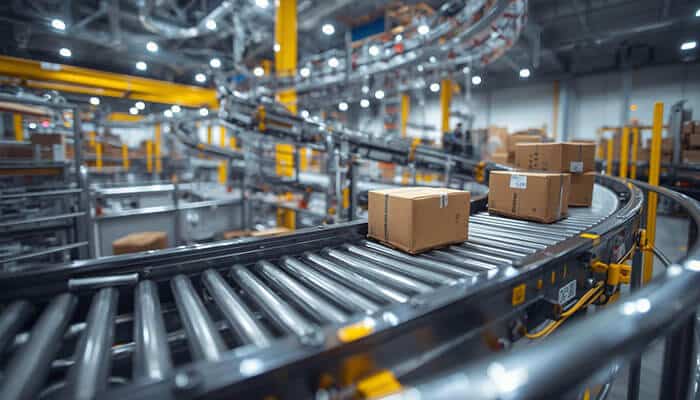
Spiral conveyors need floor space equal to their diameter—typically 4 to 12 feet across—at every level they pass through. A 6-foot diameter spiral rising 20 feet needs that 6-foot circular footprint on each floor it traverses.
Vertical lifts have a much smaller footprint, often just 4×4 or 5×5 feet for the lift itself, plus space for safe loading. They can be positioned against walls or in corners more easily.
However, spiral conveyors can be integrated directly into conveyor lines, allowing products to flow seamlessly. Vertical lifts create natural break points where products must be accumulated, lifted, and then reintroduced.
Maintenance And Reliability Considerations
Spiral conveyors have fewer moving parts than vertical lifts. There’s no complex lifting mechanism, no cables under tension, and no motors fighting gravity with full loads. This typically translates to less frequent maintenance.
Vertical lifts have more mechanical complexity with lifting mechanisms, safety systems, and controls. They require regular inspection of cables, chains, and brakes.
Energy consumption differs significantly. Spiral conveyors run continuously, consuming steady power throughout operating hours. Vertical lifts only use power during lifting cycles, which can result in lower energy costs for lower-volume operations.
Cost Comparison
Initial investment costs vary widely. Generally, spiral conveyors range from $50,000 to $200,000+ for standard industrial applications.
Vertical lifts typically start around $30,000 for basic models and can exceed $150,000 for heavy-duty pallet lifts. They’re often less expensive for the same vertical rise, especially when handling heavier loads.
Spiral conveyors require specialized installation and structural support at multiple points. Vertical lifts need solid foundations and overhead support but typically install faster. Over 10 years, the lower maintenance costs of spiral conveyors can offset their higher initial price.
Safety Features And Compliance
Both systems have evolved to meet modern safety standards but address different risk profiles. Spiral conveyors present risks related to pinch points and rotating components. They require guarding, emergency stops, and careful design to prevent jams.
Vertical lifts deal with risks related to moving platforms and falling objects. They typically include safety gates, interlocks, overload sensors, and emergency lowering systems.
Spiral conveyors generally keep workers further from the vertical transport zone since products load automatically. Vertical lifts may require operators to work closer to the lift zone during loading.
What Are The Key Operational Factors?
Before committing to either system, evaluate several operational metrics that directly impact which solution will perform better.
Calculate your actual throughput requirements in units per hour at peak times. Spiral conveyors maintain consistent throughput. Vertical lifts require different calculations—if each lift cycle takes 45 seconds and you fit 15 cartons per load, you’re looking at about 1,200 cartons per hour maximum.
Product characteristics matter significantly. Measure not just weight, but also stability. Round containers like bottles behave differently on spirals than on lift platforms. Products with high centers of gravity may tip during lift acceleration but handle fine on gradual spiral inclines.
Environmental conditions also play a role. Temperature-controlled environments or food-grade facilities often favor spiral conveyors because they’re easier to seal and sanitize.
How Do Integration Requirements Affect Selection?
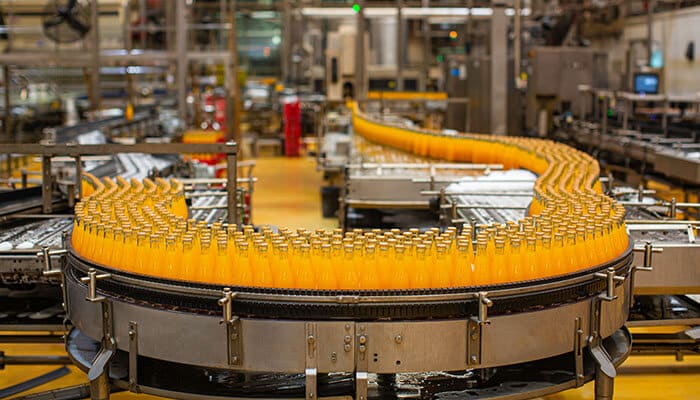
The way each system connects with your existing material handling equipment significantly impacts efficiency.
Spiral conveyors integrate seamlessly into conveyor networks. Products move from a horizontal belt onto the spiral and back to a horizontal belt without stopping.
Vertical lifts require more complex integration. You need accumulation zones before the lift to collect products into batches, and discharge systems after the lift. Product tracking becomes more complicated.
Fully automated facilities benefit from spiral conveyors because products just keep moving. Facilities with manual processes between levels might prefer vertical lifts because they create natural staging points where workers can access products.
What Are The Long-Term Operational Cost Differences?
While initial purchase price gets most attention, the total cost of ownership over 10-15 years often tells a very different story.
Energy costs accumulate differently. Spiral conveyors run continuously during operating hours, typically consuming 5-15 kW. Vertical lifts only consume power during lift cycles—perhaps 10-20 kW but only for 30-40% of operating time.
Maintenance costs follow different patterns. Spiral conveyors need regular belt inspection and lubrication. Annual maintenance typically runs $2,000-$5,000. Vertical lifts require more frequent safety inspections and cable replacement. Annual costs often run $3,000-$8,000.
Downtime costs can dwarf direct maintenance expenses. Spiral repairs often take longer because accessing components along the spiral path is more difficult than working on a vertical lift’s concentrated mechanical systems.
Can You Modify Or Expand These Systems?
Flexibility for future growth often gets ignored during initial planning, but most facilities evolve significantly over a 10-15 year equipment lifespan.
Spiral conveyors are essentially permanent installations. Once you’ve determined the diameter, height, and location, those parameters are locked in. You can’t easily make a spiral taller without replacing major components.
Vertical lifts offer considerably more flexibility. Many models allow you to add height by extending the mast. You can often increase capacity by upgrading the lifting mechanism. Changing entry and exit points is relatively straightforward.
Spiral conveyors can increase speed somewhat, but there are practical limits based on product stability. Vertical lifts can sometimes double their throughput by optimizing loading procedures or upgrading to faster lifting mechanisms.
Map Your Requirements To The Right System
Create a detailed profile of your products, throughput needs, space constraints, and future growth plans, then consult with manufacturers from both categories to get proposals tailored to your actual situation. The right choice isn’t about which system is better overall—it’s about which system aligns with the unique demands of your facility and will deliver the best total cost of ownership over its lifespan.