
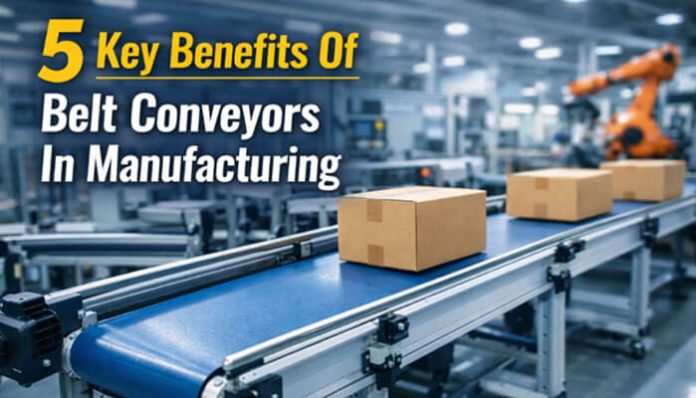

Manufacturing plants require constant material flow. However, stalling components between stations reduces production and increases labor expenses. In Belt Conveyors in Manufacturing, employees avoid wasting time taking parts, moving boxes, or carts on the floor.
As a result, such manual handling disrupts the workflow and predisposes the possibility of errors or injuries. Over time, inefficient material transport becomes a hidden barrier to productivity.
To address this issue, belt conveyor systems are a viable alternative to that challenge. The materials are transported automatically by a belt conveyor, which runs over a predetermined pattern linking various phases of the production process.
In this way, moving products between workstations could be done in a smooth manner without the use of manual transport. This article discusses what belt conveyors are, how manufacturers use them, and the five key benefits they bring to modern manufacturing.
What are Belt Conveyors?
Belt conveyors are machines that are used to transport materials between two places with a continuous loop of belt. The belt normally passes over a number of rollers and pulleys, which direct movement on a fixed path.
This system is supported by a motor that enables the belt to carry goods at a steady pace over a short or long distance within a facility. Manufacturers depend on the belt conveyors since the machine offers a controlled and predictable flow of materials.
Uses of Belt Conveyors
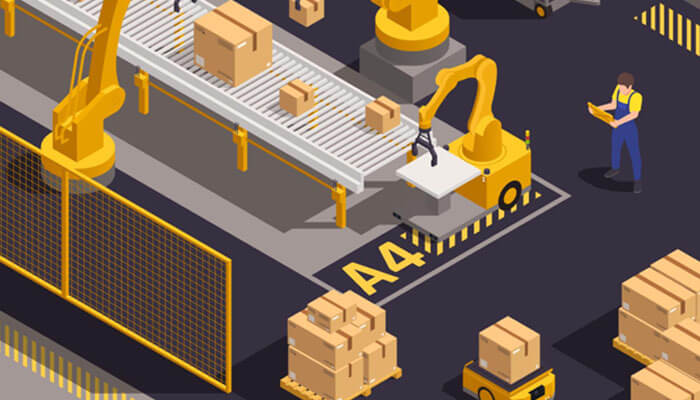
Belt conveyors are used to join distinct production steps in manufacturing plants. Finished products may pass through packaging or shipping stations and raw materials between storage areas to processing machines.
The system generates a consistent workflow that advances continuous production. Belt conveyors also assist industries where there is a need to handle the products carefully. These systems are frequently used in electronics assemblies, food processing facilities, car manufacturing plants, and warehouses.
Key Benefits of Belt Conveyors
Now that you have an understanding of what belt conveyors are and how manufacturers use them, it becomes easier to see why these systems are widely adopted. Below are the five key benefits of belt conveyors to modern manufacturing operations:
1. Continuous Material Flow
A constant flow of materials is necessary in manufacturing settings. This is done with the help of a belt conveyor system, as it is a continuous roll of material that rotates on rollers and pulleys. Manufacturers use belt conveyors to transport parts, packaged goods, raw materials, and components between workstations without constant human handling.
Continuous transport offers measurable operational improvements. Research published highlights that conveyor systems significantly reduce manual handling while improving efficiency across industrial production environments. When materials move automatically between processes, production bottlenecks decrease and throughput increases.
2. Reduced Labor Requirements
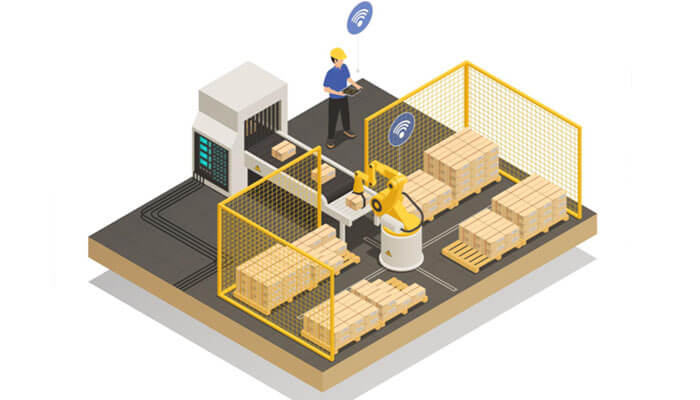
Handling materials manually takes time and labor. There is always a lot of waste of time when workers have to transfer parts inside assembly areas, in storage, and at packaging plants.
These repetitive movements are automated by belt conveyors, and the personnel can focus on something higher in value, like monitoring equipment, conducting inspections, or managing production systems.
Labor reduction does not simply mean fewer workers on the floor. It also improves workforce efficiency. Automated transport systems allow one operator to supervise multiple production stages at once. As production lines expand, conveyor systems scale far more efficiently than manual handling methods.
3. Improved Workplace Safety
Manufacturing facilities involve heavy materials, repetitive motion, and constant movement. When workers frequently carry loads across the floor, the risk of accidents increases. Strains, slips, and dropped materials are common hazards in manual transport environments.
Belt conveyors eliminate those risks by minimizing physical lifting and carrying. As the materials transfer between the stations, they stay on the conveyor surface.
Additional aspects added to modern conveyor systems are sensors, emergency stops, and guards, which assist in safe operation. Manufacturers also provide safer workplaces, as well as minimize downtimes incurred because of injuries.
4. Energy Efficiency and Cost Control
Energy consumption plays a major role in manufacturing costs. Transport equipment that operates continuously must use power efficiently. Belt conveyors are widely recognized for their relatively low energy requirements compared with many other material handling methods.
Research published shows that improvements in belt design and drive systems can significantly reduce energy consumption by lowering rolling resistance and mechanical losses in conveyor drives.
Lower resistance allows motors to operate more efficiently while maintaining steady transport speeds. Over time, energy-efficient conveyor systems reduce operational expenses while supporting sustainable manufacturing goals.
5. Flexible Layout Adaptation
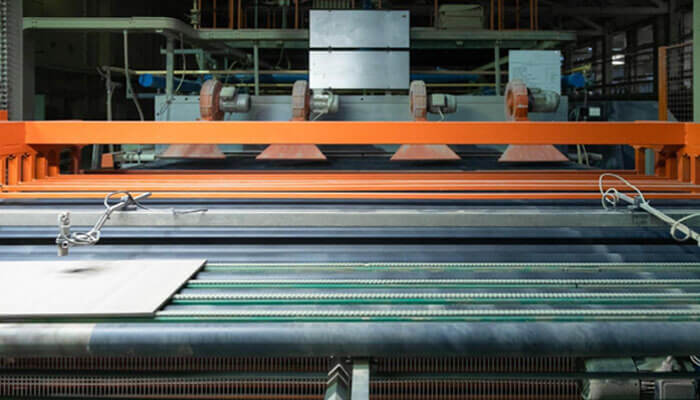
Manufacturing environments rarely remain static. Production lines evolve as companies introduce new products, adjust volumes, or reorganize workflow. Equipment that cannot adapt quickly becomes a limitation. Belt conveyors provide layout flexibility that helps facilities respond to changing production needs.
Conveyor systems can run horizontally, vertically, or along inclined paths. Engineers can design routes that move around equipment, through tight areas, or between multiple production floors.
Adjustable belt speeds also allow manufacturers to match conveyor output with different machine cycles. This adaptability allows conveyor systems to integrate into existing facilities without major structural modifications.
Conclusion
Belt conveyors are one of the key components of a manufacturing system. These systems transfer materials continuously through production lines and minimize human labor.
This enhances security and manages the use of energy. Their versatile structures also enable engineers to come up with effective work processes that can be easily scaled up or down depending on manufacturing needs.
Manufacturers seeking to improve material handling efficiency should start by evaluating how products move through their facility. Mapping those pathways often reveals opportunities to replace manual transport with automated conveyor systems.
Even a single conveyor installation can remove bottlenecks and improve production flow almost immediately.