

How we picked the nine winners
We began with one question you care about most: “Who will lend to a brand-new business without gut-punch rates or paperwork purgatory?” From there, we reviewed dozens of bank, fintech, and community offers to uncover the options that provide real access, fair cost, and reliable support.
First, we set firm guardrails. Every lender on the list
- lends nationwide
- accepts companies under two years old
- caps borrowing costs below forty percent
- publishes rates or fees in plain sight
Providers that paused originations, operated in only a few states, or scored below a B on BBB or 3.5 on Trustpilot were removed.
Next, we graded the remaining contenders against five weighted factors that mirror the pain points founders highlight online:
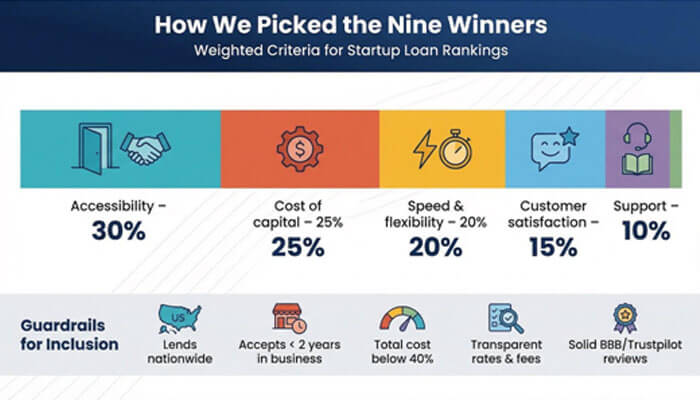
- Accessibility 30 percent (low credit, limited revenue, short time in business)
- Cost of capital 25 percent (APR or factor plus fees)
- Speed and flexibility 20 percent (approval time, funding time, line versus lump sum)
- Customer satisfaction 15 percent (public reviews and service reputation)
- Support 10 percent (human guidance, learning tools, calculators)
Accessibility gets the highest weight because recent SBA guidance lets lenders skip collateral on loans up to $50,000, opening doors for first-time owners with more hustle than hard assets sba.gov.
Finally, we checked every score against live borrower discussions on Reddit, where founders share blunt wins and warnings in real time. The outcome is a ranked shortlist you can trust, built on transparent math and current rules, not yesterday’s marketing copy.
1. Lendio: the SBA matchmaker built for first-timers
Securing an SBA loan on your own can feel like translating tax code while juggling flaming swords. Lendio lightens the load by routing one application to more than 75 lenders and coaching you through the paperwork that still comes with government-backed funding.
According to a January 2026 rate roundup from Nav.com, rates stay in the single digits to low teens—roughly 9.75 percent to 14.75 percent—for most 7(a) deals. That’s a fraction of the 30-plus percent common with many “easy-approval” fintech loans.
What pushes Lendio to the top of our list is access. The platform welcomes founders with personal FICO scores in the low 600s and less than two years of operating history, then pairs them with banks that now waive collateral on loans up to $50,000 under the 2023 SBA rule change. Translation: you keep your house keys and your startup still gets cash.
Turnaround isn’t instant: the average SBA file still takes two to four weeks. Lendio’s funding coaches keep the process moving and flag missing docs before a banker kicks your file back. That guidance can shave days off approval and spare you the “lost in underwriting” black hole.
At-a-glance
- Typical loan size: $30,000–$350,000
- Estimated APR: 9.75 percent–14.75 percent
- Time to funds: two to four weeks
- Minimum credit score: about 600
- Best for: owners who want bank-level rates without bank-level headaches
If you want the lowest possible cost and can wait a few weeks, start your search here. We’ve linked Lendio’s SBA portal so you can check eligibility without dinging your credit.
2. OnDeck: lightning-fast cash when time is money
Sometimes you cannot wait weeks for an SBA underwriter to approve your file. You need payroll by Friday or inventory before a flash sale ends. That is when OnDeck shines. The online lender approves most qualified borrowers the same day and wires funds as soon as the next business morning.
The trade-off is price. OnDeck’s term loans and revolving lines start near thirty percent APR (about triple a bank loan), but founders keep choosing the company because the math can work. Paying a premium on a four- to twelve-month loan often beats missing a revenue spike.
Qualifying is simple. Show at least one year in business, around $100,000 in annual revenue, and a personal FICO of 625 or higher. Collateral is optional for smaller balances, though you will sign a personal guarantee. Upload bank statements, connect your business account, and you can move forward quickly.
Customer reviews back the speed claims. Many users on Reddit and Trustpilot note applying over lunch and seeing an approval email before dinner. The platform’s support team also earns credit for guiding newcomers through repayment schedules and early-payoff discounts, small touches that lessen the sting of a higher rate.
At-a-glance
- Typical funding speed: 24 hours
- Loan sizes: $5,000–$250,000 term, up to $200,000 line
- Starting APR: about 29.9 percent
- Minimum requirements: 1 year in business, $100K revenue, 625 FICO
- Best for: founders who value rapid access over lowest cost
3. Fundbox: a credit line in three minutes
Picture this: you open your laptop at breakfast, request capital, and see “approved” before the coffee cools. That is Fundbox. The fintech’s software reviews your bank data, returns a decision in as little as three minutes, and wires money the next business day. Based on Bankrate’s review, approvals can indeed happen that fast.
Fundbox keeps its door open to young businesses with just three months of operating history, about $100,000 in annual revenue, and a 600 personal FICO score. No collateral, no mountains of PDFs. You draw only what you need, then repay weekly over 12 or 24 weeks at a flat fee that starts around 4.66 percent for the shorter term, again according to Bankrate.
The catch? Short repayment windows require disciplined cash flow. Miss a weekly debit and Fundbox tacks on a six-dollar NSF fee, so keep a cushion. Still, for swing-season inventory or a marketing blitz that cannot wait, the speed-to-cash ratio is hard to beat.
At-a-glance
- Credit line: $1,000–$150,000
- Decision time: roughly three minutes
- Funding: one business day
- Cost: weekly fees equal to 4.66–8.99 percent of each draw
- Best for: founders who value ease and immediacy over long-term amortization
4. BlueVine: flexible credit that grows with your sales cycle
When your cash flow swings with customer invoices, a traditional term loan can feel like wearing a winter coat in July: helpful but poorly timed. BlueVine smooths the mismatch with two tools—a revolving line of credit up to $250,000 and an invoice-factoring program that advances up to 90 percent of an outstanding bill.
Qualifying is straightforward. Show six months in business, at least $100,000 in annual revenue, and a 625 personal FICO score to be in the running. Approvals often land the same day, with funds available within 24 hours. Rates for the credit line start near 7.8 percent, well below many online rivals, but the repayment window is short—typically 26 weeks—so each draw needs a clear profit plan.
Founders appreciate the flexibility. You can tap funds for an inventory buy, repay as invoices close, then draw again without re-applying. That revolving pattern builds business credit each cycle, a plus when you graduate to longer-term funding.
BlueVine does require a personal guarantee and automatic weekly debits, so monitor your account to avoid surprise sweeps. Still, for owners who juggle B2B receivables or seasonal spikes, the platform balances speed, cost, and control.
At-a-glance
- Loan types: line of credit ($5,000–$250,000) and invoice factoring
- Funding speed: 24 hours after approval
- Starting APR: about 7.8 percent
- Minimums: 6 months in business, $100K revenue, 625 FICO
- Best for: businesses with lumpy cash flow that need repeat access to working capital
5. American Express Business Line of Credit: swipe-level ease for bigger needs
Remember Kabbage, the fintech that wrote checks in minutes? American Express bought the engine, polished the interface, and now runs the show under its own banner. The result is a credit line that feels as effortless as tapping your Amex card, and the limit can reach $250,000.
Here is the draw: you skip the document scavenger hunt. Connect your business bank account, grant read-only access, and the platform crunches deposit data to underwrite your line. Most applicants see a decision within hours and can pull cash in two business days. Credit requirements hover around a 660 FICO, and revenue hurdles are light, roughly $3,000 in monthly deposits.
Costs fall in the mid-teens to low-twenties APR once you translate Amex’s flat monthly fees. That price beats many fast-funding rivals yet remains higher than an SBA loan, so reserve the line for working-capital gaps, not long-term projects. Repayment terms run six, twelve, or eighteen months, offering more breathing room than Fundbox’s weekly cadence.
The fine print: every draw starts a new installment plan, and a personal guarantee is mandatory. Still, for founders who already trust Amex for travel points, integrating a low-doc credit line into the same dashboard feels smooth.
At-a-glance
- Credit line: up to $250,000
- Decision speed: same day
- Funding: two business days
- Typical cost: effective 15–25 percent APR
- Minimums: 1 year in business, 660 FICO, $3K monthly deposits
- Best for: owners who want credit-card simplicity at business-loan scale
6. QuickBridge: big checks without bank baggage
Need more than six figures yet still want funds this week? QuickBridge fills the gap between fintech speed and bank-sized checks, offering term loans from $10,000 to $500,000 with funding as fast as the next business day.
The company relies on factor rates rather than traditional APRs. Think of a factor as a one-time fee multiplied by your loan amount. Entry pricing hovers around 1.11 for short six-month terms, translating to an effective APR in the low twenties. The longer you stretch payments (up to thirty-six months), the higher the fee, so aim for the shortest term your cash flow can handle.
Eligibility stays within reach for many startups: roughly one year in business, $96,000 in annual revenue, and a 600 personal credit score open the door. No collateral is required on smaller balances, and the online application takes about ten minutes.
Where QuickBridge stands out is human service. Every borrower gets a dedicated funding advisor who calls, not emails, to walk through approval terms and repayment calendars. That guidance matters when you are juggling factor-rate math and need clarity fast.
At-a-glance
- Loan size: $10,000–$500,000
- Funding speed: next business day
- Cost: factor rates starting near 1.11 (≈ 20–25 percent APR on six-month terms)
- Minimums: 1 year in business, $96K revenue, 600 FICO
- Best for: startups that outgrew micro-loans but still need rapid funding
7. Accion Opportunity Fund: mission-driven money for overlooked founders

Every founder deserves a fair shot, yet traditional underwriting often sidelines women, minority, and immigrant-owned startups. Accion Opportunity Fund (AOF) works to close that gap. The nonprofit CDFI pairs affordable capital with coaching, offering term loans from $5,000 to $250,000 at rates that start near 8.5 percent, roughly half the cost of many online competitors.
Accessibility is AOF’s hallmark. The organization can work with credit scores in the high 500s and accepts businesses just one year old with as little as $50,000 in annual revenue. Instead of a quick “no,” loan officers dig into story, community impact, and growth plans. That human lens helps founders who look risky on paper yet viable in real life.
Turnaround takes one to two weeks, slower than fintech speedsters but faster than most banks. During that window, borrowers gain free access to webinars, budgeting templates, and mentoring sessions that sharpen financial skills long after the check clears. Those extras feed our “support” score and explain why AOF earns rave reviews despite modest loan sizes.
Because funds come from a nonprofit pool, availability can tighten near fiscal year-end, so apply early. Repayment terms cap at five years, which keeps the monthly payment digestible without being bargain-basement.
At-a-glance
- Loan size: $5,000–$250,000
- APR: about 8.5 percent–18 percent
- Funding time: one to two weeks
- Minimums: 1 year in business, $50K revenue, flexible credit
- Best for: founders who value guidance and inclusive underwriting over raw speed
8. Kiva: zero-interest loans powered by your community
Free money may sound like folklore, yet Kiva’s crowdfunded microloan platform proves it is possible—if you can rally supporters. Entrepreneurs post a profile, invite friends and customers to back the first portion, and then tap Kiva’s global network to raise up to $15,000 at zero percent interest.
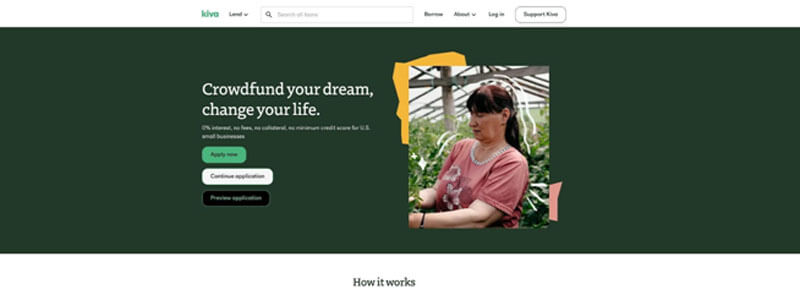
There is no credit check, no collateral, and no revenue minimum. Approval depends on character: your business plan, social capital, and willingness to engage donors during a 15-day private fundraising window. Once you hit that initial target—often a few dozen people pledging $25 each—Kiva’s wider community usually fills the rest within days.
After funding, you repay over 12 to 36 months, interest-free. The price you pay is time: crafting a compelling story, nudging backers, and posting updates. Founders with lively social channels ace that requirement; introverts may find it tougher.
Because loan amounts are small, Kiva works best for prototype inventory, certifications, or a pilot marketing push when traditional lenders say “too early.” Think of it as a micro-stage rehearsal before you graduate to larger capital.
At-a-glance
- Loan size: up to $15,000
- Cost: 0 percent interest, no fees
- Funding speed: 15–45 days (campaign dependent)
- Eligibility: global, no credit or revenue requirements
- Best for: mission-driven founders with an engaged community and modest capital needs
9. SBA microloans: small checks, strong training wheels
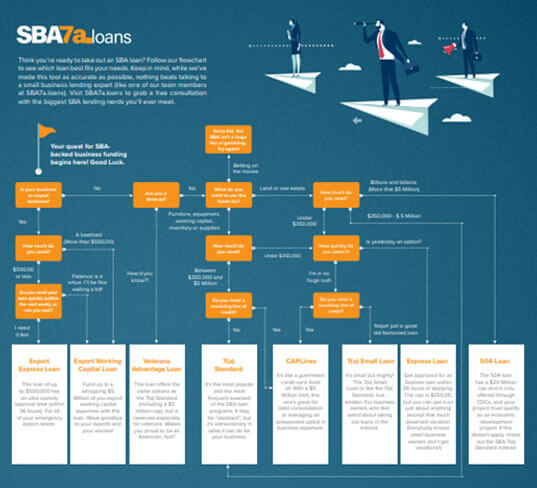
Think of SBA microloans as the bicycle with training wheels of business finance. You will not top out at Tour de France money (the ceiling is $50,000), but you gain balance, credibility, and coaching that prepare you for bigger rides.
According to the SBA’s microloan program page, the agency lends funds to nonprofit intermediaries, often local CDFIs, which then make loans to brand-new ventures. Because risk is shared with the government, rates stay friendly at about seven to nine percent, and collateral rules relax; loans under $50,000 now skip collateral entirely under the August 2023 reforms.
Startups value microloans for three reasons:
- Lenient requirements. Many intermediaries accept six months of operating history and credit scores in the high 500s.
- Hands-on help. Training, budgeting templates, and mentorship often come bundled so that borrowers build skills while repaying.
- Credit springboard. On-time payments build business credit, smoothing the path to bank or SBA 7(a) funding later.
Trade-offs remain: paperwork rivals a regular SBA loan, and funding can take six to twelve weeks. Amounts also rarely exceed $20,000 in practice, so consider the program for starter inventory, a food-truck retrofit, or early marketing—not a full restaurant build-out.
At-a-glance
- Loan size: up to $50,000 (average around $13,000)
- APR: roughly seven to nine percent
- Funding time: six to twelve weeks
- Eligibility: startups under two years, ~580+ credit, low revenue floor
- Best for: first-time owners who value education as much as capital
FAQs: your top borrowing questions, answered fast
Can I get a loan if my business is under one year old?
Yes. Fundbox approves firms after just three months on the books, and SBA microloan intermediaries welcome six-month-old ventures. The key is showing consistent revenue, even if it’s modest, along with healthy personal credit or community backing.
What if my credit score is below 620?
Accion Opportunity Fund and some microloan providers weigh cash flow, industry experience, and community impact more than a single number. Kiva skips credit checks entirely, relying on social underwriting instead.
How long does funding take?
Fintech lines such as Fundbox and OnDeck can move money in 24 hours. SBA-backed options take two to twelve weeks because banks and the government double-check every detail, so plan your runway accordingly.
Is a line of credit better than a term loan?
Lines shine when expenses pop up in waves—inventory or payroll gaps, for example. Term loans work best for one-time buys like equipment or a franchise fee. If cash flow is lumpy, start with a line; if you need a set lump sum, choose a term loan.
Do I need collateral?
Not always. Online lenders rarely ask for hard assets, though they do require a personal guarantee. Recent SBA reforms waive collateral on loans under $50,000, removing a big hurdle for first-time owners.
Where do grants fit in?
Treat grants as icing. They are free but fiercely competitive and slow. Use them to top off projects, not as your primary lifeline.
Conclusion
Still weighing options? Bookmark this guide, run the numbers with a payment calculator, and apply before you need the cash. Borrowing is easier when your back isn’t against the wall.