
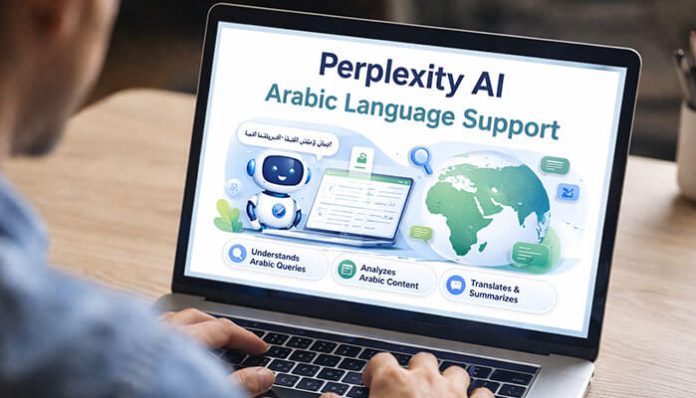

Artificial intelligence search platforms are rapidly transforming how people access information online. Among the newest AI-powered tools, Perplexity AI has gained global attention as an intelligent search engine that combines conversational AI with real-time web research. As the platform expands globally, many users are exploring perplexity ai arabic language support to understand how effectively the system can process Arabic queries and analyze Arabic content.
An important question naturally follows:
Does Perplexity AI support Arabic language users?
The Arabic language is spoken by more than 460 million people worldwide, making it one of the most widely used languages globally. It is the official language of more than 20 countries across the Middle East and North Africa (MENA) and ranks among the top five most spoken languages worldwide, according to linguistic research sources such as Ethnologue.
Because of this massive user base, Arabic support in AI tools has become a critical requirement for digital accessibility, global knowledge access, and AI adoption in emerging markets.
Perplexity AI Arabic language support refers to the platform’s ability to understand Arabic queries, analyze Arabic web content, and generate AI-powered responses using multilingual language models. While the interface currently operates mainly in English, the system can process Arabic questions and research Arabic sources effectively.
This guide explores perplexity ai arabic language support, including its capabilities, multilingual architecture, limitations, real-world use cases, and the future of Arabic AI search technology.
What Is Perplexity AI?
Perplexity AI is an AI-powered answer engine and research assistant designed to provide direct answers to user questions while citing credible sources from the internet.
Instead of returning a list of links like traditional search engines, Perplexity synthesizes information and presents structured answers with references and source citations.
Key characteristics of Perplexity AI include:
- AI-powered conversational search
- Real-time web browsing and information retrieval
- Deep research summaries
- Follow-up question support
- Integration with multiple AI models
- Source-based AI answers
One of Perplexity’s most distinctive features is that it shows citations for every response, allowing users to verify the original sources used to generate answers.
These capabilities position Perplexity AI as a hybrid between a search engine, research assistant, and AI knowledge platform.
Evolution of Multilingual Capabilities in Perplexity AI
One of the major reasons Perplexity AI can support Arabic language queries is the evolution of multilingual large language models (LLMs).
Earlier search engines and AI systems were primarily optimized for English-language content. However, modern AI models are trained using massive multilingual datasets covering dozens of languages, including Arabic.
Perplexity integrates multiple advanced AI models and ranking systems such as:
- GPT-based models
- Claude AI models
- Mistral models
- Proprietary search-ranking and retrieval models
These technologies enable the platform to:
- Interpret Arabic queries
- Retrieve Arabic and multilingual sources
- Summarize global research content
- Translate and synthesize information across languages
Development of Multilingual Capabilities
Rather than a single release event, Perplexity’s multilingual capabilities have expanded gradually as AI models improved and new models were integrated into the platform.
| Period | Development Trend |
|---|---|
| Early releases | AI search focused mainly on English content |
| Model integrations | Addition of advanced multilingual LLMs |
| Research expansion | Improved cross-language retrieval and summarization |
| Current development | Continued improvements in global language support |
As AI models continue evolving, the list of Perplexity AI supported languages is expected to expand further.
How Perplexity AI Processes Arabic Queries
Perplexity AI processes Arabic queries using multilingual natural language processing systems that interpret meaning rather than translating words literally.
When a user submits a question in Arabic, the platform typically performs several technical steps:
- Language detection to identify Arabic input
- Semantic interpretation using multilingual AI models
- Information retrieval from Arabic and international sources
- Content summarization and synthesis
- Citation generation linking to original sources
This pipeline allows Perplexity AI to generate research-based answers even when queries are written in languages other than English.
Does Perplexity AI Support Arabic Language?
Partial Arabic Language Support
Perplexity AI can process Arabic queries and Arabic documents, meaning users can ask questions in Arabic and receive AI-generated answers.
The platform’s multilingual capabilities allow it to:
- Understand Arabic search queries
- Retrieve Arabic web content
- Summarize Arabic sources
- Translate results into other languages
In many cases, users can input Arabic questions and receive summarized information derived from both Arabic and multilingual sources across the web.
This functionality is made possible by large language models trained on multilingual datasets.
Current Limitations of Arabic Support in Perplexity AI
Despite progress in multilingual AI, Arabic language integration still has limitations.
1. Limited Interface Localization
The Perplexity interface is primarily designed in English. Although Arabic queries are supported, the platform interface itself is not yet fully localized in Arabic.
This means the system supports Arabic input and analysis, but the interface remains mostly English.
2. Mixed Language Responses
Sometimes:
- Arabic queries may return answers partly in English
- AI may combine Arabic and English sources
- Additional translation may be required
This occurs because many academic and high-authority sources online are still published in English.
3. Dialect Complexity
Arabic includes many regional dialects such as:
- Gulf Arabic
- Egyptian Arabic
- Levantine Arabic
- Maghrebi Arabic
Most AI systems perform best with Modern Standard Arabic (MSA) rather than highly localized dialects.
Perplexity AI API Arabic Language Support
Developers can also access Arabic capabilities through the Perplexity API, which allows integration of AI-powered search features into applications, websites, and research tools.
A major advantage of the API is the language filtering system.
Developers can apply ISO 639-1 language codes when retrieving results.
For example:
Arabic language filter code: ar
According to the Perplexity developer documentation, the API supports multiple language filters in a single request, allowing developers to retrieve results from specific languages.
Key developer features include
• Language Filters: Developers can restrict search results to Arabic-language sources.
• Multilingual Search Queries: Applications can process queries in Arabic while retrieving global research content.
• Integration With Arabic Applications:
Organizations can integrate Perplexity AI into:
- Arabic research platforms
- educational systems
- Arabic news monitoring tools
- AI-powered customer support platforms
• AI-Powered Arabic Chatbots:
Developers can build:
- Arabic knowledge assistants
- automated research tools
- multilingual AI help systems
This makes perplexity ai multilingual support particularly valuable for developers building products for the Middle East and North Africa (MENA).
What Arabic Users Can Expect When Using Perplexity AI

In real-world usage, Arabic users may experience the following:
- Arabic prompts usually work best when written in Modern Standard Arabic
- AI answers may combine Arabic and English information sources
- Some responses may require translation adjustments
- Results often improve when Arabic and English keywords are combined
For research tasks, Perplexity performs particularly well when summarizing Arabic news, academic research, and government reports.
Growing Demand for Arabic AI Tools
The demand for AI search Arabic language support is growing rapidly.
Key factors include:
- Arabic is among the five most widely spoken languages globally
- Over 400 million Arabic speakers worldwide
- The Middle East is one of the fastest-growing artificial intelligence markets
Countries investing heavily in AI include:
- Saudi Arabia
- United Arab Emirates
- Qatar
- Egypt
Government initiatives such as Saudi Vision 2030 aim to accelerate digital transformation and AI adoption across the region.
Real-World Use Cases of Perplexity AI for Arabic Speakers
Arabic language support enables many practical applications.
| Use Case | Description |
|---|---|
| Arabic academic research | Summarizing Arabic research papers |
| Arabic news analysis | Monitoring regional news |
| Arabic business research | Market insights for MENA markets |
| Arabic content writing | Generating blog ideas |
| Translation and summarization | Arabic ↔ English knowledge access |
These use cases make perplexity ai arabic language support valuable for students, researchers, journalists, and businesses.
Comparison of Perplexity AI With Arabic-Focused AI Language Models
Some AI systems are specifically optimized for Arabic language processing.
| AI Model | Arabic Optimization | Citations | Use Case |
|---|---|---|---|
| Jais AI | High | Limited | Arabic research |
| Falcon LLM | Moderate | Limited | Enterprise AI |
| AraGPT | High | Limited | Arabic NLP |
| Perplexity AI | Moderate | Strong | AI research search engine |
Although specialized Arabic models may have stronger language optimization, Perplexity excels at source-based AI research and web-grounded answers.
Perplexity AI Supported Languages and Multilingual Capabilities
Perplexity AI is designed as a multilingual AI research platform, meaning it can understand and process queries across many global languages. The system relies on multilingual large language models that allow users to search for information beyond English content.
While perplexity ai arabic language support is an important capability for users in the Middle East and North Africa, the platform also supports many other widely spoken languages.
Examples of Languages Supported by Perplexity AI
| Language | AI Query Support | Content Analysis |
|---|---|---|
| English | Excellent | Full support |
| Arabic | Partial to strong | Multilingual processing |
| Spanish | Strong | Full multilingual support |
| French | Strong | Content summarization |
| German | Strong | Research analysis |
| Chinese | Moderate | Multilingual processing |
| Japanese | Moderate | AI query interpretation |
These multilingual capabilities allow Perplexity AI to function as a global research assistant rather than a traditional search engine.
For Arabic users, this means the platform can analyze both Arabic-language sources and international research, making it easier to access global knowledge while still supporting regional content.
As multilingual AI models continue improving, the list of supported languages — including perplexity ai arabic language support — is expected to expand further.
Technical Challenges of Arabic Natural Language Processing
Arabic language processing presents unique technical challenges.
Right-to-Left Text Structure
Arabic text flows from right to left, requiring specialized formatting systems.
Arabic Morphology
Arabic words change form depending on grammar and context.
Diacritics
Arabic diacritical marks influence pronunciation and meaning.
Dialect Diversity
Different Arabic dialects create additional complexity for AI interpretation.
Because of these factors, building accurate Arabic NLP systems requires specialized training datasets and linguistic models.
The Future of Arabic Support in Perplexity AI
Several trends suggest Arabic AI support will continue improving.
Arabic Dataset Expansion
AI companies are expanding Arabic training data.
Regional AI Investments
Middle Eastern countries are investing heavily in AI infrastructure.
Local AI Model Partnerships
Global AI companies are partnering with regional organizations.
Arabic-Focused AI Research
Universities and AI startups are developing Arabic-optimized language models.
These developments will likely significantly improve perplexity ai arabic language support in the coming years.
Tips for Using Perplexity AI in Arabic
To improve search results:
- Use Modern Standard Arabic
- Request translation when needed
- Ask the AI to summarize Arabic sources
- Combine Arabic and English keywords
Example prompt:
“Summarize the latest Arabic news about renewable energy in Saudi Arabia.”
Perplexity AI Arabic Language Support FAQs
1. Does Perplexity AI support the Arabic language?
Yes, perplexity ai arabic language support allows users to ask questions in Arabic and receive AI-generated answers. The system can analyze Arabic websites and summarize Arabic content, although the interface is mainly in English.
2. How does Perplexity AI process Arabic queries?
Perplexity AI uses multilingual NLP models to detect Arabic input, understand the query meaning, retrieve Arabic and global sources, and generate summarized answers with citations.
3. Can Perplexity AI translate Arabic content into other languages?
Yes, perplexity ai arabic language support includes translation capabilities. The platform can analyze Arabic documents and translate key insights into English or other languages.
4. What are the limitations of Perplexity AI Arabic language support?
Current limitations include an English-based interface, mixed Arabic and English responses, and challenges with regional Arabic dialects. The system works best with Modern Standard Arabic.
5. Why is Arabic language support important for AI search engines?
Arabic support is important because more than 400 million people speak Arabic worldwide. Improving perplexity ai arabic language support helps AI platforms deliver better research and knowledge access in the Middle East and North Africa.
Conclusion
Perplexity AI is rapidly emerging as one of the most powerful AI research engines and answer platforms available today. While Arabic language support is currently partial, the platform already enables users to search, analyze, and summarize Arabic content using multilingual AI technologies.
As artificial intelligence models continue evolving and multilingual datasets expand, perplexity ai arabic language support will likely improve significantly, enabling millions of Arabic speakers to access AI-powered knowledge discovery tools.
For researchers, businesses, and content creators across the Middle East and North Africa, the expansion of Arabic AI capabilities represents an important step toward a more inclusive global AI ecosystem.