


Last updated: September 2026
Campo minado is the Portuguese name commonly used for Minesweeper, the classic logic puzzle in which players reveal safe cells while avoiding hidden mines. Although the rules are simple, successful play depends on reading numbers, identifying patterns, making logical deductions, and managing uncertain situations.
Today, you can jogar campo minado on computers, smartphones, and websites offering campo minado online versions. Some modern versions also add custom boards, statistics, no-guess modes, advanced difficulty settings, and competitive timing.
This complete guide explains what campo minado is, how to play campo minado, what the numbers mean, classic difficulty levels, strategies, online versions, the Campo Minado do Google search intent, advanced techniques, and common questions.
What Is Campo Minado?
Campo minado is a single-player logic puzzle played on a rectangular grid containing hidden mines.
The objective is straightforward:
REVEAL EVERY SAFE CELL WITHOUT CLICKING ON A MINE.
When a safe cell is opened, it may display a number from 1 to 8. That number tells you exactly how many mines are located in the surrounding cells, including diagonal neighbors.
For example, if a revealed cell contains 3, exactly three of its surrounding cells contain mines.
The game therefore becomes a process of collecting information and using that information to determine which covered cells are safe and which contain mines.
Is Campo Minado the Same as Minesweeper?
Yes. Campo Minado and Minesweeper refer to the same general type of game.
Minesweeper is the English name.
Campo Minado is the Portuguese name.
The objective and basic number system are essentially the same.
Individual versions can have different board sizes, controls, graphics, first-click rules, or special modes.
This distinction is useful when searching for campo minado online, because many websites use the English term “Minesweeper” even when the player is searching for the Portuguese name.
What Is the Goal of Campo Minado?
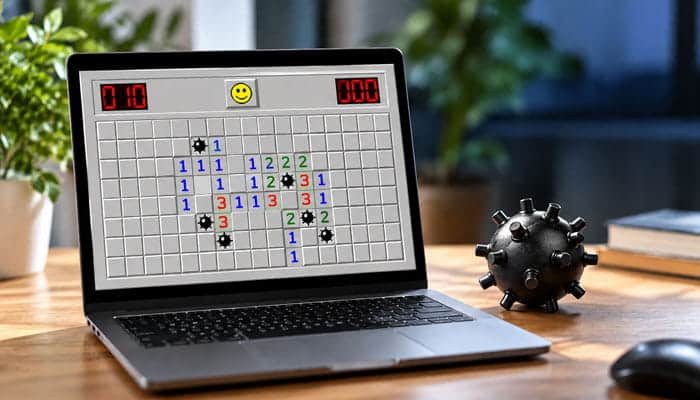
The goal is to uncover all non-mine cells.
You do not need to click every mine or physically remove mines. Instead, you win when every safe cell has been revealed. You do not have to flag every mine to win. Flags are optional markers that can help you keep track of suspected mines.
A typical game has three important cell states:
| Cell state | Meaning |
|---|---|
| Covered | The contents are unknown |
| Revealed number | The cell is safe and shows the number of adjacent mines |
| Mine | A dangerous cell that must not be revealed |
Flags are normally used as visual markers to identify suspected mines, but a flag itself does not prove that the cell contains a mine.
How to Play Campo Minado
The basic process is:
- Open a covered cell.
- Read the number revealed.
- Count the surrounding covered cells.
- Determine which cells must contain mines.
- Mark suspected mines if desired.
- Identify cells that are guaranteed to be safe.
- Open those safe cells.
- Continue using the new information until the board is cleared.
The most important skill is learning to treat the numbers as constraints, rather than simply looking for familiar shapes.
First-click behavior can vary by implementation. Many modern versions protect the first click, while some may also guarantee a larger safe opening. Always check the rules of the version you are playing.
What Do the Numbers Mean?
Every revealed number represents the number of mines among its neighboring cells.
A cell can have up to eight neighbors:
- Above
- Below
- Left
- Right
- Upper-left diagonal
- Upper-right diagonal
- Lower-left diagonal
- Lower-right diagonal
For example:
- 1 = exactly one neighboring mine
- 2 = exactly two neighboring mines
- 3 = exactly three neighboring mines
- 8 = all eight neighboring cells contain mines
Example
Imagine a revealed 1 touches three covered cells.
If one of those three cells is already known to contain a mine, the other two cells are safe.
The reasoning is:
1 required mine − 1 known mine = 0 additional mines
Therefore, the remaining covered neighbors can be opened safely.
A Worked Campo Minado Deduction Example
Suppose a revealed cell contains 2 and touches four covered cells.
You determine that two of those four cells must be mines.
Once those two mines are identified, the other two cells cannot contain mines because the number 2 has already been satisfied.
This gives you two separate conclusions:
- Two cells are mines.
- Two cells are safe.
This simple relationship forms the foundation of advanced Campo Minado play.
What Are Empty or Zero Cells?
A blank cell represents zero adjacent mines.
Because none of its neighboring cells contain mines, the game can safely reveal neighboring cells automatically. This often creates a large opening or cascade across the board.
These automatic openings are particularly important for speed because a single click can reveal many safe cells.
What Are Flags in Campo Minado?
A flag is a marker placed on a covered cell that you believe contains a mine.
On many desktop versions:
- Left-click reveals a cell.
- Right-click places or removes a flag.
On mobile versions, controls vary. Common alternatives include:
- Long-pressing a cell
- Switching to a flag mode
- Using an on-screen control
Important: Flags Are Not Proof
A flag is a tool for you, not necessarily a verification mechanism.
If you accidentally flag a safe cell, the game may continue until your incorrect assumption causes a later move to reveal a mine.
For this reason, strong players do not simply count flags. They also verify that their assumptions are logically supported by the surrounding numbers.
Classic Campo Minado Difficulty Levels
The traditional Minesweeper configurations are commonly represented by three standard levels:
| Difficulty | Board size | Total cells | Mines | Mine density | Safe cells |
|---|---|---|---|---|---|
| Beginner | 9 × 9 | 81 | 10 | 12.3% | 71 |
| Intermediate | 16 × 16 | 256 | 40 | 15.6% | 216 |
| Expert | 30 × 16 | 480 | 99 | 20.6% | 381 |
These classic configurations are widely used by Minesweeper websites and communities.
Beginner
Beginner is generally the easiest standard board and is useful for learning:
- Number counting
- Basic deductions
- Flags
- Safe-cell identification
- Simple patterns
Intermediate
Intermediate increases both the board size and the number of mines. You encounter longer chains of deductions and more complex boundaries between known and unknown cells.
Expert
Expert uses a 30 × 16 board with 99 mines. The higher mine density means there are more complicated situations and less room for error.
What Is Mine Density?
Mine density is the percentage of board cells occupied by mines.
The classic configurations illustrate why Expert is not simply a larger Beginner board.
- Beginner: about 12.3%
- Intermediate: about 15.6%
- Expert: about 20.6%
As the density increases, there are generally more constraints and fewer broadly open areas.
Mine density is therefore useful when comparing the basic difficulty of different board configurations.
Campo Minado Online
Campo minado online refers to browser-based versions that let you play without installing a traditional desktop game.
Online versions can offer features such as:
- Beginner, Intermediate, and Expert boards
- Custom board sizes
- Timers
- Win statistics
- Best times
- Keyboard controls
- Mobile support
- No-guess modes
- Competitive statistics
- Different visual themes
However, online implementations are not identical. Rules such as first-click protection, timer behavior, board generation, and scoring can differ between websites.
For that reason, a time from one website should not automatically be treated as directly comparable with a time from another.
What Is Campo Minado do Google?
People searching for campo minado do Google are often looking for an easy way to access a Minesweeper-style game through Google or the web without installing software.
Search availability and interfaces can change, so it is better to treat Google-based game access as a web-search intent rather than assuming a particular permanent game interface.
If the goal is simply to jogar campo minado, a dedicated browser-based Minesweeper implementation may provide more controls and statistics than a basic search experience.
How to Find Campo Minado Through Google
People looking for a browser-based game may search for terms such as:
- campo minado
- campo minado online
- jogar campo minado
- Minesweeper online
- Google Minesweeper
Search results and available game interfaces can change over time, so the exact experience may differ depending on the search and the version currently available.
How to Play Campo Minado on Mobile
Mobile Campo Minado versions adapt the traditional mouse controls to touchscreens.
Typical controls include:
- Tap to reveal
- Long-press to place a flag
- Flag mode for marking mines
- Tap or hold controls depending on the implementation
Because a touchscreen does not have separate left- and right-click buttons, mobile versions can feel different from desktop play.
For speed-focused play, the exact touch controls and input method can significantly affect completion times.
Campo Minado on Desktop vs. Mobile
| Feature | Desktop | Mobile |
|---|---|---|
| Primary input | Mouse and keyboard | Touch |
| Reveal cell | Left-click | Tap |
| Flag cell | Right-click | Long-press or flag mode |
| Fast chording | Usually easier | Depends on implementation |
| Screen size | Larger | Smaller |
| Precision | Generally high | Depends on touchscreen |
| Portability | Limited | Excellent |
Neither platform changes the fundamental logic of the game, but the control method can affect speed and comfort.
Campo Minado Strategies for Beginners
Learning the rules is easy. Applying them consistently is the real challenge.
1. Start With Certain Information
Do not make random moves when a guaranteed deduction is available.
Look for situations where:
- A number already has the required number of adjacent mines.
- A number has only one remaining covered neighbor.
- The number of remaining mines equals the number of remaining covered cells.
These situations often produce immediate safe moves.
2. Count All Eight Neighbors
One of the most common beginner mistakes is forgetting diagonal cells.
Always check:
- Horizontal neighbors
- Vertical neighbors
- Diagonal neighbors
A number applies to every adjacent cell, not just the four cells directly beside it.
3. Separate Known Mines From Unknown Cells
When examining a number, ask:
How many mines does this number still need?
For example, if a cell displays 3 and you have already identified two neighboring mines, only one additional neighboring cell can be a mine.
This approach makes complex positions easier to understand.
4. Look for Overlapping Clues
Two neighboring numbers can provide information about many of the same covered cells.
Suppose:
- One clue requires two mines among three covered cells.
- A neighboring clue requires one mine among two of those same cells.
The overlap can allow you to eliminate one or more possibilities.
This type of reasoning becomes increasingly important on Intermediate and Expert boards.
Common Campo Minado Patterns
Players often learn recurring configurations such as:
- 1-1
- 1-2
- 1-2-1
- 1-2-2-1
These patterns can be useful shortcuts, but they should not be memorized as automatic rules.
The surrounding cells matter.
A pattern only has meaning when the covered cells around the numbers match the situation for which the pattern applies.
The 1-2-1 Pattern
A classic example occurs when three consecutive numbers constrain three covered cells in a particular arrangement.
Under the correct surrounding conditions, a 1-2-1 configuration can identify which cells contain mines and which are safe.
The important lesson is not simply to memorize “1-2-1.” Instead, learn why the pattern works.
What Is Chording in Campo Minado?
Chording is an advanced technique that can reveal multiple safe cells at once.
If a revealed number has the correct number of flags surrounding it, activating that number can open its remaining covered neighbors in supported versions.
For example:
- A cell displays 3.
- Three neighboring cells have been correctly flagged.
- The other neighboring covered cells are therefore safe.
- Chording opens those safe cells together.
Chording is particularly useful for speed because it reduces the number of individual actions required.
However, it is dangerous if your flags are incorrect.
Why Chording Can Cause a Loss
Suppose a cell displays 3, but you have placed three flags around it and one of those flags is actually incorrect.
The game may interpret the situation as three identified mines and open the remaining cells.
If one of those remaining cells is a real mine, the game can end immediately.
Not every Campo Minado implementation supports chording in exactly the same way, so check the controls of the version you are playing.
Always verify flags before using chording.
What Is the Frontier in Campo Minado?
The frontier is the boundary between:
- Revealed cells containing useful information
- Covered cells whose contents are still unknown
Most logical deductions occur along this boundary.
Instead of examining the entire board randomly, focus on frontier cells where numbered clues interact with covered cells.
This helps reduce visual clutter and makes complicated boards easier to solve.
What Is No-Guess Campo Minado?
A no-guess version is designed so that the board can be solved through logical deductions rather than requiring an unavoidable blind choice.
This is an important distinction because traditional Minesweeper boards can sometimes produce positions where the visible information does not uniquely determine which of two or more cells contains a mine.
Some modern implementations generate and validate boards specifically to avoid such situations.
No-guess behavior is therefore a variant feature, not a universal property of every Campo Minado implementation.
What Is a 50/50 Situation?
A 50/50 occurs when two or more covered cells appear equally possible based on the available information.
For example:
- Two cells remain.
- Exactly one contains a mine.
- No visible clue distinguishes between them.
If there is genuinely no additional information elsewhere on the board, logical deduction alone cannot identify the mine.
In a traditional game, the player may have to make a probability-based choice.
In a no-guess game, the board generator may be designed to avoid such unavoidable situations.
What Is No-Flag Campo Minado?
No-flag (NF) play is an advanced style in which the player does not use flags.
Instead, the player keeps track of mine locations mentally or through the surrounding numbers and uses direct deductions to open safe cells.
No-flag play can reduce mouse actions because there is no need to place and remove flags.
However, it requires strong visualization and careful bookkeeping.
For beginners, flags are usually easier because they externalize information that would otherwise need to be remembered.
Advanced Campo Minado: 3BV
Competitive Minesweeper players often use 3BV, which stands for Bechtel’s Board Benchmark Value.
3BV (Bechtel’s Board Benchmark Value) is a Minesweeper board-complexity metric based on the number of openings required to clear the board under its defined scoring rules. It provides a way to describe the amount of work contained in a board independently of the player’s actual completion time.
A board with a higher 3BV generally requires more individual opening actions than a board with a lower 3BV.
What Is 3BV/s?
3BV/s means 3BV per second.
The basic calculation is:
3BV/s = 3BV ÷ completion time in seconds
It provides a speed-oriented measurement that considers the amount of board work involved.
For example, two players might finish boards in similar times, but if one board has a substantially higher 3BV, the comparison is not equivalent.
3BV and 3BV/s are mainly relevant to advanced and competitive Minesweeper rather than casual play.
How to Improve Your Campo Minado Speed
Once you can consistently solve boards, speed becomes the next challenge.
Improve Your Number Recognition
Try to recognize simple situations immediately instead of recounting every neighboring cell from scratch.
Reduce Unnecessary Cursor Movement
On desktop, efficient mouse movement can make a noticeable difference.
Use Chording
When supported, correct chording can open multiple safe cells with fewer actions.
Learn Patterns
Pattern recognition reduces the amount of calculation required in familiar positions.
Avoid Unnecessary Flags
Flags can be useful, but placing a flag on every suspected mine can slow down fast play.
Keep Your Eyes Near the Frontier
Instead of scanning the entire board after every move, focus on the areas where new information has appeared.
How to Compare Campo Minado Times Fairly
A completion time by itself does not tell the whole story.
Before comparing two times, check:
- Board dimensions
- Number of mines
- Mine density
- Board-generation rules
- First-click rules
- No-guess or traditional mode
- Timer behavior
- Input method
- Whether chording is supported
- Whether the board meets any competitive requirements
A 20-second result on one configuration is not necessarily equivalent to a 20-second result on another.
For competitive or statistical comparisons, the board format and scoring rules need to match.
Is Campo Minado Based on Luck or Logic?
Campo Minado is primarily a logic puzzle game, but traditional implementations can contain situations in which the available information does not guarantee a single safe choice.
The distinction is important:
- Logical position: the available clues determine a safe or mined cell.
- Ambiguous position: multiple possibilities remain consistent with the available clues.
- Probability-based move: the player chooses among possibilities when logic cannot distinguish them.
- No-guess mode: the board is designed to avoid unavoidable guessing.
Therefore, calling the entire game either “pure luck” or “pure logic” oversimplifies how different implementations work.
Does Campo Minado Improve Reasoning Skills?
Playing Campo Minado requires several forms of in-game reasoning, including:
- Counting
- Deduction
- Pattern recognition
- Spatial relationships
- Attention to detail
- Working with constraints
- Decision-making under uncertainty
These are genuine cognitive activities involved in playing the game.
However, playing Campo Minado should not automatically be presented as a proven way to increase general intelligence or guarantee broad academic improvement. Its strongest, most defensible benefit is that it gives players repeated practice with these reasoning tasks within the game itself.
Is Campo Minado Good for Children?
Campo Minado can work as a recreational logic puzzle for older children who understand the rules and number relationships.
It can encourage practice with:
- Counting
- Careful observation
- Logical elimination
- Following constraints
- Patience
Difficulty should be adjusted to the player’s age and experience.
For younger children, simpler grid-based logic games may be easier to understand before introducing more complex Minesweeper boards.
Campo Minado Classic vs. Modern Versions
| Feature | Classic-style Campo Minado | Modern online versions |
|---|---|---|
| Standard boards | Usually available | Usually available |
| Custom boards | Sometimes limited | Often available |
| Timer | Common | Common |
| Statistics | Basic or limited | Often extensive |
| No-guess mode | Not universal | Often available |
| Themes | Simple | Frequently customizable |
| Mobile support | Not originally designed for it | Common |
| Competitive metrics | Limited | Often available |
| Game modes | Basic | May include multiple variants |
The exact features depend on the implementation.
Can You Play Campo Minado Offline?
Yes.
Offline versions can run on computers or mobile devices without requiring an active internet connection.
The advantage is that gameplay does not depend on a website remaining available.
Offline implementations may also provide:
- Local statistics
- Custom boards
- Multiple difficulty levels
- No advertisements
- Keyboard shortcuts
- Consistent controls
However, features differ from one application to another.
A Short History of Campo Minado
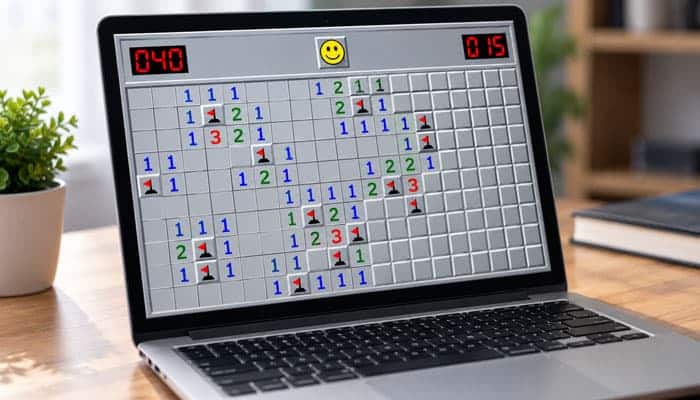
Minesweeper became especially well known through Microsoft Windows and was included in Microsoft’s Entertainment Pack era in the early 1990s.
Over time, Minesweeper became one of the best-known computer puzzle games.
Its continued popularity comes partly from its unusual combination of:
- Very simple rules
- Immediate feedback
- Short games
- Increasing difficulty
- Logical deduction
- Speed-based mastery
Modern browser and mobile implementations have expanded the original concept with custom boards, statistics, competitive timing, and alternative game modes.
Common Mistakes When Playing Campo Minado
- Clicking too quickly without checking the numbers
- Forgetting to count diagonal cells
- Trusting every flag without confirming it
- Memorizing patterns without checking the surrounding cells
- Ignoring the remaining mine counter
- Looking at only one number instead of nearby clues
- Guessing when a safe logical move is available
- Placing unnecessary flags that can cause confusion
Campo Minado Beginner-to-Advanced Learning Path
If you are learning como jogar campo minado, progress through these stages:
Stage 1: Learn the Rules
Understand:
- Safe cells
- Mines
- Numbers
- Flags
- Winning conditions
Stage 2: Master Basic Deductions
Learn to identify:
- Certain mines
- Certain safe cells
- Completed numbers
- Simple one-cell deductions
Stage 3: Learn Overlapping Clues
Start comparing adjacent numbers instead of analyzing each number independently.
Stage 4: Learn Patterns
Practice common arrangements such as 1-1 and 1-2-1 while still checking the surrounding configuration.
Stage 5: Learn Chording
Use correctly verified flags to open multiple safe cells efficiently.
Stage 6: Reduce Unnecessary Actions
Improve mouse movement, flag usage, and visual scanning.
Stage 7: Explore Advanced Metrics
Once speed becomes important, learn about:
- 3BV
- 3BV/s
- Efficiency
- No-flag play
- No-guess boards
Frequently Asked Questions About Campo Minado
1. What is campo minado?
Campo minado is the Portuguese name for Minesweeper, a logic puzzle where players reveal safe cells while avoiding hidden mines.
2. How do you play campo minado?
Reveal cells, read the numbers, identify possible mines, and continue opening safe cells until the board is cleared.
3. What does a number mean in campo minado?
A number shows how many mines are located in the surrounding cells, including diagonal cells.
4. Is the first click always safe in campo minado?
Not always. Many modern versions protect the first click, but the exact rule depends on the game version.
5. What is chording in campo minado?
Chording is a technique that opens multiple safe cells around a revealed number after the correct number of nearby mines has been marked.
6. What is a 50/50 in Minesweeper?
A 50/50 is a situation where two or more cells appear equally possible and the visible clues do not reveal which one contains the mine.
7. Can I play campo minado online for free?
Yes. Many websites offer free campo minado online games with different board sizes, difficulty levels, and features.
8. Is campo minado based on luck or logic?
Campo minado mainly depends on logical deduction, although some traditional boards can create situations where guessing may be necessary.
Conclusion
Campo minado remains popular because its rules are easy to understand while its strategic depth can become surprisingly complex.
The basic objective is simple: reveal every safe cell without hitting a mine. The real challenge comes from understanding numbers, comparing overlapping clues, recognizing patterns, managing flags, and deciding when a move is logically guaranteed.
For beginners, the best approach is to master basic deductions before worrying about speed. Once those skills become automatic, you can explore advanced techniques such as chording, no-flag play, no-guess modes, 3BV, and 3BV/s.
Whether you want to jogar campo minado casually, learn como jogar campo minado, or improve your performance in campo minado online, the same core principle applies: use the information on the board before making the next move.