Last Updated: September 2026
Memory games can turn attention, recall, sequencing, and working-memory practice into activities children genuinely enjoy. The best memory games for kids range from classic matching cards and Simon Says to story recall, memory trays, scavenger hunts, and strategy activities.
Choosing the best memory games for kids does not mean finding the hardest activity. A good game should match a child’s age, current abilities, and interests while offering enough challenge to keep them thinking without causing unnecessary frustration.
Research suggests that memory training can improve performance on tasks similar to those children practice. However, claims that memory games automatically increase intelligence, raise IQ, or dramatically improve academic performance go beyond what current evidence supports.
This guide explains practical memory activities, which skills they exercise, how to adapt them for different ages, and how parents and teachers can make memory practice part of everyday play.
Quick Answer
The best memory games for kids include Matching Cards, What’s Missing?, I Spy, Simon Says, Memory Tray, Story Recall, Number Sequence, Memory Bingo, Treasure Hunt, Memory Chain, Picture Recall, and age-appropriate strategy games.
For younger children, begin with fewer objects, simple instructions, and short rounds. Older children can handle longer sequences, changing rules, delayed recall, and activities that combine memory with planning.
What Are Memory Games for Kids?
Memory games are activities that require children to remember, recognize, retrieve, organize, or manipulate information. The best memory games for kids often exercise memory while also involving attention, language, self-control, planning, or problem-solving.
Depending on the activity, a child may need to remember:
- Where a card is located
- Which object disappeared
- A sequence of sounds
- A series of movements
- Several instructions
- Details from a story
- A collection of objects
- A visual pattern
- The order of events
- Rules that change during play
Harvard’s Center on the Developing Child describes play-based activities as opportunities for children to practice executive-function skills such as working memory, attention, and self-control.
What Is Working Memory?
Working memory is the ability to temporarily hold information in mind while using it to complete a task. Many of the best memory games for kids naturally exercise this skill.
For example, imagine telling a child:
“Get your shoes, bring me the blue book, and put the toy car on the table.”
The child must remember several pieces of information while completing each instruction.
Working memory differs from simply remembering something that happened yesterday. It involves keeping information available long enough to use it.
Working Memory Examples for Children
Children use working memory when:
- Remembering several instructions
- Repeating a number sequence
- Following a pattern
- Remembering game rules
- Recalling previously revealed cards
- Retelling part of a story
- Remembering where an object was hidden
Harvard notes that executive-function abilities such as working memory help children manage information, focus attention, plan, and adjust their behavior.
Different Types of Memory Children Practice
Not every activity exercises exactly the same skill, which is why using different best memory games for kids can provide a broader variety of experiences.
| Memory Skill | What It Involves | Example Game |
|---|---|---|
| Working memory | Holding information while using it | Simon Says |
| Visual memory | Remembering what something looked like | Picture Recall |
| Auditory memory | Remembering sounds or spoken information | Sound Sequence |
| Sequential memory | Remembering information in order | Number Sequence |
| Spatial memory | Remembering locations | Matching Cards |
| Story memory | Remembering events and details | Story Recall |
| Recognition memory | Identifying something previously seen | What’s Missing? |
| Long-term recall | Remembering information after time has passed | Memory Chain |
Using multiple types of activities prevents memory practice from becoming repetitive.
Do Memory Games Actually Improve Children’s Memory?
The best memory games for kids can provide meaningful practice with memory-related skills, but research findings should be interpreted carefully.
A 2020 multilevel meta-analysis covering 41 studies and 2,375 typically developing children found small-to-medium improvements on memory tasks, particularly when the trained activity and assessment were similar.
However, evidence was much weaker for broad improvements in intelligence or academic achievement.
Near Transfer vs. Far Transfer
Near transfer occurs when children improve at something similar to what they practiced.
For example:
A child practices remembering sequences and later becomes better at remembering similar sequences.
Far transfer would mean the improvement automatically produces substantial gains in a very different area, such as mathematics, intelligence, or overall academic performance.
Research generally provides stronger support for near transfer than far transfer.
A 2026 systematic review and meta-analysis of board games also reported promising findings for some executive-function outcomes, including certain short-term-memory measures. However, researchers noted considerable variation among studies and did not conclude that all board games broadly improve executive function.
Memory games are therefore better viewed as enjoyable opportunities to practice thinking skills rather than guaranteed intelligence boosters.
25 Best Memory Games for Kids
The following best memory games for kids cover visual, auditory, verbal, spatial, sequential, and working-memory activities. Most can be adjusted by changing the number of objects, instructions, cards, or rules.
1. Matching Card Game
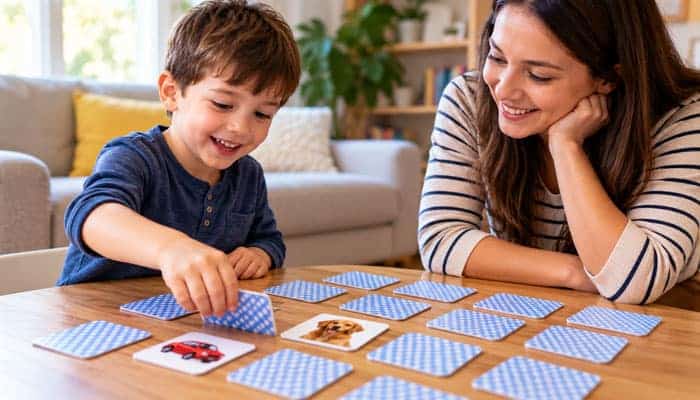
The classic matching activity remains one of the best memory games for kids because it is easy to understand and simple to make easier or harder.
How to Play
Place matching pairs of cards face down.
Players take turns turning over two cards.
If they match, the player keeps the pair. If they do not match, turn both cards face down again.
Continue until every pair has been found.
Skills Practiced
- Visual memory
- Spatial memory
- Attention
- Recognition
- Concentration
Make it easier: Start with three or four pairs.
Make it harder: Add more cards and encourage children to remember locations revealed several turns earlier.
2. What’s Missing?
What’s Missing? is one of the best memory games for kids who enjoy using familiar objects.
Place several objects on a table and let the child study them.
Ask the child to close their eyes while you remove one object.
Then ask:
“What’s missing?”
Skills Practiced
- Visual memory
- Observation
- Attention
- Recall
For preschoolers, start with only three or four familiar objects.
3. I Spy
I Spy is one of the best memory games for kids because it requires no special materials.
Start with a familiar clue such as:
“I spy something red.”
To make the activity more memory-focused, say:
“I spy something red that we saw earlier.”
The CDC includes games such as I Spy among activities that can support memory and attention in young children.
Skills Practiced
- Attention
- Visual recognition
- Categorization
- Recall
- Language
4. Memory Tray
A Memory Tray is another of the best memory games for kids who enjoy visual challenges.
Place several objects on a tray.
Allow the child to study them briefly.
Cover the tray and ask the child to name as many objects as possible.
You might use:
- Spoon
- Toy car
- Pencil
- Ball
- Cup
- Book
Start with three or four objects for younger children.
Make it harder: Add additional objects or ask the child to remember them in a particular order.
5. Simon Says
Simon Says is one of the best memory games for kids for combining attention, working memory, self-control, and movement.
Children follow an instruction only when it begins with “Simon says.”
For example:
“Simon says touch your nose.”
Then say:
“Touch your ears.”
The child should avoid following the second instruction.
Skills Practiced
- Working memory
- Attention
- Inhibition
- Rule following
- Cognitive flexibility
Harvard and the CDC both reference games such as Simon Says as useful opportunities for young children to practice developmental skills.
6. Repeat the Pattern
Repeat the Pattern is one of the best memory games for kids who enjoy colors, blocks, movements, or shapes.
Create a pattern such as:
Red → Blue → Red → Blue
Ask the child to reproduce it.
Make It Harder
Try:
Red → Blue → Green → Yellow
Then hide the original pattern and ask the child to recreate it from memory.
7. Sound Sequence
Sound Sequence is one of the best memory games for kids for practicing auditory memory.
Create a sequence such as:
Clap → Tap → Clap
Ask the child to repeat it.
Possible sounds include:
- Clapping
- Tapping
- Snapping
- Bells
- Household objects
- Musical instruments
Increase the number of sounds as the child becomes more confident.
8. Story Recall
Story Recall is one of the best memory games for kids who enjoy books and storytelling.
Read a short story and then ask questions such as:
- Who was in the story?
- Where did it happen?
- What happened first?
- What happened next?
- How did the story end?
The CDC identifies remembering and answering questions about stories as part of children’s developing language and cognitive abilities.
Make it harder: Ask the child to retell the story in the correct sequence.
9. Memory Chain
Memory Chain is one of the best memory games for kids for combining verbal recall, listening, and sequencing.
Start with:
“I went to the store and bought an apple.”
The next player repeats the sentence and adds another item:
“I went to the store and bought an apple and a banana.”
Continue adding items until someone forgets part of the sequence.
Skills Practiced
- Working memory
- Verbal recall
- Listening
- Sequencing
10. Follow-the-Directions Game
Follow-the-Directions is one of the best memory games for kids for practicing multi-step instructions.
Start with:
“Touch your head.”
Then increase the challenge:
“Touch your head, clap twice, and sit down.”
Older children can handle longer sequences.
Tip: Increase complexity gradually instead of immediately giving a long set of instructions.
11. What’s Changed?
What’s Changed? is among the best memory games for kids for combining visual memory with careful observation.
Arrange several objects and let the child examine them.
Then change one or two things.
Ask:
“What’s different?”
Possible changes include:
- Moving an object
- Removing an object
- Adding an object
- Switching two objects
12. Memory Scavenger Hunt
A scavenger hunt can become one of the best memory games for kids when children have to remember several clues while searching.
For example:
“Find something blue, something round, and something soft.”
The child must remember all three categories while looking around.
Make it harder: Add more clues or require the objects to be found in a specific order.
13. Picture Recall
Picture Recall is one of the best memory games for kids who enjoy illustrations, photographs, or picture books.
Show a picture briefly.
Remove it and ask:
- What color was the car?
- How many animals were there?
- What was the person holding?
- What appeared in the background?
You can gradually increase the amount of detail the child needs to remember.
14. Number Sequence
Number Sequence is one of the best memory games for kids for practicing sequential and short-term memory.
Say:
3 – 8 – 2
Ask the child to repeat the numbers.
Gradually increase the length.
For older children, ask them to repeat the sequence backward.
15. Word Memory Game
The Word Memory Game is one of the best memory games for kids who enjoy language activities.
Begin with several familiar words:
Dog – Apple – Chair
Ask the child to repeat them.
Gradually add more words.
You can also organize words into categories:
“Remember these animals: dog, cat, horse.”
Later, ask the child to recall all three.
16. Matching Sounds to Objects
Hide objects that produce different sounds.
Make one sound and ask the child to identify which object produced it.
You can also create a sequence such as:
Bell → Spoon Tap → Clap
Then ask the child to reproduce the sequence.
17. Memory Bingo
Memory Bingo is one of the best memory games for kids for combining listening, recognition, attention, and recall.
Create bingo cards containing pictures or words.
Instead of immediately marking each called item, ask children to remember several items before placing their markers.
This adds a stronger memory challenge to traditional bingo.
18. Treasure Hunt
Treasure Hunt is one of the best memory games for kids who enjoy movement and problem-solving.
Hide an object and provide several clues.
For example:
“It’s near something blue, below something tall, and beside a book.”
The child must remember the clues and use them to locate the object.
Make it harder: Give the clues earlier and introduce a short delay before allowing the child to search.
19. Recipe Memory Game
Use pretend cooking or a simple real recipe.
Give the child two or three ingredients to remember.
For example:
“We need flour, milk, and bananas.”
Ask the child to recall the ingredients before beginning.
This connects memory practice with an everyday activity.
20. Memory Matching Relay
Place matching cards, pictures, or household objects at one end of a room.
Children move toward the objects, examine them, and return to identify or match the correct pair.
For younger children, use only a few pairs.
For older children, increase the number of locations they need to remember.
Skills Practiced
- Visual memory
- Spatial memory
- Attention
- Movement
- Turn-taking
21. 20 Questions
One person thinks of an object, animal, or person.
Other players ask questions to identify it.
For example:
- Is it alive?
- Is it bigger than a dog?
- Can it fly?
- Is it found outside?
Children must remember previous answers so that each new question provides useful information.
22. Story Building
Story Building is one of the best memory games for kids who enjoy imaginative play.
One player begins:
“Yesterday, Mia found a tiny blue box.”
The next player adds something:
“Yesterday, Mia found a tiny blue box under a tree.”
Players continue extending the story while trying to remember everything that happened previously.
23. Reverse-the-Sequence
Reverse-the-Sequence is one of the best memory games for kids who are ready for a greater working-memory challenge.
Give a simple sequence:
Clap → Jump → Turn
Ask the child to perform it backward:
Turn → Jump → Clap
This requires the child to remember the original sequence and mentally reorganize it.
24. Memory Walk
A Memory Walk is one of the best memory games for kids because it turns an ordinary outing into a recall challenge.
During a walk, encourage children to notice their surroundings.
Afterward, ask:
- What did we see first?
- What color was the door?
- Where was the tree?
- Which animal did we see?
- What happened before we crossed the road?
25. Strategy and Planning Games
Strategy activities can be some of the best memory games for kids as children become older and capable of handling more complicated rules.
These games can require children to:
- Remember rules
- Track previous moves
- Hold information in mind
- Anticipate possibilities
- Plan ahead
- Change strategies
Harvard’s guidance for children ages 7–12 notes that strategy games can involve holding complicated moves in mind, planning ahead, and adjusting plans.
Best Memory Games at a Glance
Several of the best memory games for kids can be matched to particular memory skills and age ranges.
| Memory Game | Best For | Age Starting Point | Materials |
|---|---|---|---|
| Matching Cards | Visual and spatial memory | 3+ | Cards |
| What’s Missing? | Visual recall | 3+ | Household objects |
| I Spy | Attention and recall | 3+ | None |
| Simon Says | Working memory and self-control | 3+ | None |
| Memory Tray | Visual recall | 3+ | Household objects |
| Story Recall | Verbal memory | 4+ | Story or book |
| Number Sequence | Sequential memory | 5+ | None |
| Treasure Hunt | Spatial and working memory | 4+ | Household objects |
These ages are starting points rather than strict rules. Adjust each activity according to the child’s ability, attention span, and interest.
Best Memory Games for Kids by Skill
The best memory games for kids depend partly on the skill you want children to practice.
| Skill | Games to Try |
|---|---|
| Visual memory | Matching Cards, What’s Missing?, Picture Recall |
| Working memory | Simon Says, Memory Chain, Follow-the-Directions |
| Auditory memory | Sound Sequence, Story Recall |
| Sequential memory | Number Sequence, Repeat the Pattern |
| Attention | I Spy, Simon Says, What’s Changed? |
| Spatial memory | Matching Cards, Treasure Hunt, Memory Walk |
| Verbal memory | Story Building, Word Memory, 20 Questions |
| Planning | Strategy Games, Treasure Hunt |
| Cognitive flexibility | Reverse-the-Sequence, Simon Says, Strategy Games |
Best Memory Games for Preschoolers
For preschoolers, the best memory games for kids are usually short, visual, hands-on, active, and easy to understand.
Good options include:
- Matching Cards
- What’s Missing?
- I Spy
- Memory Tray
- Simon Says
- Repeat the Pattern
- Sound Sequence
- Picture Recall
- Story Recall
- Treasure Hunt
Harvard’s Center on the Developing Child recommends choosing play activities that match a child’s current abilities and developmental level.
Best Memory Games for 3-Year-Olds
For many 3-year-olds, the best memory games for kids involve only a few objects, pictures, sounds, or instructions at one time.
Try:
- What’s Missing?
- Simple Matching Cards
- I Spy
- Simon Says
- Copy My Actions
- Sound Matching
- Simple Picture Recall
- Short Memory Chains
At this age, making the child feel successful is usually more useful than increasing difficulty quickly.
If the child becomes confused, reduce the number of items.
Best Memory Games for 4-Year-Olds
For 4-year-olds, the best memory games for kids can include slightly longer sequences and simple multi-step rules.
Try:
- Matching Cards
- Memory Tray
- Simon Says
- Story Recall
- Repeat the Pattern
- What’s Changed?
- Treasure Hunt
- Memory Scavenger Hunt
Children can also take turns becoming the person who gives instructions.
Best Memory Games for 5-Year-Olds
For many 5-year-olds, the best memory games for kids can include more structured activities involving rules, turn-taking, and multiple steps.
Good options include:
- Matching Card Games
- Simon Says
- I Spy
- Memory Tray
- Story Recall
- Number Sequence
- Memory Bingo
- Treasure Hunt
- Follow-the-Directions
- Simple Board Games
The CDC lists following rules and taking turns during games among social-emotional milestones around age five. It also notes that most 5-year-olds can pay attention for approximately 5–10 minutes during activities such as story time or arts and crafts.
That milestone should not be interpreted as a required memory-game duration. Children differ considerably in interest and ability.
Best Memory Games for School-Age Children
For school-age children, the best memory games for kids can involve longer sequences, more complicated rules, planning, and strategic thinking.
Try:
- Strategy card games
- Board games
- Number-memory challenges
- Reverse sequences
- Story-building games
- 20 Questions
- Memory scavenger hunts
- Complex matching games
- Strategy challenges
- Multi-step instruction games
Harvard recommends gradually increasing game complexity for children around ages 7–12.
Best Memory Games for Kids by Age
| Age | Good Starting Games | How to Increase Difficulty |
|---|---|---|
| 3 years | I Spy, What’s Missing?, Simple Matching | Add one item at a time |
| 4 years | Memory Tray, Simon Says, Pattern Games | Add more items or steps |
| 5 years | Card Games, Story Recall, Memory Bingo | Increase rules and sequences |
| 6–7 years | Memory Challenges, Treasure Hunts, Board Games | Add multiple rules |
| 8–10 years | Strategy Games, 20 Questions, Number Games | Require planning and recall |
| 11+ years | Complex Strategy Games, Advanced Memory Challenges | Combine memory with reasoning and strategy |
These are practical age suggestions rather than rigid developmental requirements.
How to Choose the Right Memory Game
When selecting the best memory games for kids, the most difficult activity is not automatically the most useful one.
Look for games that are:
Challenging but Achievable
The child should need to think, but success should remain possible.
Easy to Explain
If explaining the rules takes longer than playing the game, simplify them.
Interesting
Children are more likely to keep practicing when an activity is genuinely enjoyable.
Flexible
Choose games that allow you to add or remove difficulty.
Interactive
Activities involving communication, movement, or social interaction may provide additional benefits beyond memory practice alone.
How to Make Memory Games Easier
If a child is struggling, try:
- Using fewer cards
- Showing fewer objects
- Shortening sequences
- Repeating instructions
- Using familiar objects
- Providing visual clues
- Demonstrating the rules
- Allowing another attempt
- Playing cooperatively
The goal is to provide an appropriate challenge rather than repeatedly make the child fail.
How to Make Memory Games Harder
Once a child becomes comfortable with an activity:
- Add more cards
- Increase sequence length
- Remove visual clues
- Introduce a time element
- Ask for information backward
- Combine two rules
- Increase the number of objects
- Add a short recall delay
- Ask children to explain their strategy
For example:
- Easy: Remember three objects.
- Medium: Remember six objects.
- Hard: Remember six objects in order.
Advanced: Remember six objects in order and recall them after a short delay.
Free Memory Games for Kids
Many of the best memory games for kids cost nothing because they use conversation, movement, or ordinary household objects.
Free activities include:
- I Spy
- Simon Says
- What’s Missing?
- Story Recall
- Memory Chain
- Sound Sequences
- Number Sequences
- Memory Walks
- Treasure Hunts
- Follow-the-Directions
- Pattern Copying
- 20 Questions
DIY Memory Games Using Household Items
Simple homemade activities can provide the same type of memory practice as many commercial games.
Useful materials include:
- Bottle caps
- Paper
- Plastic cups
- Socks
- Blocks
- Toys
- Spoons
- Coins
- Colored pencils
- Food containers
DIY Matching Game
Draw pairs of symbols or pictures on pieces of paper.
Place them face down.
Children turn over two pieces at a time and attempt to find matching pairs.
DIY Memory Tray
Place several household objects on a tray.
Let the child study them.
Cover the tray and ask which objects they remember.
Screen-Free vs. Digital Memory Games
Both digital and screen-free activities can involve memory.
Digital working-memory tasks can provide repeated and controlled practice. However, improvement at a specific digital task does not automatically mean children will experience broad improvements in intelligence or academic achievement.
Screen-free activities have a different advantage because they can naturally involve:
- Conversation
- Movement
- Turn-taking
- Social interaction
- Physical objects
- Imaginative play
For younger children, real-world games can therefore combine memory practice with several other developmental experiences.
Memory Games vs. Worksheets
| Memory Games | Memory Worksheets |
|---|---|
| Interactive | Usually individual |
| Often playful | Usually structured |
| Can include movement | Usually seated |
| Easy to play socially | Often completed alone |
| Immediate feedback | Feedback may come later |
| Flexible difficulty | Difficulty may be fixed |
| Can require strategy | Often emphasizes recall or written work |
Neither approach needs to replace the other.
Games can be especially useful when children need variety, interaction, or motivation.
Memory Games vs. Brain-Training Apps
Brain-training apps often provide repeated practice on specific cognitive tasks.
Traditional games can combine memory with:
- Communication
- Movement
- Social interaction
- Rule following
- Problem-solving
- Planning
- Self-control
Research into computerized cognitive training is complex. Evidence that children improve on trained tasks should not automatically be interpreted as evidence of improved intelligence or school performance.
HealthyChildren guidance from the American Academy of Pediatrics has similarly cautioned that better performance on computerized training activities does not necessarily mean those gains transfer broadly to schoolwork or everyday activities.
Cooperative vs. Competitive Memory Games
Both formats can be useful.
| Game Type | How It Works | Examples | Best For |
|---|---|---|---|
| Cooperative Games | Everyone works toward the same goal | Complete a challenge together, find matching cards, solve a treasure hunt, reconstruct a story | Younger children, teamwork, participation |
| Competitive Games | Players compete for points or matches | Matching cards, memory bingo, recall challenges | Older children, motivation, friendly competition |
For younger children, cooperative activities may be easier because the emphasis remains on participation rather than winning.
Memory Games for Classrooms
Some of the best memory games for kids can be adapted for small groups or entire classrooms.
Memory Circle
Each student adds an item to a growing list.
Picture Recall
Display an image briefly and ask questions after removing it.
Sequence Challenge
Students repeat movement or sound sequences.
Instruction Challenge
Give several classroom instructions and ask students to remember and complete them.
Story Recall
Read a short passage and ask students to reconstruct important events.
Classroom tip: Use different levels of difficulty instead of expecting every child to remember the same amount of information.
Memory Games for Travel
Memory activities can be especially useful during trips because many require no equipment.
Try:
- I Spy
- Alphabet memory
- License-plate memory
- Story Chain
- 20 Questions
- Category recall
- Number sequences
- What Did We See?
- Memory scavenger hunt
For example, during a road trip, say:
“Remember the first three animals we see.”
Later, ask the child to name them in order.
Memory Games for Different Learning Needs

Children do not all find the same memory activities equally easy.
One child may perform strongly with visual matching but find spoken sequences difficult. Another might remember stories easily but struggle to remember locations.
Experiment with different formats rather than permanently labeling a child as one particular “learning type.”
Visual Memory Activities
Try:
- Picture cards
- Matching games
- Memory trays
- Pattern games
Auditory Memory Activities
Try:
- Sound sequences
- Songs
- Rhymes
- Story recall
Movement-Based Memory Activities
Try:
- Simon Says
- Freeze games
- Movement sequences
- Follow-the-directions games
Language-Rich Memory Activities
Try:
- Story building
- Word chains
- 20 Questions
- Verbal memory challenges
The goal is to provide varied opportunities to remember, think, communicate, and solve problems.
Common Mistakes Parents Should Avoid
- Making the game too difficult
- Turning every activity into a test
- Comparing one child with another
- Using too many rewards
- Expecting instant improvement
- Assuming better memory means higher intelligence
- Using memory games as diagnostic tools
How Long Should Kids Play Memory Games?
There is no universal number of minutes that every child should spend playing memory games.
A practical approach is to keep sessions:
- Short enough to maintain interest
- Long enough to complete a meaningful challenge
- Flexible according to age and ability
If a child becomes frustrated or loses interest, stop the activity or switch games.
The CDC reports that by age five, most children can pay attention for around 5–10 minutes during certain activities, including story time and arts and crafts. This is a developmental milestone rather than a prescribed memory-training duration.
A Simple Weekly Memory Game Plan
You can rotate activities instead of repeating the same game every day.
| Day | Activity | Main Skill |
|---|---|---|
| Monday | Matching Cards | Visual memory |
| Tuesday | Simon Says | Working memory and attention |
| Wednesday | Story Recall | Verbal memory |
| Thursday | Memory Tray | Visual recall |
| Friday | Pattern Game | Sequential memory |
| Saturday | Treasure Hunt | Working and spatial memory |
| Sunday | Family Board Game | Memory, planning, and social skills |
This schedule is only an example. Children do not need a strict memory-training program to benefit from enjoyable practice.
How Parents Can Encourage Memory Without Playing a Game
Memory practice also happens naturally during everyday activities.
Ask children to:
- Remember what they need before leaving home
- Help recall a shopping list
- Retell a story
- Remember instructions
- Describe what happened during the day
- Help prepare a simple recipe
- Remember where toys belong
- Recall events from a recent outing
- Sing familiar songs
- Explain the rules of a game
These activities make memory part of ordinary life rather than something that always requires formal training.
How to Tell Whether a Memory Game Is the Right Difficulty
A useful memory activity should provide a balance between success and challenge.
The Game May Be Too Easy If
- The child succeeds every time
- The child hardly needs to think
- The activity finishes immediately
- The child repeatedly asks for something harder
The Game May Be Too Difficult If
- The child consistently forgets the instructions
- The child becomes frustrated
- The child stops participating
- The child cannot complete even the simplest version
The Game Is Probably Well Matched When
- The child makes occasional mistakes
- Performance improves with practice
- The child wants another turn
- The child can explain what they are trying to remember
Memory Games Are Not Diagnostic Tests
A child forgetting several cards during a matching game does not by itself indicate ADHD, a learning disability, developmental delay, or memory disorder.
Likewise, performing exceptionally well at one memory activity does not establish unusually high overall cognitive ability.
The CDC states that developmental milestone materials are not substitutes for standardized developmental screening tools.
If persistent concerns involve development, attention, learning, communication, or memory, discuss them with an appropriate healthcare or education professional.
When Should Parents Talk to a Professional?
Consider seeking professional guidance when memory or learning concerns persist and affect everyday activities.
Examples can include:
- Consistently struggling to remember information needed for ordinary tasks
- Memory difficulties interfering with school participation
- Losing skills the child previously had
- Several developmental concerns appearing together
- Teachers repeatedly raising concerns
- Difficulty following age-appropriate instructions
- Broader concerns about development
Memory games should never replace professional evaluation.
Memory Games and Sleep, Exercise, and Everyday Learning
Memory does not develop in isolation.
A child’s ability to concentrate and learn can be influenced by:
- Sleep
- Physical activity
- Nutrition
- Stress
- Learning opportunities
- Social interaction
- Classroom environment
- Overall health
Memory games should therefore be viewed as one small part of a child’s broader learning environment.
Harvard’s executive-function framework emphasizes that these skills develop through interactions and practice involving games, play, relationships, and schoolwork.
Best Memory Games for Kids FAQs
1. What Are the Best Memory Games for Kids?
The best memory games for kids include Matching Cards, Simon Says, I Spy, Memory Tray, Story Recall, Pattern Games, Treasure Hunt, and simple strategy or board games. The right choice depends on the child’s age and current abilities.
2. What Is the Best Memory Game for Preschoolers?
Matching games, What’s Missing?, I Spy, Simon Says, Memory Tray, and Picture Recall are good starting points because their rules can be kept short and simple.
3. Are Memory Games Good for 3-Year-Olds?
Yes. Three-year-olds can enjoy simple activities involving familiar objects, pictures, sounds, movements, and short instructions.
4. Do Memory Games Improve Concentration?
They can provide opportunities to practice attention and working memory. However, better performance in one game does not prove that concentration will automatically improve in every setting.
5. Do Memory Games Make Kids Smarter?
Memory activities can strengthen performance on specific or closely related memory tasks. Evidence is much weaker for claims that memory training broadly increases intelligence.
6. How Often Should Kids Play Memory Games?
There is no fixed requirement. Short, enjoyable activities can be included naturally during play several times a week or whenever the child is interested.
7. What Are Some Free Memory Games for Kids?
I Spy, Simon Says, What’s Missing?, Story Recall, Memory Chains, Sound Sequences, Pattern Games, Treasure Hunts, and Follow-the-Directions can all be played for free.
8. Can Memory Games Diagnose ADHD or Learning Disabilities?
No. Performance in a memory game cannot diagnose ADHD, developmental delays, learning disabilities, or other conditions. Persistent concerns should be discussed with an appropriate professional.
Final Thoughts
The best memory games for kids are usually the activities children enjoy enough to play repeatedly while still receiving an appropriate level of challenge.
Matching Cards can exercise visual and spatial recall. Simon Says combines working memory with attention and self-control. Story games provide verbal-memory practice, while Pattern Games exercise sequencing. Treasure Hunts combine memory with movement and problem-solving.
Research supports the idea that memory practice can improve performance on related tasks, but broad claims about increasing intelligence or dramatically improving academic performance are not strongly supported.
For parents and teachers, the practical approach is simple: use memory games as enjoyable opportunities to practice attention, recall, sequencing, listening, and flexible thinking rather than as intelligence tests or substitutes for professional assessment.
Choose activities that match the child’s ability, increase difficulty gradually, provide plenty of variety, and keep the experience positive.