



Last Updated: September 2026
If you search who owns Netflix, you may find answers naming Reed Hastings, Vanguard, BlackRock, or Fidelity. However, none of those answers alone explains the complete ownership structure.
Netflix is a publicly traded company owned collectively by its shareholders. Its common stock trades on the Nasdaq Global Select Market under the ticker NFLX, and no single individual or company is disclosed as owning a majority of Netflix’s common stock.
The ownership picture is more complicated than a simple list of top shareholders. Netflix’s 2026 proxy statement contains major-shareholder figures based on different reporting dates, while later SEC filings can provide newer information for some institutional investors.
Form 13F and Schedule 13G filings can also produce different-looking ownership figures because they serve different regulatory purposes.
This guide explains who owns Netflix in 2026, whether Reed Hastings still owns shares, who Netflix’s major institutional shareholders are, who controls the company, how voting rights work, and why ownership percentages can differ between sources.
Quick Answer: Who Owns Netflix?
Netflix is owned collectively by its shareholders.
Netflix, Inc. is a publicly traded corporation. Investors who purchase Netflix common stock own proportional equity interests in the company.
Netflix reported 4,163,939,676 shares of common stock outstanding as of June 30, 2026.
No single shareholder was disclosed as holding a controlling majority of Netflix.
Key Takeaways
- Netflix is publicly traded under the ticker NFLX and is owned collectively by shareholders.
- Reed Hastings co-founded Netflix but does not control the company.
- Ted Sarandos and Greg Peters are co-CEOs, while Jay Hoag is Board Chairman.
- Vanguard, BlackRock, and FMR have been major institutional shareholders.
- Netflix common stock generally carries one vote per share.
- No majority controlling shareholder is disclosed.
- Ownership percentages can vary by reporting date and filing type.
- Form 13F and Schedule 13G data should not be combined automatically.
Netflix Ownership at a Glance
| Ownership Detail | 2026 Information |
|---|---|
| Company | Netflix, Inc. |
| Stock ticker | NFLX |
| Exchange | Nasdaq Global Select Market |
| Shares outstanding | 4,163,939,676 as of June 30, 2026 |
| Founders | Reed Hastings and Marc Randolph |
| Current co-CEOs | Ted Sarandos and Greg Peters |
| Board Chairman | Jay Hoag |
| Ownership type | Publicly traded |
| Controlling shareholder | None disclosed |
| Common-stock voting rights | One vote per share |
Netflix’s common stock provides holders with one vote per share on matters submitted to stockholders.
That structure matters because Netflix does not use a separate founder-controlled super-voting share class that automatically gives a founder greater voting power.
Is Netflix Publicly Owned or Privately Owned?
Netflix is publicly traded, not privately owned.
The company completed its initial public offering in 2002. Its shares can now be held by institutional investors and eligible individual investors.
Netflix’s common stock trades on the Nasdaq Global Select Market under the ticker NFLX.
Investors can gain an economic interest in Netflix through vehicles such as:
- Individual brokerage accounts
- Mutual funds
- Exchange-traded funds
- Retirement accounts
- Pension funds
- Institutional investment portfolios
- Other investment vehicles
Netflix reported approximately 3,103 stockholders of record as of December 31, 2025, while noting that the number of beneficial owners was significantly larger.
That distinction is important because many investors hold shares through brokers, funds, nominees, or other intermediaries.
Who Founded Netflix?

Netflix was founded in 1997 by Reed Hastings and Marc Randolph.
The company began operations in 1998 as an internet-based DVD rental and sales business. Netflix later shifted toward subscription entertainment and eventually became a global streaming company.
Its DVD-by-mail service ended in 2023 when Netflix shipped its final DVD.
Does Founding Netflix Mean Hastings and Randolph Still Own It?
No.
Founding a company and controlling its present-day ownership are different things.
As Netflix expanded and became publicly traded, ownership became distributed among public shareholders.
The founders’ historical roles do not automatically give them control over Netflix today.
Does Reed Hastings Still Own Netflix?
Reed Hastings has continued to own Netflix shares.
However, Reed Hastings does not own Netflix outright and is not its controlling shareholder.
Netflix’s 2026 proxy statement reported that Hastings beneficially owned 37,759,062 shares as of April 6, 2026, representing less than 1% of the class under the proxy’s ownership calculation.
Beneficial-ownership calculations can include certain options and equity awards. Therefore, the figure should not automatically be interpreted as shares Hastings personally holds in a standard brokerage account.
What Happened to Reed Hastings in 2026?
Reed Hastings’ formal role at Netflix changed in stages.
Effective April 17, 2025, Hastings transitioned from Executive Chairman to Chairman of the Board and a non-executive director.
He later decided not to stand for re-election at Netflix’s June 4, 2026 annual meeting and left the board.
His departure from Netflix’s board did not automatically mean he sold his shares.
Board membership and share ownership are separate concepts.
Who Runs Netflix in 2026?
Netflix is run by co-CEOs Ted Sarandos and Greg Peters.
Their authority comes from their executive positions and Netflix’s corporate-governance structure rather than majority ownership of the company.
Ted Sarandos
Ted Sarandos serves as co-CEO and President of Netflix.
He has played a major role in the company’s entertainment operations and content strategy.
Greg Peters
Greg Peters serves as co-CEO and President.
His leadership responsibilities have included Netflix’s product, technology, and broader business operations.
Neither executive should be described as “the owner” of Netflix.
Who Is the Chairman of Netflix in 2026?
Jay Hoag is Chairman of Netflix’s Board of Directors.
Hoag previously served as Netflix’s Lead Independent Director.
Following Reed Hastings’ decision not to stand for re-election in 2026, Netflix moved to a new board-leadership structure, with Hoag becoming chairman after the June 4 annual meeting.
This distinction is important because older articles may still describe Hastings as Netflix’s chairman.
Who Are the Biggest Netflix Shareholders?
Determining the biggest Netflix shareholders requires careful attention to reporting dates.
Netflix’s 2026 proxy listed shareholders known to own more than 5% based on information available for its April 6, 2026 ownership table.
| Shareholder | Shares Reported | Percentage Reported | Important Note |
|---|---|---|---|
| The Vanguard Group | 364,382,750 | 8.65% | Based on historical ownership information |
| BlackRock | 308,989,260 | 7.34% | Based on historical ownership information |
| FMR LLC | 222,750,326 | 5.29% | Based on an earlier filing |
| Reed Hastings | 37,759,062 | Less than 1% | April 6, 2026 beneficial ownership |
These numbers should not automatically be treated as an exact September 2026 shareholder ranking.
Netflix’s proxy relies on information supplied by insiders and disclosures filed by outside shareholders.
Why Netflix Shareholder Percentages Can Be Misleading
Netflix’s annual proxy statement is not a real-time ownership database.
The proxy reported:
- Vanguard: 8.65%
- BlackRock: 7.34%
- FMR LLC: 5.29%
However, the underlying information was not necessarily reported on the same date.
For example, later filings can provide updated ownership information for individual investors.
That means a percentage can be accurate for the filing it describes without being the investor’s exact current position several months later.
Does Vanguard Own Netflix?
Vanguard has been one of Netflix’s major institutional shareholders.
Netflix’s 2026 proxy listed The Vanguard Group with 364,382,750 shares, or 8.65%.
However, this percentage should be described according to the relevant reporting period rather than presented as an exact September 2026 position.
Netflix’s proxy indicates that the figure relied on earlier ownership information.
The distinction is important:
Accurate wording:
“Netflix’s 2026 proxy reported an 8.65% Vanguard position.”
Potentially misleading wording:
“Vanguard currently owns exactly 8.65% of Netflix.”
Does BlackRock Own Netflix?
BlackRock has also been a significant institutional Netflix shareholder.
Netflix’s 2026 proxy listed BlackRock with 308,989,260 shares, or 7.34%.
Like the Vanguard figure, the percentage represents reported ownership information tied to a particular disclosure period rather than a real-time ownership count.
Does Fidelity Own Netflix?
FMR LLC, an entity associated with Fidelity Investments, has also been a significant Netflix investor.
A later Schedule 13G/A filing reported that FMR LLC beneficially owned approximately 137.56 million Netflix shares as of June 30, 2026, representing 3.3% of the class.
The filing also reported approximately:
- 120.98 million shares with sole voting power
- 137.56 million shares with sole disposition power
Netflix’s earlier proxy showed FMR at 5.29%, while the later filing showed 3.3%.
The figures describe different reporting periods, so the difference does not automatically mean either source is incorrect.
Understanding Netflix Ownership Filings
One reason answers to who owns Netflix can differ is that several SEC filing systems measure ownership differently.
What Is Schedule 13G?
Schedule 13G is a beneficial-ownership disclosure used by qualifying investors that meet applicable reporting requirements.
It can report information such as:
- Beneficial shares
- Voting power
- Appositive power
- Percentage ownership
- Reporting date
FMR’s later 2026 disclosure is an example.
What Is Form 13F?
Form 13F is a quarterly filing used by certain institutional investment managers.
It reports certain long U.S. equity positions held by institutional managers.
Form 13F data should not automatically be treated as equivalent to Schedule 13G beneficial-ownership data.
The filings have different:
- Purposes
- Reporting rules
- Definitions
- Filing dates
- Aggregation methods
Why 13F and 13G Figures Should Not Be Added Together
Adding a 13F position to a Schedule 13G position can produce double counting.
The same investment organization may appear through:
- Parent-company filings
- Investment-adviser filings
- Fund-level positions
- Separate reporting entities
- Beneficial-ownership disclosures
Always identify the filing type before comparing or combining shareholder numbers.
What Does Beneficial Ownership Mean?
Beneficial ownership is an SEC reporting concept.
It generally refers to securities over which a person or entity has voting or investment power.
It does not necessarily mean the person or organization personally keeps every reported share in one brokerage account.
For directors and executives, beneficial ownership can also include certain options or shares issuable through equity awards under applicable SEC rules.
Shareholder of Record vs. Beneficial Owner
These two terms describe different relationships with company stock.
Shareholder of Record
A shareholder of record is the registered holder whose name appears directly on the company’s shareholder records.
Beneficial Owner
A beneficial owner can have the economic or voting interest in shares even when another organization, such as a broker or nominee, appears as the registered holder.
This helps explain why Netflix could report approximately 3,103 stockholders of record at the end of 2025 while also saying that there were significantly more beneficial owners.
Does Netflix Have a Controlling Shareholder?
No controlling majority shareholder is disclosed.
Netflix common stock generally carries one vote per share, and no individual or institution is disclosed as owning more than 50% of Netflix’s common stock.
Netflix therefore does not have the same ownership model as a private company controlled outright by a founder or family.
How Does Voting Power Work at Netflix?
Each share of Netflix common stock generally carries one vote.
For example, an investor holding 1,000 shares would generally have 1,000 votes on matters submitted to shareholders, subject to the applicable voting rules.
A shareholder’s overall voting influence depends largely on the number of shares held relative to the total number of voting shares.
Why One Vote Per Share Matters
Some public companies use dual-class stock structures that give founders or insiders enhanced voting rights.
Netflix’s common-stock structure is different.
There is no separate founder-controlled super-voting common-stock class described in the company’s referenced financial filings.
Who Controls Netflix If Nobody Owns 50%?
Corporate control should not be confused with simple share ownership.
Netflix operates through several layers of corporate governance.
1. Shareholders Own the Equity
Netflix shareholders collectively own the company and vote on matters requiring shareholder approval.
2. The Board Provides Oversight
Netflix’s Board of Directors oversees corporate governance and management.
3. Executives Run the Business
The company’s co-CEOs and management team handle day-to-day operations and execute corporate strategy.
4. Large Shareholders Can Have Voting Influence
Large institutional shareholders may have significant voting influence.
However, owning a large minority position is not the same as having majority corporate control.
The key distinctions are:
- Ownership ≠ management
- Ownership ≠ board chairmanship
- Large shareholder ≠ majority owner
- CEO ≠ owner
What Happened at Netflix’s 2026 Annual Meeting?
Netflix held its 2026 annual meeting on June 4, 2026.
Shareholders were asked to vote on matters including:
- Election of directors
- Ratification of the independent accounting firm
- Executive compensation
- Shareholder proposals
Reed Hastings did not stand for re-election.
The meeting completed an important stage of Netflix’s leadership transition.
It also illustrates how shareholders participate in the governance of a public company even when no single investor controls a majority of its stock.
Does Owning Netflix Stock Mean You Control Netflix?
No.
Someone who buys Netflix stock becomes a shareholder, but the amount of control associated with that investment depends on the size of the holding.
Using Netflix’s reported June 30, 2026 share count of 4,163,939,676 shares:
100 ÷ 4,163,939,676 × 100 ≈ 0.0000024%
A shareholder owning 100 shares therefore has a genuine equity interest, but it represents only a tiny portion of the company’s total voting power.
The same principle applies to institutions.
A financial institution can hold hundreds of millions of shares without owning a majority of Netflix.
Did Netflix’s 2025 Stock Split Change Ownership?
Netflix completed a 10-for-1 forward stock split on November 14, 2025.
Each shareholder received nine additional shares for every share previously held.
Simple Stock Split Example
| Before Split | After Split |
|---|---|
| 1 share | 10 shares |
| 10 shares | 100 shares |
| 100 shares | 1,000 shares |
| 1,000 shares | 10,000 shares |
The stock split did not automatically change an investor’s percentage ownership.
For example, an investor who owned approximately 0.01% of Netflix before the split would continue to own approximately 0.01% after the split if no other ownership-changing transactions occurred.
Why the Split Matters for Ownership Research
Older articles may show substantially smaller share counts because they use pre-split data.
Current ownership figures therefore need to be interpreted using appropriately split-adjusted numbers.
Why Does Netflix Have Billions of Shares Outstanding?
The 2025 stock split significantly increased the numerical number of Netflix shares.
Netflix reported:
- 4,222,162,150 shares outstanding at December 31, 2025
- Approximately 4.164 billion shares outstanding at June 30, 2026
The number of shares outstanding can also change because of factors such as:
- Share repurchases
- Employee equity awards
- Option exercises
- Other equity activity
For this reason, a share count should always be published together with its reporting date.
Does Netflix Buy Back Its Own Stock?
Yes.
Netflix has operated a share-repurchase program.
Share repurchases can reduce the number of shares outstanding.
If a shareholder maintains the same number of shares while Netflix’s total outstanding share count falls, that investor can represent a slightly larger percentage of the company.
Ownership percentages can therefore change even when the investor does not buy or sell shares.
Do Netflix Executives Own Shares?
Netflix executives and directors own shares, but the disclosed insider group does not represent a controlling ownership position.
Netflix’s April 6, 2026 proxy ownership table included:
| Insider | Beneficial Shares Reported | Percentage |
|---|---|---|
| Reed Hastings | 37,759,062 | Less than 1% |
| Ted Sarandos | 5,719,962 | Less than 1% |
| Greg Peters | 2,747,038 | Less than 1% |
| Jay Hoag | 2,539,341 | Less than 1% |
| All directors and executive officers | 52,413,364 | 1.24% |
These amounts reflect beneficial ownership under applicable SEC rules and can change as shares are sold or acquired, options are exercised, awards vest, or the company’s outstanding share count changes.
Is Netflix Owned by Disney, Amazon, or Microsoft?
Several common ownership myths can be answered directly.
Is Netflix Owned by Disney?
No.
Disney and Netflix are separate companies. Netflix does not operate as a Disney subsidiary.
Is Netflix Owned by Amazon?
No.
Amazon does not own Netflix.
Amazon operates its own entertainment businesses, including Prime Video, while Netflix remains a separate publicly traded corporation.
Is Netflix Owned by Microsoft?
No.
Microsoft is not Netflix’s parent company.
Netflix maintains its own shareholders, board, management structure, and public stock listing.
Is Netflix Owned by Another Media Company?
No parent media company is disclosed as controlling Netflix.
Netflix is itself a publicly traded entertainment company.
Netflix Ownership vs. Netflix Management
| Question | Answer |
|---|---|
| Who owns Netflix? | Its shareholders collectively |
| Who founded Netflix? | Reed Hastings and Marc Randolph |
| Who are major institutional shareholders? | Large investment managers identified in SEC disclosures, depending on filing and date |
| Who runs Netflix? | Ted Sarandos and Greg Peters |
| Who chairs the board in 2026? | Jay Hoag |
| Who owns a controlling majority? | No controlling shareholder disclosed |
| Who votes on shareholder matters? | Shareholders |
| Votes per common share | One |
| Is Netflix publicly traded? | Yes |
| Netflix stock ticker | NFLX |
Netflix Ownership Compared With Other Company Structures
| Ownership Model | How Control Commonly Works | Netflix? |
|---|---|---|
| Founder-controlled private company | Founder holds majority equity | No |
| Family-controlled public company | Family retains controlling stake | No disclosed controlling family |
| Dual-class public company | Certain shares have enhanced voting rights | Not Netflix’s common-stock structure |
| Public company with distributed ownership | Shares spread among investors | Yes |
| Government-controlled company | Government holds controlling interest | No |
Netflix therefore more closely resembles a conventional publicly traded company with ownership distributed among institutional and individual investors.
Why Do Institutional Investors Own So Much Netflix Stock?
Large investment managers commonly hold public-company shares because they manage investments for clients and funds.
Netflix shares may be held through:
- Index funds
- Mutual funds
- ETFs
- Pension portfolios
- Retirement funds
- Institutional mandates
- Other managed investment vehicles
Therefore, when companies such as Vanguard, BlackRock, State Street, or FMR appear in ownership databases, it does not necessarily mean their corporate executives personally own every reported share.
The shares may ultimately represent investments held for funds and underlying investors.
Can Ordinary Investors Own Netflix?
Yes.
Because Netflix is publicly traded, eligible individual investors can purchase Netflix shares through brokerage accounts.
Someone purchasing a single NFLX share becomes a shareholder with a small economic interest in Netflix.
Buying shares, however, does not make an investor a Netflix employee, executive, director, or controlling owner.
How to Check Who Owns Netflix Yourself
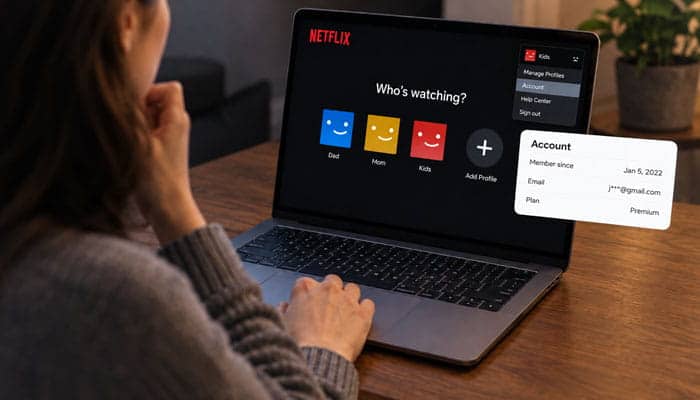
For the most reliable answer to who owns Netflix at a particular point in time, review primary SEC filings rather than relying entirely on third-party ownership websites.
Step 1: Check Netflix’s Latest Form 10-K
The annual report can provide information about:
- Share counts
- Stock structure
- Voting rights
- Stock-market listing
- Repurchase activity
- Corporate governance
Step 2: Check Netflix’s Latest Proxy Statement
The proxy can contain beneficial-ownership information for:
- Significant shareholders
- Directors
- Director nominees
- Named executive officers
- Directors and executives as a group
Netflix’s 2026 proxy identified April 6, 2026 as the ownership date for its relevant table.
Step 3: Review Schedule 13G Filings
Schedule 13G filings can provide updated beneficial-ownership information from qualifying significant shareholders.
Step 4: Check Schedule 13D Filings
Schedule 13D filings can be important when investors meet applicable ownership thresholds and reporting requirements.
Step 5: Check Form 4 Filings
Form 4 filings report certain changes in beneficial ownership involving corporate insiders.
Step 6: Review Form 13F Filings
Form 13F provides another perspective on institutional investment positions.
However, 13F information should not be treated as identical to Schedule 13G beneficial ownership.
Why Do Different Websites Show Different Netflix Ownership Percentages?
Imagine three websites publishing information about who owns Netflix.
One website may use Netflix’s April 2026 proxy and show:
Vanguard: 8.65%
Another website may rely on later Form 13F data and display a different institutional position.
A third may use a later Schedule 13G filing and show FMR at 3.3%.
All three sources could contain legitimate information while referring to different dates or regulatory reporting systems.
Differences can result from:
- Filing dates
- SEC form types
- Ownership definitions
- Aggregation methods
- Treatment of affiliated entities
- Changes in the number of Netflix shares outstanding
- Actual purchases or sales of Netflix stock
Common Mistakes When Reading Netflix Ownership Data
- Treating the largest shareholder as the sole owner of Netflix.
- Using old ownership percentages as if they are current.
- Ignoring reporting dates in SEC filings.
- Skipping important proxy statement footnotes.
- Confusing Form 13F data with Schedule 13G ownership data.
- Calling Reed Hastings the current owner of Netflix.
- Assuming Netflix’s CEOs personally own the company.
- Misunderstanding beneficial ownership.
- Ignoring Netflix’s 2025 stock split when comparing share counts.
- Confusing share ownership with voting power.
- Using outdated information about Netflix’s board leadership.
Important Warning About Netflix Ownership Data
Never publish a Netflix ownership percentage without identifying its reporting date or source period.
This is especially important because:
- Institutional positions can change.
- SEC filings are submitted at different times.
- Form 13F and Schedule 13G measure different things.
- Proxy statements use information available as of specific dates.
- Reporting structures can change.
- Netflix completed a stock split in 2025.
- Share repurchases can change the number of outstanding shares.
A more precise statement is:
“According to the filing dated…”
rather than simply writing:
“Company X owns X% of Netflix.”
Who Owns Netflix FAQs
1. Who Owns Netflix in 2026?
Netflix is owned collectively by its shareholders. No individual or company is disclosed as holding majority ownership.
2. Does Reed Hastings Still Own Netflix Stock?
Yes. Netflix’s 2026 proxy reported that Reed Hastings beneficially owned 37,759,062 shares as of April 6, 2026.
3. Who Is Netflix’s Chairman in 2026?
Jay Hoag serves as Chairman of Netflix’s Board of Directors following the company’s 2026 governance transition.
4. Who Are Netflix’s CEOs in 2026?
Ted Sarandos and Greg Peters serve as Netflix’s co-CEOs.
5. Who Is Netflix’s Largest Shareholder?
The answer depends on the filing date. Netflix’s 2026 proxy listed Vanguard at 8.65%, based on historical ownership information.
6. Does Netflix Have One Controlling Owner?
No. Netflix does not disclose any shareholder holding a controlling majority of the company.
7. How Many Votes Does One Netflix Share Have?
Each Netflix common share generally carries one vote per share.
8. Why Do Netflix Ownership Websites Show Different Percentages?
Different websites may use different SEC filings, reporting dates, ownership definitions, and data sources.
Final Thoughts: Who Owns Netflix?
The most accurate answer to who owns Netflix is straightforward:
Netflix is owned collectively by its shareholders.
It is a publicly traded company rather than a privately owned business controlled by Reed Hastings, Disney, Amazon, Microsoft, or another single corporation.
Reed Hastings and Marc Randolph founded Netflix, but founding the company does not mean they currently control it.
Hastings remained a Netflix shareholder according to the company’s 2026 proxy, but his reported beneficial ownership represented less than 1% under that filing’s calculation. He also left Netflix’s board following the June 2026 annual meeting.
Netflix’s executive leadership consists of co-CEOs Ted Sarandos and Greg Peters, while Jay Hoag serves as Chairman of the Board.
Major investment firms also hold significant Netflix positions, but their exact percentages depend on the relevant SEC disclosure and reporting date.
The most important distinction when answering who owns Netflix in 2026 is that share ownership, beneficial ownership, voting power, board governance, and executive management are related but separate concepts.
Anyone publishing current Netflix ownership information should therefore check the reporting date and filing type instead of relying on an undated shareholder ranking.
