


Last Updated: August 5, 2026
Finding the best business bank accounts for LLC owners is not simply a matter of choosing the bank with the biggest welcome bonus or the lowest advertised monthly fee.
The best business bank accounts for LLC should balance everyday usability, predictable costs, access, security, and room for the company to grow.
The right account depends on how your LLC actually handles money.
A freelance consulting LLC may want unlimited electronic transactions, accounting integrations, and no monthly fee. A restaurant may care much more about cash deposits and nearby branches. A startup with several founders may need multiple users, spending limits, wire transfers, approval workflows, and a banking platform that works with a remote team.
Even two accounts advertised as “free business checking” can produce very different annual costs once you include cash-deposit fees, wires, same-day ACH, transaction limits, and premium features.
After comparing current account structures, monthly costs, transaction policies, cash access, digital tools, interest opportunities, FDIC arrangements, and LLC-specific usability, our 11 standout options for 2026 are Bluevine, U.S. Bank, Chase, Bank of America, American Express, Axos Bank, Novo, Relay, Mercury, Found, and Wells Fargo.
This guide explains where each one shines, who should avoid it, and how to choose an LLC bank account based on your actual business rather than marketing claims.
To make the best business bank accounts for LLC easier to compare, each pick below is matched to a specific business use case.
Quick Answer: What Is the Best Business Bank Account for an LLC?
If you are comparing the best business bank accounts for LLC, start with how you get paid, whether you deposit cash, and how many people need account access.
For many online-first small businesses, Bluevine Business Checking is our strongest overall pick because its Standard plan combines a $0 monthly fee, unlimited transactions, multiple sub-accounts, and the potential to earn interest.
However, it is not automatically the best account for every LLC.
Our top picks are:
- Bluevine Business Checking — Best overall for online LLCs
- U.S. Bank Business Essentials — Best traditional bank with no monthly maintenance fee
- Chase Business Complete Banking — Best for cash deposits and branches
- Bank of America Business Advantage Fundamentals — Best for relationship banking
- American Express Business Checking — Best for APY and debit-card rewards
- Axos Basic Business Checking — Best for unlimited transactions
- Novo Business Checking — Best for ecommerce and freelance businesses
- Relay — Best for multiple accounts and cash-flow organization
- Mercury — Best for startups and international founders
- Found — Best for bookkeeping and tax organization
- Wells Fargo Initiate Business Checking — Best for conventional branch banking
The best choice comes down to one question:
Which account makes your LLC’s everyday banking easiest and least expensive?
Key Takeaways
- The best business bank accounts for LLC vary by fees, cash deposits, APY, branch access, and team controls.
- Bluevine is a strong overall option for online LLCs.
- U.S. Bank and Chase are better suited to businesses wanting traditional banking or cash deposits.
- American Express and Axos stand out for interest potential and high transaction volume.
- Relay, Mercury, Novo, and Found offer useful digital tools for startups, ecommerce businesses, and solo owners.
- $0 monthly fees do not always mean completely free banking.
- LLC owners should understand FDIC coverage, fintech partner banks, and current FinCEN ownership-verification rules.
Best Business Bank Accounts for LLC Compared
| Account | Monthly Fee | Interest Opportunity | Branch Access | Best For |
|---|---|---|---|---|
| Bluevine Standard | $0 | 1.30% APY with requirements | No | Overall online LLC banking |
| U.S. Bank Business Essentials | $0 | Not a major feature | Yes | Traditional banking without monthly maintenance fee |
| Chase Business Complete | $15, waivable | No meaningful checking yield | Yes | Cash-heavy businesses |
| Bank of America Fundamentals | $0 first 12 months; then $16, waivable | Not a major feature | Yes | Relationship banking |
| American Express Business Checking | $0 | 1.30% APY up to $500,000 | No traditional branches | Interest + rewards |
| Axos Basic Business Checking | $0 | No checking APY | Online bank | Unlimited transactions |
| Novo | $0 | No primary checking APY | No | Ecommerce and digital businesses |
| Relay Starter | $0 | Savings APY available | No | Multiple accounts and cash-flow control |
| Mercury | $0 basic banking | Savings/cash-management options | No | Startups and international founders |
| Found | $0 basic plan | APY on paid plans | No | Bookkeeping and tax tools |
| Wells Fargo Initiate | $15, waivable | Not a major feature | Yes | Traditional branch banking |
Why an LLC Should Have a Separate Business Bank Account
Before comparing the best business bank accounts for LLC, make sure you understand why a dedicated business account matters for cleaner records and day-to-day control.
A separate account gives your company a clear financial home.
It can make it easier to:
- Record business income
- Track deductible expenses
- Pay contractors
- Process payroll
- Reconcile bookkeeping
- Prepare tax returns
- Receive payments under your business name
- Document cash flow for lenders
- Separate owner distributions from ordinary expenses
- Give business partners controlled account access
The U.S. Small Business Administration recommends opening a business bank account once you begin accepting or spending money as a business.
Separate banking also supports cleaner recordkeeping and makes it easier to distinguish company transactions from the owner’s personal activity.
However, opening a business account by itself does not guarantee liability protection.
LLC owners should still follow proper legal and accounting practices, including maintaining accurate records, complying with the operating agreement, signing contracts correctly, and avoiding inappropriate mixing of business and personal funds.
1. Bluevine Business Checking — Best Overall for Online LLCs
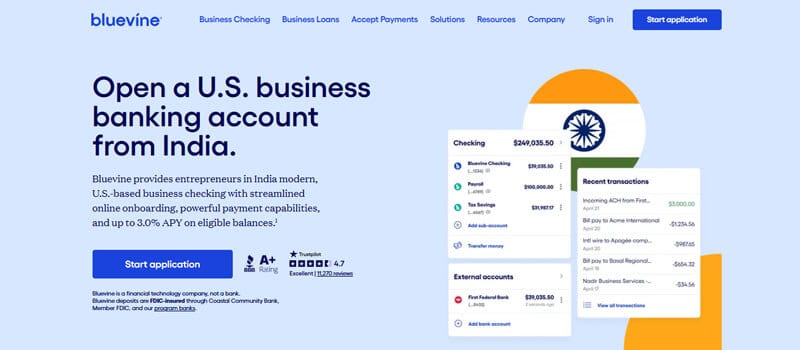
Bluevine is one of the best business bank accounts for LLC owners who want low fees, digital tools, and interest potential.
Best for: Consultants, agencies, ecommerce companies, and online-first LLCs.
Current Standard features include:
- $0 monthly fee
- Unlimited transactions
- No minimum balance
- Multiple sub-accounts
- ACH capabilities
- Team access
- Potential interest earnings
Bluevine currently lists 1.30% APY on qualifying Standard balances up to $250,000. Plus lists 1.75% APY up to $250,000, while Premier lists 3.00% APY on qualifying balances.
Bluevine Plan Comparison
| Plan | Monthly Fee | APY Structure |
|---|---|---|
| Standard | $0 | 1.30% up to $250,000 with qualifying activity |
| Plus | $30, potentially waivable | 1.75% up to $250,000 |
| Premier | $95, potentially waivable | 3.00% on qualifying balances |
Bluevine is a fintech rather than an FDIC-insured bank itself, so owners should review its partner-bank and sweep disclosures.
Why Bluevine Works Well for LLCs
Sub-accounts can help separate money for:
- Operating expenses
- Taxes
- Payroll
- Emergency reserves
- Owner distributions
Pros
- $0 Standard monthly fee
- Unlimited transactions
- Interest potential
- Multiple sub-accounts
- No minimum balance
Cons
- No conventional branches
- Standard APY requires qualifying activity
- Paid plans may charge monthly fees
Who Should Avoid It?
Cash-heavy businesses that regularly need branches, teller service, or large in-person deposits may prefer Chase, Wells Fargo, U.S. Bank, or a local bank.
2. U.S. Bank Business Essentials — Best Traditional Bank With No Monthly Maintenance Fee
U.S. Bank is one of the best business bank accounts for LLC owners who want traditional banking without a standard monthly maintenance fee.
Best for: LLCs wanting physical banking infrastructure with low ongoing costs.
Current features include:
- $0 monthly maintenance fee
- Unlimited digital transactions
- 25 included teller and paper transactions per statement cycle
- $0.50 per additional qualifying teller or paper transaction
- Debit card
- ACH and electronic transfers
- Zelle
- Mobile check deposits
Why U.S. Bank Stands Out
U.S. Bank Business Essentials combines digital convenience with access to a traditional financial institution, making it useful for LLCs that mostly bank online but occasionally need in-person services.
Pros
- $0 monthly maintenance fee
- Unlimited digital transactions
- Physical banking access
- 25 included teller/paper transactions
- Suitable for new businesses
Cons
- Teller and paper transactions are limited
- Cash-handling limits still apply
- Not focused on a high checking APY
Who Should Avoid It?
Businesses making frequent teller transactions may find a higher-tier commercial account more economical.
3. Chase Business Complete Banking — Best for Cash Deposits and Branch Access
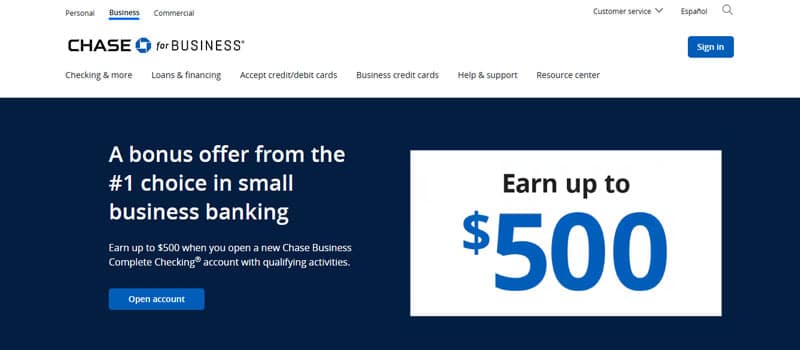
Chase can be one of the best business bank accounts for LLC owners who regularly handle physical cash.
Best for: Restaurants, retailers, contractors, salons, and local service businesses.
Chase Business Complete Banking currently charges $15 per month, although the fee can be waived by meeting qualifying requirements.
The account includes:
- Up to 20 eligible checks and teller transactions per statement cycle
- Up to $5,000 in eligible in-branch cash deposits without additional charges
- Chase ATM deposits
- Built-in invoicing
- Chase QuickAccept
- Debit cards
- Mobile banking
- Large branch and ATM network
Why Cash Changes the Decision
A $0 online account may look cheaper, but cash-deposit fees and inconvenience can quickly erase those savings.
For businesses receiving regular cash payments, branch access can be worth more than a slightly higher APY.
Pros
- Strong branch network
- Cash-deposit support
- Built-in payment acceptance
- Invoicing
- Business credit-card ecosystem
Cons
- Monthly fee unless waived
- Transaction limits
- No meaningful checking APY
Who Should Avoid It?
Fully remote businesses receiving almost all revenue electronically may not need Chase’s physical banking infrastructure.
4. Bank of America Business Advantage Fundamentals — Best for Relationship Banking
Bank of America is among the best business bank accounts for LLC owners who want access to a wider banking, lending, and credit-card ecosystem.
Best for: LLC owners already using or planning to use Bank of America products.
The account currently advertises no monthly fee for the first 12 months. After that, the standard monthly fee is $16 and can be waived by meeting qualifying balance, spending, or Preferred Rewards requirements.
The account also offers:
- Business debit card
- Zelle
- QuickBooks integration
- Online and mobile banking
- Branch access
- Access to additional business products
Why Relationship Banking Matters
A growing LLC may eventually need:
- Business credit cards
- Savings
- Merchant services
- Lines of credit
- Commercial loans
Using one institution for several services can sometimes provide more long-term value than choosing checking based only on fees.
Pros
- Introductory fee waiver
- Multiple ways to waive the regular fee
- Branch network
- Accounting integration
- Large business banking ecosystem
Cons
- $16 standard monthly fee after the introductory period
- Waiver requirements apply
- No high checking APY
Who Should Avoid It?
A small digital-only LLC with low balances and no interest in Bank of America’s broader products may prefer a permanently $0-fee account.
5. American Express Business Checking — Best for APY and Debit Rewards
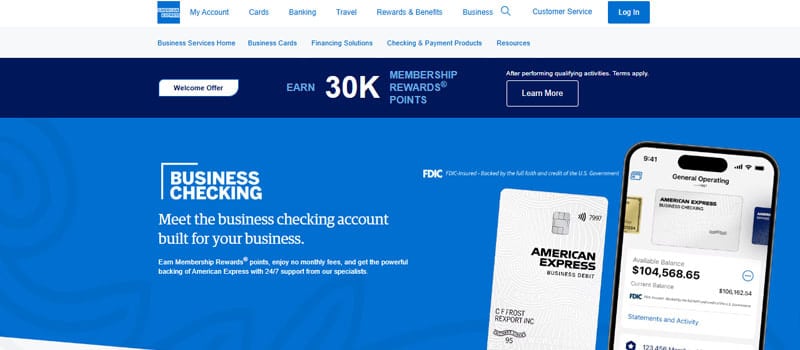
American Express stands out among the best business bank accounts for LLC owners who want interest-bearing checking without a monthly maintenance fee.
Best for: Online businesses, existing Amex customers, and LLCs maintaining larger operating balances.
Current features include:
- $0 monthly maintenance fee
- No minimum balance
- 1.30% APY on eligible balances up to $500,000
- Free standard domestic ACH
- No-fee incoming domestic wires
- 24/7 support
- Membership Rewards on eligible debit spending
Eligible debit-card purchases currently earn 1 Membership Rewards point for every $2 spent.
American Express National Bank is FDIC insured.
Why It Stands Out
The account lets qualifying LLCs earn interest on operating cash while still keeping money available for everyday business expenses.
Pros
- $0 monthly maintenance fee
- 1.30% APY on eligible balances
- Debit-card rewards
- No minimum balance
- Direct FDIC-insured bank
Cons
- No conventional branches
- APY is variable
- Some outgoing transfers may carry fees
Who Should Avoid It?
Businesses that regularly deposit physical cash may prefer a branch-based account.
6. Axos Basic Business Checking — Best for Unlimited Transactions
Axos is one of the best business bank accounts for LLC owners with high digital transaction volume.
Best for: Businesses making large numbers of electronic transactions.
Current features include:
- $0 monthly maintenance fee
- Unlimited transactions
- No required opening deposit
- No minimum balance
- Free incoming domestic and international wires
- Two reimbursed domestic outgoing wires per month
- Unlimited domestic ATM fee reimbursements
- QuickBooks integration
Axos Bank itself is FDIC insured.
Why Unlimited Transactions Matter
Businesses processing hundreds of customer payments, vendor payments, debit purchases, and ACH transfers can quickly exceed the limits of traditional business accounts.
Axos removes much of that concern.
Pros
- $0 monthly maintenance fee
- Unlimited transactions
- Free incoming wires
- No minimum balance
- Unlimited domestic ATM reimbursements
- FDIC-insured bank
Cons
- No conventional branch network
- No checking APY
- Less suitable for cash-heavy businesses
Who Should Avoid It?
Businesses that frequently handle physical cash or need face-to-face banking may prefer a traditional bank or local credit union.
7. Novo Business Checking — Best for Ecommerce and Freelance LLCs
Novo belongs on a list of the best business bank accounts for LLC owners whose customer payments, invoices, and ecommerce activity are almost entirely digital.
Best for: Ecommerce sellers, digital agencies, consultants, developers, creators, and freelancers.
Novo currently advertises:
- $0 monthly fees
- No minimum balance
- No transaction limits
- Digital business checking
- Business payment tools
- Software integrations
Novo is a fintech company, with eligible banking services provided through its FDIC-insured partner bank, Middlesex Federal Savings, F.A.
Why Novo Fits Digital Businesses
Novo’s appeal is not branch banking.
It is workflow simplicity.
That makes it particularly relevant for businesses receiving money through platforms and channels such as:
- Stripe
- Ecommerce platforms
- ACH
- Online invoices
- Digital client payments
Pros
- $0 monthly fee
- No minimum balance
- No transaction limits
- Digital-first workflow
- Useful integrations
- Simple account structure
Cons
- No traditional branches
- Not designed primarily for cash-heavy businesses
- No major checking APY advantage
Who Should Avoid It?
A restaurant, convenience store, salon, or other business handling substantial physical cash should generally choose an account with stronger cash-deposit infrastructure.
8. Relay — Best for Multiple Accounts and Cash-Flow Organization
Relay is particularly relevant when comparing the best business bank accounts for LLC owners who want multiple accounts, user controls, and cash-flow organization.
Best for: Multi-owner LLCs, agencies, businesses using Profit First-style budgeting, and companies that want detailed financial separation.
Relay Starter currently costs:
$0 per month.
Its current Starter features include:
- Up to 20 checking accounts per business
- Unlimited users
- Spend controls
- Accounting integrations
- Invoice creation and tracking
- Bill management
- Savings accounts
- Multiple card-management tools
Relay’s live pricing page currently displays 0.91% APY on Starter savings, while other rate disclosures on the same page may show different figures. Relay states that savings rates are variable and can change with market conditions.
Treat Relay’s savings APY as variable by plan and verify the live rate immediately before opening or upgrading an account.
Relay is a fintech company rather than an FDIC-insured bank. Banking services are provided by Thread Bank, Member FDIC.
Relay says qualifying sweep deposits can receive up to $3 million in aggregate FDIC insurance coverage, subject to program terms, existing deposits at program banks, and pass-through insurance requirements.
Why Multiple Accounts Can Be Powerful
Instead of one checking account containing everything, you might create:
- Income
- Operating expenses
- Payroll
- Taxes
- Marketing
- Emergency reserves
- Profit
- Owner distributions
That structure can make it far easier to see which money is actually available to spend.
Pros
- $0 Starter plan
- Up to 20 checking accounts
- Unlimited users
- Strong permissions
- Spend controls
- Accounting integrations
- Savings options
Cons
- No conventional branches
- Advanced automation may require paid plans
- Savings rates can change
Who Should Avoid It?
A very simple single-member LLC needing only one checking account may not benefit from Relay’s more elaborate organizational structure.
9. Mercury — Best for Startups and International Founders

Mercury is one of the best business bank accounts for LLC founders running startups, remote teams, or qualifying U.S. companies with international ownership.
Best for: SaaS companies, startups, ecommerce businesses, remote teams, and international founders.
Mercury currently offers:
- $0 basic business banking
- No minimum balance
- No overdraft fees
- Free ACH
- Free domestic wires
- Free international USD wires
- Invoicing and bill pay
- Accounting integrations
- User permissions and approval controls
Mercury is a fintech, not an FDIC-insured bank. Banking services are provided through Choice Financial Group and Column N.A., with eligible deposits potentially receiving up to $5 million in FDIC coverage through partner banks and sweep networks, subject to program terms.
Why Startups Like Mercury
Mercury’s permissions and approval tools work well for businesses with multiple founders, contractors, remote employees, and finance teams.
It also supports many qualifying U.S.-registered companies with founders living outside the United States. Country, business, and address eligibility rules apply.
Pros
- $0 basic banking
- Free ACH and wires
- Strong team permissions
- Startup-friendly tools
- Supports many international founders
Cons
- No conventional branches
- Not suitable for cash deposits
- Eligibility restrictions apply
10. Found — Best for Bookkeeping and Tax Organization
Found is one of the best business bank accounts for LLC owners who want banking combined with bookkeeping and tax-management tools.
Best for: Freelancers, consultants, creators, and smaller single-owner LLCs.
Found’s free plan includes:
- Expense categorization
- Receipt scanning
- Profit-and-loss reporting
- Tax estimates
- Contractor payments
- W-9 and 1099 tools
- Invoicing
- Up to 10 Pockets
Found Pricing
| Plan | Price | Interest Feature |
|---|---|---|
| Found | $0/month | No paid-plan APY |
| Found Plus | $35/month or $315/year | 1.50% APY up to $20,000 |
| Found Pro | $80/month or $720/year | 2.50% APY with no stated balance cap |
Why Found Stands Out
Found can connect banking, expense tracking, tax estimates, and invoicing in one platform, reducing the number of tools a solo business owner needs.
Pros
- $0 basic plan
- Built-in bookkeeping
- Tax estimates
- Invoicing
- Contractor tools
- Paid APY options
Cons
- No physical branches
- Higher APYs require paid plans
- Complex LLCs may still need separate accounting software
11. Wells Fargo Initiate Business Checking — Best for Conventional Branch Banking
Wells Fargo remains one of the best business bank accounts for LLC owners who value branches and cash-deposit access.
Best for: Newer LLCs wanting traditional banking and in-person service.
The account currently charges $15 per month, which can be waived by meeting qualifying balance or relationship requirements.
Current features include:
- First 100 qualifying transactions per fee period
- First $5,000 in qualifying cash deposits without processing charges
- More than 11,000 ATMs
- Digital banking
- Business Bill Pay
- 24/7 fraud monitoring
Pros
- Large branch network
- Cash deposits
- Waivable monthly fee
- Broad ATM access
- Wide range of business products
Cons
- $15 monthly fee unless waived
- Transaction limits
- Cash-deposit limits
- No meaningful checking APY
Which LLC Bank Account Is Best for Your Business Type?
The best business bank accounts for LLC should be matched to the business model, not chosen from a single universal ranking.
| Type of LLC | Strong Choice | Why |
|---|---|---|
| Online small business | Bluevine | Low cost + APY potential |
| Cash-heavy business | Chase | Cash deposits + branches |
| Traditional banking with $0 monthly fee | U.S. Bank | Branch infrastructure + unlimited digital transactions |
| Existing BofA client | Bank of America | Relationship banking |
| LLC holding substantial operating cash | American Express | Interest-bearing checking |
| High transaction volume | Axos | Unlimited transactions |
| Ecommerce company | Novo | Digital workflow |
| Multi-account budgeting | Relay | Up to 20 checking accounts |
| Startup | Mercury | Permissions + wires |
| Freelancer/solo LLC | Found | Bookkeeping + tax tools |
| Branch-oriented company | Wells Fargo | Traditional banking |
Online Bank vs. Traditional Bank for an LLC
When comparing the best business bank accounts for LLC, deciding between online and traditional banking is an important first step.
Online Banking Is Better For
- Lower monthly fees
- Unlimited digital transactions
- Virtual cards and sub-accounts
- Higher interest potential
- Remote teams
- Faster online applications
Traditional Banking Is Better For
- Cash deposits
- Teller assistance
- Cashier’s checks
- Branch support
- Commercial lending
- Treasury services
Your LLC does not have to choose only one. Some businesses use a traditional bank for cash deposits and a digital account for payments, reserves, or everyday online banking.
Bank vs. Fintech: Know Who Holds Your LLC’s Money
This distinction matters when comparing the best business bank accounts for LLC owners.
Bluevine, Novo, Relay, Mercury, and Found are fintech platforms, not banks. They generally work with FDIC-insured partner banks.
Direct Bank Account
When your LLC deposits money directly with an FDIC-insured bank, eligible funds receive FDIC protection under applicable limits and ownership rules.
Fintech Account
A fintech may place customer funds with one or more insured partner banks. Pass-through FDIC coverage may apply when the required conditions and records are maintained.
The key point is:
FDIC insurance protects against the failure of an insured bank, not the bankruptcy of the fintech company itself.
Before keeping substantial LLC funds with a fintech, check:
- Which insured bank holds the money?
- Does the provider use a sweep network?
- How does pass-through insurance work?
- Could other deposits at the same partner bank affect coverage?
These details become more important as your business balance grows.
Are Credit Unions Good for LLC Business Accounts?
Credit unions can compete with the best business bank accounts for LLC when local service, business lending, and cash deposits are more important than advanced fintech tools.
Yes.
A local or industry-specific credit union may provide:
- Lower monthly fees
- Local branches
- Cash deposits
- Business savings
- Commercial loans
- More personalized service
- Local decision-making
The main limitation is membership eligibility.
Deposits at federally insured credit unions are protected by the National Credit Union Share Insurance Fund administered by the NCUA.
For qualifying corporation, partnership, or unincorporated-association accounts, the standard limit is generally $250,000 at one federally insured credit union.
Multiple accounts owned by the same qualifying entity are generally aggregated rather than each receiving a separate $250,000 limit.
A strong local credit union may therefore be better than any national recommendation if your LLC values local lending relationships and personalized service.
Best Free Business Bank Accounts for LLC Owners
Many of the best business bank accounts for LLC offer no monthly maintenance fee, including:
- Bluevine Standard
- U.S. Bank Business Essentials
- American Express Business Checking
- Axos Basic Business Checking
- Novo
- Relay Starter
- Mercury
- Found
However, $0 monthly fee does not mean $0 total cost.
Also compare fees for:
- ACH and wires
- Cash deposits
- ATM use
- Instant transfers
- Premium features
The cheapest account is the one with the lowest overall cost for your business activity.
Best Business Bank Account for a Multi-Member LLC
For multi-owner companies, the best business bank accounts for LLC should offer strong access and approval controls.
Look for:
- Separate user logins
- Authorized signers
- Spending limits
- Wire and ACH approvals
- Accountant access
- Dual authorization
- Transaction alerts
Relay and Mercury are strong options for businesses needing detailed team controls.
Your operating agreement should also clearly state who can open accounts, move money, add users, and close accounts.
What Documents Do You Need to Open an LLC Bank Account?
Even the best business bank accounts for LLC can delay approval if your documents are incomplete.
Banks commonly request:
- Government-issued ID
- LLC legal name and business address
- EIN or accepted taxpayer ID
- Articles of Organization or Certificate of Formation
- Operating agreement
- DBA certificate, if applicable
- Ownership and manager information
- Expected business activity
- Source-of-funds information
Requirements vary by bank and ownership structure, so prepare your formation, tax, and identity documents before applying.
2026 Update: BOI Reporting and Bank Beneficial-Owner Verification Are Different
This matters when comparing the best business bank accounts for LLC because BOI filing relief does not remove a bank’s verification duties.
As of August 2026, U.S.-created entities, including domestic LLCs, are exempt from federal BOI reporting under the Corporate Transparency Act.
However, banks may still request beneficial-owner information under FinCEN’s Customer Due Diligence rules, including:
- Individuals owning 25% or more of the entity, where applicable
- An individual who controls the business
What Changed in February 2026?
FinCEN allowed covered institutions to avoid repeating full beneficial-owner verification every time an existing legal-entity customer opens another account.
Verification may instead focus on:
- The first account opening
- Questionable existing ownership information
- Situations requiring updated risk-based verification
Do You Need an EIN to Open an LLC Bank Account?
When comparing the best business bank accounts for LLC, check each bank’s EIN requirements.
Some single-member LLCs may use the owner’s taxpayer identification number for certain federal tax purposes if they have no employees or applicable excise-tax obligations.
However, the IRS allows a single-member LLC to obtain an EIN when needed for banking or state requirements.
EIN Rules and Bank Rules Are Different
A bank may require an EIN even when federal tax rules do not.
An EIN can also help with:
- Business banking
- Payroll
- Vendor paperwork
- Business credit applications
- Merchant processing
Always check the specific bank’s requirements before assuming an SSN is enough.
Can a Non-U.S. Resident Open a Business Bank Account for a U.S. LLC?
For international founders, the best business bank accounts for LLC are those that support their country, business type, address, and U.S. operations.
A U.S. LLC does not automatically guarantee bank approval.
International founders may need:
- LLC formation documents
- EIN confirmation
- Passport
- Ownership records
- Operating agreement
- Principal business address
- Business activity details
- Source-of-funds information
Applicants without a U.S. legal residence or principal business presence generally cannot use the IRS online EIN application and may need another application method.
Always verify banking eligibility before forming a U.S. LLC around a specific provider.
Business Bank Account Security Matters
Security should be part of every comparison of the best business bank accounts for LLC, especially when multiple people can access company funds.
Business accounts do not receive exactly the same consumer protections as personal accounts, so strong account controls matter.
Look for:
- Multi-factor authentication
- ACH and wire controls
- Dual approval for large payments
- Debit-card limits
- Role-based permissions
- Positive Pay
- Transaction alerts
- Card freezing
- Separate accountant access
A bookkeeper may need account access, but that does not mean they should have unrestricted authority to move large amounts of money.
9 Things to Check Before Opening an LLC Business Bank Account
Use this checklist to compare the best business bank accounts for LLC based on your actual banking needs.
1. Monthly Maintenance Fee
A $15 monthly fee costs $180 per year, so make sure the benefits justify it.
2. Fee-Waiver Rules
Check requirements such as:
- Minimum balances
- Debit-card spending
- Merchant processing
- Linked accounts
3. Transaction Limits
Find out how many transactions are included and what counts toward the limit.
4. Cash-Deposit Limits
This is especially important for retailers, restaurants, and other cash-heavy businesses.
5. ACH and Wire Fees
Compare transfer costs if you frequently pay vendors, contractors, or international partners.
6. Accounting Integration
Reliable integrations can reduce bookkeeping and reconciliation work.
7. User Permissions
Multi-member LLCs should look for role-based access and approval controls.
8. Deposit Insurance
Understand where your funds are held and how FDIC or other applicable coverage works.
9. Ability to Grow
Consider whether the provider can later support business savings, credit cards, payroll, lending, merchant services, or treasury tools.
Calculate the Real Annual Cost Before Choosing a Bank
When comparing the best business bank accounts for LLC, focus on total annual cost—not just the monthly fee.
Annual Banking Cost = Monthly Fees + Transaction Fees + Cash-Deposit Fees + ACH/Wire Fees + Other Fees − Interest and Rewards
| Expense | Bank A | Bank B |
|---|---|---|
| Annual maintenance fees | $0 | $180 |
| Cash-deposit fees | $240 | $0 |
| Wire fees | $120 | $40 |
| Other fees | $60 | $0 |
| Total annual cost | $420 | $220 |
Bank A advertises free checking, yet Bank B costs this hypothetical LLC $200 less per year.
Before applying, estimate your expected cash deposits, ACH activity, wires, ATM use, teller transactions, and average balance.
Common Business Banking Mistakes LLC Owners Make
Avoiding these mistakes can matter just as much as choosing one of the best business bank accounts for LLC:
- Choosing a bank only for the sign-up bonus
- Ignoring cash-deposit fees and limits
- Chasing a high APY while overlooking other fees
- Mixing personal and business spending
- Giving too many users full account access
- Assuming every fintech platform is a bank
- Keeping all business reserves in checking
- Relying on only one bank for all company funds
Can an LLC Have More Than One Business Bank Account?
Some owners use more than one of the best business bank accounts for LLC to separate operating cash, taxes, payroll, reserves, or backup liquidity.
Yes.
Many LLCs benefit from multiple accounts.
For example:
| Account | Purpose |
|---|---|
| Operating checking | Everyday business expenses |
| Tax account | Estimated taxes |
| Payroll account | Payroll obligations |
| Reserve savings | Emergency liquidity |
| Profit account | Retained profit/distributions |
Transfers between accounts owned by the same LLC should be correctly recorded in your bookkeeping system rather than accidentally classified as new revenue or an expense.
Should an LLC Have a Backup Business Bank Account?
A backup account can reduce the risk of one outage, restriction, or verification issue disrupting your business.
Possible problems include:
- Fraud reviews
- Identity verification
- Technical outages
- Lost credentials
- Account restrictions
- Fintech service disruptions
A simple setup could look like this:
| Account | Role |
|---|---|
| Primary checking | Everyday operations |
| Backup checking | Emergency liquidity |
| Tax account | Tax reserves |
| Savings | Longer-term reserves |
For better diversification, keep the backup account at a different financial institution.
Checking vs. Business Savings: Where Should an LLC Keep Extra Cash?
Even after choosing one of the best business bank accounts for LLC, not every dollar needs to stay in checking.
| Money | Possible Location |
|---|---|
| Next 30–60 days of expenses | Business checking |
| Tax reserves | Checking or savings |
| Emergency reserves | Business savings |
| Short-term excess cash | Savings or cash-management account |
| Immediate operating money | Highly liquid checking |
Keeping too much cash in a non-interest-bearing account may reduce potential earnings, but moving too much into less-liquid products can create cash-flow problems.
The goal is to earn a reasonable return without putting payroll, taxes, bills, or emergency access at risk.
Should an LLC Keep More Than $250,000 at One Bank?
The FDIC generally insures qualifying LLC deposits up to $250,000 per insured bank under the applicable business ownership category.
Multiple accounts owned by the same LLC at the same bank are usually combined for coverage purposes.
For example:
- Operating account: $150,000
- Tax account: $75,000
- Savings: $100,000
If all three are held by the same LLC at one bank, the balances may be aggregated.
Businesses with larger reserves can consider:
- Multiple FDIC-insured banks
- Sweep networks
- Insured cash-management services
- Business savings
- Treasury services
Also check whether your LLC already has deposits at banks participating in a sweep network.
Does Opening an LLC Bank Account Build Business Credit?
Not directly.
A business checking account is a deposit account, so normal banking activity generally does not build business credit like a loan, credit card, or reporting vendor account.
However, it can still help by:
- Establishing a separate business identity
- Documenting revenue and cash flow
- Supporting lender applications
- Building a banking relationship
- Separating personal and business finances
Think of business checking as financial infrastructure, not a business-credit tradeline.
How to Switch Business Bank Accounts Without Disrupting Your LLC
Do not close your old account immediately. Run both accounts temporarily while moving payments.
First, update incoming payments such as:
- Customer ACH
- Stripe and merchant payouts
- Marketplace deposits
- Client transfers
Then move outgoing payments, including:
- Payroll
- Tax payments
- Credit cards and loans
- Insurance
- Software and utilities
- Vendor autopay
Keep enough money in the old account for outstanding checks, refunds, chargebacks, and forgotten recurring payments.
Before closing it, save:
- Bank statements
- Check images
- Transaction exports
- Reconciliation records
- Tax documents
A gradual switch helps prevent missed payments and bookkeeping problems.
How We Selected the Best Business Bank Accounts for LLC Owners
Our ranking of the best business bank accounts for LLC focuses on long-term value rather than temporary bonuses.
We considered:
- Monthly costs: $0 fees, waivable fees, and subscriptions
- Transaction limits: Especially for high-volume businesses
- Cash handling: Important for retailers, restaurants, contractors, and local businesses
- APY: More valuable for larger balances
- Team controls: User access, permissions, and approval workflows
- Accounting tools: Integrations that simplify bookkeeping
- Money movement: ACH, wires, checks, bill pay, and invoicing
- Branch access: Important for cash-heavy businesses
- FDIC structure: Direct banks vs. fintech partner-bank models
- Growth potential: Ability to support more users, transactions, and cash as the LLC expands
Final Thoughts: What Are the Best Business Bank Accounts for LLC Owners?
The best business bank accounts for LLC owners in 2026 are the ones that match how the business actually operates—not simply the accounts with the highest APY, biggest bonus, or lowest monthly fee.
Bluevine is a strong choice for online-first businesses, U.S. Bank Business Essentials suits owners who want traditional banking with low ongoing costs, and Chase works well for cash-heavy businesses. American Express, Axos, Relay, Mercury, and Found each stand out for specific needs such as interest earnings, high transaction volume, cash-flow organization, startup banking, and built-in bookkeeping.
Before opening an account, compare fees, transaction limits, cash deposits, ACH and wire costs, balance requirements, FDIC structure, security controls, and accounting integrations.
Ultimately, the right account should make your LLC’s money easier to manage, access, protect, and organize while supporting the business as it grows.
Best Business Bank Accounts For LLC FAQs
1. Can two separate LLCs use the same business bank account?
Generally, each LLC should maintain its own business bank account. Separate accounts make bookkeeping, taxes, ownership records, and financial separation much clearer.
2. Should an LLC bank account use the legal business name or DBA?
Banks generally open the account under the LLC’s legal name. If you operate under a DBA, the bank may ask for your assumed-name or DBA registration before allowing deposits under that name.
3. Can a brand-new LLC open a business bank account before earning revenue?
Yes. Many of the best business bank accounts for LLC accept newly formed businesses with no revenue history, although approval and documentation requirements vary.
4. Does an S corporation election require a new LLC bank account?
Usually not. An LLC that elects S corporation tax treatment can generally continue using its existing business account, provided the account remains correctly titled to the legal entity.
5. What minimum balance should an LLC keep in its bank account?
There is no universal amount. Keep enough to cover upcoming expenses, taxes, payroll, and emergencies while considering any minimum balance required to waive account fees.
6. Can LLC members get separate business debit cards?
Many of the best business bank accounts for LLC allow multiple authorized users or employee cards. Look for individual spending limits, transaction alerts, and permission controls.
7. Should an LLC choose a bank that also offers business loans?
It can be useful if you expect to need credit later. An established banking relationship may simplify financial documentation, although loan approval is never guaranteed.
8. How often should LLC owners review their business bank account?
Review the account at least annually—or whenever transaction volume, cash deposits, team size, or banking fees change. The best business bank accounts for LLC today may not remain the best fit as your company grows.