


Last Updated: August 5, 2026
The first time you need to undercut a door jamb, cut a hidden nail behind finished trim, open drywall without swinging a reciprocating saw around, or remove grout from one damaged tile, an oscillating multi-tool suddenly makes a lot of sense.
That versatility is why the DEWALT Oscillating Multi Tool remains a popular choice for remodelers, flooring installers, carpenters, electricians, maintenance professionals, and DIY homeowners. Instead of specializing in one job, it can plunge cut, flush cut, scrape, sand, remove grout, trim flooring, and reach areas where conventional saws struggle.
DEWALT’s lineup is especially interesting in 2026. The proven DCS356 remains heavily represented in DEWALT’s current U.S. catalog, including newer 4Ah and 5Ah kit configurations, while the next-generation DCS359 is beginning to appear. DEWALT has published the DCS359 instruction manual, and independent 2026 testing identifies it as an early-release model with four speed modes, a larger oscillation angle, and significantly improved vibration control.
Quick Answer: Is the DEWALT Oscillating Multi Tool Worth It?
Yes. A DEWALT Oscillating Multi Tool is worth buying in 2026 for most homeowners, remodelers, flooring installers, maintenance professionals, and contractors particularly if you already use DEWALT batteries.
For most buyers, the DCS356 remains the best-value choice. It combines a brushless motor, up to 20,000 OPM, three speed ranges, a Dual-Grip variable-speed trigger, fast Quick-Change accessory swaps, a universal accessory adapter, and an LED work light.
The DCS359 is more compelling for professionals and frequent users. Its official manual confirms four operating modes at approximately 8,000, 12,000, 16,000, and 20,000 OPM. Independent 2026 testing also reports a wider 4.2-degree oscillation angle and substantially improved vibration isolation.
Best DEWALT Oscillating Multi Tool by Buyer
| Buyer | Best Choice | Why |
|---|---|---|
| Existing DEWALT 20V owner | DCS356B | Strong value without buying another battery |
| DIY homeowner | DCS356 | Powerful, versatile, and easy to control |
| Budget DIY buyer | DCS354 | Worth considering when substantially cheaper |
| Flooring installer | DCS356 or DCS359 | Excellent plunge and flush-cut capability |
| Professional remodeler | DCS359 | Better vibration control and aggressive cutting |
| Tight-space user | DCS353 12V | Compact and lightweight |
| Clearance/used shopper | DCS355 | Still useful at the right price |
| Workshop user | DWE315K | Unlimited corded runtime |
| Buyer wanting newest technology | DCS359 | Latest-generation design |
Key Takeaways
- The DCS356 delivers up to 20,000 OPM with three speed ranges and a 3.2° oscillation angle.
- The newer DCS359 adds four speed settings, a wider 4.2° oscillation angle, and improved accessory compatibility.
- The DCS354 and compact DCS353 reach up to 18,000 OPM.
- Blade quality has a major impact on cutting speed and performance.
- Existing DEWALT battery owners may save money by choosing a bare tool.
- The DCS356 performs especially well in wood, flooring, drywall, and renovation work but is less competitive in demanding metal cuts.
What Is a DEWALT Oscillating Multi Tool?
An oscillating multi-tool moves an attached accessory through a tiny side-to-side arc thousands of times per minute.
It works differently from most familiar cutting tools.
A circular saw rotates its blade continuously.
A reciprocating saw moves through a comparatively large forward-and-back stroke.
An oscillating multi-tool moves only through a few degrees of arc at high frequency.
That tiny movement makes controlled plunge cuts and flush cuts possible in areas where a larger saw would be difficult, messy, or unsafe to position.
Typical DEWALT Oscillating Multi Tool applications include:
- Plunge cutting wood
- Undercutting door jambs
- Cutting drywall
- Trimming baseboards
- Flush-cutting protruding material
- Cutting nails
- Cutting selected screws and bolts
- Cutting PVC pipe
- Removing grout
- Scraping adhesive
- Removing old caulk
- Detail sanding
- Surface preparation
- Flooring repairs
- Cabinet modifications
- Small plumbing-access openings
- Electrical-access openings
It is not the fastest tool for every one of those jobs.
Its biggest advantages are access, control, and versatility.
Which DEWALT Oscillating Multi Tool Should You Buy in 2026?
DEWALT has several relevant models, and choosing solely by model number can be confusing.
| Model | Platform | Max Speed | Main Strength | Best For |
|---|---|---|---|---|
| DCS359 | 20V MAX | 20,000 OPM | New performance and vibration design | Professionals |
| DCS356 | 20V MAX | 20,000 OPM | Best overall value | Most buyers |
| DCS354 ATOMIC | 20V MAX | 18,000 OPM | Simpler 20V model | DIY/light work |
| DCS355 | 20V MAX | 20,000 OPM | Older brushless platform | Used/clearance |
| DCS353 XTREME | 12V MAX | 18,000 OPM | Compact size | Tight spaces |
| DWE315K | Corded | Variable | Unlimited runtime | Workshop use |
DEWALT’s current U.S. oscillating-tool catalog continues to prominently feature multiple DCS356, DCS354, DCS353, and DWE315K configurations.
For shoppers comparing the DEWALT Oscillating Multi Tool range, that broad lineup means there is still a meaningful choice between value, compactness, corded runtime, and next-generation performance.
That matters because the DCS356 does not suddenly become obsolete just because the DCS359 is arriving.
DCS356 Specifications
| Specification | DCS356 |
|---|---|
| Battery platform | 20V MAX |
| Motor | Brushless |
| Maximum no-load speed | 20,000 OPM |
| Speed selector | 3 ranges |
| Oscillation angle | Approx. 3.2° |
| Trigger | Dual-Grip variable speed |
| Blade changes | Quick-Change |
| Universal accessory adapter | Yes |
| LED light | Yes |
| Cordless | Yes |
How Good Is the DCS356 at Cutting?
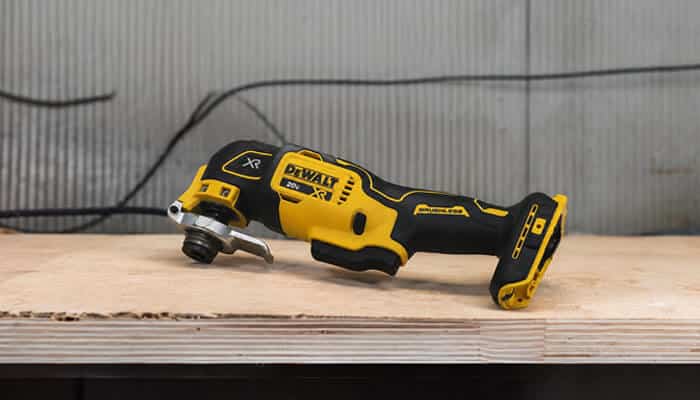
Maximum OPM alone does not determine cutting speed. Performance also depends on:
- Oscillation angle
- Motor output under load
- Blade sharpness and tooth design
- Material hardness
- Battery charge
- Cutting pressure
- Workpiece stability
A worn or unsuitable blade can make a DEWALT Oscillating Multi Tool feel weaker than it actually is. A quality carbide or precision wood blade can noticeably improve performance.
Wood Cutting Performance
Wood is one of the DCS356’s stronger applications. It works particularly well for:
- Door casings
- Baseboards
- Hardwood flooring
- Plywood
- Cabinet and trim work
- Flush cuts
- Plunge cuts
In 2026 independent testing, the DCS356 finished second in red oak and third in nail-embedded pine, although it performed less competitively in demanding metal cuts.
Its performance therefore depends heavily on the material.
Cutting Door Jambs for Flooring
Undercutting door jambs is one of the best uses for an oscillating multi-tool.
A simple method is to:
- Place a scrap piece of finished flooring beside the casing.
- Rest the blade flat on the flooring sample.
- Cut horizontally through the jamb.
- Remove the waste.
- Slide the flooring underneath.
This usually creates a cleaner finish than cutting the flooring around the trim.
The DEWALT Depth and Cut Guide
The depth guide is an underrated accessory for a DEWALT Oscillating Multi Tool.
The DCS356D1 kit includes one, and DEWALT describes the guide system as useful for controlling cutting depth or height.
| Guide Use | Benefit |
|---|---|
| Depth control | Helps limit blade penetration |
| Cut-line tracking | Helps maintain a marked line |
| Height control | Helps create repeatable cuts |
The new DCS359 also supports an optional depth/cut guide.
Its manual says the guide can help cut to a specified depth or height and track a marked line more accurately.
This is useful around:
- Flooring
- Trim
- Cabinets
- Wall panels
- Drywall
However, a depth guide is not protection from hidden electrical wiring or pipes.
Always identify what is behind the surface first.
Can a DEWALT Oscillating Multi Tool Cut Metal?
Yes—with the correct blade.
A quality bi-metal or carbide blade can handle:
- Nails and nail-embedded wood
- Thin sheet metal
- Copper pipe
- Small brackets
- Selected screws and bolts
- Thin conduit
However, a DEWALT Oscillating Multi Tool is not the best choice for repeated heavy metal cutting. An angle grinder, band saw, or reciprocating saw may be faster for larger jobs.
In Pro Tool Reviews’ 2026 testing, the DCS356 performed better in wood than in demanding metal cuts, including copper pipe and EMT conduit.
What Does That Mean for Real Buyers?
The DCS356 is well suited to occasional tasks such as cutting a hidden nail, small fastener, or thin metal piece.
For frequent conduit, threaded rod, or heavy fastener cutting, consider the newer DCS359 or a dedicated metal-cutting tool.
What Materials Can a DEWALT Oscillating Multi Tool Cut?
The better question is not simply whether the tool can cut something.
It is whether you have the correct blade for the material.
| Material | Suitable? | Recommended Accessory |
|---|---|---|
| Softwood | Yes | Wood blade |
| Hardwood | Yes | Precision wood blade |
| Plywood | Yes | Wood/plunge blade |
| Drywall | Yes | General cutting blade |
| PVC/plastic | Yes | Fine-tooth blade |
| Nails | Yes | Bi-metal or carbide |
| Screws | Often | Carbide |
| Small bolts | Selected applications | Carbide |
| Thin metal | Yes | Bi-metal/carbide |
| Fiber cement | Selected applications | Carbide |
| Plaster | Yes | Carbide |
| Grout | Yes | Carbide-grit blade |
| Mortar | Detail work | Carbide/diamond accessory |
| Adhesive | Yes | Scraper |
| Caulk | Yes | Flexible scraper |
DEWALT’s current ELITE SERIES carbide oscillating blades use Universal Fitment and are designed for demanding applications such as cutting wood with nails. DEWALT also offers dedicated carbide-grit grout-removal accessories.
Why Oscillation Angle Matters More Than OPM Alone
Two multi-tools can both advertise 20,000 OPM and still cut at noticeably different speeds. When comparing any DEWALT Oscillating Multi Tool, oscillation angle deserves nearly as much attention as the headline OPM figure.
One reason is oscillation angle.
The angle describes how far the blade swings during each oscillation.
| Model | Max OPM | Approx. Oscillation Angle |
|---|---|---|
| DCS356 | 20,000 | 3.2° |
| DCS359 | 20,000 | 4.2° |
Independent testing lists the DCS356 at a 3.2-degree arc and the DCS359 at approximately 4.2 degrees.
A larger arc makes the teeth travel farther through the material during every cycle, which can increase material removal.
But bigger is not automatically better.
Cutting performance also depends on:
- Motor output
- Speed under load
- Vibration isolation
- Blade design
- Ergonomics
- Control
- Battery performance
The DCS359 is interesting because DEWALT appears to have combined a more aggressive oscillation arc with substantially better vibration isolation rather than simply chasing a higher OPM number.
DEWALT DCS359: The Big 2026 Upgrade
The DCS359 is the most important development in the DEWALT multi-tool lineup this year. For buyers who want the newest DEWALT Oscillating Multi Tool, it is the model that changes the 2026 buying conversation most.
There is one availability detail to understand.
As of August 5, 2026, DEWALT’s U.S. oscillating-tool catalog still prominently lists the DCS356 family and does not yet present the DCS359 alongside those mainstream listings. However, DEWALT has published an official North American DCS359 manual, while an independent 2026 head-to-head reported an August 1, 2026 early-release launch date.
The DCS359 should therefore currently be considered a new or early-release model, with availability potentially varying by retailer and region during the transition.
DCS359 Speed Modes
The official manual confirms four selectable modes.
| Setting | Approximate Speed |
|---|---|
| Mode 1 | 8,000 OPM |
| Mode 2 | 12,000 OPM |
| Mode 3 | 16,000 OPM |
| Mode 4 | 20,000 OPM |
The variable-speed trigger provides additional control within the selected mode.
DEWALT recommends beginning at a lower setting when you are unsure and gradually increasing speed until you find an appropriate operating range.
DCS359 vs DCS356
| Feature | DCS356 | DCS359 |
|---|---|---|
| Platform | 20V MAX | 20V MAX |
| Max OPM | 20,000 | 20,000 |
| Speed modes | 3 | 4 |
| Variable trigger | Yes | Yes |
| Oscillation angle | Approx. 3.2° | Approx. 4.2° |
| Tool-free accessory changes | Yes | Yes |
| Starlock support | Not native | Yes |
| Starlock Plus support | Not native | Yes, with adapter/pin |
| LED | Yes | Yes |
| Optional depth/cut guide | Yes | Yes |
| Lock-on | Supported on current versions | Yes |
| Vibration-focused redesign | Limited | Major improvement |
| Best reason to buy | Value | Performance + comfort |
How Much Better Is the DCS359?
The DCS359 is a meaningful upgrade, especially for frequent users.
Independent 2026 testing reported a wider 4.2° oscillation angle, improved vibration isolation, and strong overall cutting performance. It ranked first overall in Concord Carpenter’s 15-tool comparison.
Its biggest advantage is balance: stronger cutting, better comfort, and broader accessory compatibility rather than simply having a higher maximum OPM.
Should You Buy the DCS356 or DCS359?
Buy the DCS356 If:
- You find it at a substantial discount.
- You already own DEWALT 20V batteries.
- You use a multi-tool occasionally.
- Most jobs involve wood, trim, flooring, drywall, and general repairs.
- Fast accessory changes matter to you.
- You want a proven model rather than the newest release.
Buy the DCS359 If:
- You use a multi-tool frequently.
- You are a professional remodeler or installer.
- Vibration fatigue matters.
- You perform demanding cuts regularly.
- You want four speed modes.
- You want official compatibility with Starlock accessories.
- You expect to keep the tool for many years.
- The price premium is reasonable for your workload.
Simple Recommendation
For occasional use, save the money and buy the DCS356. It remains the more sensible DEWALT Oscillating Multi Tool when value matters more than having the newest vibration-control design.
For frequent professional use, the DCS359 is the more compelling long-term tool.
DCS356B vs DCS356C1 vs DCS356D1 vs DCS356M1 vs DCS356P1
The model suffixes mainly refer to different kit configurations built around the same DCS356 platform.
| Model | General Configuration | Best For |
|---|---|---|
| DCS356B | Bare tool | Existing battery owners |
| DCS356C1 | Starter kit | New DEWALT users |
| DCS356D1 | 2Ah kit + accessory bundle | DIY/remodeling |
| DCS356M1 | 4Ah kit | Longer sessions |
| DCS356P1 | 5Ah kit | Runtime-focused users |
The M1 and P1 kits include larger 4Ah and 5Ah batteries, while the DCS356B is better for users who already own compatible DEWALT batteries.
What Comes With the DCS356D1?
The DCS356D1 is a strong starter package that includes:
- DCS356 multi-tool
- 2Ah battery
- Charger
- Depth guide
- Two cutting blades
- Universal accessory adapter
- Sanding pad
- 25 sanding sheets
For first-time buyers, this kit can offer better value than purchasing the tool and accessories separately.
DCS356 vs DCS354 ATOMIC
The DCS354 is a more budget-friendly 20V MAX option, while the DCS356 offers higher speed and better control.
| Feature | DCS356 | DCS354 |
|---|---|---|
| Platform | 20V MAX | 20V MAX ATOMIC |
| Brushless | Yes | Yes |
| Max OPM | 20,000 | 18,000 |
| Multi-speed selector | 3 ranges | No 3-range selector |
| Variable trigger | Yes | Yes |
| Quick-Change | Yes | Yes |
| Universal adapter | Yes | Yes |
| LED | Yes | Yes |
Which One Is Better?
Choose the DCS356 when prices are close because it offers up to 20,000 OPM and three speed ranges.
Choose the DCS354 when it is significantly cheaper and you only need a simpler DEWALT Oscillating Multi Tool for lighter work.
DCS355 vs DCS356: Is the Older Model Still Worth Buying?
The older DCS355 may still appear on used marketplaces or clearance shelves.
It shares much of the basic design philosophy of the later DCS356, including brushless operation, Quick-Change accessories, and variable-trigger control.
The biggest practical improvement with the DCS356 is its three-speed selection.
| Model | Speed Control | Best Reason to Buy |
|---|---|---|
| DCS355 | Variable trigger | Cheap used/clearance purchase |
| DCS356 | 3 modes + trigger | Better overall value |
| DCS359 | 4 modes + trigger | Latest performance and comfort |
Unless the DCS355 is substantially cheaper, most buyers are better served by the DCS356.
What About the DCS353 12V MAX?
Not every buyer needs 20V.
The DCS353 XTREME 12V MAX uses a brushless motor producing up to 18,000 OPM with a 3.2-degree oscillation angle. DEWALT emphasizes its compact size and maneuverability.
It makes sense for:
- Electricians
- Cabinet installers
- Maintenance technicians
- Finish carpenters
- Overhead work
- Restricted cabinets
- Detail repairs
When you work in cramped spaces for long periods, a smaller tool can be more valuable than a larger model with higher output.
Cordless vs Corded: Is the DWE315K Still Worth Considering?
Cordless tools dominate modern jobsites, but corded multi-tools still have one unbeatable feature. A corded DEWALT Oscillating Multi Tool can be especially appealing in a garage or workshop where mobility matters less than uninterrupted runtime:
They never need a battery recharge.
The DEWALT DWE315K uses a 3-amp motor, Dual-Grip variable-speed trigger, Quick-Change accessory system, LED light, universal accessory adapter, and adjustable tool guide. DEWALT also packages it with 29 cutting and sanding accessories.
DWE315K Advantages
- Unlimited runtime
- No battery investment
- Strong workshop option
- Good starter accessory package
- Variable speed
- Tool guide included
DWE315K Disadvantages
- Requires an outlet
- Extension cords reduce convenience
- Cord can interfere in tight spaces
- Less convenient on mobile jobsites
For contractors moving around a jobsite, cordless wins.
For a garage or workshop user, the DWE315K remains a sensible option.
Why the Variable-Speed Trigger Matters
One of DEWALT’s most useful design choices is its Dual-Grip variable-speed trigger. On a DEWALT Oscillating Multi Tool, that control is particularly valuable because plunge cuts often begin in finished material where a sudden full-speed start can reduce precision.
Instead of immediately running the blade near maximum speed, you can begin gently and increase speed according to trigger pressure.
That is particularly useful when starting a plunge cut.
You can establish the exact cut location before increasing the oscillation rate.
This helps with:
- Finished trim
- Cabinets
- Laminate
- Plastic
- Drywall
- Detail sanding
- Delicate plunge cuts
The DCS356 combines trigger control with three electronic speed ranges.
The DCS359 expands the system to four selectable modes.
Best DEWALT Oscillating Multi Tool Speed for Different Jobs
| Application | Starting Approach |
|---|---|
| Delicate trim | Low to medium |
| Plastic | Low to medium |
| Detail sanding | Low to medium |
| Adhesive scraping | Low to medium |
| Drywall | Medium |
| Grout removal | Medium |
| Metal | Medium; monitor heat |
| Hardwood | Medium to high |
| Nail-embedded wood | Medium to high |
| Fast wood plunge cut | High |
How Good Is the DEWALT Quick-Change Blade System?
Very good.
Accessory changing has long been one of DEWALT’s biggest advantages.
On suitable open-back accessories, you pull the clamp lever, position the accessory, and release the clamp.
No Allen wrench is required.
That becomes valuable when a project involves frequent changes between:
- Plunge blade
- Flush-cut blade
- Scraper
- Sanding pad
- Grout blade
DEWALT officially describes the DCS356 Quick-Change system as allowing blades and attachments to be changed without wrenches.
Does the DEWALT Oscillating Multi Tool Take Universal Blades?
The DCS356 includes a universal accessory adapter for use with most oscillating-tool accessory brands.
DEWALT also sells UNIVERSAL FITMENT blades.
For example, its DWA4209 is marketed for adapter-free compatibility with major oscillating-tool brands.
However, there is an important distinction:
Compatible does not always mean direct Quick-Change compatible.
Open-back accessories provide the easiest experience on the DCS356.
Fully enclosed accessories may require the adapter, making blade changes less convenient.
DEWALT Universal Fit vs Starlock
This distinction becomes more important with the new DCS359.
DCS356
The DCS356 is primarily built around:
- Quick-Change open-back accessories
- DEWALT Universal Fitment accessories
- Universal adapter compatibility
DCS359
DEWALT’s official DCS359 manual states that the new model is compatible with:
- Universal Fitment
- Starlock
- Starlock Plus
Standard Starlock accessories use the designated retaining pin.
Starlock Plus requires the adapter and longer PLUS-marked pin described in the manual.
That expanded compatibility is a genuine advantage for professionals with existing accessory inventories.
Best Blades for a DEWALT Oscillating Multi Tool
Blade selection can matter as much as the tool itself. A DEWALT Oscillating Multi Tool paired with the correct blade will usually outperform the same tool fitted with a cheap or badly matched accessory.
| Job | Best Blade Type |
|---|---|
| Clean softwood cutting | High-carbon-steel wood blade |
| Hardwood | Precision wood blade |
| Wood with occasional nails | Bi-metal |
| Nail-heavy demolition | Carbide |
| Screws/bolts | Carbide demolition blade |
| PVC | Fine-tooth blade |
| Flush cutting | Semi-circle/flush blade |
| Grout | Carbide-grit blade |
| Adhesive | Rigid scraper |
| Caulk | Flexible scraper |
| Detail sanding | Triangular sanding pad |
DEWALT’s current accessory range includes high-carbon-steel precision wood blades, bi-metal flush-cut accessories, carbide demolition blades, scrapers, and carbide-grit grout-removal blades.
Are Premium Oscillating Blades Worth It?
Frequently, yes.
Cheap bulk blades can be useful for disposable demolition work, but blade life matters if you use the tool regularly.
Higher-quality blades may provide:
- Better tooth geometry
- Cleaner cuts
- Greater heat resistance
- Longer cutting life
- Better carbide retention
- Less blade flex
- Faster material removal
This matters especially in metal and nail-embedded wood, where a blade can deteriorate rapidly.
Do not judge the tool’s performance while using a visibly dull accessory.
Battery Life and Runtime
There is no useful single runtime figure for a cordless oscillating tool. Runtime for a DEWALT Oscillating Multi Tool changes so much with battery size, material, blade condition, and duty cycle that one universal number would be misleading.
Battery life varies dramatically depending on what you are doing.
A battery used for occasional drywall cuts may last much longer than the same battery used for continuous sanding or repeated cuts through nail-embedded hardwood.
Runtime depends on:
- Battery capacity
- Battery age
- Battery temperature
- Blade sharpness
- Material
- Speed
- Cutting pressure
- Continuous vs intermittent work
Which Battery Is Best for a DEWALT Oscillating Multi Tool?
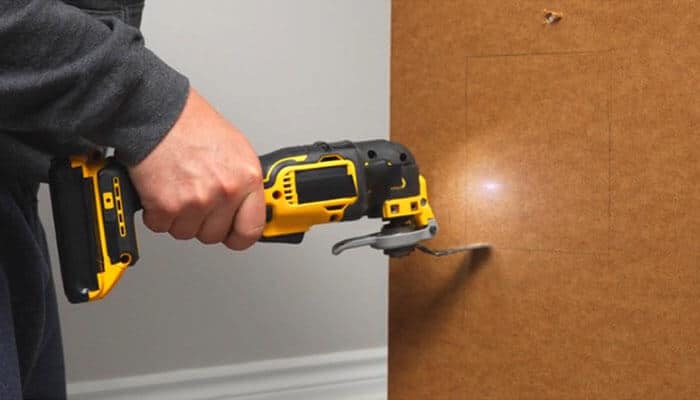
For most users, the best battery balances runtime with tool weight.
| Battery Size/Type | Main Advantage | Best Use |
|---|---|---|
| Compact 20V MAX | Lowest weight | Short jobs |
| 2Ah | Light and balanced | Trim/detail work |
| Compact XR pouch-cell | Strong output in a small pack | Everyday use |
| 4Ah | Good balance | Remodeling |
| 5Ah | Longer runtime | Frequent work |
| FLEXVOLT | Very high capacity | Extended work |
FLEXVOLT batteries are compatible with 20V MAX tools, but their extra size and weight can make a multi-tool less comfortable.
For most users, 2Ah, 4Ah, or 5Ah batteries offer the best balance of runtime and handling.
Is DEWALT 20V MAX Really 20 Volts?
This is a common source of confusion.
DEWALT states that maximum initial battery voltage measured without a workload is 20 volts, while nominal voltage is 18 volts.
That is why similar tools may appear as:
20V MAX in North America
and
18V XR in other markets.
It does not mean the North American tool operates at a fundamentally higher nominal voltage.
Sanding Performance
Add a triangular sanding pad and the multi-tool becomes particularly useful in areas where larger sanders cannot reach. This is one reason a DEWALT Oscillating Multi Tool can remain useful even on projects where most of the heavy cutting is handled by dedicated saws.
Good applications include:
- Inside corners
- Cabinet corners
- Stair components
- Window frames
- Furniture repairs
- Trim
- Tight recesses
The advantage is access rather than speed.
If you need to sand an entire tabletop, use a random-orbit sander.
If you need to reach the final corner that the random-orbit sander cannot touch, the oscillating multi-tool is ideal.
Scraping Adhesive and Caulk
A scraper accessory makes the tool extremely useful during renovation.
It can remove:
- Old caulk
- Flooring adhesive
- Construction adhesive
- Sealant
- Paint buildup
- Thin layers of dried material
DEWALT sells both rigid and flexible scraping accessories with Universal Fitment.
Start at a relatively conservative speed.
Maximum speed can create unnecessary heat and make delicate scraping harder to control.
Removing Grout
Grout removal is another job where the oscillating design works exceptionally well.
Install a carbide-grit or suitable abrasive accessory and you can remove grout around:
- One damaged tile
- Shower repairs
- Deteriorated joints
- Tile edges
- Small repair sections
DEWALT’s DWA4220 uses carbide grit and is specifically designed for grout removal.
For an entire large tile floor, however, a multi-tool can become slow and tiring.
That is another situation where lower vibration becomes valuable.
Cutting Drywall
A DEWALT Oscillating Multi Tool works well for creating controlled openings in drywall.
Typical uses include:
- Electrical boxes
- Plumbing access
- HVAC adjustments
- Repairs
- Inspection openings
Plunge-cutting is convenient because you do not necessarily need to drill a pilot hole first.
But never blindly cut into a wall.
DEWALT’s DCS359 manual specifically warns users to check for hidden wiring, gas lines, and other utilities before performing cutting or removal operations.
Ergonomics and Vibration
Oscillating tools create vibration by design.
That makes ergonomics more important here than with many cordless tools.
The DCS356 has a relatively slim grip and a long trigger that can be operated from several positions.
That helps when working:
- Horizontally
- Vertically
- Near floors
- Inside cabinets
- Around trim
In Pro Tool Reviews’ 2026 testing, the DCS356 received a middle-of-the-pack vibration score while still earning praise for its slim, comfortable grip and fast blade changes.
For occasional use, that is usually sufficient.
For long professional sessions, vibration control becomes much more important.
DCS359 Vibration Control
The DCS359 improves this area with a vibration-isolated head design and a wider 4.2° oscillation angle.
For occasional DIY use, the DCS356 is usually comfortable enough. For frequent professional use, the DCS359’s lower vibration can make a noticeable difference.
LED Work Light
An LED sounds trivial until you need to work:
- Inside cabinetry
- Under a sink
- Behind plumbing
- Beneath flooring
- Inside a wall
- In a dark corner
DEWALT includes LED lighting on the DCS356, DCS354, DCS353, and DCS359 platforms.
The light also helps keep the blade aligned with a pencil mark during precise cuts.
How to Get Better Cuts From Your DEWALT Oscillating Multi Tool
1. Use a Sharp Blade
A dull blade converts battery energy into friction and heat rather than useful cutting.
2. Match the Blade to the Material
Use a wood blade for clean wood and bi-metal or carbide when metal is involved.
3. Stop Forcing the Tool
Excessive pressure can reduce efficiency instead of improving it.
Too much force can increase:
- Heat
- Blade wear
- Vibration
- Battery consumption
4. Rock the Blade Slightly
A small controlled rocking movement can help expose fresh teeth and clear material.
5. Secure the Workpiece
A loose workpiece can vibrate with the blade instead of allowing the teeth to cut efficiently.
DEWALT recommends clamping or otherwise securing the workpiece to a stable platform.
6. Start Slowly
Use the variable trigger to establish a precise cut before increasing speed.
7. Watch Heat
Blades can become extremely hot during demanding cuts.
Allow them to cool before touching or changing them.
Common DEWALT Oscillating Multi Tool Problems and Fixes
Tool Runs but Barely Cuts
Common causes include:
- Dull or incorrect blade
- Low battery
- Loose workpiece
- Excessive pressure
Try a fresh blade matched to the material first.
Blade Burns the Wood
Usually caused by excess heat from:
- A dull blade
- Too much pressure
- The wrong blade
- Holding the blade in one spot too long
Reduce pressure and gently rock the tool while cutting.
Blade Feels Loose
Remove the battery and check:
- Blade seating
- Clamp engagement
- Adapter fit
- Debris or accessory damage
Do not use the tool until the blade is securely mounted.
Battery Drains Quickly
Possible causes include high-speed cutting, a dull blade, hard material, an aging battery, or excessive pressure.
Tool Gets Hot
Stop using the tool, remove the battery, let it cool, and inspect the blade. Continued overheating may require DEWALT service.
Excessive Vibration
Check for a bent, damaged, or incorrectly mounted blade and make sure the workpiece is secure. For frequent use, the DCS359 offers better vibration control.
Basic Maintenance
Oscillating tools are relatively low maintenance, but neglect can shorten service life. Keeping a DEWALT Oscillating Multi Tool clean around its vents and accessory clamp is a simple way to support reliable operation over time.
Keep the Clamp Clean
Remove the battery and clear dust or debris from the accessory interface.
Keep Air Vents Clear
Sanding and drywall dust can accumulate around cooling openings.
The DCS359 manual recommends blowing dirt and dust from air vents with clean, dry air as part of routine cleaning.
Inspect Accessories
Replace blades that are:
- Bent
- Cracked
- Missing teeth
- Severely worn
- Damaged around the mounting area
Do Not Add Random Lubricants
Do not spray oil, cleaner, or lubricant inside the housing unless specifically directed by the manufacturer.
Bare Tool vs Kit: Which Is Better Value?
The cheapest listing is not necessarily the cheapest overall purchase.
Buy the Bare Tool If:
- You already own several DEWALT batteries.
- You already have a compatible charger.
- You already own oscillating blades.
- You want the lowest initial cost.
Buy a Kit If:
- This is your first DEWALT tool.
- You need batteries anyway.
- You need blades and sanding accessories.
- The bundled battery is useful for other DEWALT tools.
The DCS356D1 is a particularly complete starter bundle, while newer M1 and P1 packages provide larger-capacity 4Ah and 5Ah battery options.
DEWALT Oscillating Multi Tool Pros and Cons
Pros
- Versatile for cutting, sanding, scraping, and grout removal
- Strong brushless cordless options
- Up to 20,000 OPM on DCS356 and DCS359
- Excellent variable-speed control
- Fast Quick-Change accessory system
- Broad blade and battery compatibility
- Useful LED lighting
- DCS359 offers improved vibration control
Cons
- DCS356 is weaker in demanding metal cuts
- Some accessories require an adapter
- Quality blades can be expensive
- Large batteries can affect balance
- DCS359 may cost more
- Specialized tools are faster for heavy repetitive work
DEWALT Oscillating Multi Tool vs the Competition in 2026
The DCS356 now competes against several newer-generation tools from Milwaukee, Makita, Bosch, FLEX, Ridgid, Fein, and others.
| Model/Brand | Major Strength | Main Consideration |
|---|---|---|
| DEWALT DCS359 | Balance of cutting, control, and vibration | New-model availability/pricing |
| DEWALT DCS356 | Value and Quick-Change system | Older performance design |
| Milwaukee M18 FUEL | Aggressive cutting | Different accessory/interface approach |
| Makita AVT models | Excellent vibration control | Higher price on some models |
| Bosch Starlock | Strong accessory interface | Different battery ecosystem |
| FLEX | High cutting performance | Smaller ecosystem than DEWALT |
| Fein | Premium multi-tool heritage | Premium pricing |
Pro Tool Reviews’ 2026 comparison gave the DCS356 a 62-point overall score. It remained competitive in red oak and nail-embedded wood but fell behind significantly in several metal tests.
A separate 2026 test from Concord Carpenter placed the new DCS359 first overall after evaluating performance, vibration, ergonomics, features, noise, weight, and price.
Those findings are not necessarily contradictory.
They show the difference between DEWALT’s established DCS356 generation and its newer DCS359 design.
Is the DEWALT Oscillating Multi Tool Good for DIY?
Yes.
A homeowner may get more use from one than expected because it solves so many small home repair and renovation problems.
Useful DIY projects include:
- Repairing drywall
- Removing old caulk
- Cutting trim
- Adjusting flooring
- Removing grout
- Undercutting jambs
- Cutting hidden nails
- Sanding furniture corners
- Modifying cabinets
- Creating access openings
For occasional DIY use, the DCS356 is usually more than enough.
You do not necessarily need to pay extra for the DCS359.
Is It Good for Professional Contractors?
Yes. A DEWALT Oscillating Multi Tool is useful for:
- Carpenters: trim, cabinetry, and flush cuts
- Flooring installers: undercutting jambs and trim
- Remodelers: drywall, scraping, grout, and repair work
- Electricians and plumbers: tight access cuts
- Maintenance technicians: cutting, sanding, and scraping
For frequent professional use, the DCS359 is the better choice because its improved vibration control can reduce fatigue during longer jobs.
When an Oscillating Multi Tool Is the Wrong Tool
Versatility does not mean efficiency in every situation.
Use a Circular Saw Instead When:
You need long, straight cuts through lumber or sheet goods.
Use a Reciprocating Saw Instead When:
You need aggressive demolition.
Use an Angle Grinder Instead When:
You need repeated heavy metal cutting or grinding.
Use a Random-Orbit Sander Instead When:
You need to sand large flat surfaces.
Use a Jigsaw Instead When:
You need long curved cuts through sheet material.
The oscillating multi-tool wins when access, control, plunge capability, or flush cutting matters more than maximum production speed.
DEWALT Warranty
Warranty terms vary by DEWALT model and package. Many current oscillating-tool listings include:
- 3-year limited warranty
- 1-year free service
- 90-day satisfaction guarantee on applicable models
The three-year limited warranty generally covers qualifying defects in materials and workmanship rather than normal wear or tool abuse. Warranty eligibility can also depend on factors such as the original purchaser and authorized seller requirements.
Some newer kit listings show a 30-day satisfaction guarantee instead of 90 days, so verify the warranty terms shown on the exact SKU before purchasing.
Safety Tips Before Using a DEWALT Oscillating Multi Tool
An oscillating tool may look less intimidating than a circular saw, but the accessory can still cause serious injury.
Before using it:
- Wear eye protection.
- Wear hearing protection when appropriate.
- Use respiratory protection when harmful dust is generated.
- Secure the workpiece.
- Identify hidden wires.
- Check for plumbing.
- Check for gas lines.
- Keep hands away from the blade.
- Remove the battery before changing accessories.
- Allow hot accessories to cool.
- Use the correct accessory for the material.
- Do not use damaged blades.
- Keep handles clean and dry.
- Wait for the accessory to stop before setting the tool down.
DEWALT’s DCS359 manual specifically instructs users to remove the battery before adjustments or accessory changes, secure workpieces, and check for hidden wiring, gas lines, or other utilities before cutting.
Is the DEWALT Oscillating Multi Tool Worth the Money in 2026?
For most buyers, yes—but the best value depends on how often you will use it.
The DCS356 is the practical choice for homeowners, occasional remodelers, and existing DEWALT battery owners who want a proven brushless model with three speed ranges, Quick-Change accessories, and up to 20,000 OPM.
The DCS359 makes more sense for professionals or frequent users who are willing to pay extra for improved vibration control, four speed modes, a wider reported oscillation angle, and broader accessory compatibility.
For most occasional users, paying significantly more simply to own the newest model is unnecessary.
Final Thoughts
The DEWALT Oscillating Multi Tool remains a strong choice in 2026 for remodeling, flooring, carpentry, maintenance, and DIY work.
For most buyers, the DCS356 offers the best balance of performance, speed control, Quick-Change convenience, and value. The newer DCS359 is better suited to frequent professional use thanks to improved vibration control, four speed modes, and broader accessory compatibility.
The compact DCS353 works well for lighter jobs, while the corded DWE315K is useful for workshop users who want unlimited runtime.
Overall, the DEWALT Oscillating Multi Tool is worth buying in 2026 if you choose the model that matches your workload and budget. A sharp, properly matched blade will also make a major difference in real-world performance.
DEWALT Oscillating Multi Tool FAQs
How long do DEWALT Oscillating Multi Tool blades last?
Blade life depends on the material, blade quality, speed, and cutting pressure. Wood blades may last through many cuts, while metal, nails, grout, and abrasive materials can wear blades much faster.
Can a DEWALT Oscillating Multi Tool cut ceramic tile?
It can make small cuts or adjustments in some tile materials when fitted with a suitable carbide or diamond accessory. For long or precise tile cuts, a dedicated tile saw is usually the better choice.
Is a brushless DEWALT Oscillating Multi Tool better?
A brushless motor generally offers better efficiency, lower maintenance, and improved runtime compared with older brushed designs. Models such as the DCS356 and DCS359 use brushless motors.
Can I use a DEWALT multi-tool to cut baseboards without removing them?
Yes. With the correct plunge or flush-cut blade, the tool can make controlled cuts in installed baseboards and trim, making it useful during flooring and remodeling projects.
How often should I replace a DEWALT Oscillating Multi Tool blade?
Replace the blade when cutting becomes noticeably slower, teeth become damaged, excessive heat develops, or more pressure is required to complete the same cut.
Can a DEWALT oscillating tool cut cement backer board?
Yes, for smaller cuts when equipped with an accessory rated for abrasive materials such as fiber cement. Carbide blades are generally more suitable than standard wood blades.
Can a DEWALT Oscillating Multi Tool replace a detail sander?
It can handle corners, edges, trim, and other tight spaces with a sanding attachment, but a dedicated detail or random-orbit sander is usually faster for larger sanding projects.
Can you flush-cut PVC pipe with a DEWALT Oscillating Multi Tool?
Yes. With a fine-tooth blade rated for plastic, an oscillating multi-tool can make controlled flush cuts on PVC, especially where a conventional saw has limited clearance.