

Last Updated: August 4, 2026
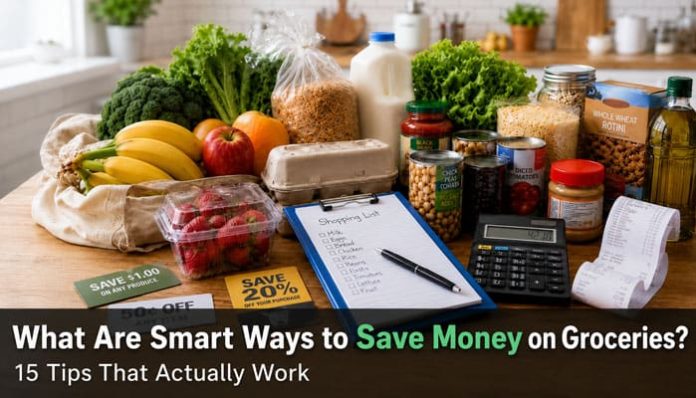
Groceries are one household expense you cannot eliminate, which is why many families ask what are smart ways to save money on groceries? Small changes in how you plan meals, compare prices, choose ingredients, store food, and use leftovers can produce meaningful savings without forcing you to eat less or give up the foods you enjoy.
Start by shopping your kitchen before the supermarket, planning realistic meals around ingredients you already have, comparing unit prices, substituting expensive foods when practical, buying only quantities you can use, and making food-waste prevention part of your grocery budget.
That approach is especially relevant in 2026. USDA’s July 2026 Food Price Outlook forecasts food-at-home prices to rise 2.7% in 2026, slightly faster than their 20-year historical average. Some categories are increasing much faster than others, which makes flexible shopping especially important.
This guide explains 15 practical grocery-saving strategies, shows where common money-saving tactics can backfire, and provides a repeatable weekly system you can actually maintain.
Quick Answer: What Are Smart Ways to Save Money on Groceries?
The smartest ways to save money on groceries are to:
- Plan meals before shopping.
- Check your pantry, fridge, and freezer first.
- Shop with a list and budget.
- Compare unit prices and store brands.
- Use sales and coupons only for planned purchases.
- Choose lower-cost proteins and seasonal produce.
- Buy in bulk only when you can use everything.
- Freeze leftovers and reduce food waste.
Small, consistent habits usually save more than chasing every coupon or sale.
Key Takeaways
- Grocery prices are still rising in 2026, so flexible shopping matters.
- Meal planning and using shared ingredients can reduce spending and waste.
- Compare unit prices, store brands, and bulk deals carefully.
- Frozen and canned foods can sometimes offer better value than fresh.
- Food waste is a major hidden cost; EPA estimates it can cost a family of four about $2,913 per year.
- A good grocery budget should save money without sacrificing nutrition or food safety.
Why Saving Money on Groceries Matters in 2026
For readers asking what are smart ways to save money on groceries?, understanding which food prices are rising fastest can help you make smarter substitutions instead of cutting everything equally.
USDA forecasts food-at-home prices to rise about 2.7% in 2026, but some categories are increasing much faster. Beef and veal, for example, were 11.8% more expensive in June 2026 than in June 2025.
When one ingredient becomes costly, flexible swaps can help control your grocery bill.
| If This Is Expensive | Compare With |
|---|---|
| Beef | Chicken, pork, beans, lentils, eggs |
| Fresh berries | Frozen berries or seasonal fruit |
| Fresh tomatoes | Canned tomatoes |
| Individual yogurt cups | Larger yogurt container |
| Name-brand cereal | Store brand |
| Prepared rice | Dry rice |
| Pre-cut vegetables | Whole vegetables |
The goal is to balance price, nutrition, convenience, taste, and low waste.
15 Smart Ways to Save Money on Groceries
If your main question is what are smart ways to save money on groceries?, these 15 strategies cover planning, shopping, storage, and waste prevention.
| Strategy | Main Savings Benefit |
|---|---|
| 1. Shop your kitchen first | Prevents duplicate purchases |
| 2. Plan meals before shopping | Reduces random buying |
| 3. Set a grocery budget | Creates a spending boundary |
| 4. Make a detailed list | Reduces impulse purchases |
| 5. Compare unit prices | Reveals actual value |
| 6. Test store brands | Can eliminate brand premiums |
| 7. Build meals around sales | Makes promotions useful |
| 8. Use lower-cost proteins | Reduces expensive meal components |
| 9. Buy produce strategically | Controls price and spoilage |
| 10. Use coupons carefully | Lowers planned purchase costs |
| 11. Reduce shopping trips | Limits impulse spending |
| 12. Buy bulk selectively | Can lower unit cost |
| 13. Use your freezer | Prevents spoilage |
| 14. Plan leftovers | Creates additional meals |
| 15. Understand date labels | Reduces unnecessary disposal |
1. Shop Your Pantry, Refrigerator, and Freezer First
For anyone wondering what are smart ways to save money on groceries?, start by using food you already have before buying more.
Check your:
- Refrigerator
- Freezer
- Pantry
- Cabinets
- Open packages
- Sauces and condiments
If you already have rice, frozen vegetables, chicken, eggs, and soy sauce, you may have enough for stir-fry or fried rice without buying many extra ingredients.
USDA MyPlate recommends checking your kitchen before planning meals because using food already on hand can save money.
Create a “Use First” Section
Keep foods that need to be eaten soon in one visible refrigerator area, such as:
- Leftovers
- Open yogurt
- Cut vegetables
- Ripe fruit
- Cheese
- Half-used ingredients
FDA recommends keeping foods likely to spoil soon in a designated area.
The easier food is to see, the less likely it is to be forgotten and wasted.
2. Plan Meals Before You Shop
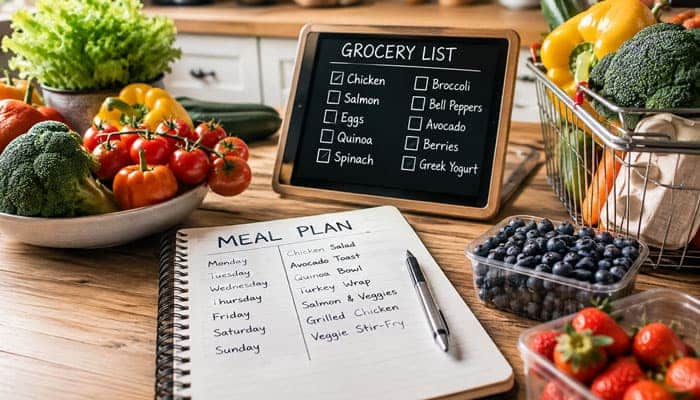
Meal planning is one of the strongest answers to what are smart ways to save money on groceries?
Start with food you already own instead of choosing several unrelated recipes.
Use this simple order:
- Check your refrigerator, freezer, and pantry.
- Identify food that should be used soon.
- Review your weekly schedule.
- Decide how many meals you will eat at home.
- Check useful store promotions.
- Choose realistic meals.
- Buy only the missing ingredients.
USDA MyPlate recommends planning meals, using leftovers, and keeping a mix of fresh, frozen, and shelf-stable foods.
Don’t Plan Seven Perfect Dinners
A realistic week might include:
- 4 freshly cooked dinners
- 1 leftovers night
- 1 freezer or emergency meal
- 1 flexible meal
This reduces the risk of buying ingredients for meals you never cook.
Plan Meals Around Shared Ingredients
Shared ingredients are another practical answer to what are smart ways to save money on groceries? because one purchase can support several meals.
For example, one package of chicken could become:
- Chicken and rice bowls
- Chicken tacos
- Chicken salad
- Chicken stir-fry
The same principle works with vegetables such as carrots, onions, or spinach.
Try the 2–3 Meal Rule
Before buying a perishable ingredient, ask:
“Can I use this in at least two meals?”
If not, consider:
- Buying less
- Choosing frozen
- Using something already at home
- Selecting another recipe
3. Set a Realistic Weekly Grocery Budget
When households ask what are smart ways to save money on groceries?, setting a realistic budget provides a clear starting point.
Your grocery budget depends on factors such as:
- Household size
- Location
- Dietary requirements
- Food preferences
- Cooking habits
- How often you eat at home
Review four to eight weeks of spending and separate groceries from toiletries, cleaning products, pet supplies, restaurant meals, and other purchases.
Reduce Spending Gradually
If you currently spend $250 per week, cutting immediately to $150 may be difficult.
A target of $225 is more realistic.
A $25 weekly reduction equals:
$25 × 52 = $1,300 per year
Small reductions can create meaningful annual savings.
Use USDA Food Plans for Context
USDA publishes Thrifty, Low-Cost, Moderate-Cost, and Liberal Food Plans.
These can provide useful benchmarks, but your own household spending history is usually a better guide for setting a realistic budget.
4. Make a Detailed Grocery List
A detailed list helps answer what are smart ways to save money on groceries? by connecting purchases directly to planned meals.
Instead of writing:
Vegetables
write:
1 bag frozen broccoli and 4 onions
Include quantities and intended uses whenever possible.
Organize Your List by Department
Produce
- Bananas
- Onions
- Carrots
- Lettuce
Protein
- Chicken
- Eggs
- Beans
Dairy
- Milk
- Yogurt
Pantry
- Rice
- Pasta
- Canned tomatoes
USDA recommends organizing grocery lists by store section to make shopping more efficient.
A clear list also reduces unnecessary wandering and impulse purchases.
5. Compare Unit Prices, Not Just Package Prices
One of the clearest answers to what are smart ways to save money on groceries? is to compare the cost per ounce, pound, or item instead of looking only at the shelf price.
| Product | Price | Size | Price Per Ounce |
|---|---|---|---|
| Product A | $4.50 | 12 oz | $0.375 |
| Product B | $5.75 | 20 oz | $0.288 |
Product A has the lower checkout price, but Product B costs less per ounce.
Unit-Price Formula
Package Price ÷ Package Quantity = Unit Price
Compare price per:
- Ounce
- Pound
- Quart
- Count
But remember: a lower unit price does not save money if part of the package gets wasted.
Watch for Shrinkflation
Shrinkflation matters when considering what are smart ways to save money on groceries? because a product can become more expensive even when the shelf price barely changes.
Manufacturers may reduce package size while keeping a similar price.
| Old Package | New Package | Shelf Price |
|---|---|---|
| 16 oz | 14 oz | $4.49 |
| 12-count | 10-count | $3.99 |
| 20 oz | 18 oz | $5.49 |
Check:
- Net weight
- Number of pieces
- Serving count
- Unit price
This makes changes in real value easier to spot.
Compare Cost Per Serving Too
Cost per serving adds another layer to what are smart ways to save money on groceries? because a cheaper package can still cost more per usable portion.
For example:
$6 ÷ 6 servings = $1 per serving
$5 ÷ 4 servings = $1.25 per serving
The $5 package is cheaper at checkout but more expensive per serving.
Cost per serving is especially useful for comparing:
- Bone-in vs. boneless meat
- Fresh vs. frozen vegetables
- Dried vs. canned beans
- Large vs. individual containers
6. Test Store Brands Instead of Automatically Buying Name Brands
For shoppers asking what are smart ways to save money on groceries?, store brands can help reduce the extra cost attached to familiar labels.
They are worth testing for staples such as:
- Rice
- Oats
- Pasta
- Canned beans
- Frozen vegetables
- Dairy products
- Spices
However, store brands are not always cheaper. Sales or coupons can sometimes make national brands a better deal.
Compare:
Store brand vs. sale price vs. coupon-adjusted price vs. unit price
Run a One-Product Test
Replace one branded product with the store version each week.
If your household likes it, keep the cheaper option. If the quality difference matters, switch back.
7. Build Meals Around Useful Sales
Planning meals around discounts is another answer to what are smart ways to save money on groceries? because sales should support your meal plan, not create unnecessary purchases.
If chicken thighs are discounted, you might make:
- Chicken tacos
- Chicken rice bowls
- Chicken soup
If pasta and canned tomatoes are on sale:
- Tomato pasta
- Pasta bake
- Vegetable pasta soup
USDA MyPlate recommends checking store sales when planning groceries.
Learn What a Good Price Looks Like
Before stocking up, ask:
- What is the normal price?
- What is the unit price?
- Is another size cheaper?
- Is the store brand less expensive?
- Will I actually use it?
Focus on the final price, not the sale label.
8. Use Lower-Cost Proteins More Often
For families asking what are smart ways to save money on groceries?, switching proteins can reduce meal costs when meat prices rise.
USDA reported beef and veal prices were 11.8% higher in June 2026 than one year earlier.
Depending on local prices, compare:
- Beans
- Lentils
- Eggs
- Tofu
- Canned tuna
- Chicken thighs
- Ground turkey
Stretch Meat Instead of Eliminating It
Try:
- Ground meat + beans in tacos
- Beef + lentils in pasta sauce
- Chicken + vegetables in stir-fry
- Smaller meat portions with rice and vegetables
- Chicken added to bean soup
This keeps meat in the meal while reducing the amount required.
Compare the Whole Meal Cost
A cheaper cut may not save money if:
- Much of it is bone or trimming.
- It requires expensive extra ingredients.
- Your household does not eat it.
- Part of it gets wasted.
Compare the cost of the usable portions, not just the price per pound.
9. Compare Fresh, Frozen, and Canned Produce
Comparing different forms of produce is useful when considering what are smart ways to save money on groceries? because shelf life and waste can matter as much as price.
Consider:
- Current price
- Season
- Shelf life
- Recipe
- Storage space
Frozen vegetables can be economical because you can use only what you need.
Canned options such as:
- Tomatoes
- Beans
- Corn
- Peas
- Fruit
can also last longer.
USDA recommends keeping a mix of fresh, frozen, and shelf-stable foods.
Match the Form to the Meal
| Meal | Practical Choice |
|---|---|
| Smoothie | Frozen fruit |
| Soup | Fresh, frozen, or canned vegetables |
| Chili | Canned tomatoes and beans |
| Stir-fry | Frozen vegetables |
| Salad | Fresh produce |
| Oatmeal | Fresh, frozen, or canned fruit |
| Pasta sauce | Canned tomatoes |
Choose the option that best balances price, shelf life, and likely use.
10. Use Coupons, Loyalty Programs, and Cashback Strategically
Coupons belong in what are smart ways to save money on groceries? only when they reduce the price of something you already planned to buy.
If you were not going to buy a $7 product, a $2 coupon does not save you $2—it creates a $5 purchase.
Use discounts mainly for:
- Products already on your list
- Foods you regularly buy
- Items you can safely store
- Deals that beat alternative prices
USDA recommends checking grocery-store loyalty programs for discounts and special offers.
Calculate the Final Price
Use:
Sale Price – Coupon or Reward = Final Price
Then compare it with:
- Store brand
- Another size
- Another brand
- A substitute ingredient
Do not buy something simply because it offers a coupon or cashback reward.
11. Reduce Unnecessary Grocery Trips
Reducing extra store visits is part of what are smart ways to save money on groceries? because every unplanned trip creates another opportunity for impulse spending.
You may enter for milk and leave with:
- Cookies
- Chips
- Soda
- Ice cream
- Checkout snacks
Planning fewer, more complete grocery trips can reduce these extras. USDA also recommends eating before shopping because hunger can encourage impulse purchases.
Can Grocery Pickup Help You Save?
Pickup can support what are smart ways to save money on groceries? when it helps you see the total before checkout and avoid in-store temptations.
You can:
- Build your cart from your list
- See the total before paying
- Remove unnecessary items
- Compare alternatives calmly
However, compare all costs, including:
- Product markups
- Pickup or delivery fees
- Tips
- Membership fees
Example:
- In-store basket: $105
- Pickup: $99 + $5 fee = $104
- Delivery: $99 + $8 fee + $12 tip = $119
Compare the final total, not just product prices.
12. Buy in Bulk Only When the Math Works
Bulk buying belongs in what are smart ways to save money on groceries? only when the lower unit price is not erased by waste or storage problems.
Before buying a large package, ask:
- Is the unit price lower?
- Will we use everything?
- Can we store it properly?
Potential Bulk-Buy Candidates
Good options often include:
- Rice
- Oats
- Pasta
- Dried beans
- Canned foods
- Frozen vegetables
- Meat you can portion and freeze
Be More Careful With
- Delicate produce
- Bakery products
- Short-life dairy foods
- Unfamiliar snacks
- Foods your family rarely eats
Bulk savings disappear when part of the purchase is wasted.
Is a Warehouse Club Membership Worth It?
Warehouse memberships can fit into what are smart ways to save money on groceries?, but the annual fee must be included.
Use:
Annual Membership Cost ÷ Estimated Savings Rate = Required Annual Spending
Example:
- Membership cost = $60
- Estimated savings = 5%
$60 ÷ 0.05 = $1,200
In this example, you would need about $1,200 in qualifying annual purchases to recover the membership fee.
Warehouse clubs generally work better when you:
- Have enough storage
- Feed several people
- Use products regularly
- Portion and freeze large packages
- Compare unit prices
13. Turn Your Freezer Into a Money-Saving Tool
Using your freezer is another practical answer to what are smart ways to save money on groceries? because it extends the life of food you already paid for.
Foods that may freeze well include:
- Bread
- Meat
- Soups
- Cooked meals
- Fruit
- Vegetables
- Sauces
- Leftovers
FDA recommends freezing appropriate foods before they spoil.
Portion Before Freezing
Instead of freezing a large package as one block:
- Divide it into meal-size portions.
- Package each portion.
- Label it.
- Add the date.
- Freeze it.
Then you can defrost only what you need.
Practice FIFO
FIFO means:
First In, First Out
Keep older groceries in front and newer items behind them.
Use this system in your:
- Freezer
- Refrigerator
- Pantry
- Cabinets
Store Food Correctly
Proper storage matters in what are smart ways to save money on groceries? because food that spoils before being eaten provides no savings.
Useful habits include:
- Dating leftovers
- Labeling freezer containers
- Keeping perishables visible
- Moving older items forward
- Freezing food before it spoils
The USDA-developed FoodKeeper resource also provides food-storage guidance.
Try Three Food Zones
- Use Now – Foods that need attention first.
- This Week – Ingredients for upcoming meals.
- Later – Frozen and shelf-stable foods.
14. Schedule Leftovers Instead of Hoping They Get Eaten
Planned leftovers help answer what are smart ways to save money on groceries? by turning one cooking session into more than one meal.
| Day | Dinner |
|---|---|
| Monday | Chicken, rice, vegetables |
| Tuesday | Tacos |
| Wednesday | Leftovers |
| Thursday | Pasta |
| Friday | Stir-fry with remaining vegetables |
| Saturday | Freezer meal |
| Sunday | Flexible meal |
USDA recommends deliberately planning to use leftovers, especially on busy days.
Turn Leftovers Into New Meals
Try:
- Roast chicken → tacos
- Rice → fried rice
- Vegetables → soup
- Chili → baked-potato topping
- Meatballs → sandwiches
- Beans → burritos
The goal is to get another useful meal from food you already purchased.
Keep Two or Three Emergency Meals
Emergency meals are often overlooked in what are smart ways to save money on groceries? because they can prevent expensive takeout.
Keep simple backups such as:
- Pasta + sauce + frozen vegetables
- Eggs + toast
- Rice + beans
- Soup + sandwiches
- Tortillas + beans + cheese
A quick backup meal can be much cheaper than restaurant delivery.
Store Leftovers Safely
FDA recommends refrigerating perishables and leftovers within two hours, or within one hour when temperatures exceed 90°F.
15. Understand Food Date Labels Before Throwing Food Away
Understanding date labels is another important part of what are smart ways to save money on groceries? because confusing a quality date with a safety deadline can cause unnecessary waste.
FDA states that, except for infant formula, federal law generally does not require quality-based dates on packaged foods. FDA also estimates date-label confusion contributes to about 20% of consumer food waste.
FDA supports “Best if Used By” as wording related to best flavor or quality.
That does not mean food safety should be ignored.
Follow:
- Proper storage guidance
- Product-specific instructions
- Signs of spoilage
- Special rules for infant formula
- Food-safety guidance for perishables
The key point is simple: a quality date should not automatically be treated as a universal safety deadline.
The Biggest Hidden Grocery Expense: Food Waste
Food waste is central to what are smart ways to save money on groceries? because reducing what gets thrown away can recover value without requiring you to find a cheaper store.
One of the strongest opportunities to save money happens after checkout.
EPA estimates that more than one-third of food in the United States is never eaten.
Its analysis estimates uneaten food costs approximately:
- $728 per consumer per year
- $14 per person per week
- $2,913 per year for a household of four
- $56 per week for a four-person household
Those numbers do not mean every family can immediately cut its grocery bill by $2,913.
They show how valuable food that ultimately goes uneaten can become.
Track What You Throw Away for Two Weeks
Write down:
- Spoiled produce
- Moldy bread
- Unfinished leftovers
- Expired dairy
- Forgotten freezer foods
- Unused herbs
- Prepared food nobody ate
Patterns will emerge.
Suppose you repeatedly throw away half of a $7 package of salad greens.
Buying a smaller $5 package that you completely consume may provide better value—even if the larger package technically has a cheaper unit price.
That leads to one of the most useful concepts in grocery budgeting:
Measure the cost of food actually eaten, not just food purchased.
Create a Grocery Price Book
A price book supports what are smart ways to save money on groceries? by helping you recognize genuine bargains instead of relying on sale signs.
Track the regular and sale prices of foods you buy often using a notebook, spreadsheet, or phone note.
| Product | Store | Regular Price | Good Sale Price | Unit Price |
|---|---|---|---|---|
| Rice | Store A | — | — | — |
| Chicken | Store B | — | — | — |
| Eggs | Store A | — | — | — |
| Oats | Store C | — | — | — |
| Yogurt | Store B | — | — | — |
| Cooking oil | Store A | — | — | — |
After a few shopping trips, you can quickly tell whether a promotion is truly cheaper than the price you normally pay.
Price books are especially useful for staples such as meat, eggs, coffee, cereal, rice, dairy, cooking oil, and frozen foods.
Should You Shop at More Than One Grocery Store?
Store comparison can help with what are smart ways to save money on groceries? when the total basket savings are large enough to justify the added travel, time, and effort.
One supermarket is unlikely to have the lowest price on every product.
A retailer may be particularly competitive on:
- Pantry staples
while another may offer stronger prices on:
- Meat
- Produce
- Dairy
- Weekly promotions
But visiting five stores to save small amounts can become counterproductive.
Consider using:
One primary store + one secondary store
Use the second retailer only when the savings are meaningful.
Calculate the Real Cost of the Extra Trip
Suppose another store saves $4 but requires:
- Extra fuel
- 25 minutes of additional travel
- Another opportunity for impulse purchases
That may not be worthwhile.
Saving $25 on a planned stock-up trip is a different calculation.
Compare total basket savings, not one unusually cheap product.
Smart Grocery Swaps Worth Comparing
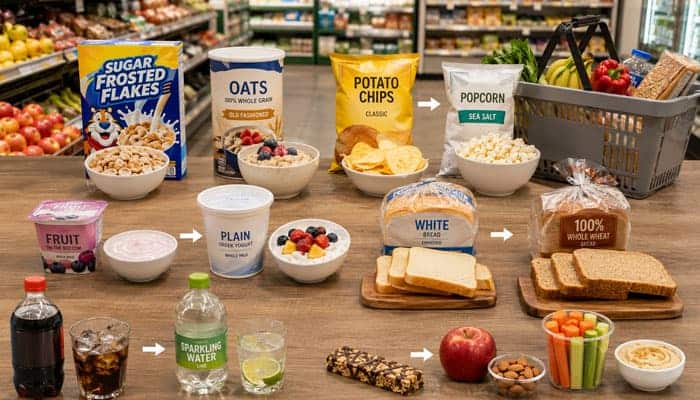
Strategic substitutions are useful for what are smart ways to save money on groceries? because they let you respond to changing prices without giving up an entire meal.
Prices vary by location and season, so no substitution wins everywhere.
But these comparisons are worth making:
| Instead of Automatically Buying | Compare With |
|---|---|
| Name-brand cereal | Store-brand cereal |
| Individual yogurt cups | Large yogurt container |
| Pre-cut fruit | Whole fruit |
| Salad kits | Lettuce + separate toppings |
| Instant rice | Dry rice |
| Individual oatmeal packets | Large oats container |
| Premium beef | Poultry, beans, or lentils |
| Fresh out-of-season berries | Frozen berries |
| Prepared meals | Simple home-cooked meals |
| Single-serving snacks | Larger package portioned at home |
Convenience also has value. If pre-cut vegetables prevent spoilage and are consistently eaten, a higher shelf price may still be worthwhile.
Useful Low-Cost Grocery Staples
Versatile staples are important when asking what are smart ways to save money on groceries? because they can be used across several meals.
Grains and Starches
- Rice
- Oats
- Pasta
- Potatoes
- Bread
Lower-Cost Proteins
- Beans
- Lentils
- Eggs
- Peanut butter
- Chickpeas
- Tofu
Vegetables
- Carrots
- Onions
- Cabbage
- Frozen mixed vegetables
- Canned tomatoes
Fruit
- Bananas
- Seasonal fruit
- Apples
- Frozen fruit
Pantry Basics
- Canned beans
- Flour
- Cooking oil
- Herbs
- Spices
Choose foods that work in several meals. A versatile ingredient often provides better value than a cheap item used only once.
Can You Save Money on Groceries and Still Eat Healthy?
Yes. Nutrition should remain part of what are smart ways to save money on groceries? because saving money should not mean sacrificing a balanced diet.
USDA MyPlate recommends meal planning, smart shopping, and choosing budget-friendly nutritious foods.
Affordable meal ideas include:
- Oatmeal + fruit + peanut butter
- Rice + beans + vegetables
- Lentil soup
- Eggs + potatoes + vegetables
- Chicken + rice + frozen vegetables
- Yogurt + oats + fruit
You also do not need expensive foods labeled “premium” or “superfood.” Compare the nutrition, serving size, usefulness, and price instead.
10 Grocery-Saving Mistakes That Can Cost You More
A complete answer to what are smart ways to save money on groceries? also means avoiding common mistakes such as:
- Buying something only because it is on sale.
- Purchasing bulk packages you cannot finish.
- Driving far just to save a small amount.
- Ignoring unit prices.
- Missing shrinkflation.
- Planning more meals than you will actually cook.
- Forgetting to use your freezer.
- Avoiding all convenience foods, even when they prevent takeout.
- Assuming store brands are always cheaper.
- Ignoring food waste.
Avoiding these mistakes can protect your grocery budget just as much as finding lower prices.
How Much Can You Realistically Save on Groceries?
The answer to what are smart ways to save money on groceries? becomes more useful when you compare savings with your own spending habits.
Potential savings depend on factors such as:
- Current grocery spending
- Household size
- Food waste
- Location
- Brand preferences
- Store choices
- Cooking habits
- Dietary needs
| Weekly Grocery Spending | 5% Savings | 10% Savings | 15% Savings |
|---|---|---|---|
| $100 | $5 | $10 | $15 |
| $150 | $7.50 | $15 | $22.50 |
| $200 | $10 | $20 | $30 |
| $250 | $12.50 | $25 | $37.50 |
| $300 | $15 | $30 | $45 |
If you spend $200 per week and reduce it by 10%:
$20 × 52 weeks = $1,040 per year
A modest reduction you can maintain is more useful than an aggressive budget you quickly abandon.
A Simple Weekly Grocery-Saving System
Turning what are smart ways to save money on groceries? into a weekly routine makes the advice easier to repeat than trying to remember dozens of isolated hacks in the store.
You do not need to remember every tactic in this guide while shopping.
Use this six-step routine.
Step 1: Inventory
Check your:
- Refrigerator
- Freezer
- Pantry
Step 2: Identify “Use First” Foods
List ingredients and leftovers that need attention.
Step 3: Review Your Schedule
Determine how many meals will realistically be eaten at home.
Step 4: Check Useful Promotions
Look for discounts that fit foods you already use.
Step 5: Plan Your Meals
Build meals around:
food already owned + useful sale items + versatile low-cost staples
Step 6: Complete the Grocery List
Purchase only what is needed to fill the remaining gaps.
This keeps the trip focused on filling specific gaps rather than browsing.
Try This 30-Day Grocery Savings Challenge
A 30-day challenge can show which ideas from what are smart ways to save money on groceries? actually work for your household.
Week 1: Measure
Track:
- Grocery spending
- Store visits
- Takeout
- Food waste
- Impulse purchases
Week 2: Plan
Focus on:
- Kitchen inventory
- Meal planning
- Shared ingredients
- Detailed shopping lists
- One leftovers night
Week 3: Compare
Check:
- Unit prices
- Cost per serving
- Store brands
- Protein swaps
- Fresh vs. frozen vs. canned
- Shrinkflation
Week 4: Reduce Waste
Add:
- A “Use First” section
- FIFO storage
- Freezer labels
- Emergency meals
- Leftover makeovers
After 30 days, compare your spending with Week 1 and keep the habits that save money without making your routine harder.
When Grocery Budgeting Is Not Enough
A complete answer to what are smart ways to save money on groceries? should also recognize when the issue is not overspending but simply not having enough money for food.
If your household struggles to afford adequate groceries, assistance programs may help.
SNAP
SNAP provides eligible households with benefits for qualifying food purchases. Eligibility can depend on:
- Household income
- Household size
- Resources
- Allowable deductions
- State rules
USDA updates SNAP eligibility standards annually.
WIC
WIC provides nutrition assistance to eligible women, infants, and young children. Some participants may also qualify for farmers-market benefits for approved produce.
Other resources may include:
- Food banks
- Community pantries
- School meal programs
- Senior nutrition programs
- Local assistance programs
If the problem is food insecurity rather than unnecessary spending, seeking available assistance may be more useful than cutting an already tight grocery budget further.
Frequently Asked Questions
1. What are smart ways to save money on groceries?
Some of the best strategies include planning meals before shopping, checking what you already have at home, comparing unit prices, choosing lower-cost alternatives, using leftovers, and reducing food waste.
2. How can meal planning reduce my grocery bill?
Meal planning helps you buy only the ingredients you need and makes it easier to use food already in your pantry, refrigerator, and freezer. When researching what are smart ways to save money on groceries?, meal planning is one of the easiest habits to start with.
3. Is it cheaper to buy store brands instead of name brands?
Store brands are often cheaper, but not always. Compare the unit price, sale price, and any available coupons before deciding which product offers better value.
4. Should I buy groceries in bulk to save money?
Bulk buying can save money when the unit price is lower and you can use or store the entire quantity. Large packages become expensive if part of the food spoils or goes unused.
5. How can I save money on groceries without using coupons?
If you are asking what are smart ways to save money on groceries? without coupons, focus on meal planning, store brands, lower-cost proteins, fewer shopping trips, frozen foods, unit-price comparisons, and reducing waste.
6. Is frozen food cheaper than fresh food?
Sometimes. Frozen fruits and vegetables can offer good value because they last longer and allow you to use only what you need. Compare prices based on the specific product and season.
7. How can I reduce food waste and grocery spending?
Check your kitchen before shopping, keep foods that need to be used soon visible, freeze suitable items before they spoil, plan leftover meals, and avoid buying more than your household can realistically eat.
8. What is the easiest way to start saving money on groceries?
For anyone wondering what are smart ways to save money on groceries?, start with one simple routine: check what you already have, plan a few realistic meals, make a shopping list, and buy only the missing ingredients. This can reduce duplicate purchases, impulse spending, and food waste at the same time.
Final Thoughts: Spend Less by Getting More From What You Buy
What are smart ways to save money on groceries? The strongest strategies are not extreme couponing, buying enormous quantities, or choosing the cheapest product every time.
They are habits that improve the entire grocery cycle.
Start with what you already own. Plan realistic meals around overlapping ingredients. Compare unit prices and cost per serving. Watch for shrinkflation. Substitute expensive ingredients when appropriate. Test store brands. Use your freezer deliberately. Buy bulk only when you can actually consume the food.
Most importantly, judge savings by what your household actually uses. Preventing waste can be just as important as finding a lower shelf price, especially while grocery costs remain elevated.
The most effective grocery-saving system can therefore be summarized in three rules:
Buy intentionally.
Use what you buy.
Waste as little as possible.
Follow those principles consistently, and saving money on groceries becomes less about temporary tricks and more about a repeatable household system that keeps working week after week.