

Last reviewed: August 3, 2026
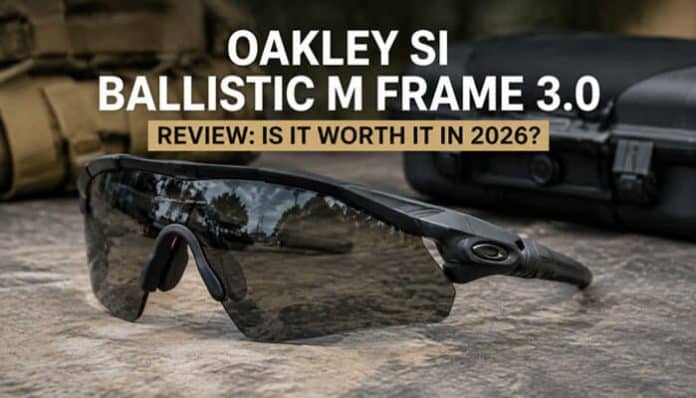
The Oakley SI Ballistic M Frame 3.0 has been around long enough to earn a recognizable place among military, law-enforcement and shooting eyewear, but longevity alone does not make protective equipment worth buying.
What continues to make the M Frame 3.0 relevant in 2026 is its combination of low weight, interchangeable lenses, wide coverage, thin temples, anti-fog treatment and documented military ballistic credentials.
Most importantly, the U.S. Army currently lists the Oakley SI Ballistic M Frame 3.0 on its Authorized Protective Eyewear List, or APEL. The Army states that the approved configuration provides ballistic-fragmentation protection and meets MIL-PRF-32432A optical and safety requirements.
However, the product is not automatically the right choice for every user. It comes in one primary size, uses a High Bridge Fit, is not compatible with the Army’s Universal Prescription Lens Carrier, and costs more than basic protective eyewear. Oakley also sells several lens types and related M Frame products, so buyers need to understand exactly which configuration they are purchasing.
This Oakley SI Ballistic M Frame 3.0 review covers its ballistic rating, APEL status, lenses, ANSI standards, MIL specifications, fit, comfort, optical quality, hearing-protection compatibility, helmet compatibility, airsoft use, laser lenses, replacement parts, prescription options, NSNs, M Frame Alpha comparison, competing ballistic eyewear and overall value in 2026.
Quick Answer: Is the Oakley SI Ballistic M Frame 3.0 Worth It?
Yes. The Oakley SI Ballistic M Frame 3.0 remains worth considering in 2026 for shooters, military users and professionals who want lightweight ballistic eyewear that works well with helmets and hearing protection.
Key Advantages
- Current U.S. Army APEL listing
- MIL-PRF-32432A compliance for the approved configuration
- Lightweight 1.05-ounce design
- Wide protective lens
- Interchangeable, tool-free lens system
- Thin temples for headsets and earmuffs
- Anti-fog treatment
- Clear, Grey, Prizm and specialized lens options
- Strong UV protection
- Replaceable parts and military NSNs
Main Drawbacks
- One primary frame size
- High Bridge Fit may not suit everyone
- No Army UPLC compatibility
- Premium price
- Not full-seal protection
- Replacement lenses add cost
Key Takeaways
- The Oakley SI Ballistic M Frame 3.0 is currently listed on the U.S. Army APEL.
- The approved configuration meets MIL-PRF-32432A optical and safety requirements.
- ANSI/ISEA Z87.1-2025 is the current eye-protection standard, while Oakley still references older Z87.1 editions.
- The frame is approximately 145 mm wide, weighs about 1.05 oz, and uses a Wide, High Bridge Fit.
- The Army says it is not UPLC compatible, though Oakley offers a separate prescription lens carrier for some configurations.
- Prizm TR22 provides about 19% VLT, while TR45 provides about 44% VLT.
- Specialized laser-protection lenses are available for specific hazards.
- Buyers needing full-seal protection, multiple sizes or Army UPLC support should compare other APEL-listed options.
Oakley SI Ballistic M Frame 3.0 Specifications
| Specification | Details |
|---|---|
| Product type | Ballistic protective spectacle |
| Army APEL listed | Yes |
| Military standard | MIL-PRF-32432A |
| Frame width | 145 mm |
| Lens height | 50.7 mm |
| Temple length | 135 mm |
| Fit | Wide / High Bridge Fit |
| Weight | Approx. 1.05 oz |
| Frame material | O-Matter |
| Lens system | Interchangeable, tool-free |
| Anti-fog | Permanent rear-surface treatment |
| UV protection | UVA/UVB protection through 400 nm |
| Hearing-protection compatible | Yes |
| Helmet compatible | Yes |
| Army UPLC compatible | No |
| Oakley prescription carrier | Available on some configurations |
| Military NSN | 4240-01-630-6064 |
The M Frame 3.0 combines a lightweight 1.05-ounce design with a 145 mm frame, interchangeable lenses, anti-fog treatment and compatibility with helmets and hearing protection.
What Is the Oakley SI Ballistic M Frame 3.0?
The Oakley SI Ballistic M Frame 3.0 is part of Oakley’s Standard Issue protective eyewear line. It uses a lightweight wraparound design built for ballistic protection, clear vision and compatibility with tactical equipment.
Key features include:
- O-Matter frame
- Plutonite shield lens
- Unobtainium nosepad
- Thin temples
- Permanent anti-fog treatment
- Interchangeable lenses
- High Definition Optics
Its low-profile design works well with helmets, hearing protection, communications headsets and other headborne equipment.
Is the Oakley SI Ballistic M Frame 3.0 Really Ballistic Rated?
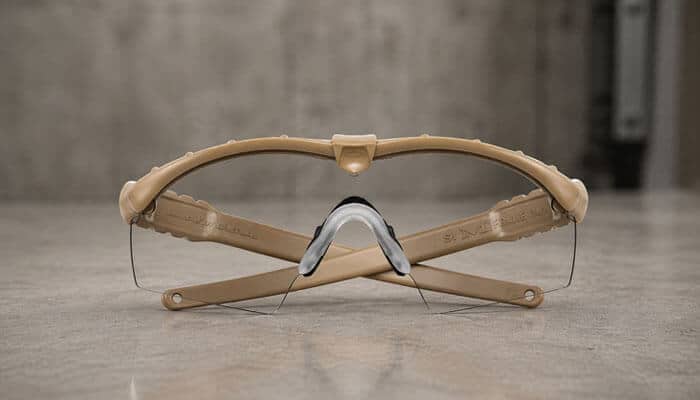
Yes. The U.S. Army currently lists the Oakley SI Ballistic M Frame 3.0 on its APEL as an authorized protective spectacle.
According to the Army, the approved configuration:
- Provides ballistic-fragmentation protection
- Meets MIL-PRF-32432A optical and safety requirements
- Uses interchangeable polycarbonate lenses
- Includes hard-coat and anti-fog treatments
- Blocks 99.9% of UVA and UVB radiation
- Is not UPLC compatible
This Army APEL status is more meaningful than general marketing terms such as “tactical” or “impact resistant.”
What Is MIL-PRF-32432A?
MIL-PRF-32432A is a U.S. military performance specification relevant to military combat eye protection.
The Army uses testing under this specification as part of its Military Combat Eye Protection program.
The broader purpose is to protect personnel against hazards such as:
- Fragmentation
- Flying debris
- Impact
- Ultraviolet exposure
- Training-related eye hazards
The Army states that ballistic-fragmentation testing, optical-quality testing and operational testing prescribed under MIL-PRF-32432A are among the requirements evaluated before eyewear is placed on APEL.
For buyers looking at the Oakley SI Ballistic M Frame 3.0 for military use, this current Army documentation is more useful than simply repeating older product descriptions.
What About MIL-PRF-31013?
This is where researching the M Frame 3.0 can become confusing.
Some currently accessible Oakley commercial product material continues to reference ANSI Z87.1-2003/2010 high-mass and high-velocity impact requirements and older MIL-PRF-31013 ballistic-fragmentation language.
However, the Army’s current CPE Ground APEL listing clearly states that the approved M Frame 3.0 meets MIL-PRF-32432A optical and safety requirements.
For current military compliance, the Army’s APEL/QPL documentation for the specific approved configuration should therefore carry greater weight than legacy marketing language.
ANSI/ISEA Z87.1-2025: What Buyers Should Know
The current U.S. eye-and-face protection standard is ANSI/ISEA Z87.1-2025, which updates the 2020 edition with changes involving markings, impact testing, lens haze, coverage, anti-fog assessment and prescription carriers.
Oakley’s current M Frame 3.0 documentation still references ANSI Z87.1-2003/2010 for high-mass and high-velocity impact claims. That does not automatically mean every M Frame 3.0 configuration is certified to the 2025 edition.
For regulated workplace or government use, verify:
- Product markings
- Current manufacturer documentation
- Required standard edition
- Exact lens and frame configuration
For military use, the current Army APEL listing remains the key reference because it identifies the approved M Frame 3.0 configuration as meeting MIL-PRF-32432A requirements.
APEL Listed Does Not Mean Every M Frame 3.0 Variant Is Identical
The Army approves specific Oakley SI Ballistic M Frame 3.0 configurations and replacement parts, identified by product numbers and NSNs.
Oakley also sells different lenses, colors and configurations, including Clear, Grey, Prizm TR22, TR45, Persimmon, laser-protection and Hybrid options.
When official compliance matters, verify:
- Exact product code
- Lens type
- Frame and lens markings
- Current APEL/QPL listing
- Required organizational specification
Do not assume every M Frame 3.0 variant has the same approval status. For military or professional PPE use, the exact listed configuration matters.
Oakley SI Ballistic M Frame 3.0 Lens Options
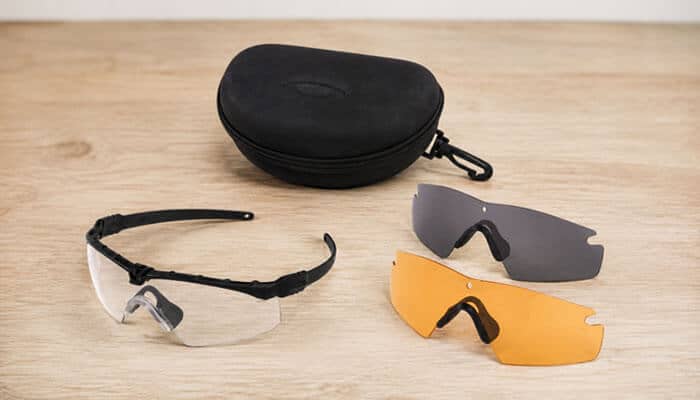
One of the strongest reasons to buy the system is its lens ecosystem. Different lenses can be selected for different lighting conditions.
| Lens | Approx. Visible Light Transmission | Best Use |
|---|---|---|
| Clear | About 89–93% depending on current SKU | Indoor or very low light |
| Grey | About 15% on Oakley’s traditional specification | Bright sunlight |
| Prizm TR22 | 19% | Medium-light shooting |
| Prizm TR45 | 44% | Lower-light shooting |
| Persimmon | About 69% | Low light |
| LPL-5 | 48% in Oakley’s 2026 laser matrix | Specific green-laser hazard |
| LPL-5+ | 42% | Specific green/violet/blue laser hazards |
| LPL-3B | 22% | Specialized military laser protection |
| LPL-B | 57% | Specialized infrared military laser protection |
Oakley’s current product pages and replacement-lens listings can vary by SKU and generation.
If exact VLT matters, verify the specification for the precise lens and product code being purchased.
Prizm TR22 vs TR45
Prizm Shooting lenses are designed to enhance contrast rather than simply reduce brightness.
Prizm TR22
Oakley lists Prizm TR22 with approximately:
- 19% light transmission
- Rose base
- Medium-light positioning
TR22 is generally better for brighter conditions where contrast enhancement is still useful.
Prizm TR45
Oakley lists Prizm TR45 with approximately:
- 44% light transmission
- Rose base
- Low-light designation
TR45 allows more visible light through the lens, making it more suitable for cloudy, shaded or lower-light environments.
TR22 vs TR45 Comparison
| Situation | Better Starting Choice |
|---|---|
| Bright outdoor range | TR22 |
| Normal daylight | TR22 |
| Cloudy range | TR45 |
| Heavily shaded area | TR45 |
| Lower-light competition | TR45 |
| Indoor range | Clear may be preferable |
| Very bright general outdoor use | Grey |
| Night operation | Clear |
The right choice depends mainly on ambient light conditions.
What Does MCEPS-Compliant Grey Mean?
Oakley’s specifications contain another detail that many reviews overlook.
Oakley states that its traditional Grey M Frame 3.0 lens provides approximately 15% visible light transmission and meets MCEPS neutrality and chromaticity requirements.
In practical terms, a neutral Grey lens is designed to reduce brightness without aggressively changing perceived colors.
That makes Grey particularly useful for:
- Bright outdoor ranges
- Daytime military training
- Patrol work
- Strong sunlight
- Outdoor tactical activities
- General-purpose sun protection
Prizm TR22 and TR45 serve a different purpose because they deliberately alter contrast to improve visibility under particular shooting conditions.
M Frame 3.0 Lens Selection: Simple Decision Table
| Environment | Suggested Starting Lens |
|---|---|
| Indoor shooting range | Clear |
| Night use | Clear |
| Very low light | Clear |
| Overcast outdoor range | TR45 |
| Variable lower light | TR45 |
| Typical daylight shooting | TR22 |
| Strong sunlight | Grey |
| Bright outdoor general use | Grey |
| Particular laser exposure | Correct wavelength-specific laser-protection lens |
A Prizm lens is not automatically a laser-protection lens, and a laser-protection lens should never be selected solely because of its color.
M Frame 3.0 Laser Lenses Explained
Oakley offers specialized laser-protection lenses for M Frame 3.0 systems. These are different from standard Clear, Grey, TR22 or TR45 lenses.
| Laser Lens | Primary Covered Wavelengths | VLT |
|---|---|---|
| LPL-5 | Visible green around 532 nm | 48% |
| LPL-5+ | Visible green 532 nm and violet/blue 405–450 nm | 42% |
| LPL-3B | Visible green plus specified infrared wavelengths | 22% |
| LPL-B | Specified infrared wavelengths | 57% |
For the M Frame 3.0 specifically, Oakley lists LPL-5, LPL-5+ and LPL-B configurations.
The 57% VLT figure applies to LPL-B, not LPL-5. Because laser protection is wavelength-specific, verify the exact SKU and current Oakley documentation before use.
LPL-5+
Oakley describes LPL-5+ as providing protection for specified:
- 532 nm visible green wavelengths
- 405–450 nm violet/blue wavelengths
Oakley lists approximately:
- Greater than 2.5 OD around 532 nm
- Greater than 1.5 OD from 405–450 nm
- 42% visible light transmission
Why Optical Density Matters
Optical Density, or OD, indicates how strongly a lens attenuates specified wavelengths.
A higher OD generally means greater attenuation at the stated wavelength.
However, laser protection is highly wavelength-specific.
A lens designed for one particular green laser does not automatically provide appropriate protection against:
- Infrared lasers
- Different visible wavelengths
- High-powered industrial systems
- Every possible laser exposure
Always use protection specifically selected for the identified hazard.
ITAR Considerations
Oakley’s Standard Issue documentation also notes that certain laser-protective products may be subject to U.S. export restrictions.
For ordinary recreational shooting, standard Clear, Grey, TR22 or TR45 lenses are generally far more relevant than specialized laser-protection configurations.
M Frame 3.0 Strike vs Hybrid: Don’t Buy the Wrong Lens Shape
Another common point of confusion is Strike vs Hybrid.
Oakley lists standard M Frame 3.0 replacement lenses as well as Ballistic M Frame Hybrid 3.0 replacement lenses.
These names largely refer to different shield-lens geometries rather than completely unrelated eyewear concepts.
However, replacement-lens compatibility should never be assumed from appearance.
Before purchasing a lens:
- Check your exact Oakley style code.
- Identify your lens shape.
- Match the replacement lens to Oakley’s compatibility information.
- Check the manufacturer’s product number.
- Avoid relying only on third-party marketplace titles.
- Use genuine protective components when certified impact performance matters.
Oakley states that authentic Oakley lenses and frames are designed to work together to maintain fit, comfort, optics and impact protection.
Optical Quality and High Definition Optics
Ballistic protection is only useful when you can see clearly.
Oakley uses High Definition Optics across M Frame 3.0 products and describes HDO as reducing distortion while delivering clearer and more accurate vision.
That is particularly relevant to a strongly curved wraparound shield.
Poorly designed curved lenses can introduce optical distortion toward the edges.
For shooters, good optical quality may help with:
- Target identification
- Sight alignment
- Red-dot use
- Peripheral awareness
- Transitioning between targets
- Reducing visual distraction
Prizm lenses add contrast enhancement on top of the underlying optical system.
UV Protection
According to the U.S. Army’s current CPE Ground listing, M Frame 3.0 lens material blocks 99.9% of UVA and UVB light.
Oakley also states that its Plutonite lens material filters UVA/UVB and harmful light through approximately 400 nm.
That makes the M Frame 3.0 useful for extended outdoor wear as well as impact protection.
Anti-Fog Performance
Protective eyewear frequently fogs when combined with:
- Helmets
- Masks
- Respirators
- Balaclavas
- Heavy physical activity
- Hot weather
- Cold-weather transitions
The M Frame 3.0 uses a permanent anti-fog coating on the interior lens surface.
The Army likewise states that approved M Frame 3.0 lenses receive an interior anti-fog treatment and exterior hard coating.
However, anti-fog does not mean completely fog-proof.
Fogging can still occur when:
- Humidity is extremely high
- Airflow is restricted
- Sweat reaches the lens
- Face coverings direct warm breath upward
- Cold lenses suddenly enter a warm environment
Keeping the lens clean and maintaining airflow remain important.
Scratch Resistance
The Army says the exterior surface receives a hard coating intended to reduce scratching.
That should not be confused with being scratch-proof.
Sand, grit and dried dirt can still damage the lens.
A better cleaning method is:
- Remove loose debris first.
- Rinse the lens when practical.
- Use an appropriate lens cleaner.
- Wipe with a clean microfiber cloth.
- Avoid excessive pressure.
- Store spare lenses separately.
Never grind dry dust across a protective lens with a shirt sleeve.
Frame Design and Durability
Oakley uses its O-Matter frame material in the M Frame 3.0 and describes the construction as impact and chemical resistant.
The frame is intentionally minimal.
Instead of a thick rim surrounding the entire lens, the large shield performs most of the protective and optical work.
Benefits include:
- Low overall weight
- Wide vision
- Less visual obstruction
- Better compatibility with other equipment
- Large protective coverage
The trade-off is that the M Frame looks and functions more like technical protective equipment than conventional casual sunglasses.
Weight: One of Its Biggest Advantages
Oakley lists the complete system at approximately 1.05 ounces.
That matters during long periods of wear.
Protective glasses may remain on for:
- Full training days
- Range qualifications
- Patrol shifts
- Military exercises
- Competition
- Outdoor work
Light eyewear becomes particularly valuable when the same user is also wearing:
- A helmet
- Ear protection
- Communications equipment
- Night-vision mounting hardware
Low weight is therefore not merely a specification-sheet advantage.
Fit and Comfort
Oakley currently describes the M Frame 3.0 as a Wide – High Bridge Fit and sells it in one primary 145 mm size.
The current Army listing likewise describes the protective spectacle as using a one-size plastic frame.
High Bridge Fit is generally intended for faces where the nose bridge sits relatively high and the cheekbones sit lower.
The hydrophilic Unobtainium nosepad is designed to help the glasses remain secure, including in wet conditions.
Who May Have Fit Problems?
The design may be less ideal for people with:
- Very narrow faces
- Low nose bridges
- High cheekbones
- Smaller heads
- Facial geometry that causes the lower lens to contact the cheeks
Fit matters for both comfort and protective coverage, so trying protective eyewear before buying is worthwhile when possible.
Hearing Protection Compatibility
This is arguably one of the M Frame 3.0’s strongest practical features.
Thick sunglass temples can interfere with earmuff cushions and create uncomfortable pressure points.
Oakley’s thin-stem design is specifically intended to work with over-ear hearing protection and communications systems.
That makes the Oakley SI Ballistic M Frame 3.0 particularly attractive for:
- Indoor shooting
- Outdoor ranges
- Electronic earmuffs
- Tactical communications headsets
- Firearms instructors
- Military training
Always confirm that your specific eyewear and hearing-protector combination maintains the proper ear-cup seal.
Helmet and Night-Vision Compatibility
Oakley describes the M Frame 3.0 as compatible with helmet-mounted night-vision equipment and several military helmet families, including:
- MICH
- ACH
- CVD
- PASGT
- Crye systems
The thin arms and low-profile architecture are central to this compatibility.
If you never wear helmets or headsets, this advantage may have limited value.
For tactical and military users, it may be one of the strongest reasons to choose this design.
Tool-Free Lens Changes
The M Frame 3.0 allows tool-free lens changes.
That means one frame can serve several environments.
For example:
- Clear lens for an indoor range
- TR45 for cloudy outdoor shooting
- TR22 for normal daylight
- Grey for intense sunlight
Instead of carrying several complete pairs of ballistic glasses, users can carry one frame and multiple protected lenses.
Oakley SI Ballistic M Frame 3.0 NSN and Military Procurement Information
Military and government readers may need exact part information rather than consumer product descriptions.
The U.S. Army currently lists:
| Component | Oakley Part Number | NSN |
|---|---|---|
| M Frame 3.0 Spectacle Kit | OO9146-21 | 4240-01-630-6064 |
| Replacement frame | 101-039-001 | 4240-01-641-4640 |
| Clear replacement lens | 100-742-010 | 4240-01-641-4657 |
| Grey replacement lens | 100-742-009 | 4240-01-641-4504 |
| Clear lenses, package of 10 | 100-743-003 | 4240-01-632-5884 |
| Grey lenses, package of 10 | 100-743-002 | 4240-01-632-5887 |
| Protective case | 101-501-001 | 4240-01-641-4650 |
| Microfiber bag | 101-321-001 | 4240-01-633-3505 |
| Anti-fog drops | 11-466 | 4240-01-633-0951 |
| Retention strap | 06-617 | 8465-01-570-0403 |
| Standard nosepiece | 101-297-001 | 4240-01-633-3532 |
These part numbers and NSNs are listed on the Army’s current dedicated CPE Ground page.
They can help with:
- Unit supply
- Replacement ordering
- Inventory verification
- Military procurement
- Identifying issued components
An NSN for one configuration does not mean every commercially sold M Frame 3.0 lens or frame color has the same approval status.
Is the M Frame 3.0 Good for Construction or Industrial Work?
Potentially, but workplace PPE requirements come first.
Oakley describes the M Frame 3.0 as meeting high-mass and high-velocity ANSI impact requirements, while current workplace programs may require specific:
- Z87 markings
- Side, splash or dust protection
- Prescription compatibility
- Employer-approved PPE
- Current ANSI/ISEA Z87.1-2025 compliance
A ballistic spectacle should not automatically replace chemical splash goggles, fine-dust goggles, welding protection or fully sealed eye protection.
Bottom line: Match the eyewear to the actual workplace hazard and required standard.
Can You Use the Oakley SI Ballistic M Frame 3.0 for Airsoft?
The M Frame 3.0 provides serious ballistic-fragmentation protection, but that does not automatically make it acceptable at every airsoft facility.
The issue is often coverage rather than lens strength.
The M Frame 3.0 is a protective spectacle, not a completely sealed goggle.
Small gaps can remain around the eye area.
Airsoft venues may require:
- Full-seal goggles
- Specific impact ratings
- Retention straps
- Full eye enclosure
- Lower-face protection
- Additional protection for minors
If a field requires full-seal eye protection, the M Frame 3.0 alone should not be substituted simply because it carries military ballistic credentials.
Always follow the specific field rules.
Is It Good for Military and Law-Enforcement Use?
This is a core use case.
The Army’s current Approved Eyewear QPL includes the Oakley SI Ballistic M Frame 3.0 among spectacles approved for military combat and training.
However, individual organizations may impose their own rules covering:
- Authorized models
- Lens color
- Frame color
- Uniform requirements
- Procurement channels
- Required markings
- Mission-specific protection
APEL eligibility does not mean every organization must approve every possible commercial variant.
Is the M Frame 3.0 Good for Construction or Industrial Work?
Potentially, but workplace PPE rules come first.
Oakley describes the system as meeting high-mass and high-velocity ANSI impact requirements, while its commercial documentation currently references earlier ANSI Z87.1 editions.
Regulated workplaces may require very specific:
- Z87 markings
- Side protection
- Splash protection
- Dust protection
- Prescription features
- Employer-approved PPE
- Current standard compliance
ANSI/ISEA Z87.1-2025 distinguishes among hazard-specific requirements and markings, including impact, splash, dust and fine-dust protection.
A ballistic spectacle should not automatically be treated as a substitute for:
- Chemical splash goggles
- Fine-dust goggles
- Welding protection
- Arc-flash protection
- Fully sealed eye protection
Match the PPE to the actual hazard.
Prescription Compatibility: UPLC vs Oakley’s Carrier
The U.S. Army states that the M Frame 3.0 is not compatible with the Universal Prescription Lens Carrier (UPLC).
However, Oakley separately offers an Oakley Authentic Prescription lens carrier for certain M Frame 3.0 configurations. These are different systems.
If You Need Army UPLC Support
Consider APEL-listed options such as:
- AMI E-Tint CTRL MS1
- ESS CrossBlade
- ESS Crossbow
- Revision Sawfly
- Revision StingerHawk
- Wiley X Vapor
Oakley M Frame 3.0 vs M Frame Alpha: Which Is Better?
One of the most useful comparisons is Oakley M Frame 3.0 vs M Frame Alpha.
Both currently appear on the U.S. Army APEL, but their designs differ.
| Feature | M Frame 3.0 | M Frame Alpha |
|---|---|---|
| Current Army APEL listing | Yes | Yes |
| Ballistic protective system | Yes | Yes |
| Army UPLC compatible | No | No |
| Frame width | 145 mm | Approx. 139 mm |
| Lens height | 50.7 mm | Approx. 57 mm |
| Temple length | 135 mm | Approx. 132 mm |
| Lens system | Interchangeable | Interchangeable |
| Dedicated gasket ecosystem | No Alpha-style system | Yes |
| Matching goggle ecosystem | No | Yes |
| Primary advantage | Lightweight simplicity | Modularity |
The Alpha is more modular, using a frame, gasket and goggle ecosystem.
Choose the M Frame 3.0 if:
- You want lightweight spectacles.
- Thin temples and earmuff compatibility matter.
- You prefer a simpler design.
- You already own compatible M Frame 3.0 lenses.
Consider the M Frame Alpha if:
- You want gasket capability.
- Wind and dust protection matter more.
- You want access to the Alpha goggle ecosystem.
- You prefer its slightly narrower frame and taller lens.
Neither is automatically better. The right choice depends on your fit and protection needs.
Oakley M Frame 3.0 vs ESS Crossbow
The ESS Crossbow is another strong military alternative.
Both are APEL-listed protective spectacles.
The key distinction for many military buyers is prescription support.
The Army lists the ESS Crossbow among its UPLC-compatible products, while the dedicated M Frame 3.0 page says the Oakley is not UPLC compatible.
M Frame 3.0 May Be Better If:
- You prioritize thin temples.
- You like Oakley’s lens ecosystem.
- You use Prizm shooting lenses.
- You value its lightweight, minimal design.
ESS Crossbow May Be Better If:
- You require Army UPLC support.
- Your organization already issues ESS equipment.
- Military prescription integration is more important than Oakley-specific features.
M Frame 3.0 vs Revision Sawfly
The Revision Sawfly has another notable advantage: sizing.
The Army lists the Sawfly in:
- Small
- Regular
- Large
The M Frame 3.0, by comparison, uses one primary size.
The Sawfly is also among the Army’s UPLC-compatible systems.
Therefore, the Sawfly may be more attractive if:
- You struggle with one-size protective eyewear.
- You require Army UPLC integration.
- You want more size flexibility.
Which Ballistic Eyewear Should You Choose?
| Your Main Priority | Strong Option to Consider |
|---|---|
| Lightweight shooting eyewear | Oakley M Frame 3.0 |
| Earmuff/headset compatibility | Oakley M Frame 3.0 |
| Oakley modular gasket/goggle system | Oakley M Frame Alpha |
| Army UPLC prescription carrier | ESS Crossbow, CrossBlade or compatible Revision model |
| Multiple frame sizes | Revision Sawfly |
| Maximum sealed protection | Purpose-designed ballistic goggle |
| Basic recreational range use | Appropriate certified safety eyewear |
| Airsoft requiring full seal | Approved full-seal airsoft goggle |
| Military procurement | Current organization-approved APEL configuration |
| Specific laser hazard | Proper wavelength-specific laser protection |
The key is matching the protective system to the actual hazard rather than simply choosing the product with the strongest marketing claims.
Price and Value in 2026
The price of the Oakley SI Ballistic M Frame 3.0 varies substantially depending on:
- Lens
- Frame color
- Single-lens vs Array package
- Prizm configuration
- Laser-protection configuration
- Retailer
- Standard Issue eligibility
- Promotions
- Country
That makes one fixed price misleading.
Instead, compare total package value.
For example, if you know you need both Clear and Grey lenses, an Array package may provide better value than buying a single-lens kit and adding another lens separately.
Also consider the long-term cost of:
- Replacement lenses
- Nosepieces
- Retention straps
- Cases
- Anti-fog products
The modular design can reduce waste because a scratched lens does not necessarily require replacing the entire frame.
What Are You Paying Extra For?
Compared with basic safety glasses, much of the premium goes toward the combination of:
- Ballistic credentials
- Oakley optical technology
- Low weight
- Wide protective shield
- Thin temples
- Helmet integration
- Lens interchangeability
- Prizm options
- Replacement ecosystem
- Military procurement history
A person who only needs basic workshop glasses may receive little value from several of those features.
A shooter wearing electronic earmuffs for six hours may appreciate them significantly more.
How to Choose the Right M Frame 3.0 Package
1. Identify Your Primary Use
Determine whether you need the eyewear for:
- Military duty
- Law enforcement
- Recreational shooting
- Competition
- Industrial PPE
- Outdoor work
- Airsoft
Different activities can have different approval requirements.
2. Determine Your Lighting
Choose Clear, Grey, TR22 or TR45 based primarily on the environment.
3. Decide Whether You Need Multiple Lenses
If you frequently move between indoor and outdoor environments, multiple lenses may provide better value.
4. Check Your Fit
Remember the basic dimensions and fit:
145 mm / Wide / High Bridge Fit
This will not suit every face.
5. Address Prescription Needs
If you specifically require the Army UPLC system, consider another approved spectacle.
If you are exploring Oakley’s separate prescription carrier, verify compatibility with the exact M Frame 3.0 configuration.
6. Verify Certification
Check the exact product rather than assuming every M Frame 3.0 variation carries identical approvals.
The Army specifically advises that only eyewear appearing on APEL has been validated against its ballistic-fragmentation requirements.
7. Buy From a Reliable Source
Protective eyewear is one category where counterfeit or unknown components can create a genuine safety problem.
How to Avoid Buying the Wrong M Frame
Oakley has produced several related products, including:
- M Frame 2.0
- M Frame 3.0
- M Frame 3.0 Strike
- M Frame 3.0 Hybrid lenses
- M Frame Alpha
- Industrial M Frame variants
- Sports-oriented M Frame products
Do not treat all of these names as interchangeable.
When ordering:
- Match the style code.
- Match the lens shape.
- Verify the product number.
- Confirm frame/lens compatibility.
- Check official Oakley information when possible.
How to Spot a Safer Purchase
Because ballistic eyewear is protective equipment, authenticity matters.
Before buying:
- Use Oakley or a reputable seller.
- Check the exact model.
- Confirm part numbers.
- Inspect product markings.
- Compare packaging with the advertised configuration.
- Keep proof of purchase.
- Be cautious of suspiciously cheap replacement lenses.
- Avoid unknown aftermarket components when certified protection matters.
A product that merely looks like an Oakley M Frame cannot automatically be assumed to perform like one.
How to Maintain the Oakley SI Ballistic M Frame 3.0
Inspect It Regularly
Check:
- Lens
- Frame
- Retention clip
- Temples
- Nosepiece
- Lens mounting points
Watch for:
- Cracks
- Deep scratches
- Deformation
- Loose components
- Damage following an impact
Clean the Lens Correctly
Use:
- Clean water
- Appropriate lens cleaner
- Clean microfiber material
Avoid abrasive household cleaners.
Keep the Microclear Bag Clean
Oakley recommends hand washing and air drying its Microclear cleaning and storage bag regularly.
This matters because a dirty microfiber bag can trap:
- Dust
- Sand
- Oil
- Abrasive particles
Those particles can scratch the lens during cleaning.
Store Spare Lenses Separately
Do not place multiple bare lenses together in the same compartment.
After a Serious Impact
Inspect the entire protective system carefully.
When structural integrity is uncertain, replacing damaged safety equipment is preferable to relying on a compromised component.
Common Mistakes to Avoid
- Choosing lenses only by color instead of checking the actual safety rating.
- Assuming all M Frame lenses have the same fit, protection or compatibility.
- Treating ballistic spectacles as full-seal goggles.
- Ignoring face fit and protective coverage.
- Using unverified aftermarket replacement lenses.
- Confusing ANSI standards with military ballistic requirements.
- Assuming Prizm lenses provide extra ballistic protection.
- Using laser-tinted lenses without checking the protected wavelength.
- Confusing the Army UPLC system with Oakley’s separate prescription carrier.
Who Should Buy the Oakley SI Ballistic M Frame 3.0?
It is particularly well suited to:
- Military personnel
- Law-enforcement users
- Range shooters
- Firearms instructors
- Competitive shooters
- Users wearing over-ear hearing protection
- People using tactical helmets
- Users who want interchangeable lenses
- Buyers who prioritize low weight
- People who appreciate Oakley’s optical system
Oakley SI Ballistic M Frame 3.0 Pros and Cons
| Pros | Cons |
|---|---|
| Current Army APEL-listed configuration | Premium price |
| MIL-PRF-32432A credentials for approved configuration | One primary frame size |
| Very lightweight | High Bridge Fit is not ideal for everyone |
| Wide field of view | No Army UPLC compatibility |
| Excellent earmuff compatibility | Replacement lenses increase total cost |
| Thin temples | Not full-seal protection |
| Interchangeable lenses | Exact configuration matters for compliance |
| Quick tool-free lens changes | Commercial standards wording can be confusing |
| Clear, Grey and Prizm choices | Some buyers do not need its advanced features |
| Specialized laser lenses available | Laser products require careful wavelength matching |
| Strong UV protection | Counterfeit/unknown components are a concern |
| Anti-fog treatment | No eyewear is completely immune to fogging |
| Military replacement parts and NSNs | Less fit flexibility than multi-size competitors |
| Separate Oakley prescription-carrier option | Different from Army UPLC |
Oakley SI Ballistic M Frame 3.0 Review Score
| Category | Editorial Score |
|---|---|
| Protective credentials | 10/10 |
| Optical quality | 9.5/10 |
| Weight | 10/10 |
| Hearing-protection compatibility | 10/10 |
| Helmet compatibility | 9.5/10 |
| Lens selection | 9.5/10 |
| Modularity | 9/10 |
| Comfort | 9/10 |
| Fit versatility | 7.5/10 |
| Prescription flexibility | 7/10 |
| Long-term parts support | 9.5/10 |
| Value | 8.5/10 |
| Overall | 9/10 |
These scores reflect published specifications, protection credentials, system design and buyer utility rather than independent laboratory testing.
Is the Oakley SI Ballistic M Frame 3.0 Worth It in 2026?
Yes. The Oakley SI Ballistic M Frame 3.0 remains a strong choice in 2026 for shooters and professionals who want lightweight ballistic eyewear with wide optics, interchangeable lenses and good compatibility with helmets and hearing protection.
Its main strengths include:
- Current Army APEL status
- MIL-PRF-32432A compliance for the approved configuration
- Low weight
- Thin temples
- Anti-fog treatment
- Multiple lens options
- Strong equipment compatibility
However, users who need Army UPLC support, full-seal protection or a different fit may be better served by another APEL-listed system.
Conclusion
The Oakley SI Ballistic M Frame 3.0 remains a strong choice in 2026 for shooters, military users and professionals who want lightweight ballistic eyewear with interchangeable lenses, anti-fog treatment and good helmet and hearing-protection compatibility.
Its Army APEL status and MIL-PRF-32432A credentials strengthen its appeal, but the one-size High Bridge Fit, lack of full-seal protection and no Army UPLC compatibility may limit some users.
The Oakley SI Ballistic M Frame 3.0 is still worth considering if its fit, protection level and lens options match your needs.
Oakley SI Ballistic M Frame 3.0 FAQs
1. How much does the Oakley SI Ballistic M Frame 3.0 weigh?
The Oakley SI Ballistic M Frame 3.0 weighs approximately 1.05 ounces, making it a lightweight option for extended range, military and tactical use.
2. Is the Oakley SI Ballistic M Frame 3.0 full-seal eyewear?
No. The Oakley SI Ballistic M Frame 3.0 is a protective spectacle rather than a fully sealed goggle. Users who need protection from fine dust, chemical splash or full eye enclosure should consider purpose-built goggles.
3. What face shape fits the Oakley SI Ballistic M Frame 3.0 best?
The M Frame 3.0 uses a Wide, High Bridge Fit. It may work best for users with higher nose bridges, while people with narrow faces, low bridges or high cheekbones may prefer another fit.
4. Can you change Oakley SI Ballistic M Frame 3.0 lenses without tools?
Yes. The Oakley SI Ballistic M Frame 3.0 uses a tool-free interchangeable lens system, making it easier to switch between Clear, Grey, TR22, TR45 and other compatible lenses.
5. How should you clean the Oakley SI Ballistic M Frame 3.0?
Remove loose debris first, then use clean water, an appropriate lens cleaner and a clean microfiber cloth. Avoid abrasive cleaners or wiping dry dirt across the lens.
6. Are aftermarket M Frame 3.0 lenses safe to use?
Do not assume aftermarket lenses provide the same ballistic performance as genuine components. When certified protection matters, use verified lenses designed for the Oakley SI Ballistic M Frame 3.0.
7. Can the Oakley SI Ballistic M Frame 3.0 be worn all day?
Its approximately 1.05-ounce weight, thin temples and low-profile design make it suitable for extended wear for many users. Comfort still depends on individual face shape and equipment setup.
8. What should you check before buying an Oakley SI Ballistic M Frame 3.0?
Verify the exact model, lens type, product number, markings, fit and required APEL or workplace approval. This is especially important when the Oakley SI Ballistic M Frame 3.0 is being purchased for professional or military use.