
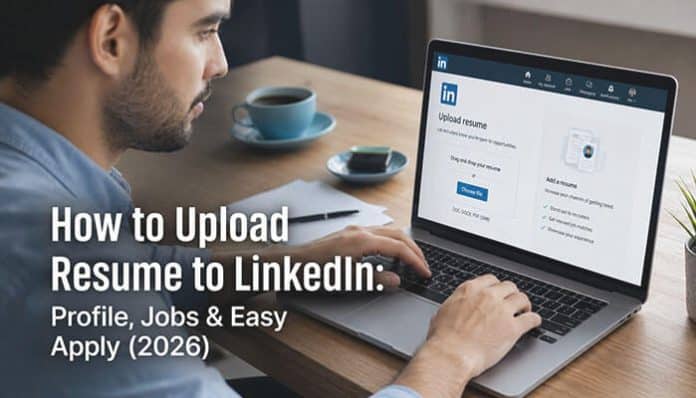

Learning how to upload resume to LinkedIn involves more than attaching a single file. LinkedIn provides several resume-upload options, and each one affects where your document is stored, who can access it and whether you can reuse it for future applications.
You can save a resume privately in your LinkedIn job settings, attach a targeted version during Easy Apply or publish a document on your profile for visitors to view. These options are separate. A resume displayed on your profile cannot automatically be selected for Easy Apply, while a resume saved for applications is not publicly displayed.
This guide explains how to upload, manage, replace, download and delete a resume on LinkedIn using desktop and mobile devices. It also covers Easy Apply, recruiter visibility, Open to Work, privacy settings, application tracking and common upload problems.
Quick Answer
To save a resume privately for future LinkedIn applications:
- Sign in to LinkedIn.
- Click Jobs.
- Select Preferences.
- Open Resumes and application data.
- Click Upload resume.
- Choose a PDF or Microsoft Word file.
- Confirm that the correct file appears in your saved-resume list.
LinkedIn stores the four most recently uploaded resumes, allowing you to reuse them during future applications completed through the platform.
Key Takeaways
- LinkedIn provides separate options for saving, submitting and publicly displaying a resume.
- A resume saved under Resumes and application data is not automatically sent to employers.
- A resume selected during Easy Apply is shared with the job poster after submission.
- LinkedIn stores up to four recently uploaded resumes.
- LinkedIn recommends PDF or Microsoft Word files smaller than 2 MB for job applications.
- A resume published on your profile may be visible and downloadable.
- A profile resume cannot automatically be selected for Easy Apply.
- Submitted LinkedIn applications cannot be edited or withdrawn.
- Job Tracker can show which resume you submitted with an Easy Apply application.
- Open to Work and recruiter resume-data sharing are separate LinkedIn features.
Three Ways to Upload a Resume to LinkedIn
The best way to upload a resume to LinkedIn depends on whether you want to save it privately, submit it with a job application or display it publicly.
| Upload method | Main purpose | Who can access it? | Reusable for Easy Apply? |
|---|---|---|---|
| Resumes and application data | Save resumes for future applications | Only you until submission | Yes |
| Easy Apply | Apply for a specific LinkedIn job | The employer or job poster | Yes, if saved |
| Profile or Featured section | Publicly showcase your experience | Profile visitors | No |
LinkedIn keeps application resumes separate from profile documents. A resume added to your profile does not automatically appear in your Easy Apply resume list.
What Does Uploading a Resume to LinkedIn Mean?
When learning how to upload resume to LinkedIn, it is important to understand the different options.
Save a Resume Privately
You can store a resume under Resumes and application data for future applications. LinkedIn may preselect your most recently used file, but you can change it before submitting.
Saved resumes are not shared with employers until you submit an application.
Attach a Resume Through Easy Apply
Easy Apply lets you apply without leaving LinkedIn. You can select a saved resume or upload a new one during the application.
Once submitted, the resume and application details are sent to the job poster.
Display a Resume on Your Profile
You may add a resume as profile media, a document post or a Featured work sample.
This option helps showcase your experience, but the document may be visible and downloadable. A profile resume cannot be used automatically for Easy Apply.
Share Resume Data With Recruiters
LinkedIn also offers a Share resume data with recruiters setting. When enabled, LinkedIn may use information from recently saved resumes to improve your visibility in recruiter searches.
Recruiters do not receive the full resume unless you submit or share it directly.
What to Do Before Uploading Your Resume
Before learning how to upload resume to LinkedIn, review the document carefully. An outdated, incorrect or poorly named file can weaken your application.
Update Your Professional Information
Confirm that your resume includes:
- Current or most recent position
- Correct employment dates
- Relevant skills
- Recent certifications
- Important projects
- Measurable achievements
- Current email address and phone number
- LinkedIn profile URL
Your resume can be more targeted than your LinkedIn profile, but important details should remain consistent, including job titles, employer names, dates, degrees and certifications.
Remove Unnecessary Personal Information
Avoid including information an employer does not need, such as:
- Full residential address
- Government identification or passport numbers
- Banking information
- Date of birth or marital status
- Personal signature
- References’ private contact details
- Confidential employer or client information
This is especially important when adding a resume to your public LinkedIn profile because visitors may be able to view or download it.
Create Multiple Resume Versions
Instead of using one general document for every application, create tailored versions for your main target roles, such as:
- Digital marketing
- SEO
- Content writing
- Product management
- Software development
- Finance
- Entry-level positions
- Senior leadership roles
Each version should emphasize the skills, terminology and achievements most relevant to the job.
Use a Professional File Name
A clear file name helps recruiters identify your resume quickly.
Good examples:
- Aisha-Khan-Digital-Marketing-Resume.pdf
- Aisha-Khan-SEO-Manager-Resume.pdf
- Rahul-Mehta-Software-Engineer-Resume.docx
Avoid names such as:
- Resume-final-final2.pdf
- New-CV.docx
- Document123.pdf
- Latest-resume-new.pdf
When following the steps for how to upload resume to LinkedIn, include your name and target role in the file name whenever possible.
Method 1: How to Upload Resume to LinkedIn Job Settings
Saving a resume in LinkedIn’s application settings is useful when you plan to apply for several jobs. LinkedIn stores your four most recently uploaded resumes for reuse in supported applications.
Upload a Resume on Desktop
- Sign in to LinkedIn.
- Click Jobs.
- Select Preferences.
- Open Resumes and application data.
- Click Upload resume.
- Choose the file from your computer.
- Confirm that the correct file appears in your resume list.
Upload a Resume on Mobile
- Open the LinkedIn app.
- Tap Jobs.
- Open Preferences.
- Select Resumes and application data.
- Tap Upload resume.
- Choose a file from your phone or cloud storage.
- Confirm that the upload is complete.
Menu names may vary slightly depending on your device or LinkedIn interface.
What Happens After You Save It?
Saving a resume does not submit a job application. LinkedIn may preselect your most recently used file during a future application, but you can change it before submitting.
Saved resumes and application answers are not automatically sent to employers.
Method 2: How to Upload a Resume Through Easy Apply
Easy Apply lets you complete supported job applications without leaving LinkedIn.
A listing with an Easy Apply button uses LinkedIn’s application form. A listing showing Apply or Apply on company website redirects you to an external site, where your saved LinkedIn resume may not transfer.
Upload a Resume Through Easy Apply on Desktop
- Sign in to LinkedIn and open Jobs.
- Search for a suitable position.
- Open a listing marked Easy Apply.
- Click Easy Apply.
- Enter your contact details.
- Complete the required screening questions.
- Select a saved resume or click Upload resume.
- Choose the correct PDF or Word file.
- Review your answers and attachments.
- Click Submit application.
LinkedIn recommends using a PDF or Microsoft Word resume smaller than 2 MB.
Upload a Resume Through Easy Apply on Mobile
- Open the LinkedIn app.
- Tap Jobs.
- Select an Easy Apply listing.
- Tap Easy Apply.
- Complete the required fields.
- Select a saved resume or upload a new one.
- Review the application.
- Tap Submit.
Review Before Submitting
Before completing the process for how to upload resume to LinkedIn, confirm that:
- You selected the correct resume version.
- Your email address and phone number are current.
- Employment dates are accurate.
- Screening and work-authorization answers are correct.
- The document opens properly.
- No comments, tracked changes or placeholder text remain.
- The resume is tailored to the position.
LinkedIn generally does not allow applicants to edit or withdraw an application after submission. Review every detail carefully before selecting Submit application.
Easy Apply Versus Apply on Company Website
| Feature | Easy Apply | Apply on Company Website |
|---|---|---|
| Application location | Completed within LinkedIn | Completed on an external site |
| Saved LinkedIn resume | Usually selectable | Usually does not transfer |
| Screening questions | Presented through LinkedIn | Controlled by the employer |
| Prefilled information | Often available | Depends on the external system |
| Submission destination | Sent through LinkedIn | Sent through an employer or job board |
| Application length | Often shorter | May be more detailed |
| LinkedIn Job Tracker | Updates automatically | May require manual tracking |
Is a Resume Required for Easy Apply?
A resume is not mandatory for every Easy Apply listing. LinkedIn describes the resume field as optional in some application flows, although employers may require screening answers or other information.
LinkedIn states that the resume field may be optional for signed-in members, but uploading a resume is mandatory when completing an application without being signed in.
Even when the file is optional, attaching a targeted resume is usually beneficial because it gives you greater control over:
- Which experience receives priority
- How achievements are presented
- Which job-related keywords appear
- The order of your qualifications
- The amount of detail provided
- Which projects and certifications are emphasized
A complete LinkedIn profile supports your application, but it does not always replace a focused resume.
Method 3: How to Add a Resume to Your LinkedIn Profile
Adding a resume to your profile is different from saving it for job applications. A profile resume is intended to showcase your experience to visitors and may be visible or downloadable depending on your privacy settings.
Add a Resume to the Featured Section
- Sign in to LinkedIn on a desktop browser.
- Click Me and select View Profile.
- Click Add profile section.
- Open Recommended and select Add Featured.
- Click the add icon in the Featured section.
- Choose the available media, post or work-sample option.
- Upload or publish your resume.
- Add a professional title and short description.
- Click Save or Done.
The available options may vary by account or interface version. When direct document upload is unavailable, you can publish the resume as a document post or keep it private in your application settings.
Can You Upload a Profile Resume From Mobile?
LinkedIn does not support uploading documents directly as profile media from a mobile device. Use a desktop browser when following this method for how to upload resume to LinkedIn.
You may still publish a document post through the mobile app and add it to your Featured section when that option is available.
Suggested Resume Title and Description
Avoid using only “Resume” as the title.
Example title:
Aisha Khan — Digital Marketing Resume
Example description:
Digital marketing professional with experience in SEO, paid media, content strategy and conversion optimization. This resume highlights recent results, technical skills and professional experience.
Should You Publish Your Resume on Your Profile?
Publishing a resume may benefit:
- Freelancers and consultants
- Creative professionals
- Recent graduates
- Researchers and speakers
- Job seekers comfortable with public visibility
It may be unsuitable when:
- Your job search is confidential.
- Your current employer does not know you are applying elsewhere.
- The document contains private contact information.
- You regularly tailor your resume for different jobs.
- It includes confidential projects or client details.
- You do not want visitors downloading it.
For many applicants, maintaining a detailed LinkedIn profile while storing resumes privately in application settings is the safer choice.
Profile Resume Versus Saved Application Resume
| Question | Profile resume | Saved application resume |
|---|---|---|
| Publicly displayed? | Potentially | No |
| Downloadable by visitors? | Potentially | No |
| Selectable during Easy Apply? | No | Yes |
| Automatically sent to employers? | No | No |
| Best purpose | Public professional showcase | Job applications |
| Main privacy concern | Public or off-platform visibility | Data storage and recruiter sharing |
The most important point when learning how to upload resume to LinkedIn is that these upload locations are not interchangeable.
LinkedIn Resume File Requirements
LinkedIn’s application-resume recommendations are straightforward.
| Requirement | LinkedIn application guidance |
|---|---|
| Accepted formats | PDF or Microsoft Word |
| Recommended file size | Less than 2 MB |
| Saved resume limit | Four most recently uploaded |
| Desktop upload | Supported |
| Mobile Easy Apply upload | Supported |
| Profile display | Requires a separate upload or post |
For profile media, LinkedIn supports PDF, Word, PowerPoint and common image formats. Profile-media limits are broader than the smaller 2 MB recommendation for job-application resumes.
Should You Upload a PDF or Word Resume?
When deciding how to upload resume to LinkedIn, both PDF and Microsoft Word formats are accepted. The best choice depends on the employer’s instructions and how you want the document to display.
PDF Resume
A PDF usually preserves fonts, spacing and layout across devices.
Advantages:
- Maintains formatting
- Opens consistently
- Is harder to edit accidentally
- Looks professional when downloaded
- Works well for profile display
Use a text-based PDF with selectable text. Scanned or image-only files may be harder for recruiters and application systems to process.
Microsoft Word Resume
A .doc or .docx file is useful when an employer requests an editable document.
Advantages:
- Easy to update
- Widely accepted
- Convenient for recruiter comments
- Suitable when Word format is required
Word formatting may shift when the file is opened with different software, fonts or operating systems.
PDF Versus Word
| Factor | Word | |
|---|---|---|
| Preserves layout | Excellent | May vary |
| Easy to edit | No | Yes |
| Accepted by LinkedIn | Yes | Yes |
| Good for profile display | Excellent | Supported |
| Best when no format is specified | Usually preferred | Keep as backup |
| Best when Word is requested | No | Yes |
Keep both a text-based PDF and a clean Word version. When you upload a resume to LinkedIn, always follow the format requested in the job listing.
How to Make Your Resume Easier to Review
Before following the steps for How to Upload Resume to LinkedIn, make sure your resume is clear, readable and easy for recruiters or application systems to process.
Use Standard Section Headings
Organize the document with familiar headings such as:
- Professional Summary
- Core Skills
- Work Experience
- Education
- Certifications
- Projects
- Technical Skills
Standard headings help recruiters find important information quickly.
Keep the Layout Simple
Avoid excessive use of:
- Decorative icons
- Text boxes
- Complex columns
- Skill-rating bars
- Large graphics or background images
- Unnecessary tables
- Important details placed only in headers or footers
A simple layout is usually easier to read on different devices and may reduce resume-parsing problems.
Avoid Image-Only Resumes
Use selectable text rather than placing all your information inside images. Scanned or image-only resumes may be harder to search, copy or process.
Check the Final File
Open the PDF or Word document before uploading it and confirm that:
- No text is cut off.
- Page breaks appear correctly.
- Bullet points are aligned.
- Links work.
- Fonts display properly.
- No blank pages appear.
- Comments and editing marks have been removed.
These checks can prevent formatting problems when you upload a resume to LinkedIn or send it directly to an employer.
How to Tailor a Resume Before Easy Apply
Before you upload a resume to LinkedIn, tailor it to the job instead of submitting the same document to every employer.
Review the Job Description
Identify the employer’s main requirements, including:
- Required and preferred skills
- Years of experience
- Industry or software knowledge
- Certifications
- Leadership expectations
- Education, location or travel requirements
Match Relevant Keywords Naturally
Use terms from the job description when they accurately describe your experience.
For example, if the employer emphasizes “content strategy” but your resume only mentions “writing,” update the wording to reflect your relevant responsibilities. Never add skills you do not have or repeat keywords unnaturally.
Prioritize Relevant Experience
Shorten older or unrelated positions and give more space to experience, projects and achievements that match the target role.
Add Measurable Achievements
Replace general responsibilities with clear results.
Weak:
Managed social media accounts.
Improved:
Managed six social media accounts and increased organic engagement by 42% within nine months.
Useful measurements may include:
- Revenue or leads generated
- Costs or time saved
- Projects completed
- Conversion or retention improvements
- Team size managed
Keep Your Resume and Profile Consistent
Confirm that your resume and LinkedIn profile agree on:
- Employer names
- Job titles
- Employment dates
- Degrees and certifications
- Major achievements
Your resume can be shorter and more targeted, but important facts should not conflict when you upload a resume to LinkedIn.
How Many Resumes Can You Save on LinkedIn?
LinkedIn stores the four most recently uploaded resumes. When you add another document, an older version may disappear from your recently saved list.
A practical four-resume system could include:
- General professional resume
- Primary target-role resume
- Secondary target-role resume
- Specialized or senior-level resume
Use clearly differentiated file names so you do not accidentally select the wrong version.
LinkedIn Resume Privacy, Visibility and Recruiter Sharing
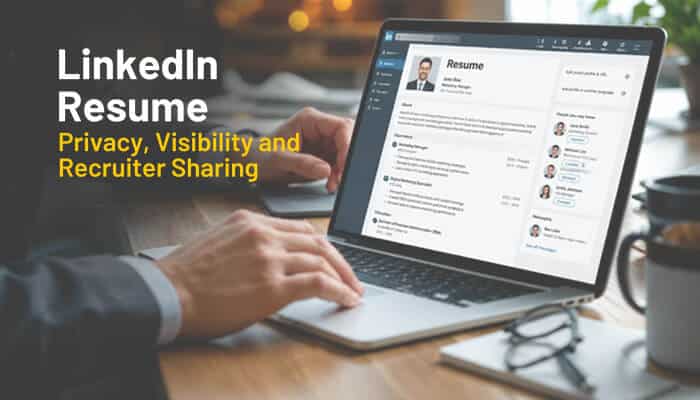
Before you upload a resume to LinkedIn, understand how its visibility changes depending on where you store it and which sharing settings you enable.
Resume Saved in Application Settings
A resume stored under Resumes and application data is not publicly displayed or automatically sent to employers.
You can review, replace or select the file before submitting an application.
Resume Attached Through Easy Apply
When you submit an Easy Apply application, the job poster may receive:
- Your attached resume
- Contact information
- Screening-question answers
- Cover letter
- LinkedIn profile information
Saving a resume and submitting it are separate actions. The employer receives the file only after you complete the application.
Resume Added to Your Profile
A resume published as profile media, a document post or Featured content may be visible and downloadable.
Before publishing, remove:
- Your full home address
- Unnecessary private phone numbers
- Identification or financial information
- Confidential employer or client details
- References’ personal contact information
- Sensitive project data
Is Uploading a Resume Visible to Your Network?
Saving or submitting a resume privately does not create a public application notice.
However:
- A resume published as a post or Featured item may be visible.
- Profile changes made during your job search remain visible.
- Some updates may be shared when network notifications are enabled.
- Public Open to Work adds an
#OpenToWorkframe to your profile photo.
Private job applications should not be confused with public profile content.
Does LinkedIn Notify Your Current Employer?
LinkedIn does not publicly announce that you saved or submitted a private application resume.
For Recruiters-only Open to Work and recruiter resume sharing, LinkedIn takes steps to hide your job-search interests from recruiters associated with your current employer. Complete privacy is not guaranteed.
Protection may depend on:
- The employer listed on your profile
- Whether the position is marked as current
- LinkedIn’s company-matching system
- Whether related companies are identified correctly
- The recruiter’s employment information
For a confidential job search:
- Keep your current employer information accurate.
- Use Recruiters-only Open to Work.
- Avoid publishing your resume publicly.
- Remove sensitive details from public documents.
- Review recruiter-sharing settings.
- Disable profile-update notifications before major edits.
Open to Work Versus Resume Sharing
Open to Work and resume sharing are separate LinkedIn features.
| Feature | Open to Work | Share resume data with recruiters |
|---|---|---|
| Main purpose | Signals interest in job opportunities | Improves recruiter discovery |
| Requires a saved resume | No | Yes |
| Shares the full resume | No | No, unless you provide it directly |
| Public option | Yes | No public label |
| Recruiter-only option | Yes | Recruiter-facing |
| Main settings location | Profile or Jobs preferences | Resumes and application data |
Open to Work may include:
- Desired job titles
- Preferred locations
- Remote, hybrid or on-site preferences
- Employment types
- Start date
- Visibility settings
When set to All LinkedIn Members, the signal may be visible to your network and current employer, and LinkedIn adds the Open to Work profile-photo frame.
When set to Recruiters only, the information is intended for LinkedIn Recruiter users, although complete privacy is not guaranteed.
In India, eligible members may also provide their notice period, availability to join and expected annual salary. These details are intended to be visible only to recruiters.
Does LinkedIn Turn Resume Sharing On Automatically?
After you apply for a job, LinkedIn may display a prompt asking you to share resume data with recruiters. Review the option carefully before enabling it.
To manage the setting:
- Open Jobs.
- Select Preferences.
- Open Resumes and application data.
- Find Share resume data with recruiters.
- Turn the toggle on or off.
Turning resume sharing off does not delete your saved documents. Remove individual files separately when you no longer want LinkedIn to store them.
How LinkedIn May Use Saved Resume Data
Depending on your settings, LinkedIn may use saved resume information to:
- Recommend and rank jobs
- Suggest profile updates
- Personalize learning recommendations
- Identify relevant skills and experience
- Improve job matching
- Help recruiters discover suitable candidates
- Support certain generative AI features
- Improve some AI systems, subject to account controls
Review your privacy, recruiter-sharing and AI settings before you upload a resume to LinkedIn, especially if the file contains sensitive professional information.
What Happens After You Apply Through Easy Apply?
After submission, LinkedIn sends the application to the job poster. Relevant skills from your profile may also be included to highlight your qualifications.
LinkedIn may then ask whether you want to save:
- The uploaded resume
- Screening-question answers
- Contact details
- Other application information
Saved information can be reviewed or changed before it is used in a later application.
If a job was posted by a recruiting agency, the agency may share your application with another client when your background appears suitable for additional roles.
Application-Viewed and Resume-Downloaded Notifications
For eligible Easy Apply jobs hosted on LinkedIn, you may receive an update when:
- The job poster views your application.
- The job poster downloads your resume.
An application-view notification means the job poster opened your submitted application. A resume-download notification means the attached file was downloaded, potentially for separate review or sharing with another hiring participant.
Neither action guarantees a reply, interview or job offer.
How to Check Which Resume You Submitted
When managing multiple versions, you may forget which document was attached to a particular application.
To check the submitted resume on desktop:
- Sign in to LinkedIn.
- Open Jobs.
- Click Job tracker.
- Select the Applied tab.
- Open the relevant application.
- Click Submitted resume.
The displayed file is the resume included with that Easy Apply application.
You can review the document, but you cannot replace it inside an application that has already been submitted.
Can You Edit or Withdraw an Easy Apply Application?
LinkedIn does not currently allow applicants to edit or withdraw an application after submission.
You cannot directly:
- Replace the submitted resume
- Edit screening-question answers
- Correct contact information
- Withdraw the application
- Reopen and resubmit the form
- Add a missing attachment
When an important correction is necessary, contact the job poster through InMail or another available contact method. Explain the issue briefly and provide the corrected document when appropriate.
How to Track Applications With Job Tracker
LinkedIn Job Tracker provides a centralized place to organize opportunities.
| Job Tracker stage | Meaning |
|---|---|
| Saved | A job you want to review later |
| In Progress | An application you started |
| Applied | An application you submitted |
| Interview | An opportunity that reached the interview stage |
| Archive | A job removed from the active search |
For Easy Apply jobs, LinkedIn can automatically move a listing from Saved to In Progress and then Applied as you begin and submit the application.
Applications completed on external company sites may require manual updates.
Job Tracker may also allow you to:
- Add notes
- Record reminders
- Review submitted jobs
- View relevant connections
- Move opportunities to Interview
- Archive inactive applications
A separate spreadsheet can still be useful for recording recruiter names, interview dates, salary ranges, follow-up deadlines and the resume version used for each job.
How to Download, Delete or Replace a LinkedIn Resume
After you upload a resume to LinkedIn, you can manage saved files from the same application settings area.
Download a Saved Resume
On desktop or mobile:
- Open Jobs.
- Select Preferences.
- Open Resumes and application data.
- Find the resume.
- Open the More menu.
- Select Download.
Resumes uploaded through an employer’s external application website may not appear in your LinkedIn resume list.
Delete a Saved Resume
- Open Jobs > Preferences.
- Select Resumes and application data.
- Find the document.
- Open the More menu.
- Select Delete and confirm.
Deleting a saved resume does not remove copies already submitted to employers.
Remove a Resume From Your Profile
- Open your LinkedIn profile.
- Find the Featured item or document post.
- Open its edit or menu options.
- Select Remove from featured, Delete post or the available removal option.
- Confirm the action.
Removing an item from Featured may only remove its placement. You may need to delete the original post or document to remove it completely.
Replace an Old Resume
LinkedIn may not provide a direct replacement option. Instead:
- Update the original resume on your device.
- Save it with a clear new file name.
- Upload the revised document.
- Open or download it to check the file.
- Use it for your next application.
- Delete the outdated version.
For a public profile resume, remove the old document or post and publish the updated version separately. Do not delete the old file until you confirm that the replacement uploaded correctly.
What Happens When You Reach the Easy Apply Limit?
LinkedIn uses daily and speed-based limits to reduce automated or excessive Easy Apply submissions.
Daily Limit
LinkedIn allows a limited number of Easy Apply applications each day. It does not publish one fixed allowance for every user, and the limit may vary based on account activity. The daily allowance generally resets at the end of the day in Coordinated Universal Time.
Speed Limit
Submitting many applications too quickly may trigger a temporary pause. This helps LinkedIn discourage bots, automated submissions and inauthentic activity.
When you reach a limit:
- Stop repeatedly clicking Easy Apply.
- Review your saved jobs.
- Prioritize the strongest matches.
- Tailor your resume for each position.
- Improve relevant LinkedIn profile sections.
- Return after the pause or daily reset.
- Complete account verification if LinkedIn requests it.
When learning How to Upload Resume to LinkedIn, focus on quality rather than application volume. A smaller number of relevant, tailored applications is usually more effective than sending the same generic resume to many employers.
Why Is My Resume Not Uploading to LinkedIn?
Problems can occur because of the file size, format, browser, connection or application type. Check the following before trying to upload a resume to LinkedIn again.
The File Is Too Large
LinkedIn recommends keeping application resumes below 2 MB. Compress large images or export a smaller PDF.
The File Format Is Unsupported
Use a PDF or Microsoft Word file for LinkedIn job applications.
The Job Does Not Support Easy Apply
A standard Apply button redirects you to an employer’s website. Upload your resume through that external application system.
The Browser Is Causing the Problem
Try:
- Updating the browser
- Clearing cookies and cached data
- Disabling conflicting extensions
- Using a private browsing window
- Signing out and back in
- Trying another supported browser
The File Name Contains Unusual Characters
Use letters, numbers and simple hyphens.
Example:
Anita-Rao-Marketing-Resume-2026.pdf
The Document Is Corrupted
Open the resume on your device. If it does not display correctly, export a fresh copy from the original file.
Your Internet Connection Is Unstable
Reconnect to a reliable network and restart the upload.
You Are Uploading Profile Media From Mobile
LinkedIn does not support direct profile-document uploads from mobile devices. Use a desktop browser, or publish the resume as a document post through the mobile app.
The Document Has No Title
Add a clear professional title before publishing the resume as profile content.
The Upload Is Temporarily Stuck
Rename the file, restart the browser and upload a freshly exported copy. This may fix interrupted uploads or damaged file metadata.
Common Resume-Upload Mistakes
Avoid these common mistakes when you upload a resume to LinkedIn:
- Uploading the wrong resume version
- Using the same resume for every job
- Publishing private or sensitive information
- Confusing profile documents with saved Easy Apply resumes
- Forgetting to update your LinkedIn profile
- Skipping the final application review
- Using an overly complicated resume design
- Leaving comments, tracked changes or template notes in the file
- Uploading an image-only or scanned PDF
- Using an outdated email address or phone number
- Choosing an unclear file name
- Submitting a resume with spelling or formatting errors
Review the document carefully before selecting Submit application, because submitted LinkedIn applications generally cannot be edited or withdrawn.
How to Create a Resume From Your LinkedIn Profile
LinkedIn may allow you to create a resume in two ways:
- Save your LinkedIn profile as a PDF
- Use LinkedIn Resume Builder, when available
To save your profile as a PDF on desktop:
- Click Me
- Select View Profile
- Open More or Resources
- Select Save to PDF
- Download the file
Important points:
- Resume Builder is not available to every LinkedIn member.
- The Save to PDF option may not appear on mobile or for every account.
- A LinkedIn profile PDF is only a starting point.
- Remove irrelevant sections before applying.
- Add measurable achievements and role-specific skills.
- Tailor the document to the job before you upload a resume to LinkedIn or send it to an employer.
LinkedIn AI-Powered Resume Tips
LinkedIn Premium members may have access to AI-powered resume tips for selected jobs.
- The feature is currently available on desktop.
- It is available in English.
- You need an existing uploaded resume.
- AI can compare your resume with a job description.
- It may identify areas that need improvement.
- It can suggest personalized changes.
- It may help rewrite selected resume sections.
- You may be able to export the revised document.
- The updated resume can be attached to a LinkedIn application.
Avoid these AI resume mistakes:
- Adding employment experience you do not have
- Inventing qualifications or degrees
- Listing certifications you have not earned
- Changing your real job titles
- Adding skills you do not possess
- Creating false achievements
- Using made-up performance figures
- Accepting every AI suggestion without checking it
Use AI to improve wording and presentation, not to create false information.
Final LinkedIn Resume Checklist
Before submitting your resume, confirm that you have:
- Updated your latest role and employment dates
- Corrected spelling and grammar
- Tailored the resume to the job
- Used a professional file name
- Saved it as a PDF or Word file
- Kept the file below 2 MB
- Removed sensitive personal information
- Checked that the document opens correctly
- Selected the correct resume version
- Reviewed contact details and application answers
- Checked recruiter-sharing settings
- Updated your LinkedIn profile
- Removed outdated resume versions
- Reviewed the full application before submitting
Frequently Asked Questions
1. How Do I Upload a Resume to LinkedIn Without Applying?
Go to Jobs > Preferences > Resumes and application data, then select Upload resume. The file remains saved until you choose it for an application.
2. Is My Saved LinkedIn Resume Public?
No. A resume saved in application settings is private. A document added to your profile, Featured section or public post may be visible and downloadable.
3. Can I Upload a Resume to LinkedIn From My Phone?
Yes. You can upload and reuse resumes through the LinkedIn mobile app for supported job applications. Use a desktop browser to add a document directly as profile media.
4. How Many Resumes Can I Save on LinkedIn?
LinkedIn stores your four most recently uploaded resumes, allowing you to choose different versions for different applications.
5. Can Recruiters See My Resume Before I Apply?
Recruiters do not automatically receive your complete saved resume. They receive it when you submit an application or share the file directly.
6. Can I Replace a Resume After Submitting an Application?
No. LinkedIn does not allow you to replace the resume inside a submitted application. Contact the job poster if an important correction is necessary.
7. How Can I Check Which Resume I Submitted?
Open Jobs > Job tracker > Applied, select the relevant job and click Submitted resume to review the attached document.
8. Does LinkedIn Use Uploaded Resumes for AI Features?
LinkedIn may use saved resume information for job matching, personalization and certain AI-powered features, depending on your account settings and available controls.
Conclusion
Knowing how to upload resume to LinkedIn begins with selecting the correct upload location.
Save resumes under Resumes and application data when you want to reuse them privately. Attach the most relevant version during Easy Apply, and publish a resume on your profile only when you are comfortable making the document visible and potentially downloadable.
Use a professional PDF or Word file, keep the application resume below LinkedIn’s recommended 2 MB limit and tailor the content to the position. Review your privacy controls, recruiter-sharing settings and application answers carefully because submitted LinkedIn applications cannot be edited or withdrawn.
Following these steps will help you upload, manage and submit your LinkedIn resume efficiently while reducing privacy risks, upload errors and application mistakes.